Hand-forged Norse blades in the shapes people actually carried — seaxes with the broken-back spine, Celtic and Odin-pattern utility knives, and Viking-styled hunting and belt knives in high-carbon and Damascus steel. Every blade is heat-treated, sharpened by hand and fitted with a leather sheath before it leaves our Memphis, TN workshop, and most can be engraved with a name, a date or Elder Futhark runes.
8 pieces in this collection
Free US shipping
On every order, no minimum.
Hand-forged
Heated, hammered and ground by hand.
Engraving available
Names, dates or Norse runes on most pieces.
Ships from Memphis
Dispatched from our Tennessee facility.
Viking Knives
What a Viking Knife Actually Was
The everyday blade of the Norse world was the seax — single-edged, carried horizontally at the belt, and used for food, woodwork, leather and defence rather than reserved for battle. Alongside it people carried smaller utility knives with much the same construction: a hard high-carbon edge, a full tang, and a handle of bone, horn or hardwood. That is what this collection reproduces.
Seax, Utility and Belt Knives
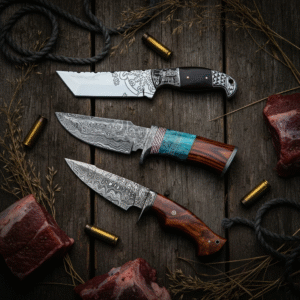
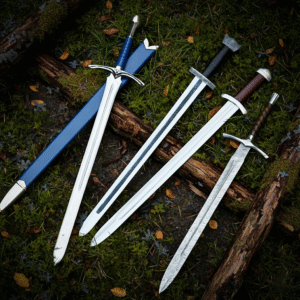
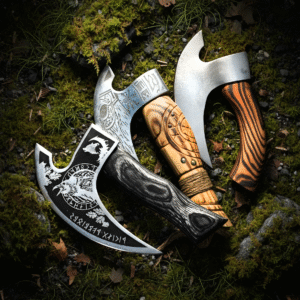
The seax is the headline shape, and the broken-back profile — with its sharp downward angle along the spine — is the one most people picture. Beside it sit Celtic and Odin-pattern utility knives, and Viking-styled hunting and belt knives that borrow the same geometry in a modern working size. If you want a folding blade instead, see the pocket knives; for the larger Norse pieces, the axes and swords.
High-Carbon or Damascus
High-carbon steel is the plainer, historically closer option — heat-treated hard, easy to resharpen, and the everyday choice. Damascus is forged from layered 1095/15N20, carrying the flowing pattern that pattern-welded Viking-age blades were prized for. Both are functional; both will rust if stored wet, so dry the blade and wipe on a light oil after use.
Viking Knives FAQ
What is a Viking knife called?
A seax. The name covers a family of single-edged blades from small utility knives up to the long langseax, and it is the knife Norse and Anglo-Saxon people carried day to day.
Are these authentic Viking knives?
They are hand-forged reproductions drawn from Viking-age and Anglo-Saxon finds — blade profile, tang construction and sheath style follow the period pattern rather than copying one specific artefact. They are not antiques.
Are Viking knives good quality, and are they functional?
Yes. Every blade is heat-treated, sharpened by hand and inspected before dispatch. These are working knives, not wall-hangers, and the high-carbon models take and hold a genuinely sharp edge.
Is there a Viking pocket knife?
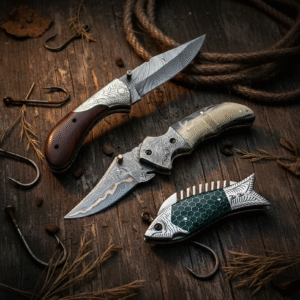
Not historically — folding knives are a later development. For an everyday carry blade in the same Damascus steel, see our folding pocket knives.
Can a Viking knife be engraved with runes?
Yes. Most take engraving on the blade or handle, including names, dates and Elder Futhark runes.
How long does delivery take?
Orders are inspected and dispatched from Memphis, TN within 1–2 weeks, with US delivery typically taking a further 3–7 business days.