
A tracker knife is a short heavy bushcraft blade with two working edges on the same piece of steel. The forward section is a deep convex belly for chopping and splitting. Behind it the edge runs straight and shallow, which is the part you use like a draw knife for shaving, notching and feathering. Most of them carry a row of saw teeth along the spine as well. It is a lot of tool in a blade the length of your hand, and closer to a hunting knife than to an axe.
The knives here run 10 to 12 inches overall with blades of 5 to 7 inches and handles of 5 inches. Most are Damascus of 1095 and 15N20, forge welded and acid etched at 352 layers, hardened to 58 to 60 HRC, in fire and twist patterns. Handles run to hardwood, rosewood, walnut, micarta, buffalo horn, ram horn and turquoise set in resin. Sheaths are stitched leather, with a few in olive burl wood.
If you camp, carve and want one blade that does the chopping too, this is the shape to take.
Free US shipping
On most pieces. Heavier and oversized ones carry a flat charge.
Hand Forged
Heated, hammered and ground by hand.
Engraving available
Names, dates or Norse runes on most pieces.
Ships from Memphis
Inspected and dispatched from our Tennessee warehouse. No import duty, no customs delay on US orders.
Tracker Knives
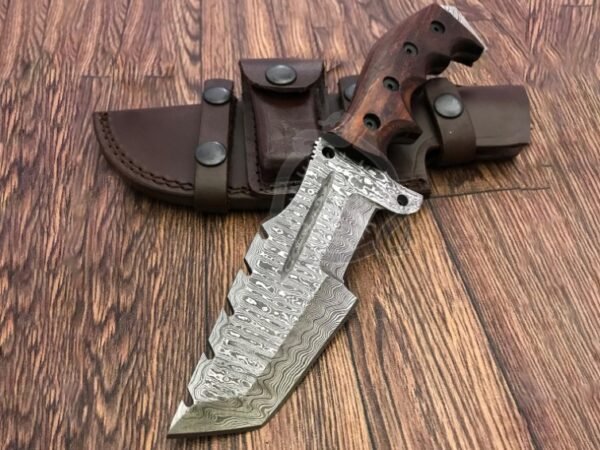
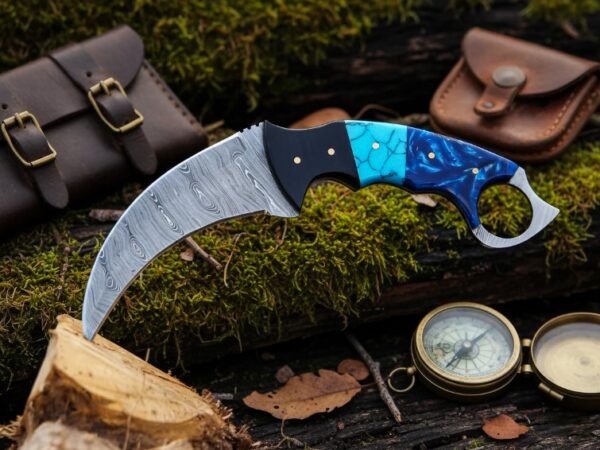
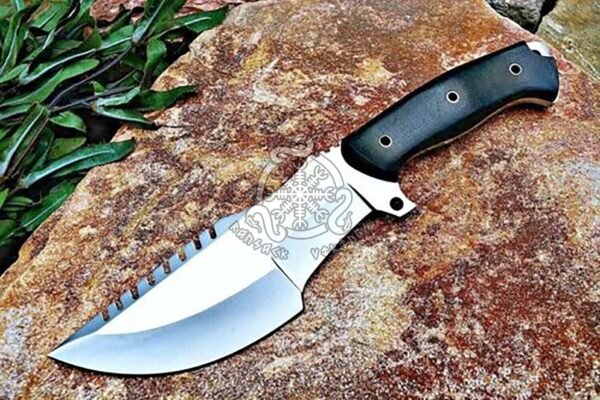
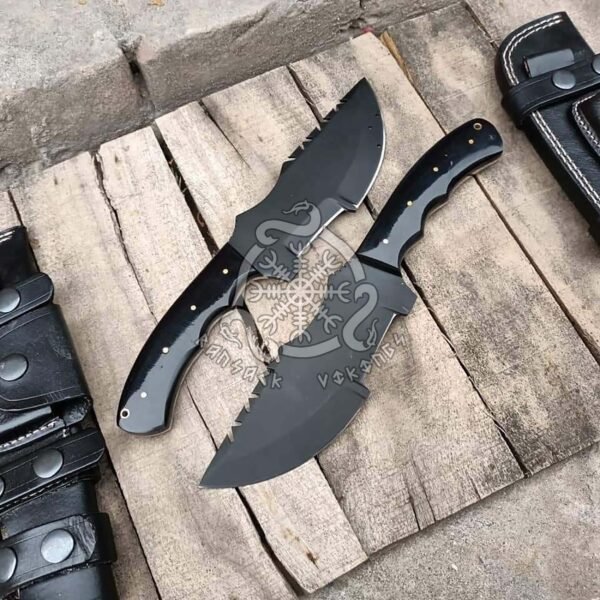
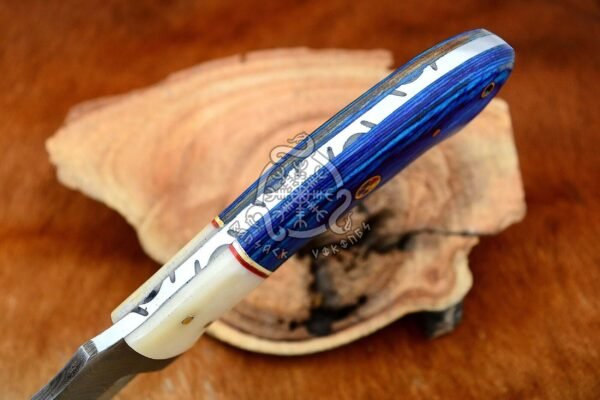
Two knives ground into one blade
Most knives do one thing. A tracker tries to do three, and the odd looking outline is the result of that ambition rather than of styling.
Start at the point and work back. The forward third is a deep convex belly, thick behind the edge and dropped well below the line of the handle. That is the chopping section. Because the mass sits ahead of your hand and the grind is convex rather than flat, it bites into wood and splits the fibre apart instead of wedging and sticking. It is not an axe, but on green wood up to a wrist thickness it does the job an axe would.
Behind the belly the edge changes completely. It runs straight and shallow for a couple of inches, close to the handle where you have the most control. That is the fine section. Turn the knife over, hold it with both hands and pull it toward you and it works like a small draw knife, which is exactly how you shave a tent peg, cut a notch or take a feather stick down to curls.
Then there is the spine. Most trackers carry a short row of coarse saw teeth on the back of the blade. Nobody is felling a tree with those. They are for cross cutting a notch in a branch, scoring bone or antler, and starting a cut in something too hard to slice.
The trade is honest. A tracker chops less well than a hatchet, carves less well than a dedicated carving knife and saws less well than a saw. It just carries all three in one sheath, which is the entire argument for the design.
The tracker knives in this collection
What separates the pieces here is size, pattern and handle. The steel is consistent across almost the whole page.
Ten inch trackers
The core of the range. Ten inches overall, a 5 inch blade and a 5 inch handle, which puts the balance point right at your index finger. This is the size that carries comfortably on a belt and still has enough forward mass to chop. Handles in this group include hardwood, rosewood, micarta, buffalo horn with rosewood, and ram horn with walnut. Patterns run to fire and twist figure at 352 layers.
Eleven and twelve inch trackers
A longer blade of 6 to 7 inches on the same 5 inch handle. The extra length goes into the chopping belly, so these hit noticeably harder and are the ones to take if the knife is going to replace a hatchet rather than sit alongside one. Handles here include buffalo horn and plain wood. One piece in this group is ground from a tool steel bar rather than pattern welded, so it has no Damascus figure at all, which some people prefer for a working blade that will be sharpened hard and often.
Handles and sheaths
Micarta is resin and canvas, waterproof and grippy when wet, and it is the sensible choice for a knife that lives in a pack. Buffalo horn and ram horn are the traditional materials, warm in the hand and better looking every year, but both dislike dry heat. Hardwood, walnut and rosewood sit in the middle. One piece sets turquoise into resin alongside the wood.
Most ship in a stitched leather sheath. Several come in a wooden sheath cut from olive burl, which is unusual, heavier than leather and considerably better looking on a shelf.
Sizes, patterns and handles across the range
Every figure below is taken from the specification panel of a knife on this page. Blades are forged and ground by hand, so read the numbers as what to expect rather than as a guarantee to the millimetre.
| Handle | Overall length | Blade length | Handle length | Pattern and layers | Sheath |
|---|---|---|---|---|---|
| Hardwood | 10 in | 5 in | 5 in | Fire pattern, 352 layers | Leather |
| Rosewood | 10 in | 5 in | 5 in | Damascus, layers not listed | Handmade leather |
| Micarta | 10 in | 5 in | 5 in | Twist pattern | Olive burl wood |
| Micarta | 10 in | 5 in | 5 in | 352 layers | Olive burl wood |
| Hardwood | 10 in | 5 in | 5 in | Twist pattern | Olive burl wood |
| Buffalo horn with rosewood | 10 in | 5 in | 5 in | 352 layers | Olive burl wood |
| Ram horn with walnut | 10 in | 5 in | 5 in | 352 layers | Olive burl wood |
| Buffalo horn | 11 in | 6 in | 5 in | Fire pattern, 352 layers | Leather |
| Wood | 11 in | 6 in | 5 in | 352 layers | Olive burl wood |
| Micarta | 12 in | 7 in | 5 in | Tool steel bar, no pattern | Leather |
One figure needs care. Blade length on a tracker is measured along the profile, and a good part of that length is the straight fine section rather than the chopping belly. A 5 inch tracker blade therefore has less chopping edge than a 5 inch drop point has cutting edge. Judge these by the depth of the belly, not by the number.
Steel, layers and hardness
Almost every blade on this page is Damascus of 1095 and 15N20, forge welded, folded and acid etched, hardened to 58 to 60 HRC. The 1095 is a plain high carbon steel and the 15N20 carries nickel, which resists the etch and stays bright while the 1095 darkens. The contrast you see is the two steels themselves, not a surface treatment, and it runs all the way through the blade.
Layer counts here are 352. More layers make a finer pattern, not a stronger blade. What decides how the knife behaves is the heat treatment, and 58 to 60 HRC on a chopping blade is a considered choice. Hard enough to hold a working edge through a day of wood, soft enough that the edge rolls rather than chipping when you find a knot or a buried stone.
Fire pattern and twist pattern describe how the billet was manipulated before it was drawn out. Twist gives tight swirls. Fire gives long flame shaped figure running with the blade. Neither affects performance. Both look different on every single piece, because no two billets move the same way under a hammer.
Using a tracker without wrecking it
Chop with the forward belly and nothing else. That section is the thickest and best supported part of the blade. Chopping with the fine straight section near the handle drives the shock into the ricasso and into your hand, and chopping with the tip is how tips break.
Use the straight section as a draw knife with the edge toward you and both hands on the tool, and take thin shavings rather than trying to hog material off. It is a controlled cut, not a strong one.
The saw spine is for notching and scoring. Do not hammer the spine of a tracker with a rock or a baton across the saw teeth, because a hardened high carbon spine with teeth cut into it has stress risers in exactly the wrong places. If you want to baton, strike the flat unbroken part of the spine behind the teeth with a wooden baton and never with steel.
Green wood, cordage, bark and brush are what this blade is for. Seasoned hardwood dulls it fast, and bone and antler will dull it faster still.
Sharpening a blade with two grinds
A tracker needs two different approaches on one piece of steel, which is the one genuine annoyance of the design.
The convex belly is sharpened on a strop or on abrasive paper over a mouse mat or a leather pad, using a rolling stroke so the curve is maintained. Do not take it to a flat stone at a fixed angle, because that puts a flat bevel onto a convex edge and you lose the geometry that makes it split wood.
The straight section takes a normal stone at a normal angle, around twenty degrees per side for a knife doing wood work. A 1000 grit stone brings it back in a couple of minutes and a 3000 grit polishes it.
Leave the saw teeth alone unless you have a small triangular file and know how to use one. A badly filed saw is worse than a dull one.
Rust, handles and storage
Every blade here is carbon steel and every one of them will rust if you let it. Wipe the blade dry after use, leave a light film of oil on it and store it out of the sheath if it is going to sit for months. Leather holds moisture against steel, and a damp sheath is the most common reason a well kept blade comes out spotted.
Grey patina is stable and harmless, and on a Damascus blade it deepens the contrast rather than spoiling it. Orange spotting lifts with fine abrasive and oil. Do not use a wire wheel on an etched blade unless you want a plain grey knife.
Buffalo horn and ram horn shrink as they dry, so keep them off a radiator and out of a hot car. Hardwood, walnut and rosewood want a wipe of oil once or twice a year. Micarta needs nothing at all. The olive burl sheaths want the same light oil as the wooden handles, and they will darken over time.
Engraving and gifting
Engraving is added in the United States after the knives arrive. A name, a date or a short rune line goes onto the flat of the blade or onto a bolster. Text engraving is 19 dollars, a symbol is 39 dollars and a family crest is 49 dollars.
Elder Futhark is a phonetic alphabet rather than a code, so a name is transliterated by sound and there is no rune for the letter C. Read the rune guide before you send a spelling.
Engraving is permanent and an engraved knife cannot be returned. Send the exact spelling and read it twice.
Where these come from and how they ship
Ransack Viking is a US company based in Memphis, Tennessee. The pieces are handmade in the Czech Republic, then imported, inspected and shipped from Memphis. Engraving is done in the US after arrival.
Because each billet is forged and etched by hand, two knives of the same name will differ in the exact figure of the pattern, in the depth of the saw teeth and in the colour of a natural handle. Two people made them on two different days. The dimensions and the hardness stay the same.
How to choose
If the knife will live in a pack and get used wet, take micarta and a 10 inch overall size. It is the most weatherproof combination here and the easiest to keep clean.
If you want it to replace a hatchet on short trips, go up to 11 or 12 inches overall so there is more mass in the chopping belly, and accept the extra weight on the belt.
If it is going on a wall or into a collection, take buffalo horn or ram horn with an olive burl sheath. If it is a gift for someone who actually goes out in the woods, take hardwood or micarta and spend the difference on getting their name on it.
Browse related collections
- Hunting knives for field dressing and skinning
- Bowie knives with long clip points and deep bellies
- Damascus knives across every blade shape
- Viking seax knives, the single edged belt blade
- Karambit knives with a hooked curved blade
- Tomahawks when you want the chopping without the compromise
- Leather sheaths and replacement scabbards
Guides worth reading first
- Knife blade shapes and what each one is good at
- Full tang vs partial tang and why it matters
- Damascus vs high carbon steel, which blade should you buy
- Real vs fake Damascus steel, how to tell
- The complete knife care guide, blade, handle and sheath
- Knife laws by state, a plain summary
Frequently asked questions
What is a tracker knife actually for?
Bushcraft. The forward belly chops and splits small wood, the straight section behind it carves and notches like a draw knife, and the saw spine scores and cross cuts. It is one sheath instead of three tools, at the cost of being slightly worse at each job than a dedicated tool would be.
Can I baton with one?
Yes, but strike the flat unbroken part of the spine behind the saw teeth, and use a wooden baton rather than steel. Hitting across the teeth drives shock into cut notches in hardened steel, which is exactly where a blade wants to crack.
What is the saw on the spine good for?
Notching, scoring and starting a cut in something hard. It is not a woodsaw and it will not fell anything. Treat it as a rasp with teeth rather than as a saw blade and it earns its place.
How do I sharpen the curved section?
On a strop or on abrasive paper over a leather pad or a mouse mat, with a rolling stroke that follows the curve. Do not put a convex belly on a flat stone at a fixed angle, because you will grind a flat bevel onto it and lose the geometry that makes it split wood.
Will these blades rust?
Yes. They are carbon steel and none of them are stainless. Wipe dry after use, leave a light film of oil on the blade and store it out of the sheath if it will sit for months. Grey patina is fine. Orange spotting is not, and it lifts with fine abrasive and oil.
Which handle should I pick?
Micarta if the knife will be used wet or carried in a pack, because it is resin and canvas and does not care about water. Buffalo horn or ram horn if it will be handled and admired. Hardwood, walnut and rosewood sit between the two and want a wipe of oil twice a year.
Do these come sharp?
Yes. They are ground and finished by hand and arrive with a working edge. They are not razors out of the box, because a very thin edge on a chopping blade chips against a knot. A few passes on a stone or a strop will take any of them further.
Where are these knives made?
They are handmade in the Czech Republic, then imported, inspected and shipped by Ransack Viking from Memphis, Tennessee. Engraving is added in the US after arrival.
Featured pieces
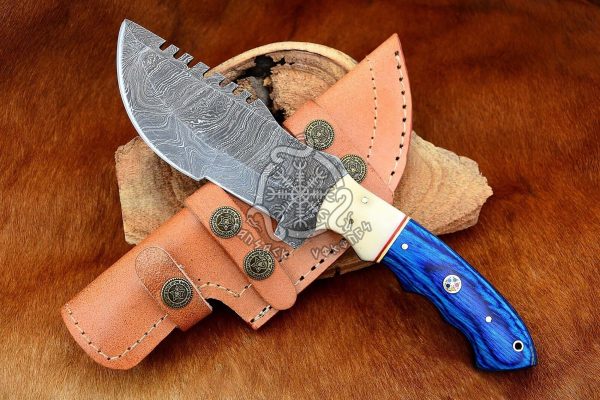 Trailwood Hand Forged Damascus Tracker Knife with Hardwood Handle & Leather Sheath
$129.00
 Trailhorn Hand Forged Damascus Tracker Knife with Buffalo Horn Handle & Leather Sheath
$149.00
 Trackerfell Hand Forged D2 Steel Tracker Knife with Micarta Handle & Leather Sheath
$129.00
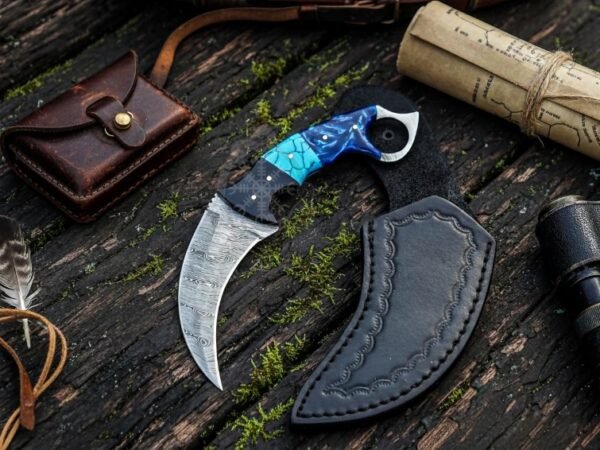 Turquoiseclaw Hand Forged Damascus Karambit Knife with Turquoise Bull Horn and Resin Handle and Damascus Finger Ring
$129.00