
A wakizashi is the short sword of the Japanese pair, worn edge up at the belt beside the katana and kept on the body when the long sword was handed over at the door. Blade length is what defines it. Between one and two shaku, which in practice means roughly 18 to 20 inches of blade, and the sword is a wakizashi. Short enough to draw indoors, long enough to be a sword rather than a large knife.
The pieces on this page run 26 to 30 inches overall with 18 to 20.5 inches of blade, and the two tanto here drop to 12.5 and 15 inches. Steel is either plain 1095 high carbon hardened to 54 to 58 HRC, several of those hardened differentially so a hamon shows along the edge, or forge welded Damascus of 1095 and 15N20 at 58 to 60 HRC. Listed weights run about 1.6 pounds to a little under 2 pounds for the sword alone. Every one ships in a fitted saya.
If you want one Japanese blade rather than a pair, start at 28 inches overall.
Free US shipping
On most pieces. Heavier and oversized ones carry a flat charge.
Hand Forged
Heated, hammered and ground by hand.
Engraving available
Names, dates or Norse runes on most pieces.
Ships from Chicago
Inspected and dispatched from our Chicago warehouse. No import duty, no customs delay on US orders.
Wakizashi
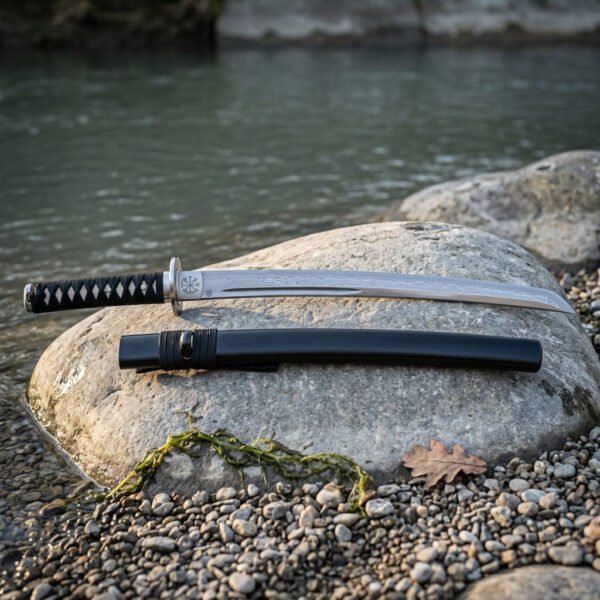
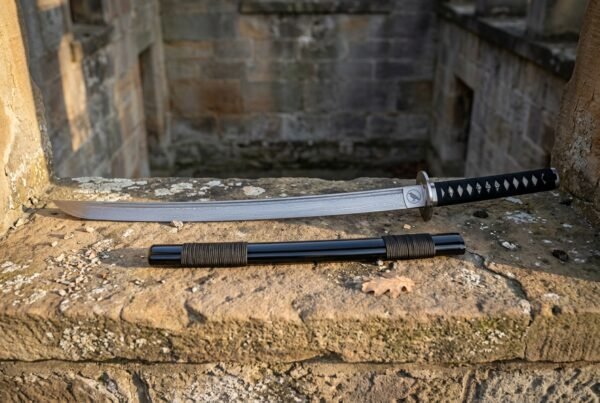
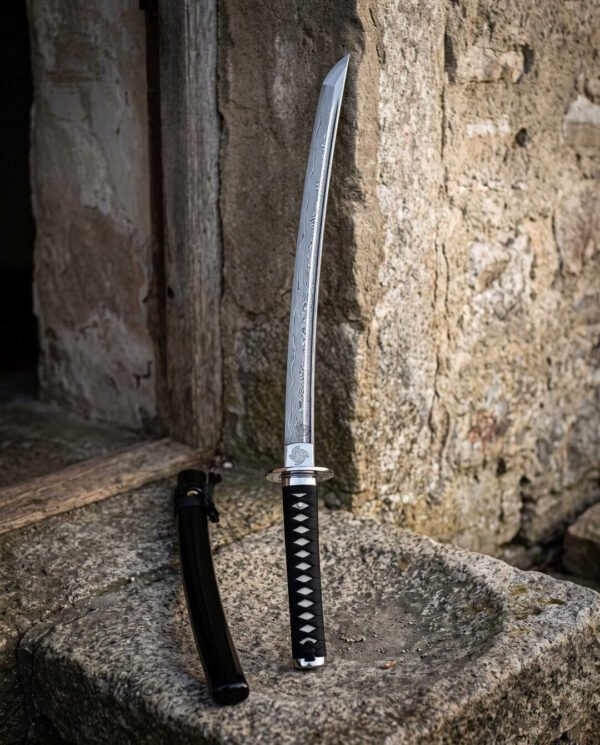
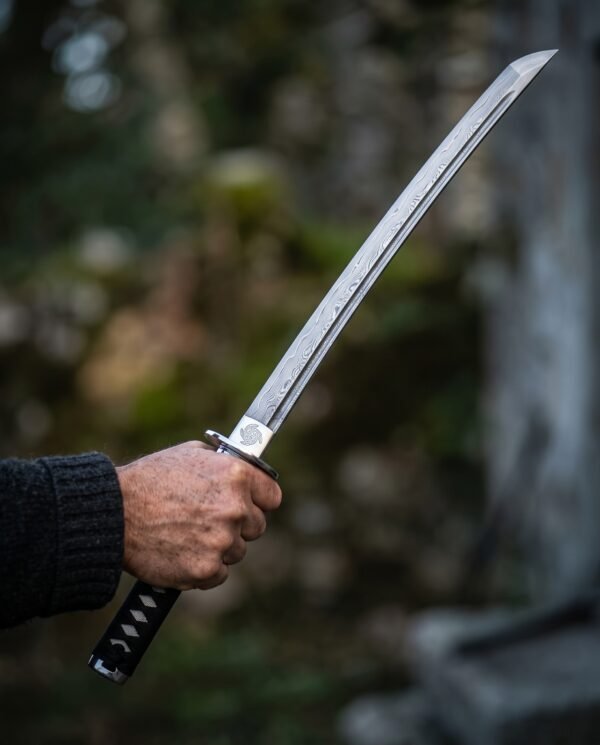
The sword that stayed on the belt
Japanese swords are sorted by blade length rather than by shape. Over two shaku, about 24 inches, and it is a katana. Between one and two shaku, roughly 12 to 24 inches, and it is a wakizashi. Under that it is a tanto. That is the entire system, and it explains why a wakizashi looks like a katana that came out of the wash smaller. Same curve, same ridge line down the flat, same style of mounting, less blade.
Length decided how the sword got used. A samurai walking into a house left the long sword with a servant at the door and kept the short one at his waist. So the wakizashi went indoors. It sat near the bed at night and it worked in corridors where a katana could not be drawn. Worn as a pair the two were called daisho, the large and the small. Edo period sword law also made the wakizashi the longest blade a merchant or a farmer was allowed to carry, which is why a great deal of surviving Japanese blade work went into short swords rather than into katana.
That history has a practical edge for a modern buyer. A wakizashi gives you everything the form is known for, the curve, the hardened edge line, the cord over ray skin, the fitted lacquered scabbard, in a blade you can draw standing in an ordinary room.
The wakizashi in this collection
Seventeen pieces sit on this page. Two things separate them. The first is steel. The second is whether you are buying one sword or a matched set. Listed prices run from 215 dollars for the smallest tanto to 649 dollars for a set of three.
Wakizashi in 1095 high carbon
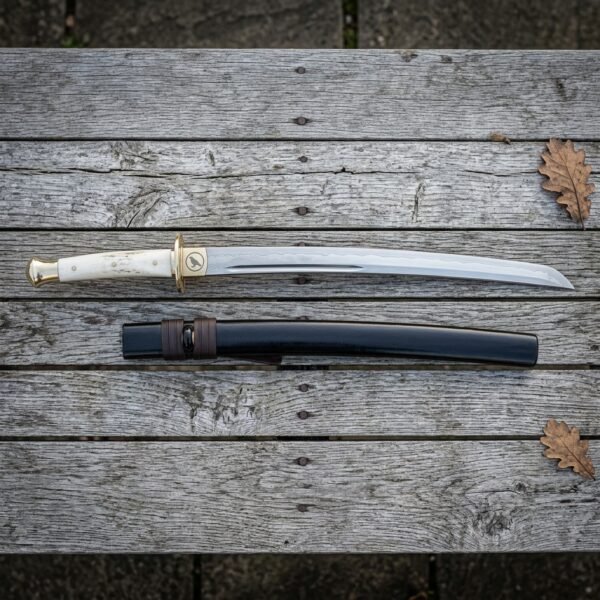
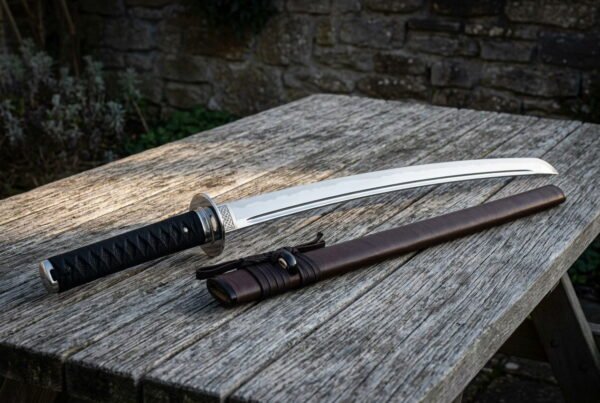
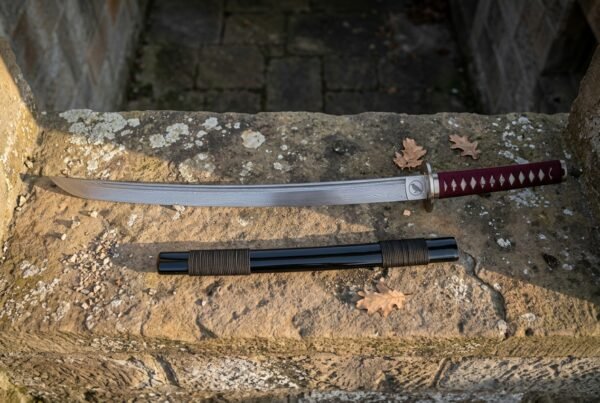
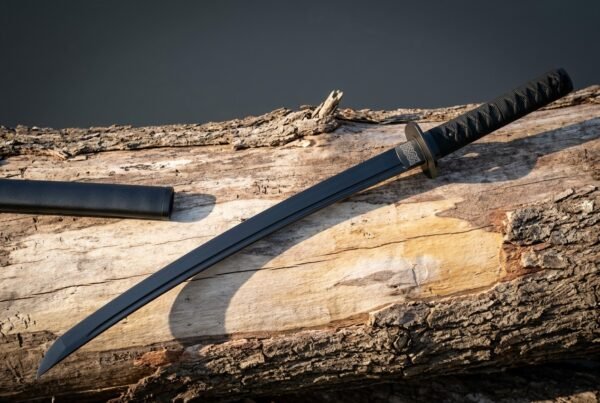
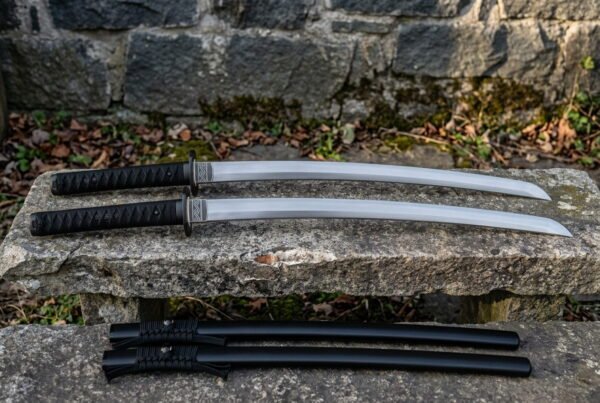
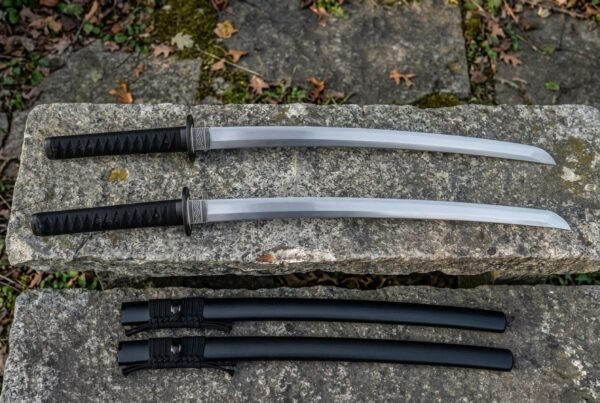
Plain high carbon blades hardened to 54 to 58 HRC, ground shinogi zukuri with the ridge line running the length of the flat and a shallow sori through the body. Overall lengths sit at 27, 28, 28.5 and 30 inches, with 19 to 20 inches of blade. Finishes run to satin hand polish, bright polish, mirror polish and, on one piece, a black oxide laid over a satin ground surface with a chisel style point. Handles are cord wrapped over black same, apart from one in polished natural bone over a full length tang.
Blades with a hamon
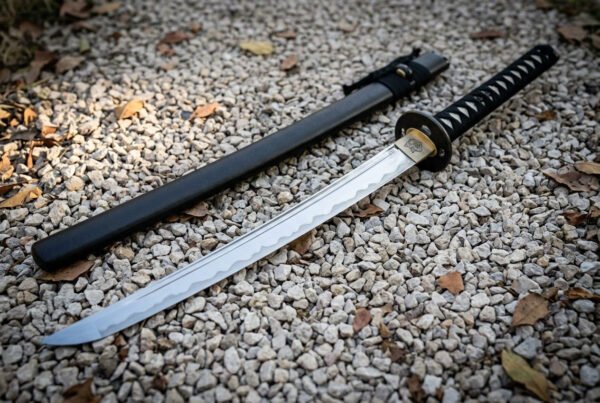
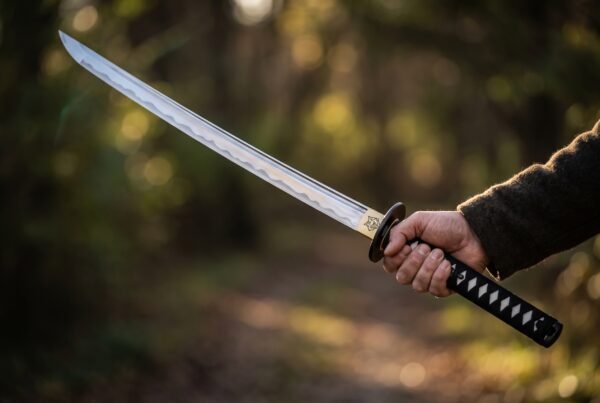
Three of the 1095 pieces are hardened differentially rather than through, so a temper line shows along the edge. One is clay hardened with a rolling notare pattern and an edge run to 58 HRC over a softer spine, mounted with a brass habaki, a round black tsuba and black ito over ray skin. The other two carry a bright polished hamon, one on a 30 inch sword with a gloss white saya and an antiqued steel tsuba, the other on a 28 inch sword with a leather covered saya.
Wakizashi in Damascus
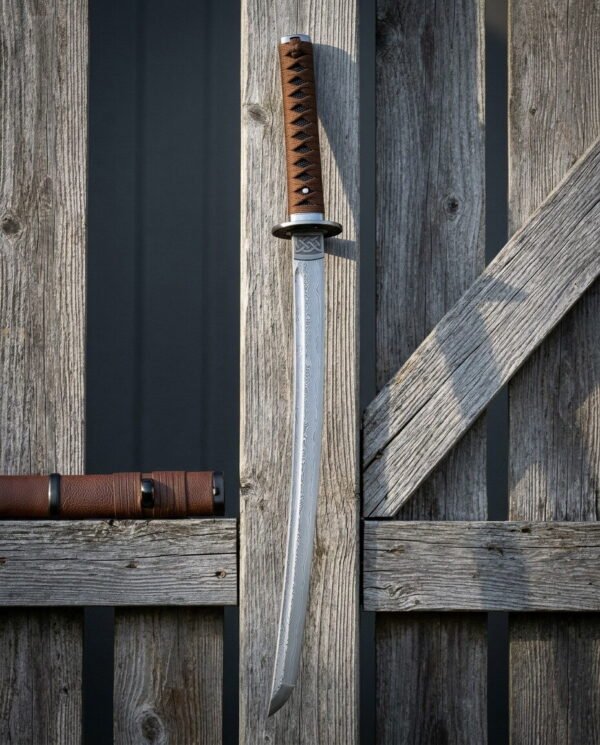
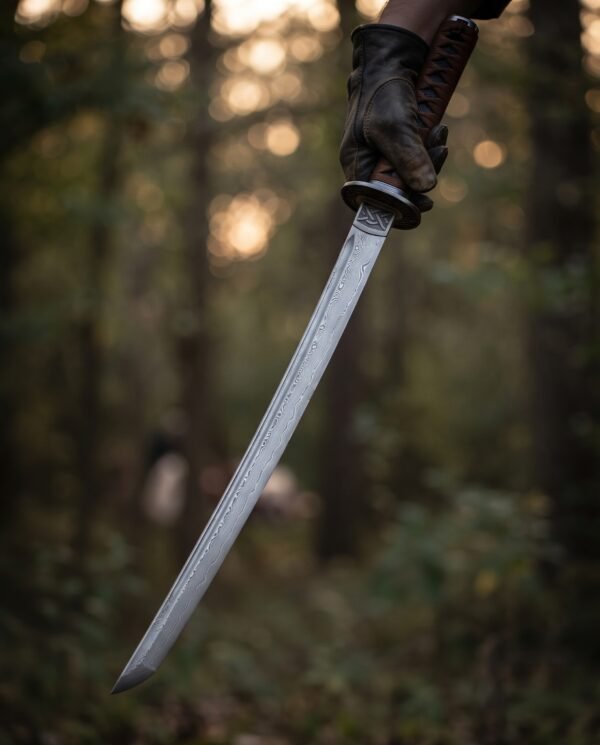
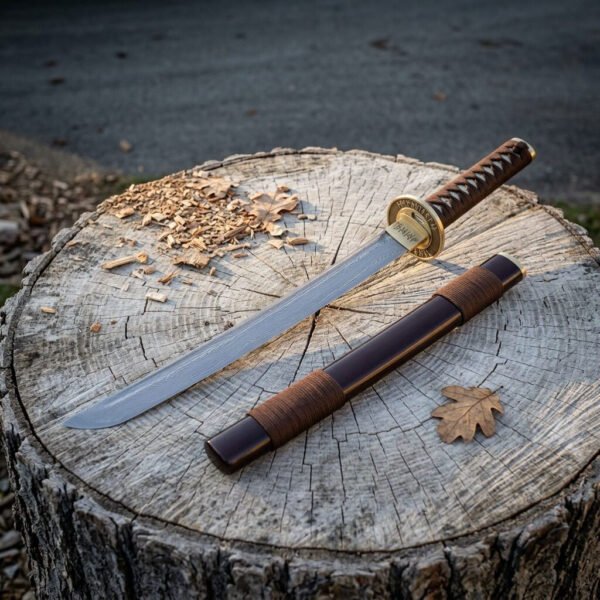
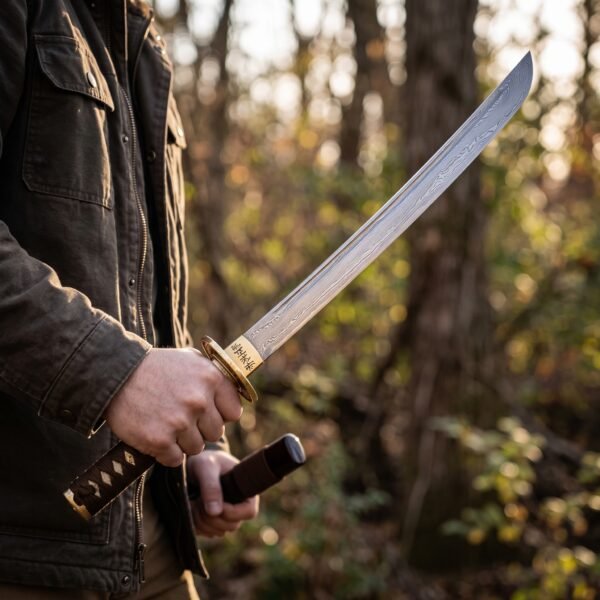
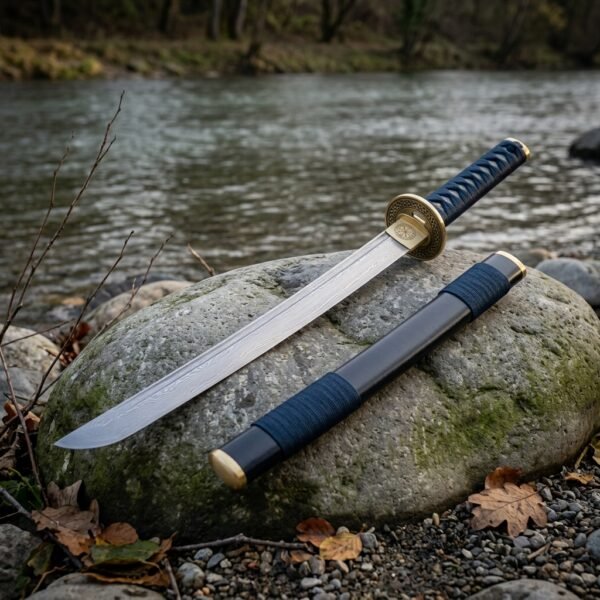
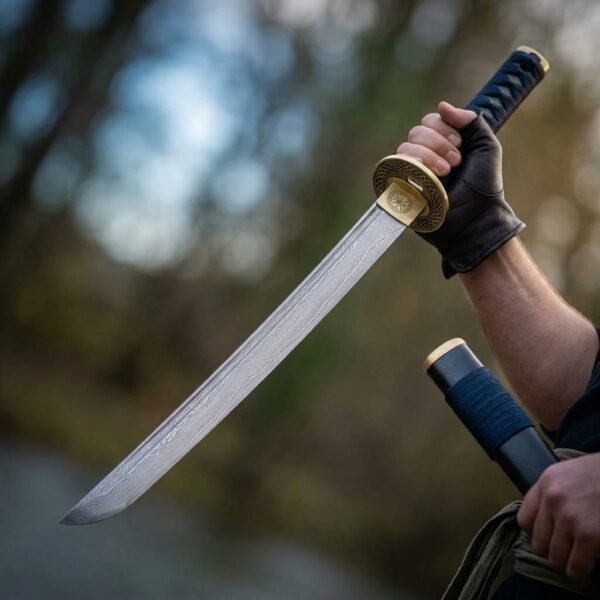
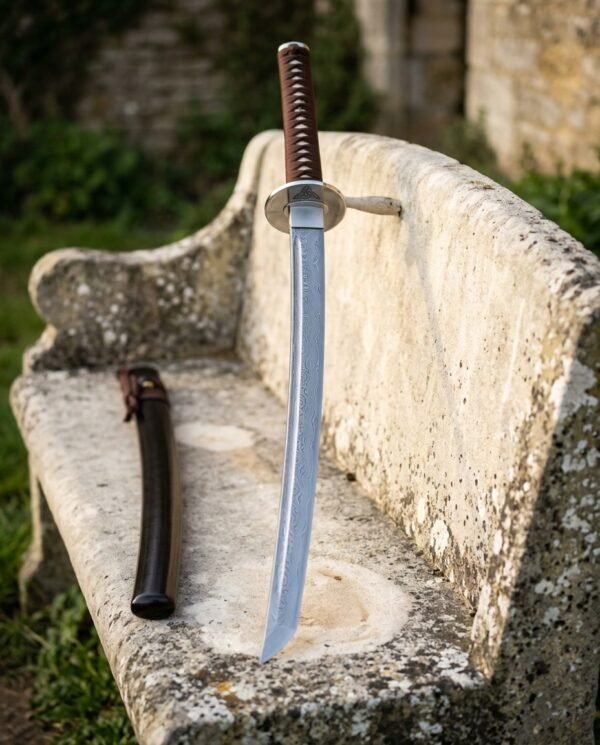
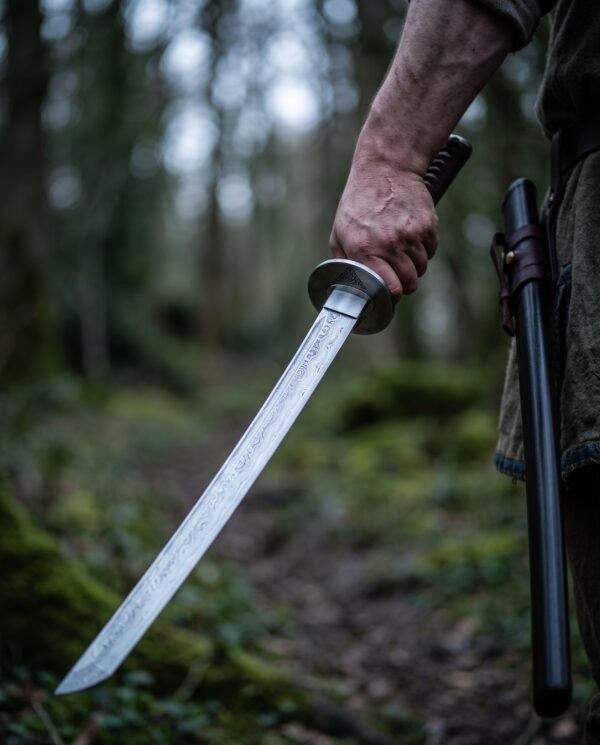
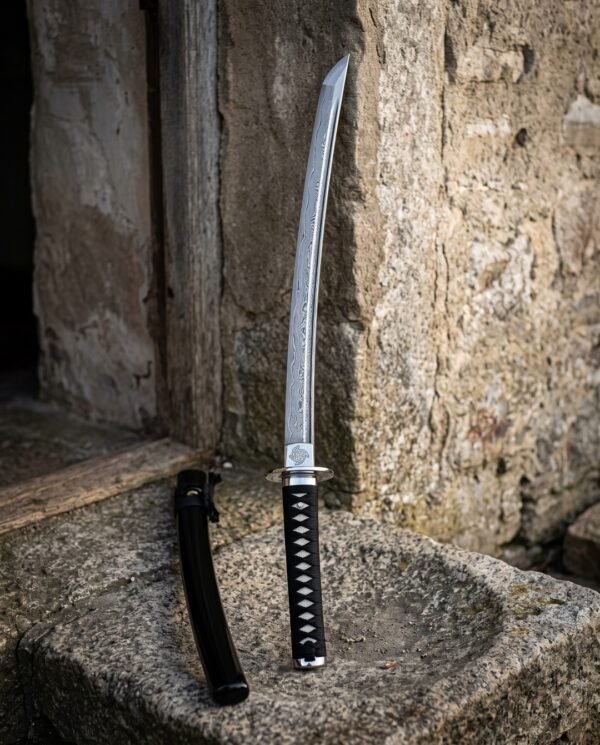
Forge welded 1095 and 15N20 hardened to 58 to 60 HRC, acid etched so the layers read as light and dark bands across the flat. Five pieces, running 28 to 29 inches overall with 19 to 20.5 inches of blade. One is a ladder pattern, cut into the billet by hand before the final draw. Fittings on this group are the most worked on the page: a solid brass oval tsuba engraved with a triquetra, an oval steel tsuba cut with interlaced knotwork, a polished steel collar carrying a circular Celtic knot, and a small engraved eight point compass above the collar on one blade.
Tanto and matched sets
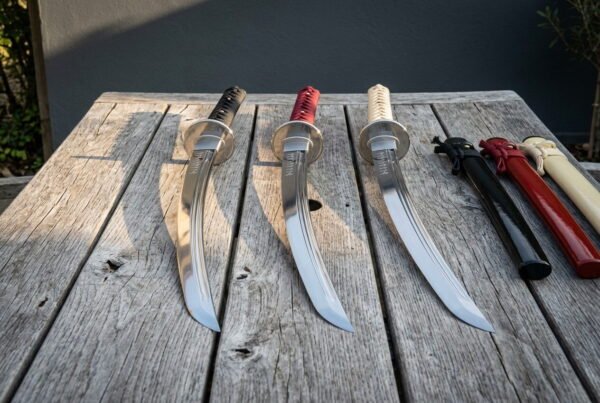
Two tanto sit here as well, at 19 and 21.5 inches overall with 12.5 and 15 inches of blade, both in 1095. One has a square iron tsuba and a black lacquered saya, the other a broad bellied blade with an upswept point and a saya wrapped in brown leather. Three set pieces round out the page. A daisho pairs a 40 inch katana with a 30 inch wakizashi, both mirror polished and both sharpened. A twin set carries two near matched blades of 24 to 27 inches with knotwork cut into the fittings. A three sword set arrives with black, deep red and ivory cord wraps and lacquered hardwood scabbards to match.
Lengths, steel and fittings across the range
Every figure below comes from the specification panel of a piece on this page. These are forged, polished and mounted by hand, so read the numbers as what to expect rather than as a guarantee to the millimetre.
| Handle and fittings | Overall length | Blade length | Steel and hardness | Listed weight | Scabbard |
|---|---|---|---|---|---|
| Black cord over same, iron tsuba | 28 in | 19.5 in | 1095 at 54 to 58 HRC | 1.6 lb bare | Black lacquer with sageo |
| Polished bone, brass collar and menuki | 27 in | 19 in | 1095 at 54 to 58 HRC | 1.6 lb bare | Dark lacquer with sageo |
| Deep red cord over same, brass seppa | 28.5 in | 20 in | 1095 at 54 to 58 HRC | 1.7 lb bare | Black wood, brown cord wrap |
| Navy cord, brass pommel cap | 29 in | 20.5 in | Damascus at 58 to 60 HRC | 1.8 lb bare | Grey wood, brass throat |
| Black ito over ray skin, brass habaki | 26 in | 18 in | 1095, edge at 58 HRC | Not listed | Black lacquer |
| Black ribbed cord, steel guard | 28 in | 20 in | 1095 at 54 to 58 HRC | Not listed | Brown leather over wood |
| Brown leather cross wrap, knotwork tsuba | 28 in | 20 in | Damascus at 58 to 60 HRC | Not listed | Brown leather, steel bands |
| Brown leather, triquetra brass tsuba | 28 in | 20 in | Damascus at 58 to 60 HRC | Not listed | Dark hardwood, brown cord |
| Black cord, cast disc tsuba, black blade | 28 in | 19 in | 1095 at 54 to 58 HRC | 1 lb 14 oz | Matte black wood |
| Black cord over white rayskin | 30 in | 20 in | 1095, edge at 58 to 60 HRC | 1 lb 15 oz | Gloss white lacquer |
| Black cord, knot medallion tsuba | 28 in | 19 in | Damascus at 58 to 60 HRC | 1 lb 12 oz | Gloss black lacquer |
| Black cord over same, square tsuba | 19 in | 12.5 in | 1095 at 54 to 58 HRC | 1 lb bare | Black lacquer, cord tie |
| Brown cord, brass pommel cap | 21.5 in | 15 in | 1095 at 54 to 58 HRC | 1.2 lb bare | Leather over wood, brass throat |
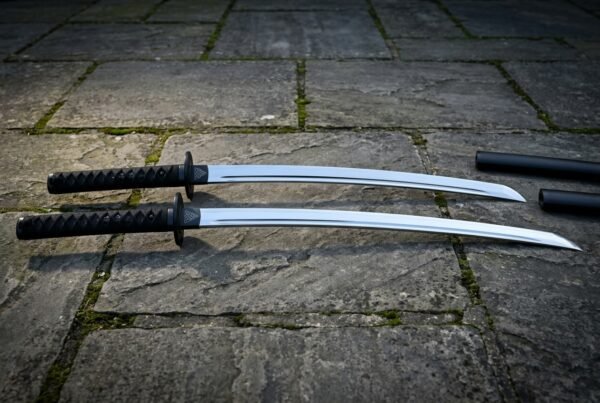
| Daisho set, black cord over rayskin | 40 in and 30 in | 27.5 in and 20 in | 1095 at 54 to 58 HRC | Not listed | Two black lacquered saya |
One number is worth a second look. Overall length is quoted with the sword sitting in its saya, and blade length is measured from the habaki to the tip along the curve. A blade listed at 20 inches has slightly less straight line reach than 20 inches of ruler.
The mounting, part by part
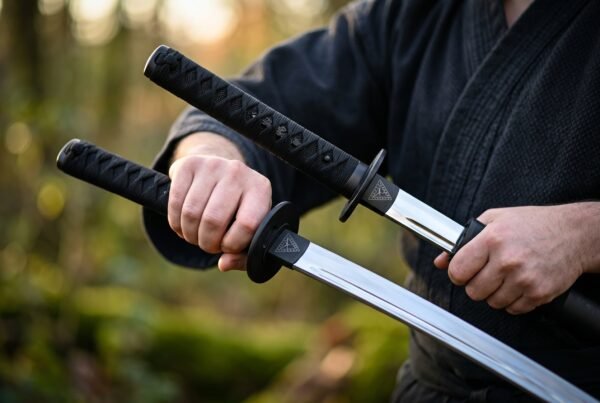
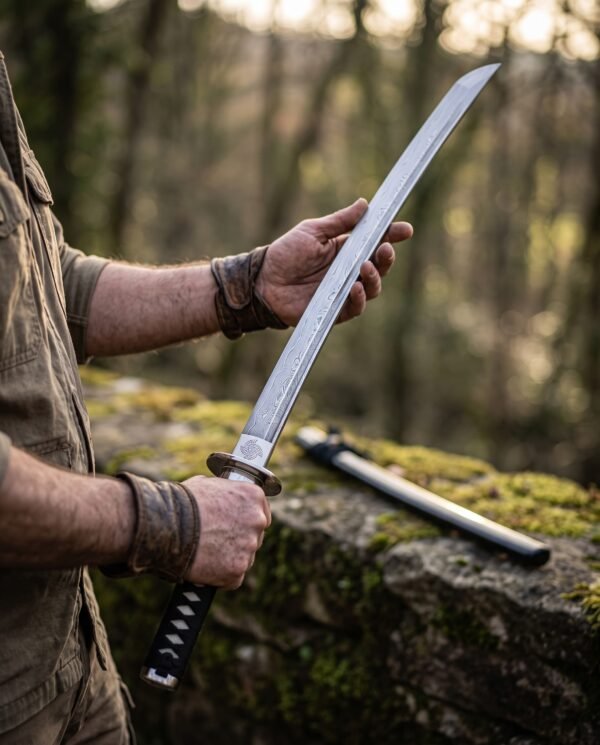
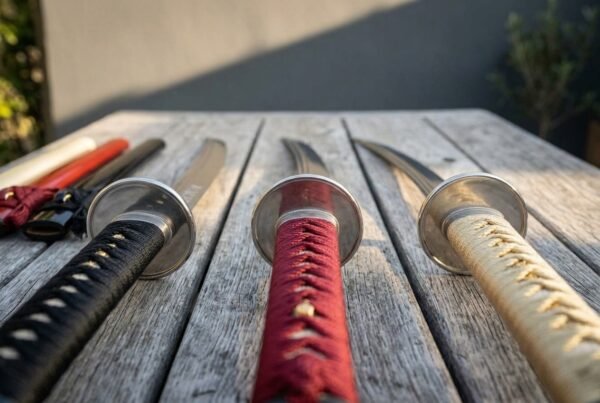
The tsuka is the handle. Under the wrap sits same, ray skin, which is hard and pebbled and grips the cord so the wrap cannot creep. Over that goes the ito, the flat cord, laid in alternating diamonds. Handles here run 6 to 8 inches, mostly black, with deep red, navy, brown leather, ivory and one polished bone grip across the range. The small ornaments trapped under the wrap are menuki, and they sit where the palm closes, so they do a job as well as look like something.
The tsuba is the guard, the flat plate between blade and handle. On this page they run to dark iron, round brass, oval steel cut with knotwork, an antiqued steel disc and a cast disc with a repeating pattern. The thin washers either side of it are seppa. The collar wedged at the base of the blade is the habaki, and it does the real work of the mounting. It locks the blade into the mouth of the scabbard so the sword hangs without rattling and the edge never touches wood.
The saya is the scabbard, carved from timber and then lacquered, or covered in leather. The cord tied at the mouth is the sageo. Inside the handle the tang is the nakago, held by a bamboo peg called a mekugi rather than by glue or a threaded pommel.
Steel, hardening and what the numbers mean
Plain 1095 is a simple high carbon steel with roughly one percent carbon and very little else in it. It takes a fine edge quickly, comes back on a stone in minutes, and rusts if you look at it wrong. At 54 to 58 HRC it is hard enough to hold an edge and tough enough to take a knock without chipping.
The Damascus here is 1095 and 15N20 forge welded together, folded, drawn out and acid etched. The 15N20 carries nickel, which resists the acid and stays bright, while the 1095 darkens. That contrast is the pattern, and it runs through the steel rather than sitting on the surface. At 58 to 60 HRC it holds an edge a little longer than plain 1095 and takes a little longer to bring back. It is not stainless.
The differentially hardened pieces are a third case. Clay is laid thick along the spine and thin along the edge before the quench. The bare edge cools in a fraction of a second into hard martensite. The insulated spine cools slower into something softer and tougher. The line between the two is the hamon. The point of it is that the edge can run hard without the whole blade turning brittle, which is an engineering answer rather than a styling choice. A hamon that has been painted or wire brushed on sits flat and looks wrong as soon as the light moves.
How a wakizashi handles
Listed weights run from about 1 pound for the smaller tanto to about 1.8 pounds for the heaviest Damascus wakizashi bare, and about 2.4 pounds with the saya on. That is light. The balance point sits close to the guard because there is far less blade in front of your hand than a katana carries.
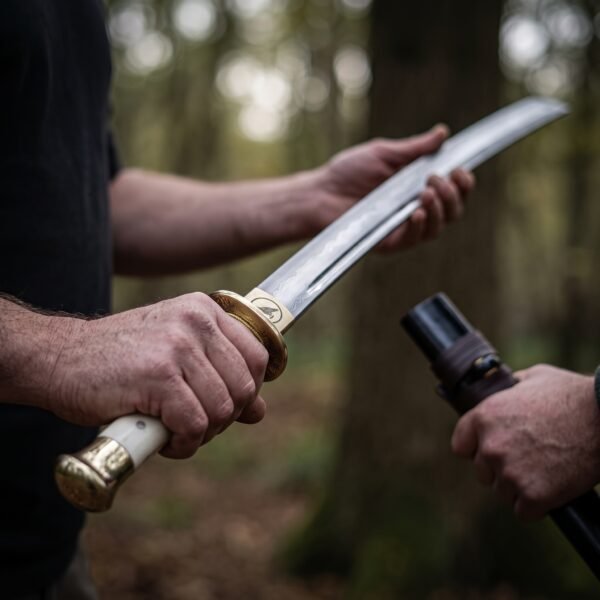
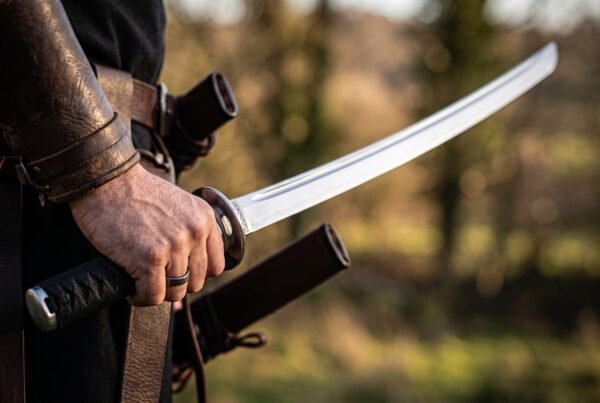
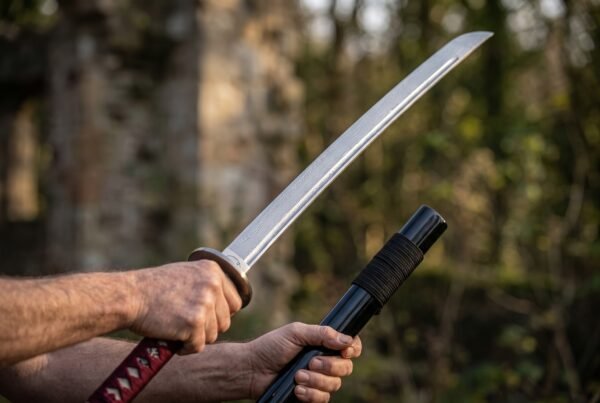
The grip is built for one hand, or for one and a bit. An 8 inch tsuka gives a full hand plus room to shift. The traditional hold is not a fist. The little finger and ring finger do most of the holding, the index finger stays relaxed, and the hand squeezes at the moment of the cut rather than clamping the whole way through. Hold it like a hammer and the edge wanders off line.
The sori, the shallow bend through the body of the blade, is what turns a push into a draw cut. It also means the sword wants to come out and away rather than straight up, which is why a wakizashi can be pulled clear in a room where a katana cannot.
Care, oil and the saya
Both steels rust. Wipe the blade down after handling, because fingerprints etch into a polish over a few weeks, and leave a light film of oil on the surface. Choji oil is traditional and plain mineral oil works. Use a soft cloth and wipe from the spine toward the edge, never along it.
Store the sword horizontal with the edge facing up. Resting a sharpened edge on the wood inside the saya for months dulls it and marks the lacquer. If a piece is going away for a season, take it out of the saya, oil it and wrap it in something breathable. Timber and lacquer hold moisture against steel, and a sword left in a damp scabbard is the most common way a well kept blade ends up spotted.
Engraving and gifting
Most swords here can be engraved once they arrive in the United States. Names, dates and short lines go onto the flat of the blade near the collar, or onto the fittings. Text engraving is 19 dollars, a symbol is 39 dollars and a family crest is 49 dollars. Several pieces already carry cut work from the maker, including the triquetra tsuba, the knotwork collar and the compass above the habaki.
Engraving is permanent and an engraved piece cannot be returned. Send the exact spelling and read it back twice before you order, because the cutter will reproduce what you typed.
Where these come from and how they ship
Ransack Viking is a US company based in Chicago, Illinois. The pieces are handmade in the Czech Republic, then imported, inspected and shipped from Chicago. Engraving is done in the US after arrival. Each sword ships in its fitted saya with a light coat of oil on the blade.
Small differences between two swords of the same name are normal. Polish, etch figure, cord tension and lacquer depth are all hand work, so two pieces made a week apart will not be identical.
How to choose
Decide first whether the sword is for a wall or for a hand. If it is going on a stand, buy for the pattern and the fittings, which points at Damascus or at one of the hamon pieces. If it is going to be drawn and handled, buy plain 1095, because it is easier to keep and cheaper to live with if you scratch it.
Then pick a length. Anything at 26 to 28 inches overall is easy indoors. At 30 inches you are close to katana handling and you need the room for it. If this is a gift for someone who has never owned a sword, a 28 inch wakizashi in 1095 with a black lacquered saya is the safe answer.
Browse related categories
- Katana and Japanese swords, the long half of the pair
- Tanto knives, the short blade below one shaku
- Short swords from other traditions
- Damascus swords in forge welded 1095 and 15N20
- Scabbards and sheaths, including replacements
- Sword stands and display racks
Guides worth reading first
- What is a wakizashi and how short is short
- Katana vs wakizashi vs tanto, sorted by length
- Damascus vs high carbon steel: which blade should you buy
- Display sword or battle ready: what the terms mean
Frequently asked questions
What is a wakizashi?
A Japanese short sword with a blade between one and two shaku, roughly 12 to 24 inches. Most sit near 18 to 20 inches. It was worn beside the katana, and it was the blade a samurai kept on him indoors when the long sword was left at the door.
How long are the swords on this page?
The wakizashi run 26 to 30 inches overall with 18 to 20.5 inches of blade. The two tanto are shorter, at 19 and 21.5 inches overall. The daisho set pairs a 40 inch katana with a 30 inch wakizashi.
Do these swords arrive sharp?
Yes. Blades are ground and polished by hand and arrive with a working edge under a light coat of oil. They are not razors out of the box, because a very thin edge on a hardened blade chips easily.
What is the wavy line along the edge?
That is a hamon, and it appears on the differentially hardened pieces here. Clay laid over the spine before the quench slows the cooling there, so the edge hardens and the spine does not. The line is the boundary between the two, and it shifts as you move the blade under light.
Should I buy 1095 or Damascus?
Take 1095 if the sword will be handled and sharpened, because it comes back on a stone faster and costs less. Take Damascus for the etched pattern and slightly longer edge retention on a piece that will mostly be displayed. Neither one is stainless and both need oil.
What is a daisho?
The pair, large and small, worn together. One katana and one wakizashi, usually mounted to match. The set on this page uses the same black cord, iron tsuba and lacquered saya on both blades, which is the traditional arrangement.
How do I look after the blade?
Wipe it down after handling, keep a thin film of oil on the steel and store it horizontal with the edge up. Do not leave it in the saya for months at a time, because timber and lacquer trap moisture against steel. Grey patina is harmless. Orange spotting lifts with fine abrasive and oil.
Where are these swords made?
They are handmade in the Czech Republic, then imported, inspected and shipped by Ransack Viking from Chicago, Illinois. Engraving is added in the United States after arrival.