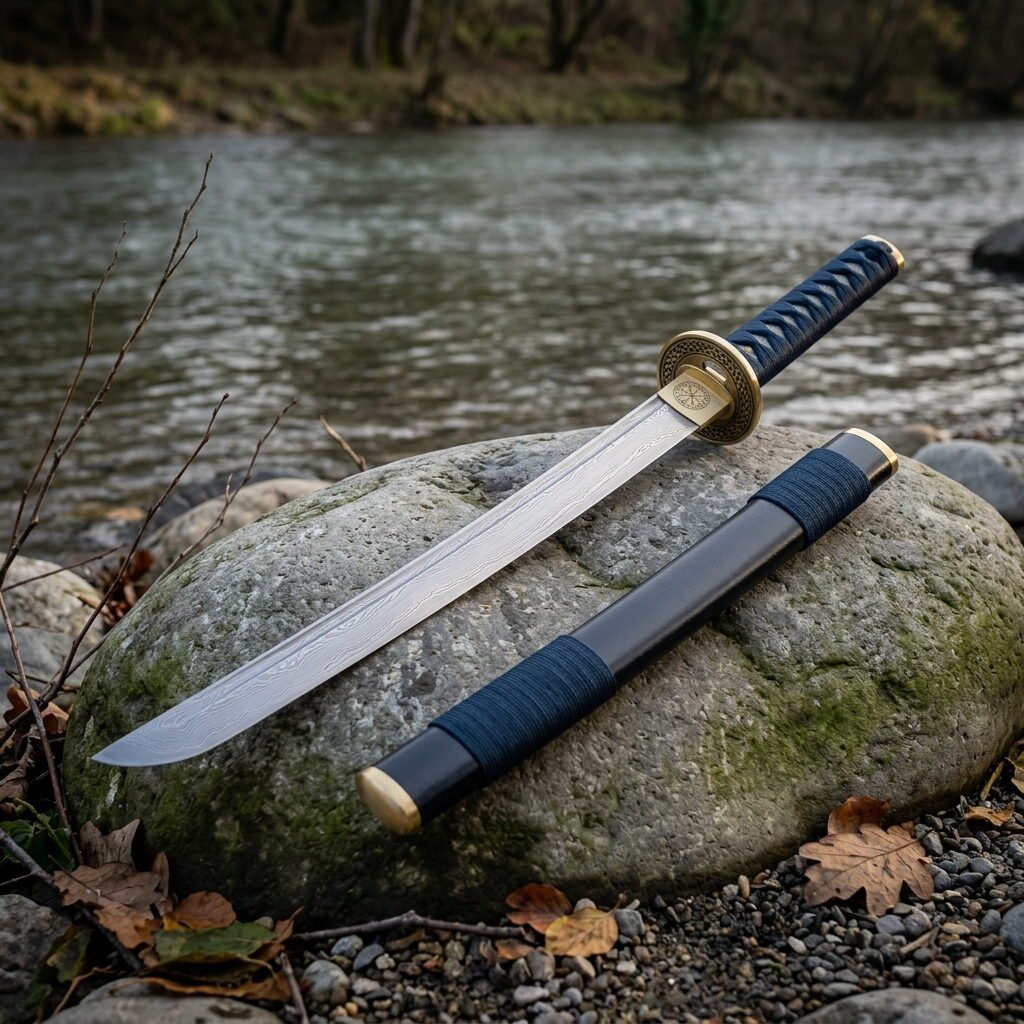
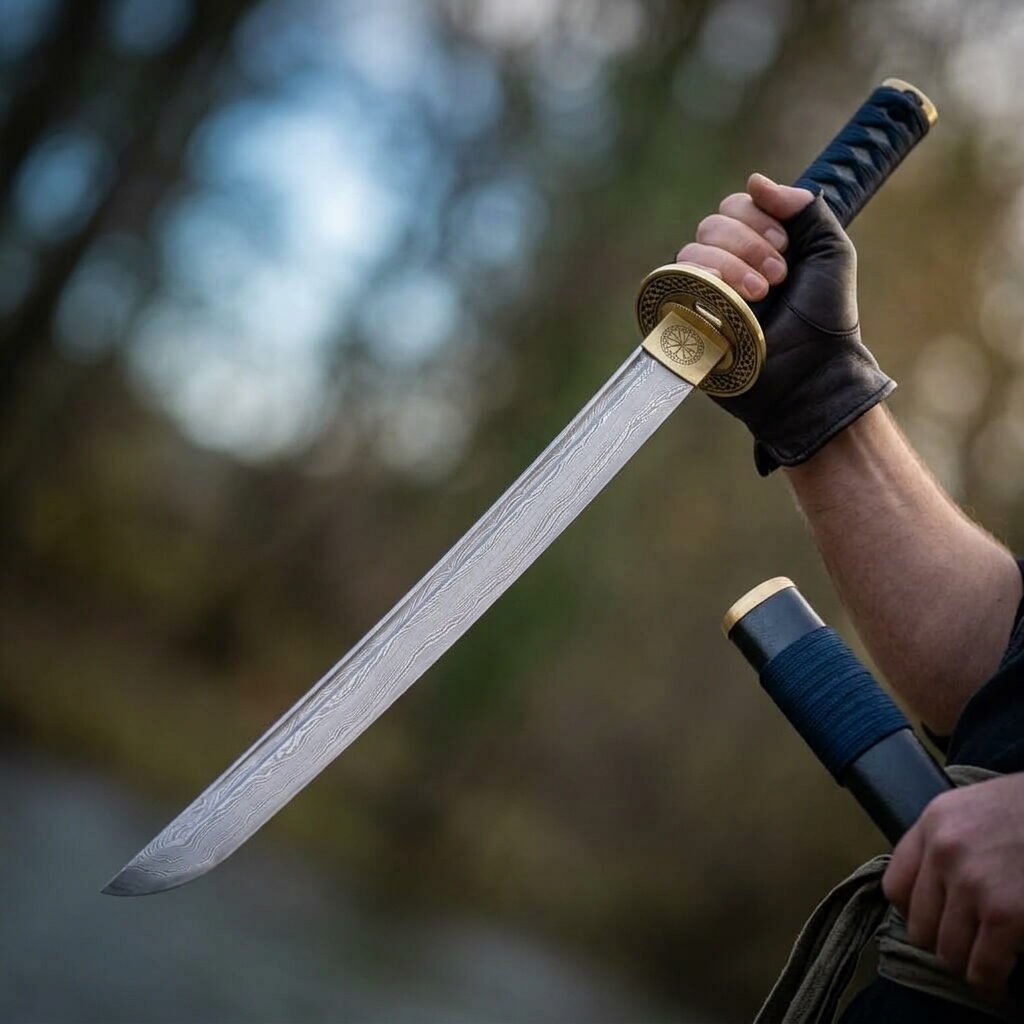
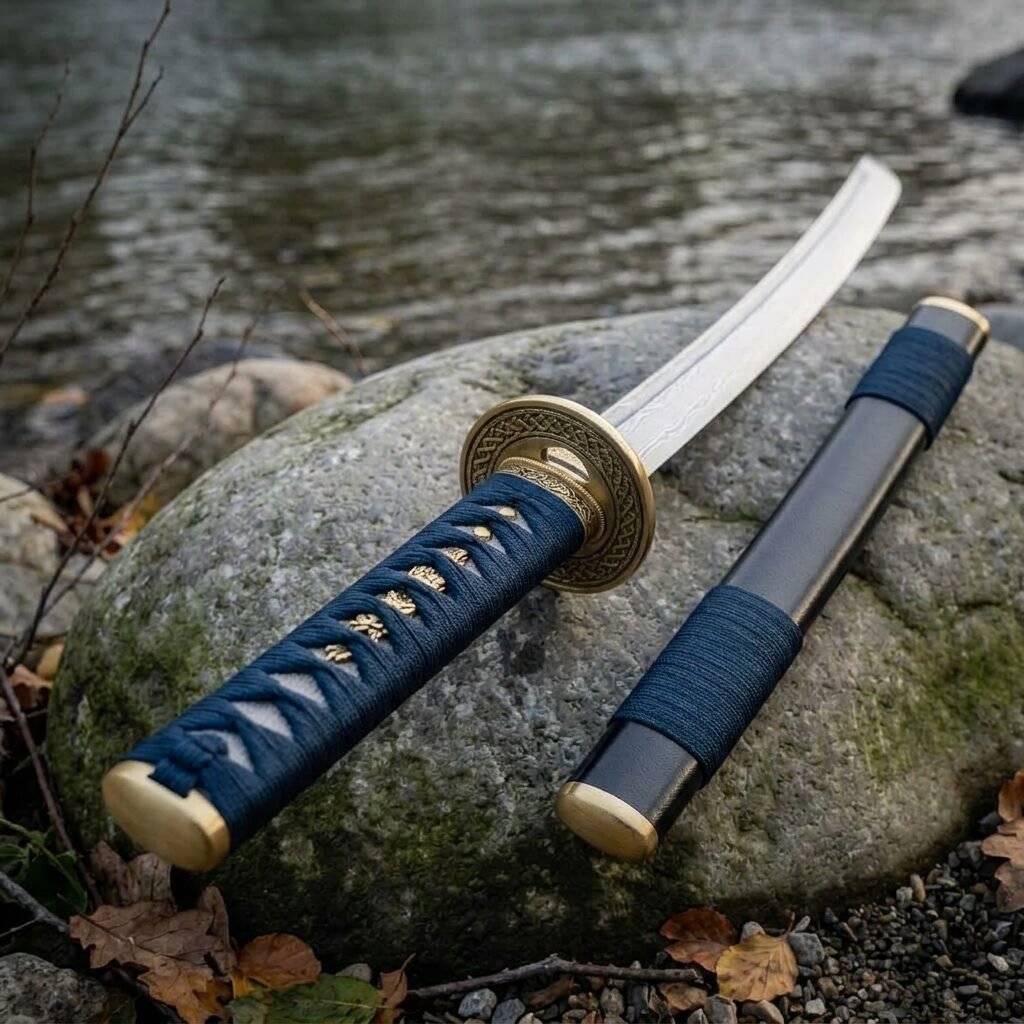
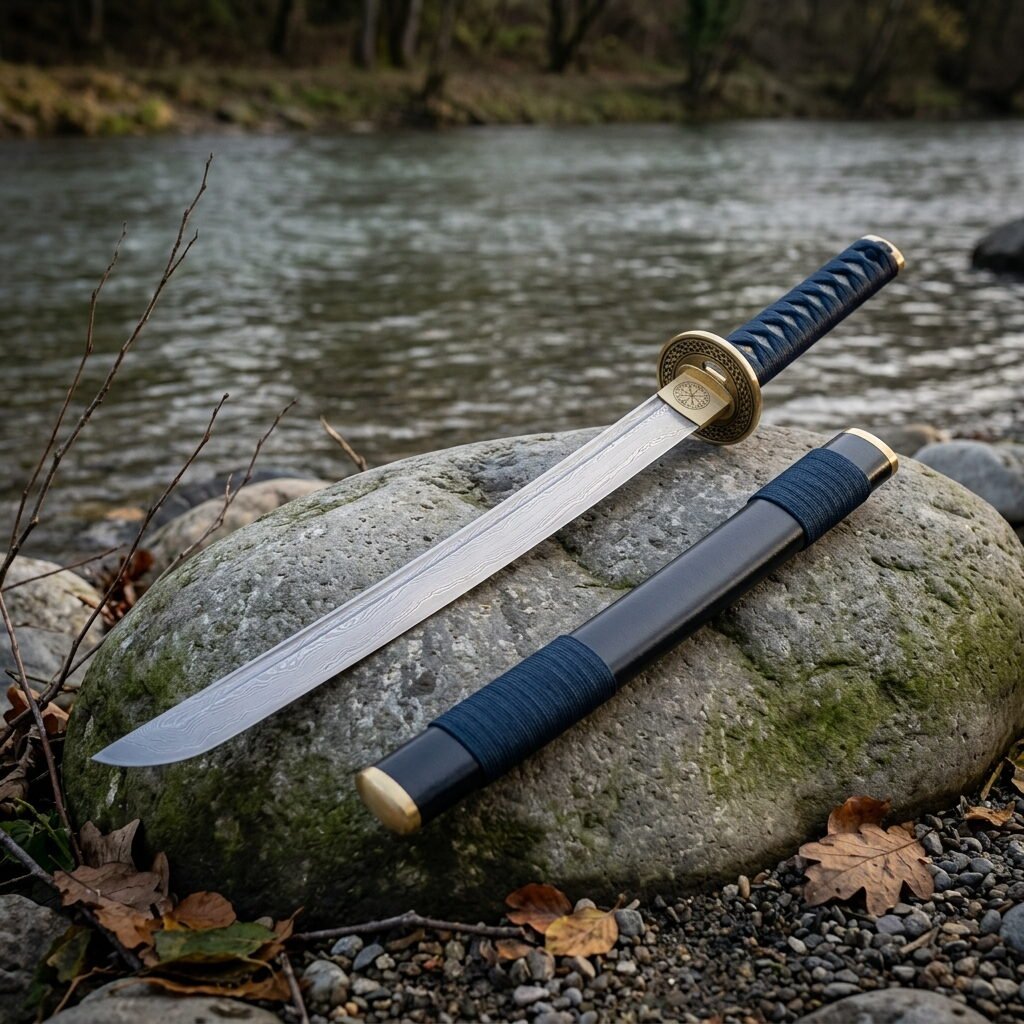
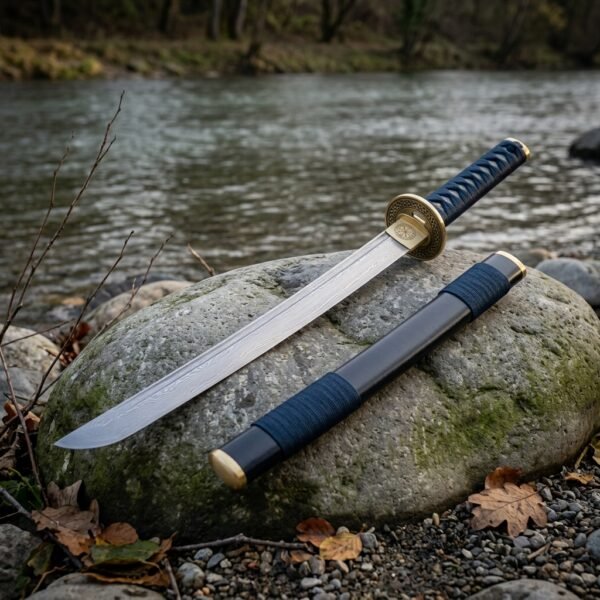
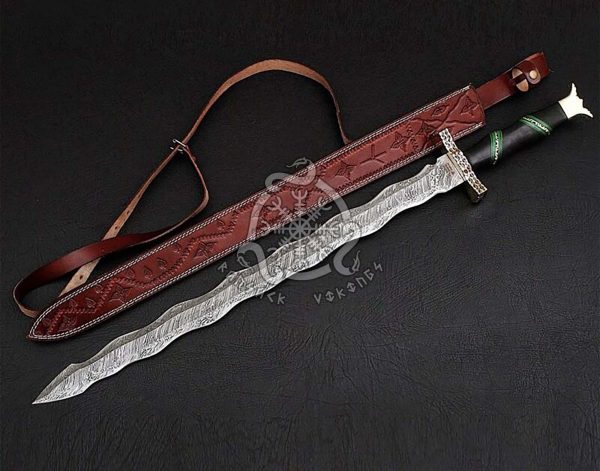
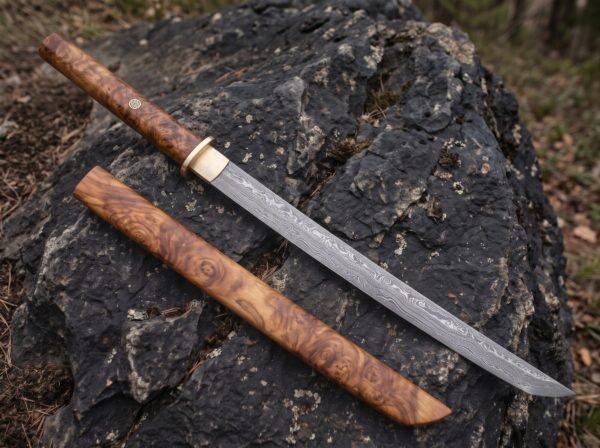
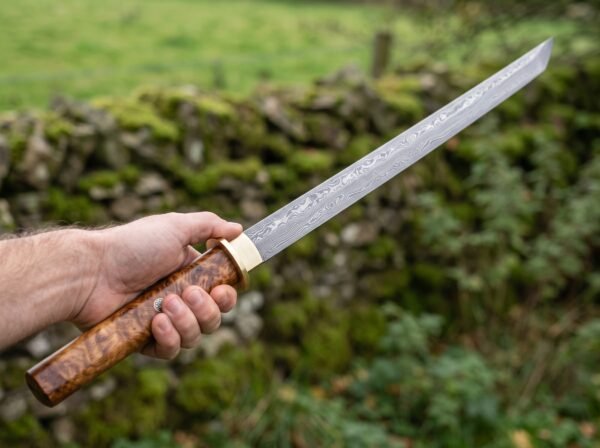
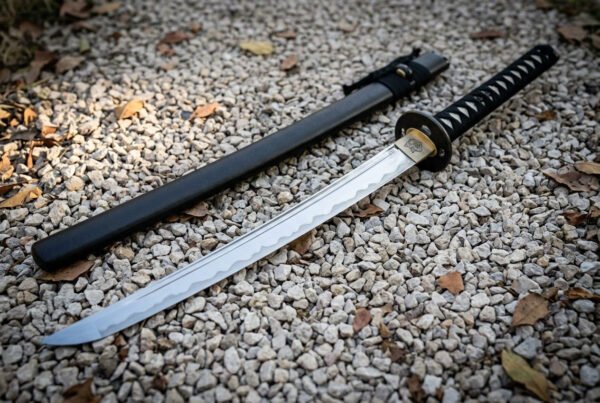
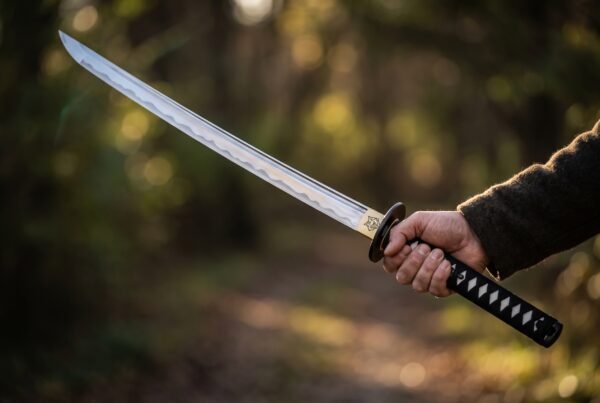
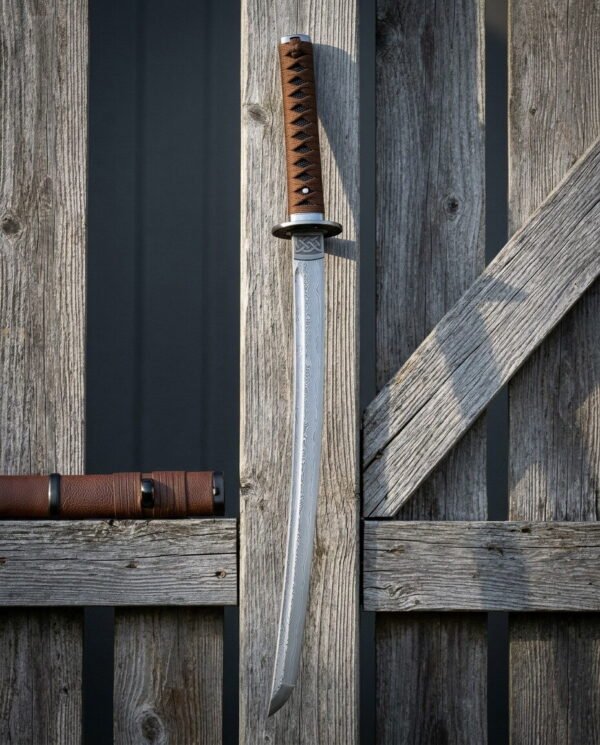
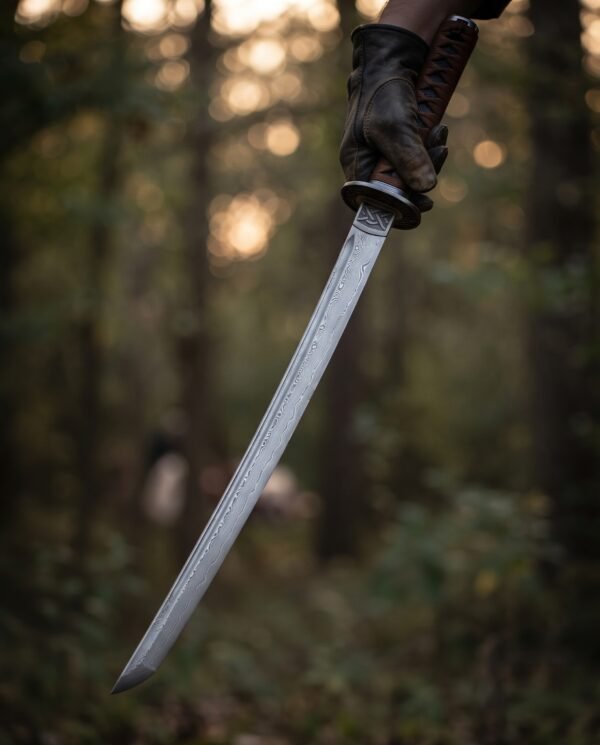
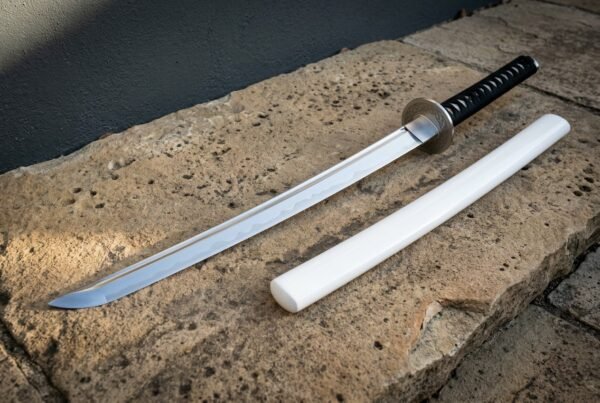
The pattern running the length of this blade is not etched on, printed on or applied. It is the cross section of the steel itself. Two steels are stacked in a billet, 1095 for hardness and 15N20 for toughness, welded together at forging heat, then drawn out, folded and drawn out again until a stack of a dozen layers has become several hundred. Grinding the blade to shape cuts through those layers at a shallow angle and exposes them on the surface as a flowing line. The reason you can see it is chemistry rather than colour. 15N20 carries about two percent nickel, which resists the acid used to finish the blade, so the etch bites the 1095 layers dark and leaves the nickel bearing layers bright. Tidefold carries that pattern on a 20.5 inch blade hardened to 58 to 60 HRC. The short sword that sat beside the katana has its own logic, explained in what a wakizashi is.
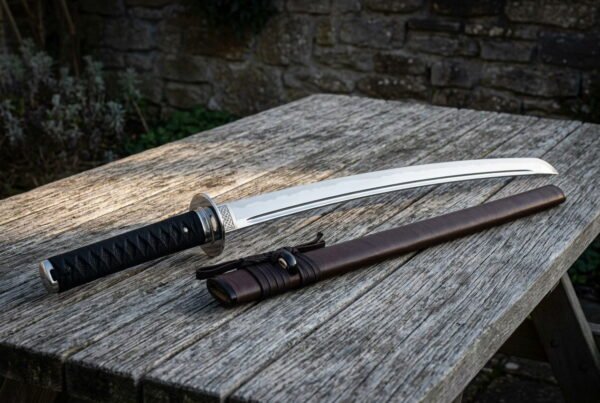
Forge welded, ground, heat treated, etched and mounted by hand in the Czech Republic. It ships with the black saya shown in the photographs, wrapped in navy cord with brass fittings, and a protective coat of oil on the blade. Shipping within the United States is free.
Specifications
| Steel | Forge welded Damascus of 1095 and 15N20 |
|---|
| Hardness | 58 to 60 HRC |
|---|
| Overall length | 29 inches |
|---|
| Blade length | 20.5 inches |
|---|
| Blade profile | Single edged with a shallow curve and a flowing layer pattern along the full length |
|---|
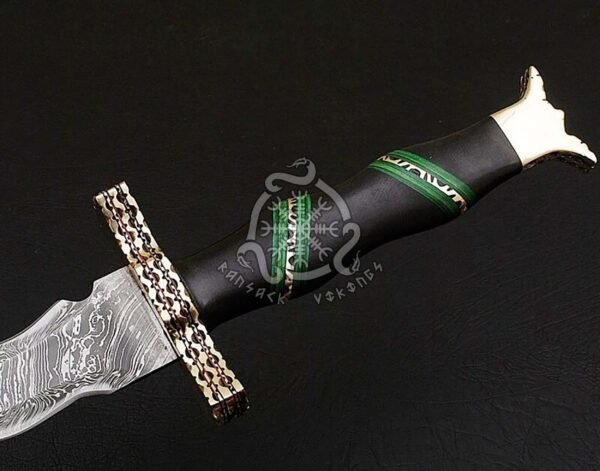
| Handle | Hardwood core wrapped in navy cord over pale panels, with brass menuki and a brass pommel cap |
|---|
| Guard | Round brass tsuba with a pierced knotwork border |
|---|
| Habaki | Brass, engraved with a round Norse emblem |
|---|
| Scabbard | Black wooden saya with two navy cord bands, brass throat and brass end cap |
|---|
| Weight | Approximately 1.8 pounds bare, 2.4 pounds in the saya |
|---|
| SKU | RK-1277 |
|---|
What forge welding actually gains you
The romantic claim about Damascus is that layering makes a blade stronger than the sum of its parts. That is mostly overstated, and it is worth being straight about it. A modern homogeneous steel, properly heat treated, performs perfectly well. What layering genuinely does is more specific and more interesting.
First, it distributes the two steels through the whole section, so every part of the edge is a fine alternation of a hard, high carbon steel and a tougher, nickel bearing one. Cracks that start in a hard layer run into a tough one and stop, which is a real and measurable effect. Second, the folding process itself refines the grain of the steel and disperses whatever inclusions were in the starting bar, which is why the technique existed in the first place. Before modern steelmaking, folding was the only way to make a bar of consistent quality out of a bar that was not. Third, the layers change the working of the edge at a microscopic scale, giving a slightly toothy quality that bites well.
The honest headline is that a good Damascus blade and a good mono steel blade are close in performance, and the Damascus one is far harder to make, which is what you are paying the premium for. What it certainly does is show its own construction, and there is not much else in the world that does that.
Why forge welded Damascus and not stainless
The two steels in this billet are chosen because they weld to each other cleanly and harden at similar rates. 1095 brings the carbon that lets the edge get genuinely hard. 15N20 brings nickel, toughness and the contrast that makes the pattern visible. Neither contains chromium, and that is deliberate, because chromium is exactly what stops a stainless blade from etching into a visible pattern and what coarsens its carbides.
Stainless resists rust, and that is its whole case. It gives up edge fineness for it, it gives up toughness in a long section, and it cannot show a Damascus pattern at all. This blade will rust if you leave it wet, and the etched surface is slightly more absorbent than a bright polish, so it needs oil and a wipe. That is the trade. The argument is set out in full in our steel and hardness notes.
The tsuka, the brass and the saya
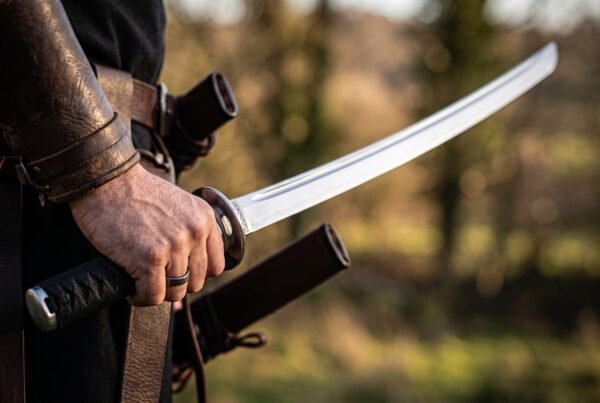
The handle is a hardwood core fitted to a full length tang, wrapped in navy cord and capped with brass at the pommel and collared in brass at the guard. The wrap is tied in alternating diamonds so each turn locks the last and the whole thing holds even if a single strand is cut. The saya is turned from wood, finished black, wrapped with two bands of matching navy cord and fitted with a brass throat and a brass end cap.
The brass will darken over a year or two into a warmer tone. Most owners leave it that way and a metal polish brings it back if you prefer bright. The wood in the handle core and the saya wants what all wood wants, which is described in handle and sheath care.
Engraving, runes and your own design
Use the rune converter on this page to turn a name, a date or a short phrase into Elder Futhark and we will cut it into the steel or the handle. If you would rather have a Viking pattern than a rune line, choose your own design in the engraving option above the add to cart button and tell us whether it goes on the blade or the handle. Where a piece already carries an engraved design, your chosen engraving replaces it rather than sitting alongside it. Cutting into a Damascus blade exposes fresh layers along the edges of the engraving, which reads well once the piece is re etched. There is more on the engraving page.
Care and sharpening
An etched Damascus surface needs a little more attention than a bright polish. The etch leaves a very slightly textured face that holds moisture, so wipe the blade down every time you handle it and keep a thin film of light mineral oil on it. If the pattern ever looks faint, it has usually just been polished flat by handling rather than lost, and a light re etch restores it.
Sharpen on ordinary water stones at the ground angle. Because the layers alternate hard and tough, a Damascus edge takes slightly longer to raise a burr on and holds it well once raised. Finish fine and strop. Full detail in steel care and sharpening with a whetstone.
Made in the Czech Republic
Every piece we sell is made by hand in the Czech Republic. The smiths there work the way the trade has been worked for a long time, heating and hammering the steel, taking the bevels down by eye, and fitting the handle and the leather one at a time. There is no automated line anywhere in it, so small differences from one piece to the next are normal and expected.
Ransack Viking is a United States company based in Chicago, Illinois. We bring the pieces in ourselves, inspect them on arrival and ship them from our own warehouse. If you add engraving, that is carried out here in the United States before your order goes out.
A note on handmade variation
Tidefold is hand forged. It is not machine made and it is not bulk produced, so what arrives will not be a pixel for pixel copy of the photograph. No two Damascus blades carry the same pattern, because the pattern is the record of how that specific billet was folded, drawn and ground, and small differences at the billet stage become large differences on the finished surface. The depth of the etch, the tone of the brass and the grain of the wood are all individual. Dimensions, steel and build are the same every time. The character is not.
Frequently asked questions
Is the pattern real or applied to the surface?
Real. It is forge welded 1095 and 15N20 running right through the blade. Grind into it and the pattern continues, because it is the structure of the steel and not a finish sitting on top of it.
Does it arrive sharp?
Yes. Say so in the order notes if you want it supplied blunt for display or for a venue with rules about edged pieces, and there is no extra charge.
Will the pattern wear off?
The pattern cannot wear off, but the contrast can dull as handling polishes the surface. A light re etch brings it straight back, and the guide covers how.
Can I have runes engraved on it?
Yes. Use the rune converter on this page for Elder Futhark or choose your own Viking pattern in the engraving option above the add to cart button. On Damascus, engraving cuts through the layers and picks up contrast at its edges.
What is the difference between this and your plain steel wakizashi?
Construction and hardness. A plain 1095 wakizashi is a single steel at 54 to 58 HRC. This is two steels forge welded together and run harder at 58 to 60 HRC. It holds an edge slightly longer, it shows its own layers, and it takes considerably more work to make, which is why it costs more.
How long does shipping take?
Free inside the United States. Damascus pieces take two to three weeks in the shop, longer with engraving, then two to five days in transit.
What is in the box
- Tidefold hand forged Damascus wakizashi in 1095 and 15N20
- Black wooden saya with navy cord wrap and brass fittings
- Protective oil coat on the blade
- Damascus care card covering oiling and re etching
- Elder Futhark rune engraving where selected
- Forged and finished in the Czech Republic
Explore the range
Browse the full Damascus sword range, the plain steel wakizashi, the matching katana and Japanese swords, or read the guides.
Others in the same line
Next along the rack is the Duskcairn wakizashi. For a straight comparison, see the Snowfold wakizashi, 30 inches overall. Worth putting side by side with this is the Duskmere wakizashi, pattern welded Damascus.
If you are putting a set together, the Gildhawk sabre sits alongside it. You can have this made your way instead on the design your own page.

This is exactly what I wanted and then some. Made overseas in the Czech Republic yet shipped from a US location so no long customs wait. The craftsmanship really shows in the small details. Will definitely order again for another gift.
My whole family was impressed when I unboxed it. Packaging was excellent and it arrived in perfect condition. Already planning my next purchase from this shop.
Got this as a birthday gift and the reaction was priceless. Feels way more premium in person than the listing photos. Exactly as described and clearly made with care. If you’re on the fence just get it. You won’t regret it.