
A sword stand is a piece of furniture with one job, holding several pounds of steel in a fixed position for years without marking it. That sounds easy until you look at where the load actually goes. A hand forged sword and its scabbard together usually run between three and six pounds, and on a wall mount that weight is not pressing straight down on the screws, it is levering out from the wall. Which is why the pieces here are built the way they are, with brass or steel cradles, felt or leather where the metal touches, and keyhole slots or bolts sized for the pull.
The range covers table top stands in solid oak and American black walnut holding two or three pieces, matched pairs of wall brackets with brass scroll hooks or brushed steel hooks, and one carved oak board that arrives with a bearded axe already fitted. Bases run to about 16 inches across and 15 inches tall. Brackets are around 9 inches each.
Buy for the wall you have, not the sword you have. Mounting one safely is its own job.
Free US shipping
On most pieces. Heavier and oversized ones carry a flat charge.
Hand Forged
Heated, hammered and ground by hand.
Engraving available
Names, dates or Norse runes on most pieces.
Ships from Chicago
Inspected and dispatched from our Chicago warehouse. No import duty, no customs delay on US orders.
Sword Stands & Displays
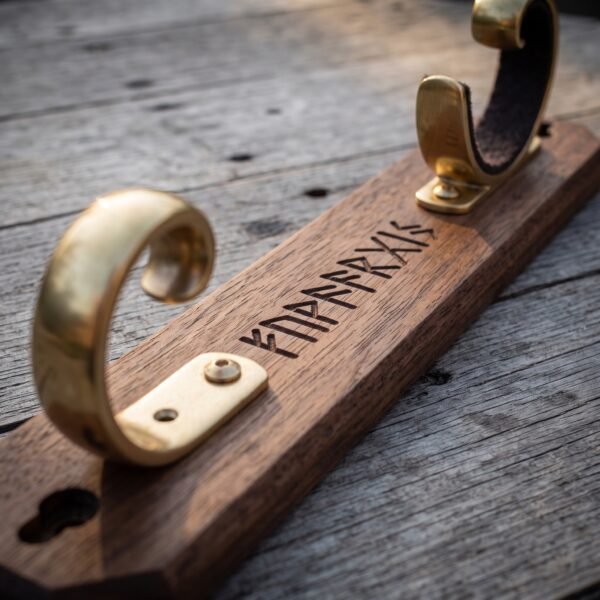
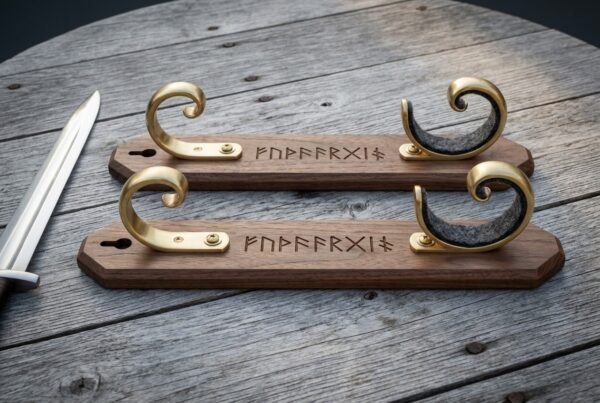
Runeledge Hand Made Walnut Sword Wall Mount Pair with Solid Brass Scroll Hooks | Felt Lined Cradles | Elder Futhark Rune Engraving and Keyhole Slots | Display Gift | RK-1759
Original price was: $169.00.$135.20Current price is: $135.20.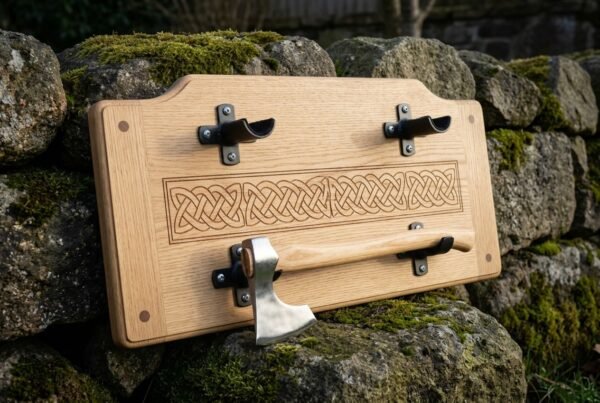
Oakhewn Hand Forged Viking Axe Wall Plaque | Bearded Axe on Carved Oak Board | Celtic Knotwork Band and Leather Lined Steel Cradles | Norse Wall Gift | RK-1683
Original price was: $329.00.$263.20Current price is: $263.20.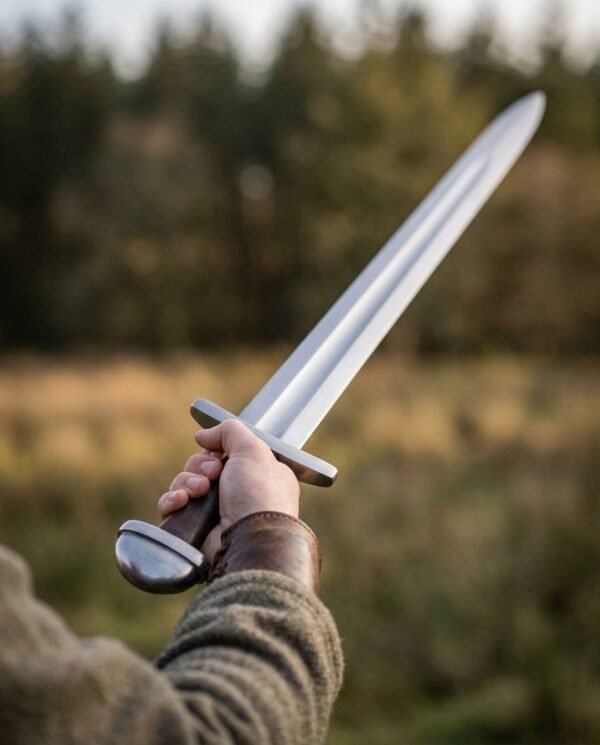
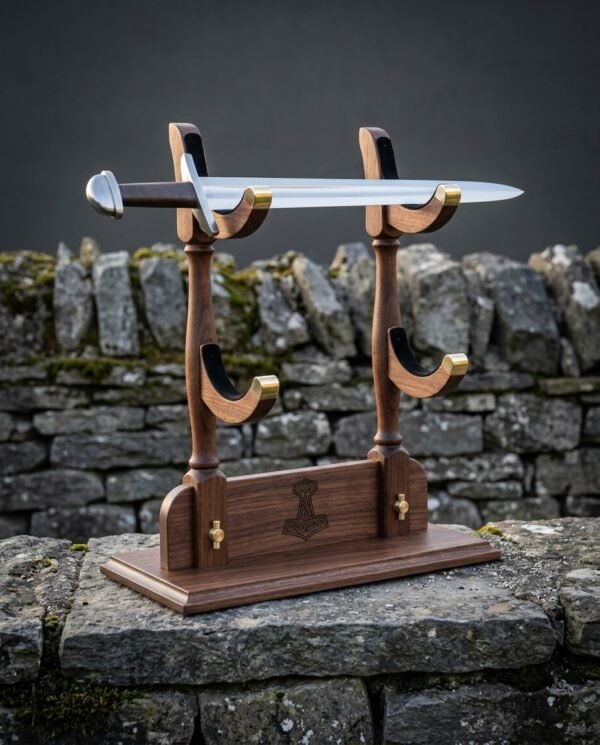
Stavecradle Hand Made Walnut Two Tier Sword Display Stand | Holds Two Swords | Brass Tipped Cradles and Thumb Screws with Mjolnir Engraving | Norse Home Gift | RK-1731
Original price was: $199.00.$159.20Current price is: $159.20.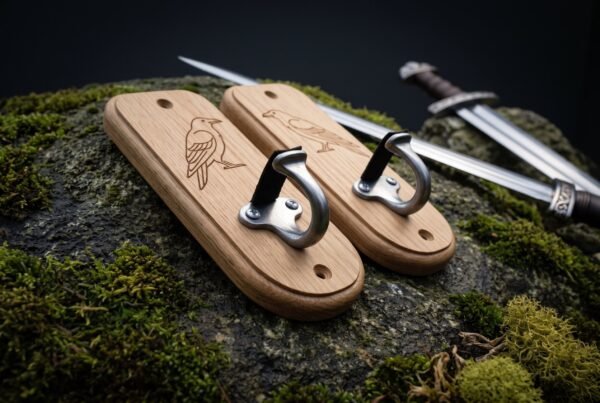
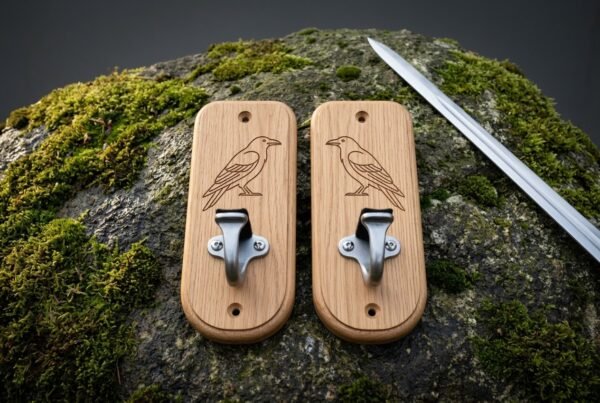
Ravenperch Hand Made Oak Sword Wall Mount Hooks | Matched Pair of Engraved Raven Plaques | Brushed Steel Hooks and Wall Fixings | Norse Display Gift | RK-1771
Original price was: $129.00.$103.20Current price is: $103.20.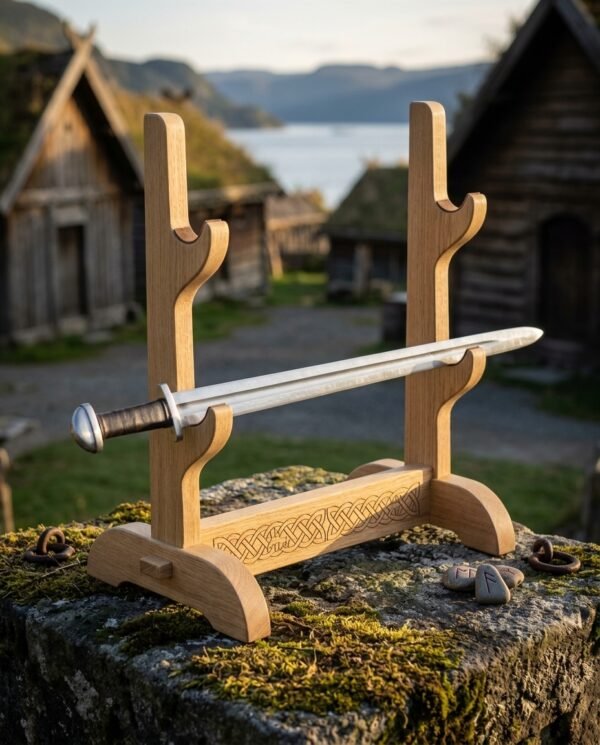
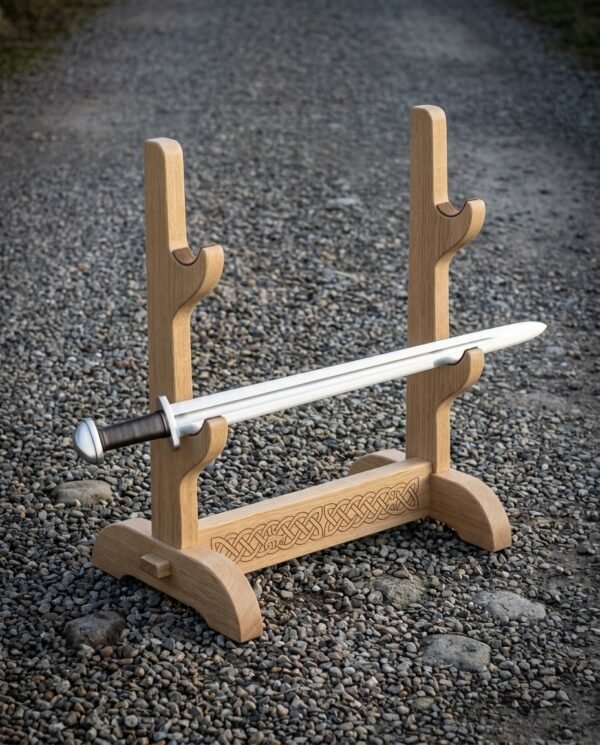
Oakrest Hand Made Oak Sword Display Stand | Two Tier Table Top Rack | Knotwork Engraved Crossbar with Wide Footed Oak Base | Norse Display Gift | RK-1783
Original price was: $179.00.$143.20Current price is: $143.20.What a stand is actually doing
Most people buy a stand after something has already gone wrong. A sword propped in a corner slides down the plaster. A blade laid across two nails picks up two bright rub marks. An axe leaned against a bookcase falls at four in the morning and takes a shelf with it. The stand is the thing that stops all of that, and the way it stops it is not complicated once you see where the forces are.
On a table top stand the load is straight down, so the only real questions are whether the base is wide enough to stop the whole thing tipping when a sword sits high on the top tier, and whether the cradles are soft enough not to mark the blade. On a wall mount the physics change completely. The weight hangs out from the wall on a bracket, so the fixings at the top are being pulled straight out of the plaster while the bottom of the bracket is pressed into it. That is why every wall piece here takes two screws per bracket, one above the hook and one below, rather than a single fixing in the middle.
The second thing a stand does is decide which way the blade sits. Rest a sword edge down and the whole weight of the piece bears on the thinnest, hardest, most fragile part of it, held against wood or metal for however many years it lives there. Rest it edge up, spine in the cradle, and the load sits on the thickest section of steel. The stands here are cut so the natural way to lay a sword is the correct one, which saves a certain amount of arguing.
The stands and mounts in this collection
Five pieces, split by whether they sit on something or hang on something.
Table top stands
Two of these. The walnut two tier stand is solid American black walnut with a chamfered plinth on felt feet, about 16 inches across the base and about 15 inches to the top of the upper cradles. Each cradle is capped in solid brass and lined with black felt bonded and trimmed by hand, and the pieces are held with solid brass thumb screws so a sword can come off the stand without tools. It holds two swords, one per tier, or one sword and its scabbard. A Mjolnir is cut into the back panel of the plinth. It arrives flat, with the two uprights bolting to the plinth using the hex key supplied.
The oak stand is a three tier table top rack in solid oak throughout, built with a through tenon stretcher passing across both uprights, which is joinery rather than a screwed butt joint and is why it stays square under load. A running knotwork band is cut along the face of the stretcher. The cradles are oak notches cut and rounded rather than lined, and the base is two curved feet set wide so the rack does not tip when the top tier is loaded. Swords are not included, and the blade in the photograph is there for scale.
Wall mounts
Two matched pairs. The walnut brackets are about 9 inches long each, sold as two brackets carrying four solid brass scroll hooks between them, with dense grey wool felt bonded into each cradle and an Elder Futhark rune line cut into the face. They mount on routed keyhole slots at each end, two screws per bracket, and the brass is left unlacquered so it will darken.
The oak pair is simpler and cheaper. Two plaques in clear oiled oak, each with a standing raven cut into the face and one cast steel hook brushed to a satin finish. The hook has an upturned lip at the end, which is the detail that matters, because a blade resting in a flat hook will creep sideways over months and eventually leave it. Two countersunk holes per plaque, one above the hook and one below. Wall screws and plugs are in the box. These take swords, axes, spears, staves and scabbarded blades, so they are the flexible option if you do not yet know what will end up on that wall.
The axe and board
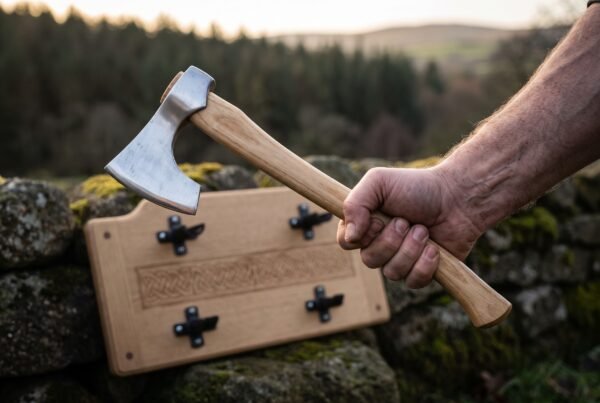
One piece here is a display in its own right rather than a fitting. A hand forged high carbon bearded axe head, hardened to 54 to 58 HRC at the edge on a light hardwood haft, mounted on a solid oak board with shaped shoulders and plugged dowels at the corners. A Celtic knotwork band is carved across the face of the board, and the axe sits in four steel brackets lined in black leather. Keyhole hanging points are routed into the reverse. It arrives complete, board and axe together, and it is the only thing on this page that does not need you to already own something.
Materials, capacity and fittings across the range
Every figure below comes from the specification panel of a piece on this page. These are cut, sanded and finished by hand, so read dimensions as what to expect rather than as a guarantee to the millimetre. Where a listing does not state a figure, the table says so.
| Piece | Type | Timber | Capacity | Cradle and lining | Size |
|---|---|---|---|---|---|
| Stavecradle | Table top stand | Solid American black walnut, hard wax oil | Two tiers, two swords or one sword and scabbard | Solid brass caps, black felt, brass thumb screws | About 16 in wide, about 15 in tall |
| Oakrest | Table top stand | Solid oak, clear oiled | Three tiers, one sword or hafted piece per tier | Cut and rounded oak notches | Not listed |
| Runeledge | Wall mount pair | Solid American black walnut, hard wax oil | Two brackets, four brass scroll hooks | Dense grey wool felt bonded in | About 9 in per bracket |
| Ravenperch | Wall mount pair | Solid oak, clear oiled | Two plaques, one hook each | Brushed cast steel, upturned lip | Not listed |
| Oakhewn | Wall board with axe | Solid oak board, light hardwood haft | One bearded axe, supplied fitted | Four steel brackets lined in black leather | Not listed |
Capacity is the figure to read twice. A two tier stand holds two swords only if both are ordinary single hand lengths. Put a longsword on the lower tier of a 15 inch stand and the tip will foul the surface it is standing on.
Weight, fixings and the wall behind them
Work out the load before you drill. A hand forged sword with a scabbard usually falls between three and six pounds. Two of them on one pair of brackets is up to twelve pounds hanging out from the wall, and that load acts as a lever against the top screws. Into a timber stud that is nothing. Into hollow plasterboard on the plugs that came in the box, it is a slow test of your plaster.
Find a stud if you can, and if you cannot, use a proper hollow wall anchor rated well above the load rather than the friction plugs supplied for solid masonry. Level the two brackets to each other before either is fully tightened, because a sword on two hooks that are half an inch out of level will slide steadily towards the lower one. Set the bracket spacing so both hooks sit inboard of the sword's balance point rather than out near the tip, which stops the blade seesawing when someone walks past.
For table top stands the equivalent question is the surface. Felt feet on a walnut plinth will not mark a table, but a stand loaded high wants a surface that does not get knocked. Mantels are the usual mistake, since anything above a working fireplace gets warm and dry air all winter and the timber does not enjoy it.
Timber, brass and steel
Oak and American black walnut behave differently and both are here on purpose. Oak is hard, open grained, pale to mid brown with visible ray fleck when it is quarter sawn, and it takes a knife cut carving cleanly, which is why the carved and engraved oak pieces show their pattern so well. Walnut is finer grained, darker, and moves less with humidity, which is what you want under a bolted joint that has to stay square.
The finishes are oil rather than lacquer. A hard wax oil sits in the timber instead of forming a film on top, so it has a low sheen, it does not craze, and a scuff can be repaired with a rub of more oil rather than by stripping a whole panel. It also means the wood is not sealed behind plastic, so it will react a little to a very dry room.
Solid brass hooks and caps are left unlacquered. They arrive bright and they will go honey coloured and then brown over a year or two. A metal polish on a cloth takes them back to bright whenever you want, and doing nothing at all is also a valid choice. Brushed steel hooks stay as they are and only want an occasional wipe.
What touches the blade
This is the part that decides whether a stand is kind to a sword or slowly ruins one. Bare wood against a polished blade is not a disaster, but grit finds its way into an open grain and then the cradle works like a very slow file every time the sword is lifted out and put back. Felt and leather solve that by giving the grit somewhere to sit below the contact surface.
The walnut pieces use bonded felt, black on the stand and dense grey wool on the brackets. The axe board uses black leather inside steel brackets. The oak rack uses rounded bare oak notches, which is the traditional answer and works fine if you keep the notches clean and lift the blade out rather than dragging it.
One warning that applies to every lined cradle. Felt and leather both hold moisture. A carbon steel blade left in a damp room will spot first at the exact points where it sits in the lining, because that is where air cannot get to it. If a room runs humid, wipe the blade and the cradle every few weeks and keep a light film of oil on the steel. Our guide to Damascus steel care covers the oiling routine.
Care and storage
Dust the timber with a dry cloth. Once a year give the oiled surfaces a thin coat of hard wax oil or a furniture oil and wipe off whatever has not soaked in after ten minutes. Keep the whole thing away from radiators, sunny windows and the top of a working fireplace, because dry heat shrinks timber and a shrunk upright loosens a bolted joint.
Check the fixings once a year. On a wall mount, put a hand under the bracket and pull gently outward, which is the direction the load actually acts. On a bolted stand, a quarter turn on the hex key takes up anything the timber has given away over a winter. Brass thumb screws want to be snug rather than forced, since brass threads strip more easily than steel ones.
Engraving
Every piece here has a flat face designed to carry a cut, which makes these some of the easier things to personalise. The plinth back panel, the bracket faces, the stretcher and the axe board all take text or a symbol. Elder Futhark is a phonetic alphabet rather than a cipher, so a name is transliterated by sound and there is no rune for the letter C. Where a piece already carries an engraved design, your engraving replaces it rather than sitting beside it. Text engraving is 19 dollars, a symbol is 39 dollars and a family crest is 49 dollars. It is permanent, an engraved piece cannot be returned, and the spelling you send is the spelling that gets cut.
Where these come from and how they ship
Ransack Viking is a US company based in Chicago, Illinois. The pieces are handmade in the Czech Republic, then imported, inspected and shipped from Chicago. Engraving is done in the US after arrival. Because the timber is natural and every board is cut from a different tree, colour and figure vary from one stand to the next, oak runs from pale straw to warm brown and walnut from mid brown to nearly black. Dimensions, joinery and fittings are the same every time. The grain is not.
How to choose
If you have one blade and a wall, buy the oak plaques and put the money you saved into the blade. If you have a collection and a shelf, buy the three tier oak rack. If the display is the point and the room is finished in dark timber, buy the walnut, because the brass and felt read as furniture rather than as a fitting. If you want something that arrives complete and goes straight on a wall, buy the axe board.
Browse related categories
- Swords across every pattern we carry
- Viking swords with pattern welded and plain blades
- Scabbards and sheaths, including replacements
- Bearded axes to hang beside them
- Viking home decor for the rest of the room
- Viking shields, the other thing that needs a wall
Guides worth reading first
- How to display swords and axes safely
- Display sword vs battle ready, what the difference actually is
- Elder Futhark runes and how a name is transliterated
- Mjolnir and what the hammer meant
Frequently asked questions
Does a sword go edge up or edge down on a stand?
Edge up, spine resting in the cradle. Edge down puts the entire weight of the sword onto the thinnest and hardest part of it, held there for years. The cradles on these stands are cut so the natural way to lay a blade is the right way.
Are swords included with the stands?
No. The table top stands and the wall brackets are supplied empty, and any blade shown in a photograph is there for scale. The one exception is the carved oak wall board, which arrives with its bearded axe already fitted in the brackets.
Will these hold a longsword?
The wall mounts will, since bracket spacing is up to you and both pairs take swords, axes, spears and scabbarded pieces. On the two tier stand at about 15 inches to the upper cradles, check the length of your blade against the height first, because a long sword on the lower tier can foul the surface underneath.
Can I fix a wall mount into plasterboard?
Only with the right anchors. The plugs supplied suit solid walls. A pair of brackets can carry ten pounds or more hanging out from the wall, and that load pulls the top screws outward rather than downward, so find a stud where you can and use a rated hollow wall fixing where you cannot.
Will the felt or the leather mark my blade?
Not by itself. What marks a blade is grit trapped in a cradle, so keep the lining clean and lift the blade out rather than dragging it. In a humid room, be aware that felt and leather hold moisture against steel, so wipe the blade and keep a light oil film on it.
Does the brass need polishing?
Only if you want it bright. The brass is left unlacquered, so it will darken to honey and then brown over a year or two. A metal polish on a cloth reverses that in a few minutes. Leaving it alone harms nothing.
Do the stands need assembly?
The walnut two tier stand ships flat, with two uprights that bolt to the plinth using the hex key in the box. The oak rack is jointed with a through tenon stretcher and arrives built. The wall mounts need only the screws and plugs supplied.
Where are these made?
They are handmade in the Czech Republic, then imported, inspected and shipped by Ransack Viking from Chicago, Illinois. Engraving is added in the US after arrival.
Featured pieces
 Stavecradle Hand Made Walnut Two Tier Sword Display Stand
Original price was: $199.00.$159.20Current price is: $159.20.
 Ravenperch Hand Made Oak Sword Wall Mount Hooks
Original price was: $129.00.$103.20Current price is: $103.20.
 Runeledge Hand Made Walnut Sword Wall Mount Pair with Solid Brass Scroll Hooks
Original price was: $169.00.$135.20Current price is: $135.20.
 Oakrest Hand Made Oak Sword Display Stand
Original price was: $179.00.$143.20Current price is: $143.20.