
The gladius is the short Roman sword, made to be worked from behind a shield in a line with no room to swing. The blade is broad, double edged and weighted close to the hand, and it ends in a long triangular point because the stroke that mattered was a thrust into the gap. Two patterns turn up here. The Mainz is waisted in the middle and drawn out into a long slender tip. The Pompeii runs near parallel from guard to point, and the later army settled on it, because parallel edges grind back to true faster and a short point does not snap off in a shield rim.
Blades here run 26 to 28 inches overall with 19 to 21 inches of edge, which puts them among the short swords, in either 1095 high carbon at 54 to 58 HRC or forge welded Damascus of 1095 and 15N20 at 58 to 60 HRC. Fittings are brass, solid bronze or polished steel, grips run to ribbed bone, walnut, cherry, turned hardwood and stitched leather, and every sword ships in a fitted leather scabbard.
If you want the sword that actually did the work, start with a Pompeii blade in plain 1095. The Roman helmets sit on their own page.
Free US shipping
On most pieces. Heavier and oversized ones carry a flat charge.
Hand Forged
Heated, hammered and ground by hand.
Engraving available
Names, dates or Norse runes on most pieces.
Ships from Chicago
Inspected and dispatched from our Chicago warehouse. No import duty, no customs delay on US orders.
Gladius
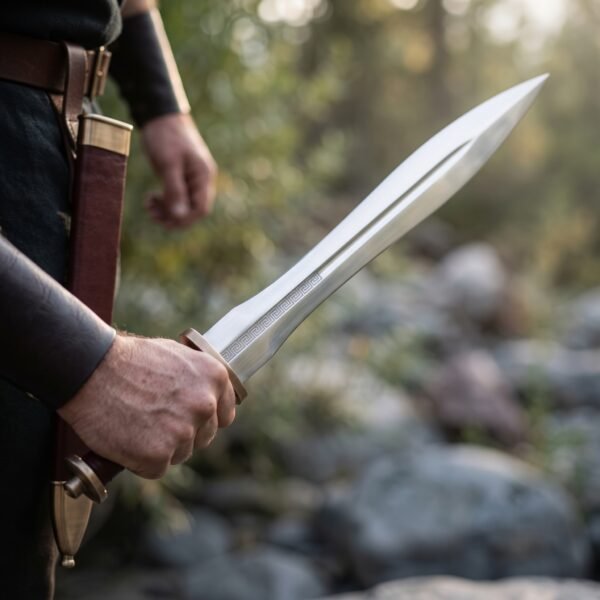
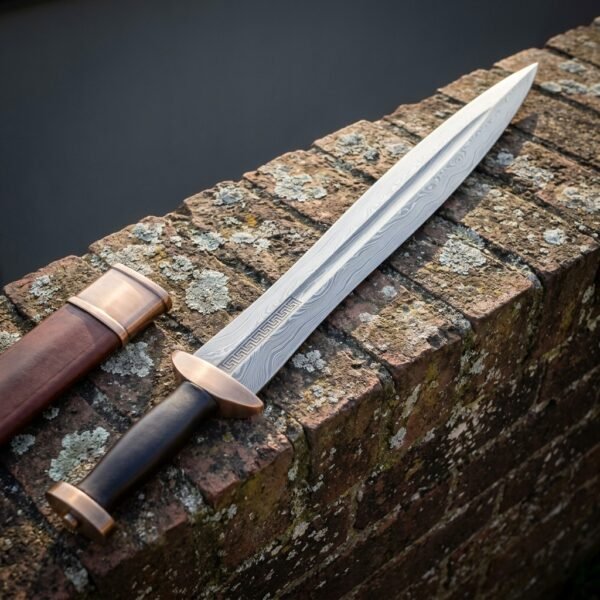
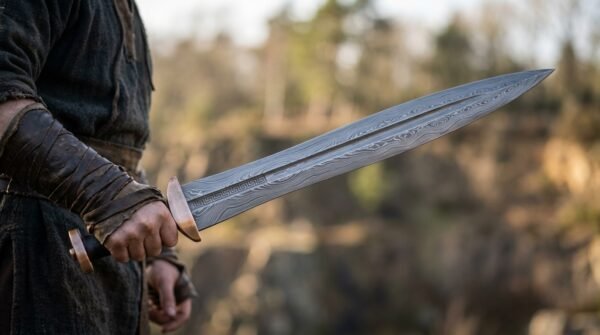
Why the Roman short sword is short
A gladius looks stubby next to almost every other sword on this site, and that is the point of it. The Roman infantryman fought behind a body shield, in a line where the man either side of him was close enough to knock elbows. A long blade in that space is a liability. It fouls on the shield rim, it fouls on your own file, and a big swing opens your body up for the half second it takes to bring it back. So the army carried a blade a little over twenty inches and taught the man to work it short and low, through the gap beside his own shield.
That job shapes the whole object. The blade is broad, close to two inches at the guard, so it stays stiff when driven into something that resists. It is double edged, because in a press you cannot afford to think about which way up the sword is. The point runs long and triangular so it parts mail and thick cloth instead of skidding. The mass sits back near the hand under a heavy pommel, so the blade recovers fast rather than feeling nose heavy.
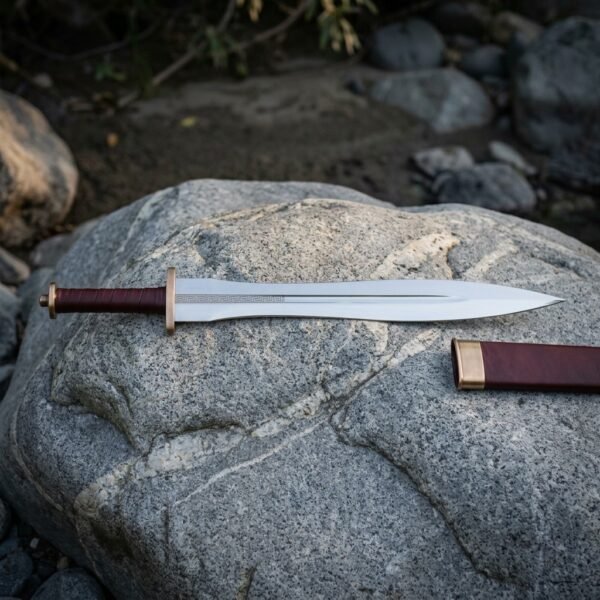
The two profiles here come from two different centuries of that idea. The Mainz type is the older shape, waisted in the middle so the edges pinch inward and then flare again before the long tapered point. It cuts well for a short sword and it is fussier to make. The Pompeii type, named after four swords pulled out of the ash after Vesuvius buried the town in AD 79, drops the waist entirely. The edges run parallel and the point is short and triangular. It is the plainer object and the more sensible one, because an army equipping tens of thousands of men wants a blade any competent smith can grind and any soldier can sharpen back to true.
The gladius blades in this collection
Ten pieces sit on this page. Nine are swords and one is the dagger a legionary carried on the other hip. They split by pattern, by steel and by what the fittings are made of.
Mainz pattern, the waisted leaf blade
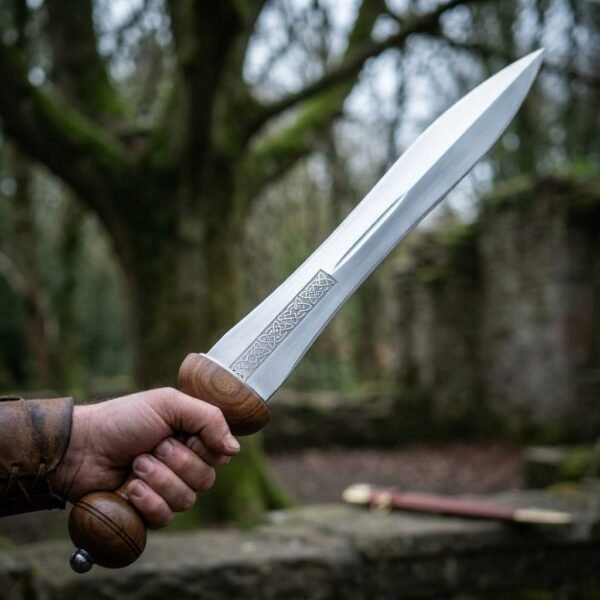
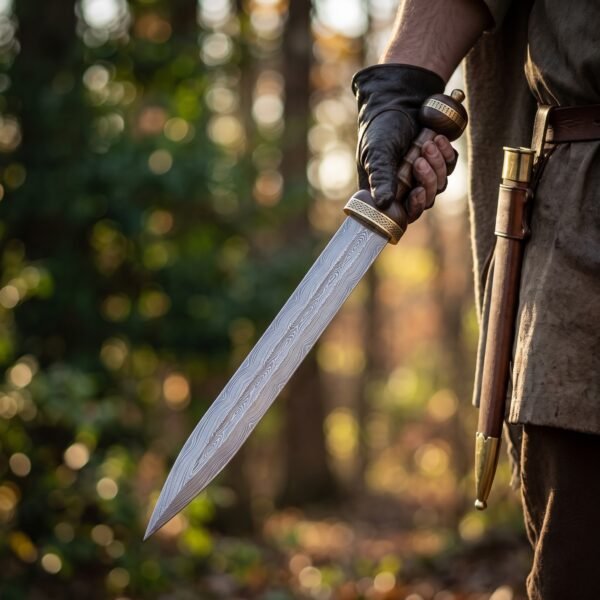
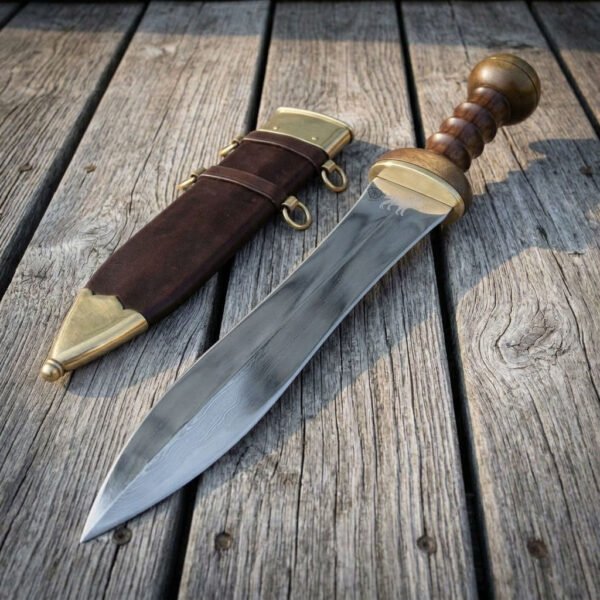
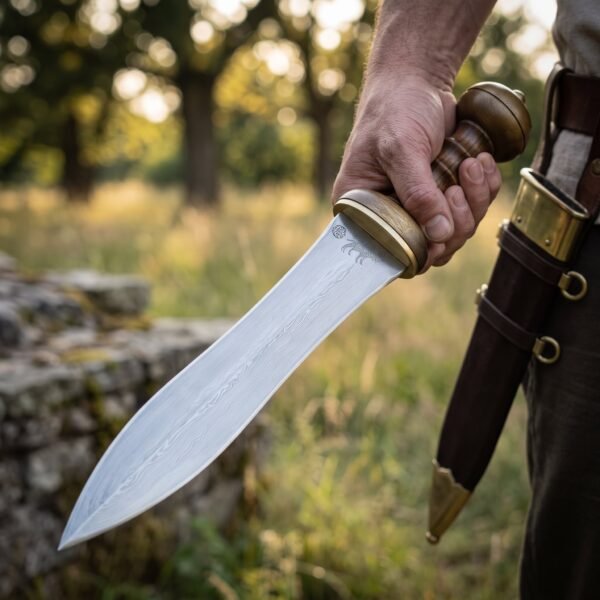
The waisted blades are the longest things here at 28 inches overall with 21 inches of edge, and the shorter leaf blades run 26 to 27 inches. The waist is easier to feel than to see. Hold one level and the balance sits further out than on the parallel blades, because there is more steel in the flare ahead of the pinch. The cherry wood piece pairs a ribbed grip with a turned wooden guard block and carries an etched knotwork panel at the forte. The Damascus version swaps in ribbed walnut, an engraved brass collar and a rune banded cap on the pommel.
Pompeii pattern, the parallel blade
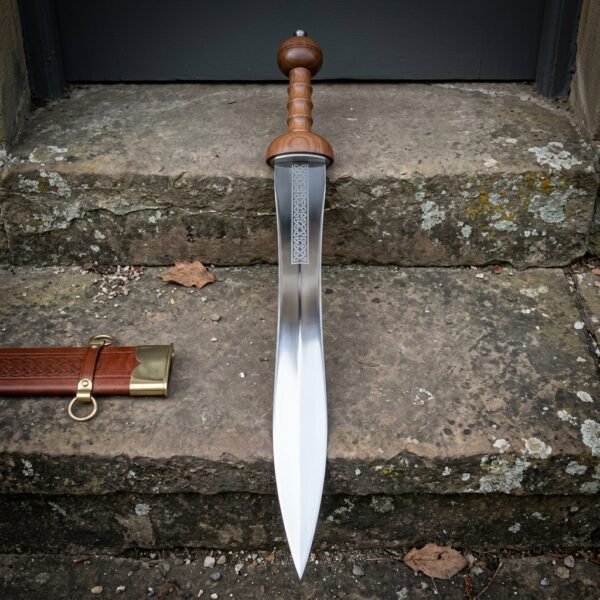
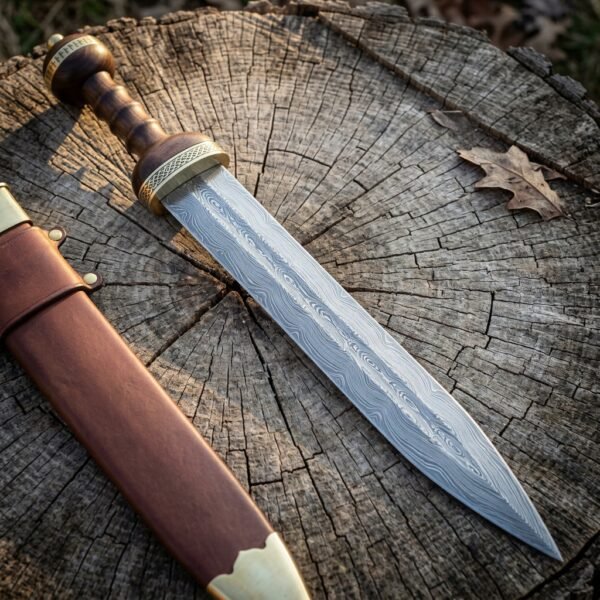
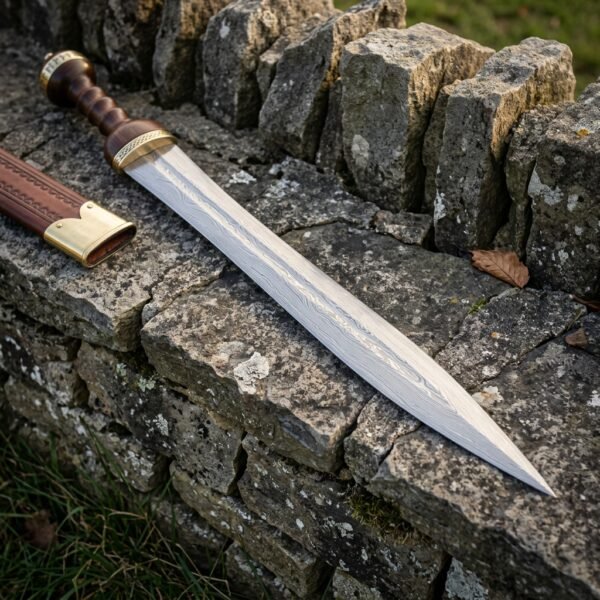
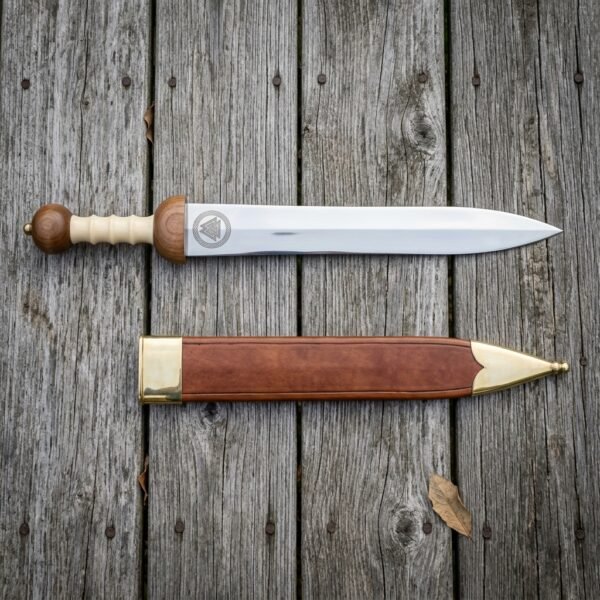
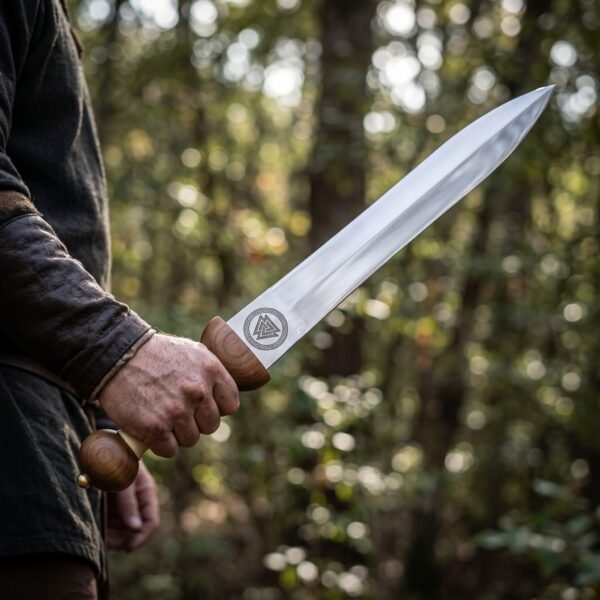
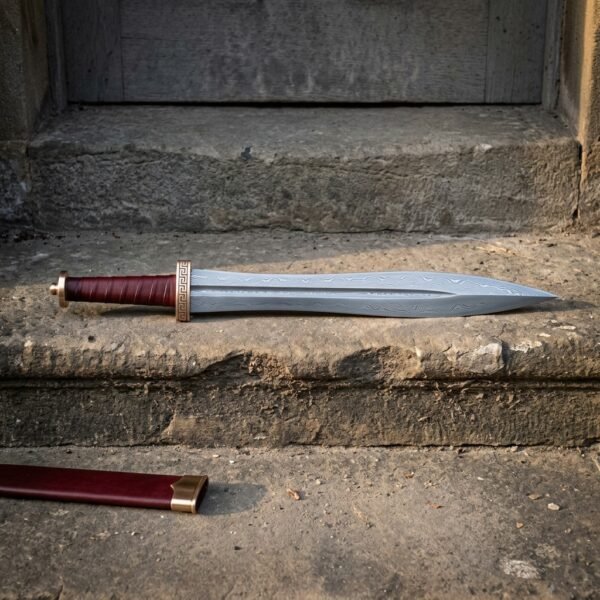
Parallel edged blades at 27 inches overall with 20 inches of edge, two inches across at the guard, running straight until they turn into a short triangular tip. In the hand they feel closer to a heavy long knife than to a sword, which is exactly what a legionary would have said about it. One is 1095 mirror polished with a Valknut roundel etched into the forte, a ribbed bone grip and a walnut guard block. The other is raindrop patterned Damascus with an engraved brass guard plate. Both wear brown leather scabbards with brass throats and chapes.
Bronze fitted and classical pieces
Four swords here use solid bronze rather than brass or steel, and the difference shows. Bronze reads warmer and redder, it is heavier for its size, and it dulls to a soft brown rather than the yellow tarnish brass gets. Two carry a running Greek key meander cut into the metal or etched along the flats. One pairs an oxblood leather ribbed grip with a bronze meander guard and a cap collar over the peened tang. The heaviest piece on the page is in this group at about 2 lb 2 oz, with a bronze locket and chape.
Steel fitted and blackened
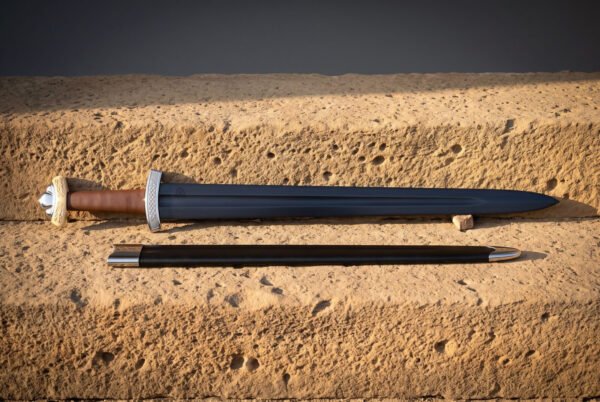
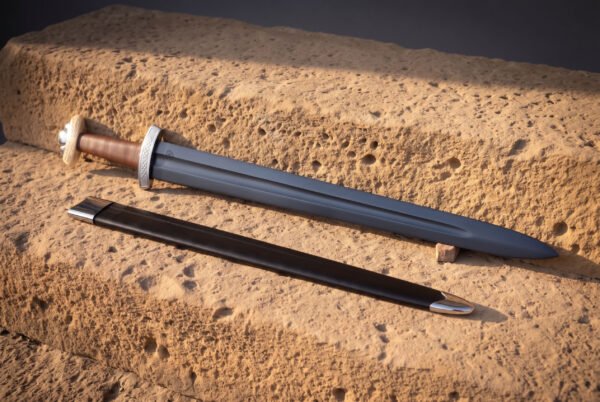
One sword goes the other way entirely. Broad double edge running near parallel with a raised central ridge down the middle, blackened rather than polished, a thick steel guard plate engraved with a plaited knot band, ribbed turned wood in a warm reddish brown for the grip, and a dark leather scabbard with a polished steel throat and tip mount. It is the least Roman looking object here and the most useful one for a display that leans dark.
The pugio
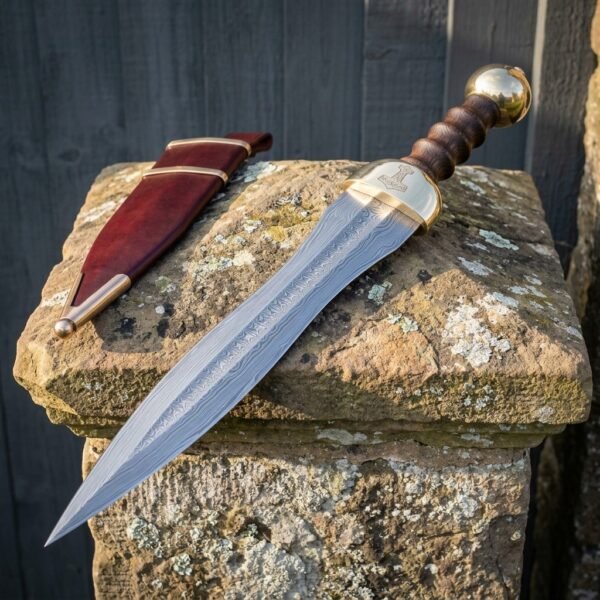
The pugio is the sidearm, 16 inches overall with an 11 inch double edged blade about two and a half inches at its widest. The section is the interesting part. A raised central rib with a sunk fuller either side of it lets a wide short blade stay rigid without being a brick. The grip is about 5 inches of ribbed hardwood between two solid brass collars, capped with a turned brass ball pommel, with a running wolf etched at the blade shoulder. It weighs about 1 lb 6 oz bare and 1 lb 12 oz in its sheath, and the sheath carries a brass throat plate, a brass chape and two suspension rings.
Sizes, steel and fittings across the range
Every number below comes off the specification panel of a piece on this page. These are forged and ground by hand, so treat the figures as what to expect rather than as a promise to the millimetre.
| Blade pattern | Overall length | Blade length | Steel and hardness | Guard and pommel | Grip | Price |
|---|---|---|---|---|---|---|
| Pompeii, parallel edged | 27 in | 20 in | 1095 at 54 to 58 HRC | Walnut block and globular walnut pommel | Ribbed bone | 310 dollars |
| Pompeii, parallel edged | 27 in | 20 in | Damascus at 58 to 60 HRC | Engraved brass plate and walnut pommel | Ribbed walnut | 405 dollars |
| Mainz, waisted leaf | 28 in | 21 in | 1095 at 54 to 58 HRC | Turned wooden block and globular pommel | Ribbed cherry wood | 325 dollars |
| Mainz, waisted leaf | 28 in | 21 in | Damascus at 58 to 60 HRC | Engraved brass collar and rune banded cap | Ribbed walnut | 425 dollars |
| Mainz, waisted leaf | 27 in | 20 in | Damascus at 58 to 60 HRC | Engraved brass plate and spherical brass pommel | Turned ribbed hardwood | 469 dollars |
| Leaf blade, bronze mounted | 26 in | 19 in | Damascus at 58 to 60 HRC | Bronze meander guard and bronze cap collar | Oxblood leather | 549 dollars |
| Double edged, long taper | 27 in | 20 in | Damascus at 58 to 60 HRC | Bronze lower guard and domed bronze pommel | Dark ribbed with bronze ferrule | 649 dollars |
| Waisted leaf, bronze mounted | 27 in | 20 in | 1095 at 54 to 58 HRC | Bronze guard plate and bronze end cap | Burgundy leather | 409 dollars |
| Near parallel, ridged and blackened | Not listed | Not listed | 1095 at 54 to 58 HRC | Engraved steel plate and steel capped pommel | Ribbed turned wood | 349 dollars |
| Pugio dagger, twin fullered | 16 in | 11 in | 1095 at 54 to 58 HRC | Brass guard plate and turned brass ball | Ribbed hardwood, brass collars | 279 dollars |
Only one sword here carries a stated weight, about 2 lb 2 oz with bronze fittings, and bronze is the heaviest option on the page. Where a panel gives no weight, expect somewhere near two pounds for a blade of this length and section.
Sizing, reach and how it hangs
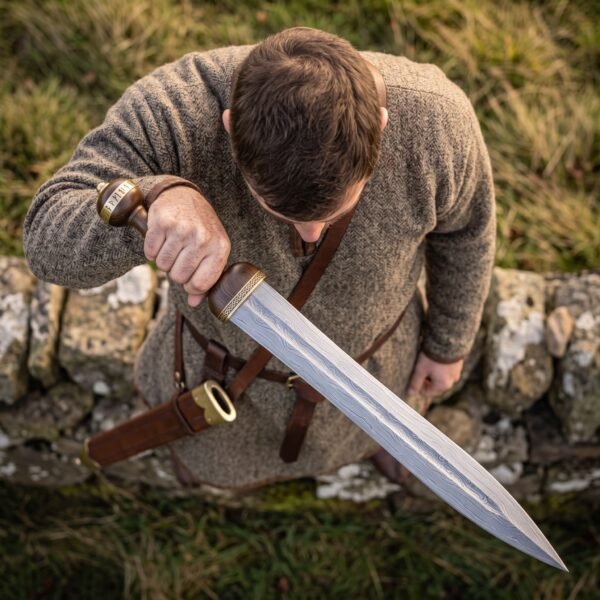
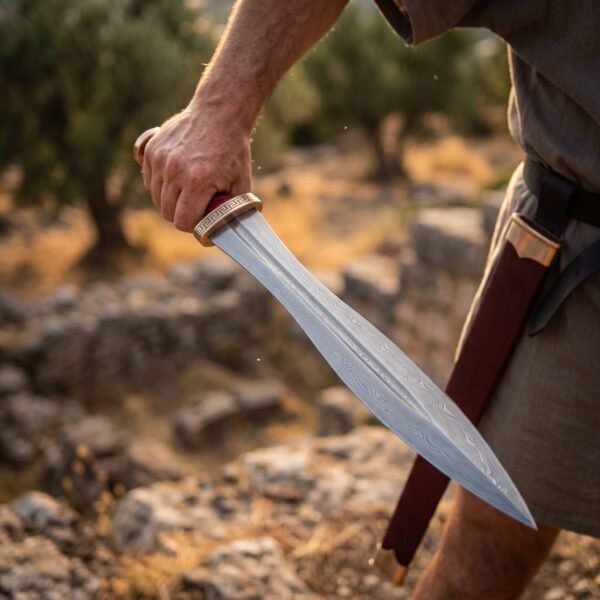
A gladius is not sized to your height. Twenty inches of blade suits a person of five foot four and one of six foot two equally, because the sword is used with a short arm action rather than at full extension. What changes with your build is where it sits on a belt. Roman practice hung it high on the right, almost at the ribs, which sounds awkward until you try to draw a long blade from a low hanger with a shield in your left hand.
Buying for display, measure the shelf before you take a 28 inch piece, because the scabbard adds an inch at the chape and most people forget the stand. Buying to handle, the parallel Pompeii blades are the easier ones to live with. Grips are single hand at roughly four to five inches, so a large hand sits against the pommel rather than free of it. That is normal on a Roman pattern and it is what the globular pommel is shaped for.
Steel and hardness
Two steels run through the whole range. Plain 1095 high carbon is hardened to 54 to 58 HRC. That is deliberately not the hardest 1095 can be taken, because a long thin blade that is too hard chips or cracks instead of flexing. It sharpens quickly and comes back on a stone in a couple of minutes.
Damascus here is 1095 and 15N20 forge welded together, folded, ground and then acid etched so the two steels read as light and dark bands. It is hardened to 58 to 60 HRC, so it holds an edge slightly longer than the plain carbon blades and takes slightly more work to bring back. Patterns here include a raindrop, a flowing pattern, and a wavy and ladder combination. The etch is a surface effect, so hard polishing fades it and light oiling does not.
Neither steel is stainless. Both will rust if you leave them wet, and both will take a grey patina over years that does no harm at all.
Guards, grips and pommels
Roman hilts are built in layers threaded onto the tang, and every piece here is full length tang, peened or nutted over at the top. That matters more on a thrusting sword than on anything else, because a thrust loads the joint between blade and hilt in a straight line.
The guard on a gladius is a block rather than a crossbar. It fills the hand at the front, keeps your fist off the edge and takes the shock coming back up the blade. Here they come in walnut, turned wood, engraved brass plate, solid bronze cut with a meander, and polished steel with a plaited knot band.
Grips are ribbed, always, and the ribs are not decoration. A gladius is held in a hammer grip and the ribs stop the hand sliding forward on a hard thrust. Bone is the hardest material here and takes hand oil over time. Walnut and cherry are warmer and want a wipe of oil once a year. Leather stitched over a shaped core is the softest in the hand and darkens most obviously with use. Pommels are globular or domed because they are counterweights first, and the big spherical brass pommel on one of the Damascus pieces does more for the balance than anything else on that sword.
Scabbards, care and storage
Every sword here ships with a fitted scabbard, most of them leather over a wooden core with metal at the mouth and the tip, the metal matched to the hilt. The wooden core does the work. It holds the shape, keeps the blade off the stitching and takes the wear.
Carbon steel and leather are a bad long term pair. Leather holds moisture and the tanning agents in it are mildly acidic, so a sword left sheathed for a year in a damp room comes out spotted. Wipe the blade dry, put a light film of mineral or camellia oil on it, and if it will sit for months, store it out of the scabbard.
Fingerprints are the usual culprit rather than weather. Skin is salty and a print left on a mirror polished blade etches itself in over a few weeks, so handle the polished pieces with a cloth. Grey patina is stable and can be left alone. Orange spotting lifts with a light abrasive and oil before it pits. Brass darkens over months and comes back with metal polish on a cloth, bronze goes browner and most people prefer it that way, and blackened steel should be left alone because polishing takes the finish off.
Engraving
Most pieces here can be engraved after they arrive in the United States. The obvious places on a gladius are the flat of the blade above the guard, where several of these already carry an etched meander or a knotwork panel, and the guard plate itself. Text engraving is 19 dollars, a symbol is 39 dollars and a family crest is 49 dollars.
Elder Futhark is a phonetic alphabet rather than a code, so a name is transliterated by sound and there is no rune for the letter C. A Latin motto sits better on a Roman sword than runes do, though the rune banded pommel cap on one of the Mainz pieces shows both work. Engraving is permanent and an engraved piece cannot be returned, so send the exact spelling and read it twice.
Where these come from and how they ship
Ransack Viking is a US company based in Chicago, Illinois. The pieces are handmade in the Czech Republic, then imported, inspected and shipped from Chicago. Engraving is done in the US after arrival. Small differences in etch figure, polish and grip colour between two swords of the same name are normal, because two people made them on two different days.
Swords ship boxed with the scabbard. Blades arrive with a working edge rather than a razor edge, which is correct for a thrusting sword.
How to choose
First Roman sword? Take a Pompeii pattern in plain 1095 at 310 dollars. It is the shape the army settled on, it is the easiest to maintain, and nothing about it will annoy you in five years.
Buying for a case or a wall, where the sword gets looked at rather than swung? Go to the bronze mounted Damascus pieces. Etched layers and warm bronze read from across a room in a way polished steel does not.
Buying for somebody who already owns swords? The pugio, because most collections have a sword and almost none have the dagger that went with it.
Related collections
- Short swords, the wider family this pattern belongs to
- Damascus swords in forge welded 1095 and 15N20
- Viking swords, the northern answer to the same problem
- Roman and Greek shields to go with the sword
- Roman and Greek helmets
- Daggers, including double edged thrusting blades
- Sword stands and display fittings
- Scabbards and replacement sheaths
Guides worth reading first
- How to buy your first sword
- Display sword or battle ready: what the difference actually is
- Damascus or high carbon steel: which blade should you buy
- Full tang and partial tang explained
- How to display swords and axes without wrecking them
- Steel and hardness: what HRC numbers mean
Frequently asked questions
What is a gladius used for?
It was the Roman infantry sword, used short and low from behind a shield, mostly for thrusting into the gap beside your own shield rim. Today it is bought for display and for reenactment. The pieces here are made as functional swords rather than cast wall hangers.
What is the difference between a Mainz and a Pompeii gladius?
The Mainz blade is waisted, pinching in at the middle before flaring out to a long slender point. The Pompeii has parallel edges and a short triangular tip. Mainz is older and cuts a little better. Pompeii is later, simpler to make and quicker to sharpen back to true.
How long is a gladius?
The swords here run 26 to 28 inches overall with 19 to 21 inches of blade. That is short for a sword and long for a knife, which is exactly where the Romans wanted it.
Are these swords sharp when they arrive?
They arrive with a working edge, ground and finished by hand. They are not razors, because a very thin edge on a thrusting blade rolls the first time it meets anything hard. A few passes on a stone take any of them further.
Which should I buy, 1095 or Damascus?
Take 1095 for the plainer, more historically honest object and an edge that comes back fast on a stone. Take Damascus for the pattern and slightly longer edge retention. Neither is stainless and both want a wipe of oil.
What is a pugio?
The dagger a Roman soldier wore opposite his sword. The one here is 16 inches overall with an 11 inch double edged blade, a raised central rib with a fuller either side, and a brass mounted leather sheath.
Can a gladius be engraved?
Yes, after it arrives in the United States. The flat above the guard is the usual place. Text is 19 dollars, a symbol is 39 dollars and a family crest is 49 dollars. Engraved pieces cannot be returned.
Where are these made?
Ransack Viking is a US company based in Chicago, Illinois. The pieces are handmade in the Czech Republic, then imported, inspected and shipped from Chicago, with engraving added in the US after arrival.