Exactly one helmet has been recovered from a Viking Age grave in Scandinavia, the iron cap from Gjermundbu in Norway, and it has a rounded skull, a brow band and a spectacle guard over the eyes. No horns. Everything else we think we know comes from a handful of contemporary carvings, from earlier Vendel period finds in Sweden, and from a nineteenth century opera costume designer who had a lot to answer for.
The helmets on this page follow those sources. Spectacle helmets with forged eye guards, spangenhelms built from panels riveted to a brow band and a ridge, conical and rounded nasal helmets, one Sutton Hoo style full face mask and one visored medieval helm. Two horned helmets sit here as well, sold honestly as costume rather than history. Most are 18 gauge mild steel at about 1.2 mm, with several in heavier 16 gauge and one at 2 mm. Listed weights run about 3 lb 6 oz to 6 lb and standard builds fit a 22 to 24 inch head over a liner.
Measure your head over whatever padding you plan to wear before you order. If the helmet is going to an event rather than a shelf, the renaissance faire and reenactment kit guide covers what else you need to bring with it.
Free US shipping
On most pieces. Heavier and oversized ones carry a flat charge.
Hand Forged
Heated, hammered and ground by hand.
Engraving available
Names, dates or Norse runes on most pieces.
Ships from New York
Inspected and dispatched from our New York warehouse. No import duty, no customs delay on US orders.
Viking Helmet
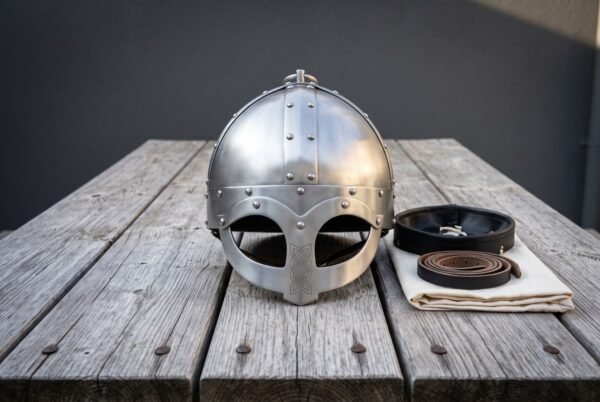

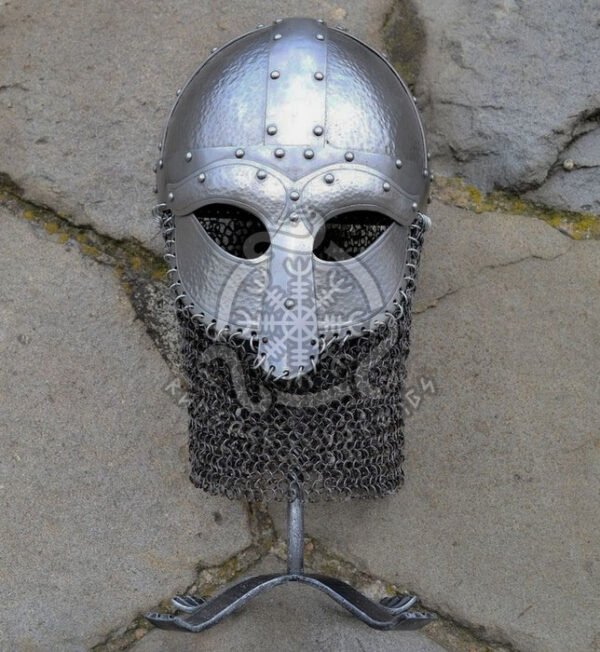
Ironcrown Handcrafted Viking Helmet | Medieval Norse Armour for Reenactment Cosplay and Wall Display | RK-628
Price range: $390.00 through $450.00What a Viking helmet actually looked like
Start with the evidence, because there is not much of it. One near complete helmet has been found in a Viking Age grave in Scandinavia, at Gjermundbu in Norway, dated to around the tenth century. It has a rounded skull built from panels riveted to a brow band and two crossing bands, a short spike at the crown and a forged spectacle guard covering the eyes and the bridge of the nose. Fragments have turned up elsewhere. That is close to the whole archaeological record for helmets of the period.
Behind it sits the Vendel material from Sweden, a couple of centuries earlier and considerably richer. Those helmets have crested skulls, applied decorated panels, mask like face pieces and brass fittings, and they are the ancestors of the Sutton Hoo helmet from Suffolk. When people picture an ornate Norse helmet, what they are usually picturing is Vendel or Anglo Saxon rather than Viking.
What was not there was horns. No horned helmet has ever been found in a Viking Age context. The image comes from nineteenth century romantic painting and from Carl Emil Doepler, who designed horned helmets for the first Bayreuth production of the Ring cycle in 1876. It stuck, and it has been on cereal boxes ever since. There are two horned helmets on this page and they are sold for what they are, which is costume.
The helmets in this collection
Fourteen helmets sit on this page. They divide by what they cover: the skull only, the skull and the nose, the skull and the eyes, or the whole face.
Spectacle helmets
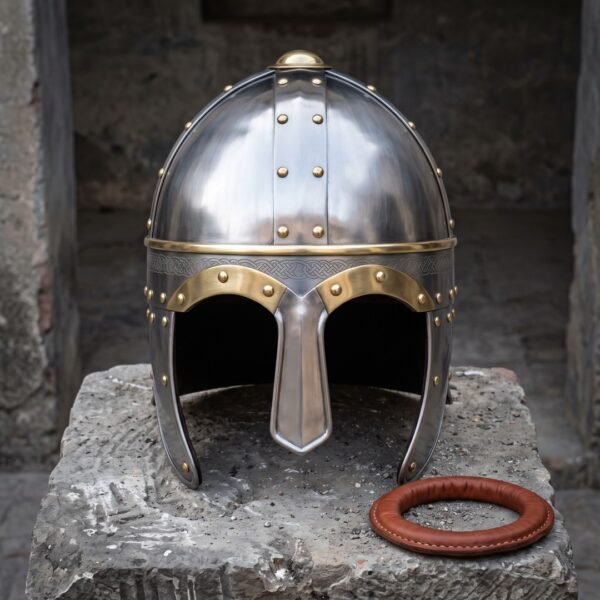
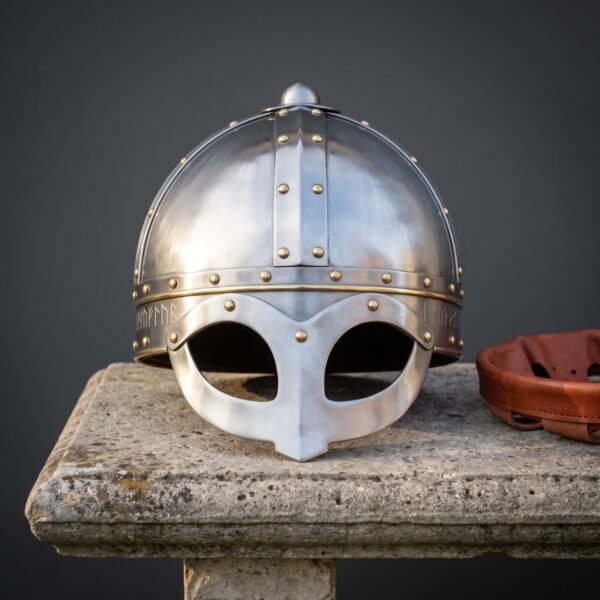
Three pieces, all following the Gjermundbu arrangement of a forged eye guard riveted across the brow. One is a four panel skull with a brow band and spangen strips, polished, with a padded removable leather liner and a chin strap, at about 4 lb. One carries brass spectacle arches, a brass finial at the apex and a knotwork line cut into the brass brow band. The third is a four panel riveted skull on a banded frame with a one piece spectacle face guard, a brass brow band trim, an Elder Futhark rune line and a raised crown finial, at 4 to 5 lb.
Spangenhelms and caps
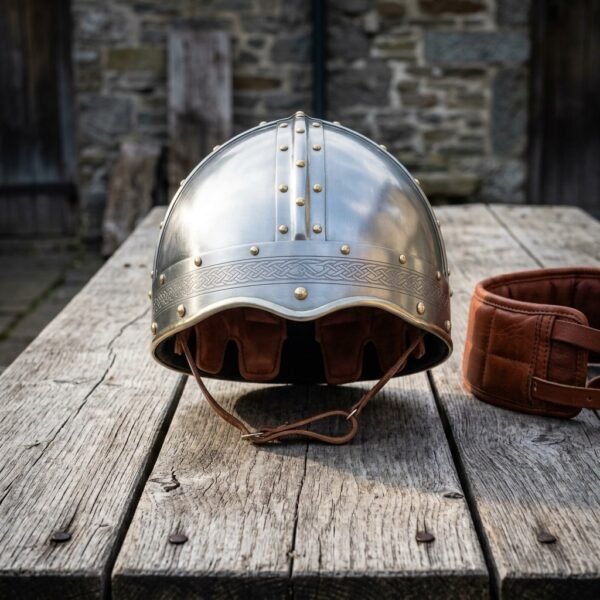
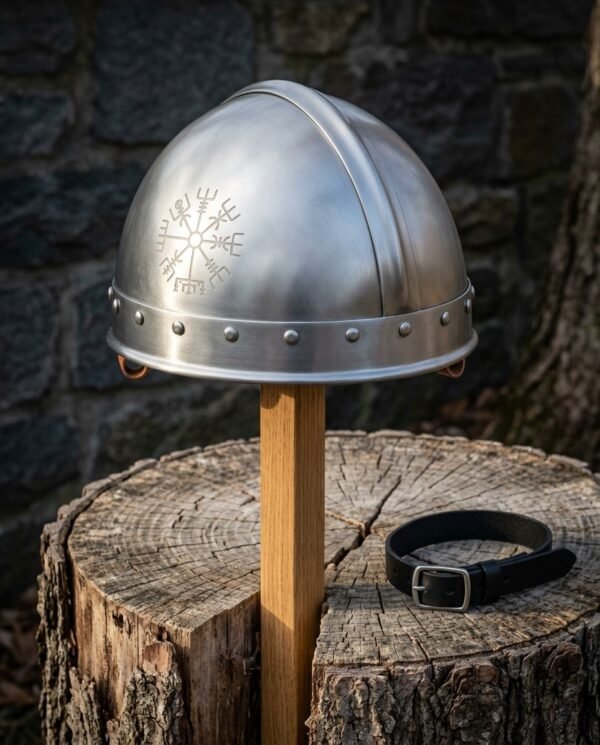
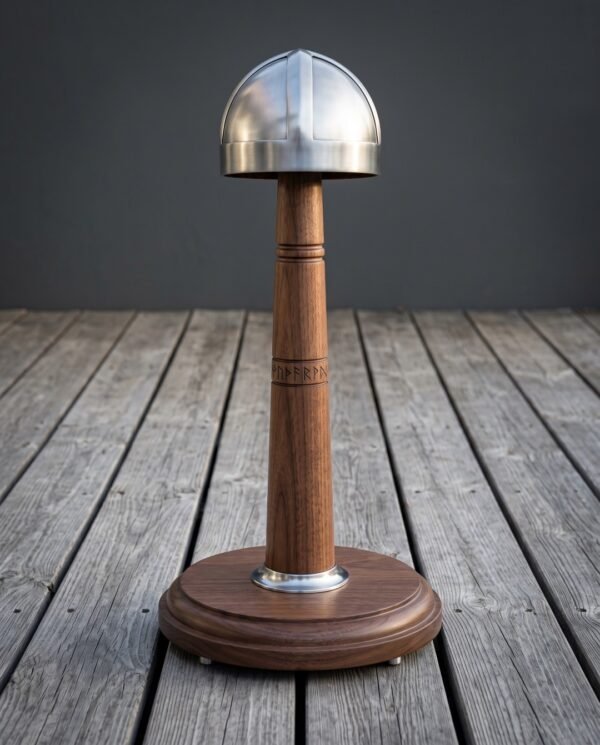
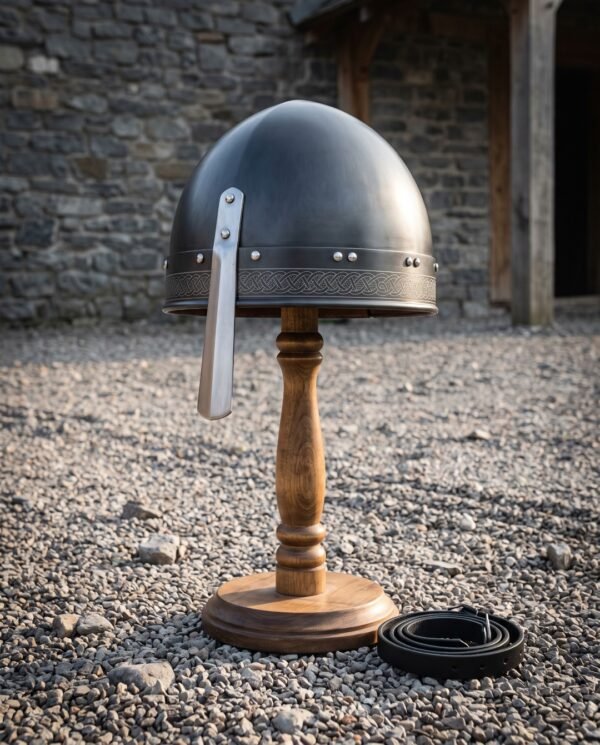
Three riveted panel helmets in 16 gauge. One has a solid brass browband with an engraved knotwork border and a scalloped brown suede liner. One uses shaped panels joined on a raised central ridge with a Vegvisir cut into the left front quarter and a leather suspension liner. The third is a four panel dome with raised joining ribs rising to a point, supplied unlined so you can fit your own liner, and it comes with a turned American walnut display stand carved with an Elder Futhark band.
Nasal helmets
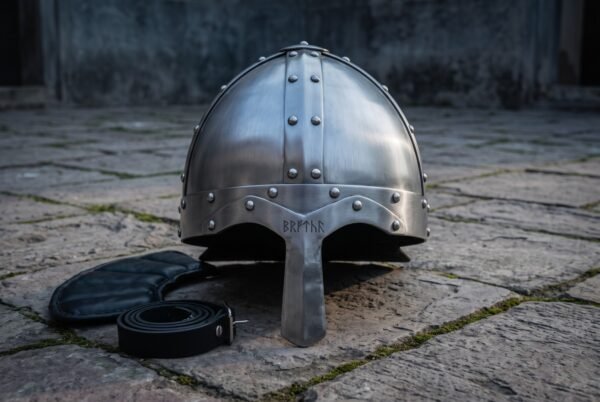
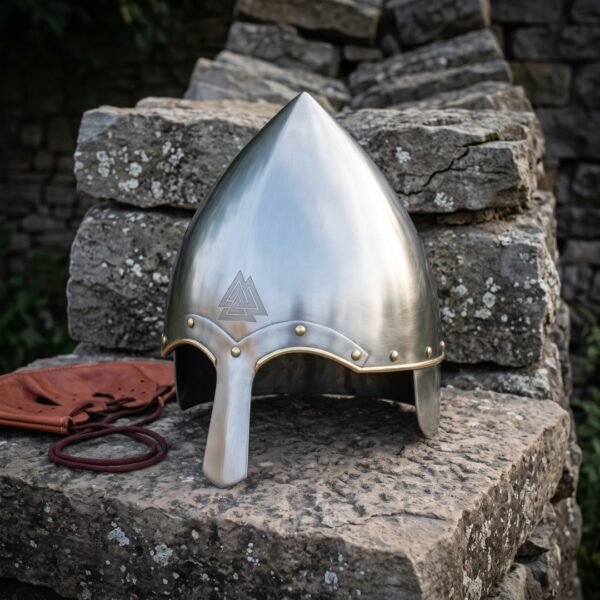
Three pieces where a steel bar drops from the brow band over the nose. One has a riveted panel dome on a full circumference brow band with a short rune line cut above the nasal, a padded black leather liner and a roller buckle strap. One has a conical skull with a brass browband, brass rivets and a Valknut cut into the brow, at 4 to 5 lb with the liner. One has a rounded skull raised from a single sheet with a running knotwork browband, darkened against satin steel.
Full face and visored
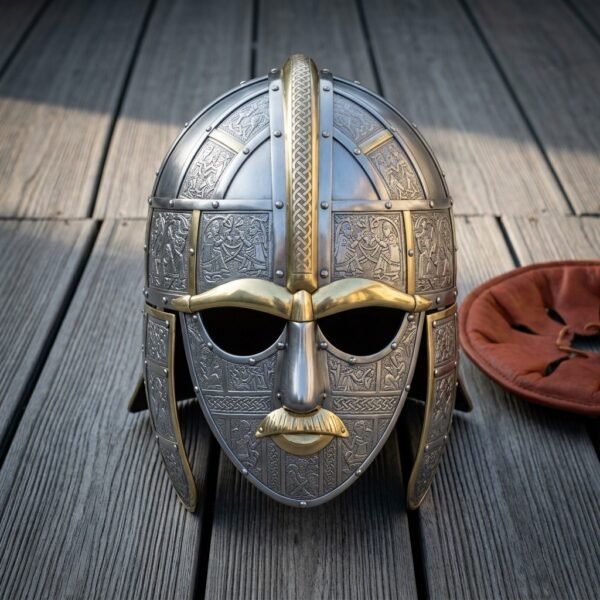
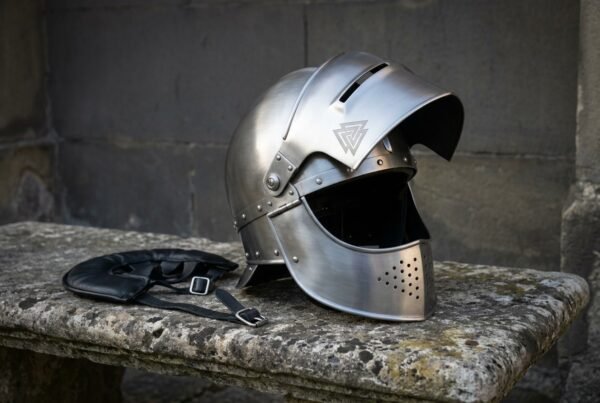
Two pieces that close the face. The Sutton Hoo style helmet has a banded cap riveted to a raised bowl, applied embossed panels, hinged cheek guards and a fixed full face mask, with brass crest ridge, eyebrows, nose and moustache, at 5 to 6 lb. The visored helm has a dished skull, a hinged brow plate, a riser bevor with a horizontal vision slit and a drilled breath field, and a Valknut cut above the slit.
Horned helmets, sold as costume
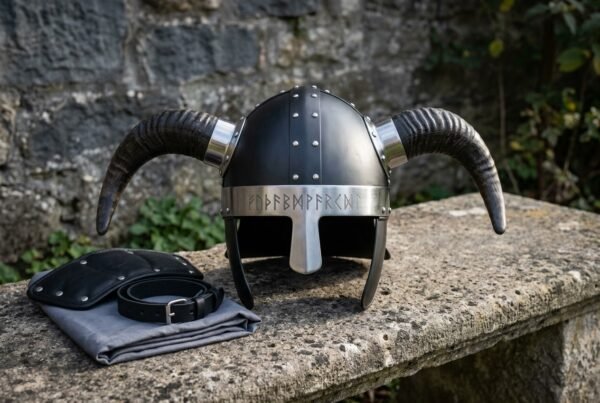
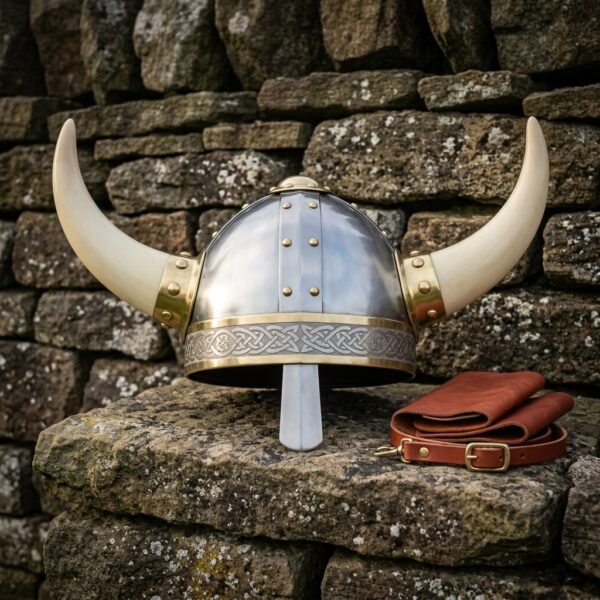
Two of them. One is a blackened bowl with a riveted nasal, a bright brow band with a cut rune line and natural buffalo horns on threaded mounts, which come off, taking the weight from about 4 lb 8 oz down to about 3 lb 6 oz. The other is a riveted dome with solid brass rivets, an apex boss, an engraved knotwork browband and natural horns mounted in brass sockets at the temples, at about 5 lb. Historically wrong and honestly the best thing on the page for a photograph.
Gauge, weight and fit across the range
Every figure below comes from the specification panel of a helmet on this page. These are raised, riveted and finished by hand, so treat head sizes as build targets rather than exact numbers.
| Type | Gauge | Listed weight | Head fit | Liner and strap | Decoration |
|---|---|---|---|---|---|
| Spectacle helmet, four panel | 18 gauge, about 1.2 mm | About 4 lb | 22 to 24 in | Padded leather, removable, chin strap | Polished steel, spangen strips |
| Spectacle helmet, brass arches | 18 gauge | Not listed | Stated circumference | Padded leather ring, removable | Knotwork on brass, apex finial |
| Spectacle helmet, banded frame | 18 gauge, about 1.2 mm | 4 to 5 lb | 22 to 24 in over the liner | Brown leather, adjustable strap | Elder Futhark on the brow band |
| Spangenhelm, brass browband | 16 gauge | About 4 lb | 22 to 24 in | Scalloped suede, chin strap | Engraved knotwork border |
| Spangenhelm, ridged panels | 16 gauge | Not listed | Standard adult | Leather suspension, chin strap | Vegvisir on the left front quarter |
| Spangenhelm cap with stand | 16 gauge | Not listed | Stated circumference | Supplied unlined | Runed walnut display stand |
| Nasal helmet, riveted panels | 18 gauge | Not listed | Stated circumference | Padded black leather, roller buckle | Elder Futhark above the nasal |
| Conical nasal helmet | 18 gauge, about 1.2 mm | 4 to 5 lb | 22 to 24 in over the liner | Brown leather with a drawcord | Valknut cut into the brow |
| Rounded nasal helmet | 18 gauge, about 1.2 mm | 4 to 5 lb | 22 to 24 in over the liner | Leather liner, black chin strap | Running knotwork browband |
| Full face mask helmet | 18 gauge, about 1.2 mm | 5 to 6 lb | 22 to 24 in | None fitted, wear over a cap | Brass crest, brows, embossed panels |
| Visored helmet with bevor | 18 gauge | Not listed | Stated circumference | Padded black leather, roller buckle | Valknut above the vision slit |
| Horned helmet, blackened bowl | 18 gauge, about 1.2 mm | 4 lb 8 oz, 3 lb 6 oz bare | About 22 to 23 in | Padded suspension on a cord | Rune line, buffalo horns |
| Horned helmet, brass fittings | 18 gauge | About 5 lb | 22 to 24 in | Unlined, wear over a padded cap | Knotwork browband, apex boss |
| Formed steel helmet shell | 2 mm shell | Not listed | Stated on request | Not listed | Engraving available on request |
Gauge numbers run backwards and it catches people out every time. A higher number is a thinner sheet. The 18 gauge helmets here are about 1.2 mm, the 16 gauge ones are thicker, and the single 2 mm shell is the heaviest steel on the page.
How a helmet is put together
There are two ways to make a helmet skull and both are represented here. Raising means taking one sheet and hammering it into a dome over a stake, thinning and stretching as you go. It gives a skull with no seam and no weak line, and it is slow work. Two helmets here are raised from a single sheet.
The other way is riveting. Cut four or six panels, join them to a brow band and to crossing or ridge bands, and rivet the lot together. That is the spangenhelm principle and it is what the Gjermundbu helmet does. It is faster, it is easier to size, and the bands themselves add stiffness where the panels meet. Most of this page is built that way, with domed rivets in rows along the seams.
The brow band carries the fit. It is the full circumference ring that everything else hangs from, and it is where the liner rivets or loops attach. If a helmet fits badly, the brow band is almost always the reason.
Liners, caps and why the helmet must not touch your head
A helmet that sits directly on the skull is useless and uncomfortable. There has to be a gap, and something has to hold it. Suspension liners do that with a leather cradle on an adjustable cord, which is light and lets air move. Padded liners do it with foam or wool inside leather, which is more comfortable to wear for a long day and warmer.
Several helmets here arrive lined. Some are supplied unlined on purpose, so you can fit a liner to your own head or wear an arming cap under them. A padded arming cap is worth having either way, because it takes up the last of the play, it absorbs sweat before the leather does, and it lets you use one cap across several helmets.
Chin straps stop the helmet lifting or rotating. Most here have one on a roller buckle. Some do not, including one of the horned helmets, which ships without a strap as standard.
Getting the size right
Measure the circumference of your head with a tape, level, just above the ears and around the widest part of the back of the skull. Then measure it again over the arming cap or padded liner you intend to wear, because that is the number that matters. Two inches of difference between those figures is normal.
Standard builds on this page fit roughly 22 to 24 inches. Several are made to a stated head circumference rather than sold as a standard size, so give the measurement in inches when you order. Too tight cannot be fixed. Too loose can be padded out with a thicker cap, but a helmet that swings independently of your head is not a helmet you want to wear.
Steel, finish and what it costs to keep
All of these are mild steel, which is right for a helmet. It forms cleanly, takes a riveted seam without cracking, and deforms rather than shattering. Finishes here run to polished bright, brushed satin, blackened, and steel set against solid brass browbands, rivets, arches and finials.
Brass and steel together is the traditional Norse combination and it is the most work to maintain, because brass darkens on a completely different schedule to steel. A metal polish on a cloth brings brass back. Leave it and it dulls to a warm brown, which many people prefer.
Bright polish shows every fingerprint. Satin hides handling. Blackened oxide is the most stable finish and the easiest to live with if the helmet is going to a muddy field rather than a shelf.
Care, sweat and storage
Sweat is the real enemy, not rain. It is salty and it sits inside the bowl where you cannot see it, so wipe the inside of a helmet out after every wear and let it dry with the liner loosened or removed. Then put a light film of oil or a coat of hard wax on the steel, inside and out.
Store a helmet upright on a stand or a form rather than face down on a shelf, so the rim stays true and the liner keeps its shape. Do not seal it in a plastic box, which traps condensation. Leather liners and straps want conditioning once or twice a year, and the strap holes are where a strap tears first.
Every helmet on this page is described by the maker as display, costume, film, photography and light reenactment weight. None is rated for full contact combat, and 18 gauge mild steel is not the specification a heavy fighting league will accept.
Engraving and gifting
Most helmets here already carry cut work: Elder Futhark rune lines across brow bands, running knotwork borders, a Vegvisir stave on a spangenhelm quarter and a Valknut on two brows. Further engraving can be added after the helmet arrives in the United States. Text engraving is 19 dollars, a symbol is 39 dollars and a family crest is 49 dollars.
Elder Futhark is a phonetic alphabet rather than a cipher, so a name is transliterated by sound, and there is no rune for the letter C. Engraving is permanent and an engraved piece cannot be returned.
Where these come from and how they ship
Ransack Viking is a US company based in North Babylon, New York. The pieces are handmade in the Czech Republic, then imported, inspected and shipped from New York. Engraving is done in the US after arrival. Helmets ship padded, with liners fitted where the listing says so.
Because every skull is raised or riveted by hand, no two are identical. Hammer texture, rivet spacing and the exact tone of a blackened or brass finish vary a little between one and the next.
How to choose
If you want the historically defensible answer, take a spectacle helmet or a plain riveted spangenhelm. Those are the two forms with actual evidence behind them, and either will pass at a living history event without an argument.
If the helmet is going on a shelf, the Sutton Hoo style mask and the spangenhelm cap with its runed walnut stand are the two that hold a room. If it is for a costume, a photograph or a party, buy a horned one and enjoy it, because nobody at the party is checking the archaeology.
Browse related categories
- Medieval helmets, great helms and visored patterns
- Roman and Greek helmets
- Chainmail shirts and coifs to wear under a helmet
- Plate armour, cuirasses and full harnesses
- Viking shields and round shields
- The full Viking armour range
Guides worth reading first
- Buying a Viking helmet: sizing, gauge and liners
- The horned helmet myth and where it came from
- What Viking helmets actually looked like
- Viking armour explained
- Renaissance faire and reenactment kit, what to actually bring
Frequently asked questions
Did Vikings wear horned helmets?
No. Not one horned helmet has been found in a Viking Age context. The image comes from nineteenth century romantic art and from the costume designer for the first Bayreuth Ring cycle in 1876. The two horned helmets on this page are sold as costume and the listings say so.
What did a real Viking helmet look like?
Like the Gjermundbu helmet from Norway, the only near complete example ever found. A rounded skull built from panels riveted to a brow band and crossing bands, a small spike at the crown and a forged spectacle guard over the eyes and nose.
What size do I need?
Measure your head circumference with a tape just above the ears, then measure again over the arming cap or liner you plan to wear. Order to the second number. Standard builds here fit roughly 22 to 24 inches, and several are made to a stated measurement in inches.
What does 18 gauge mean?
It is sheet thickness, and the numbers run backwards, so higher means thinner. The 18 gauge helmets here are about 1.2 mm, the 16 gauge ones are thicker and heavier, and one shell is 2 mm. Thicker steel means more protection and more weight on your neck.
Do they come with a liner?
Most do, either a padded leather liner or a suspension cradle on an adjustable cord. A few are supplied unlined on purpose so you can fit your own or wear an arming cap. Check the listing, and buy a padded cap either way.
Can I fight in one of these?
Not in a full contact league. Every listing on this page describes the helmet as display, costume, film, photography and light reenactment weight, and none is rated for full contact combat. Heavy fighting groups have their own specifications and they are stricter than this.
How do I stop it rusting?
Wipe the inside out after every wear, because sweat pits steel from the inside where you cannot see it. Dry it, then oil or wax the steel. Store it upright on a stand and never sealed in plastic. Brass fittings darken on their own and polish back with a cloth.
Where are these helmets made?
They are handmade in the Czech Republic, then imported, inspected and shipped by Ransack Viking from North Babylon, New York. Engraving is added in the United States after arrival.