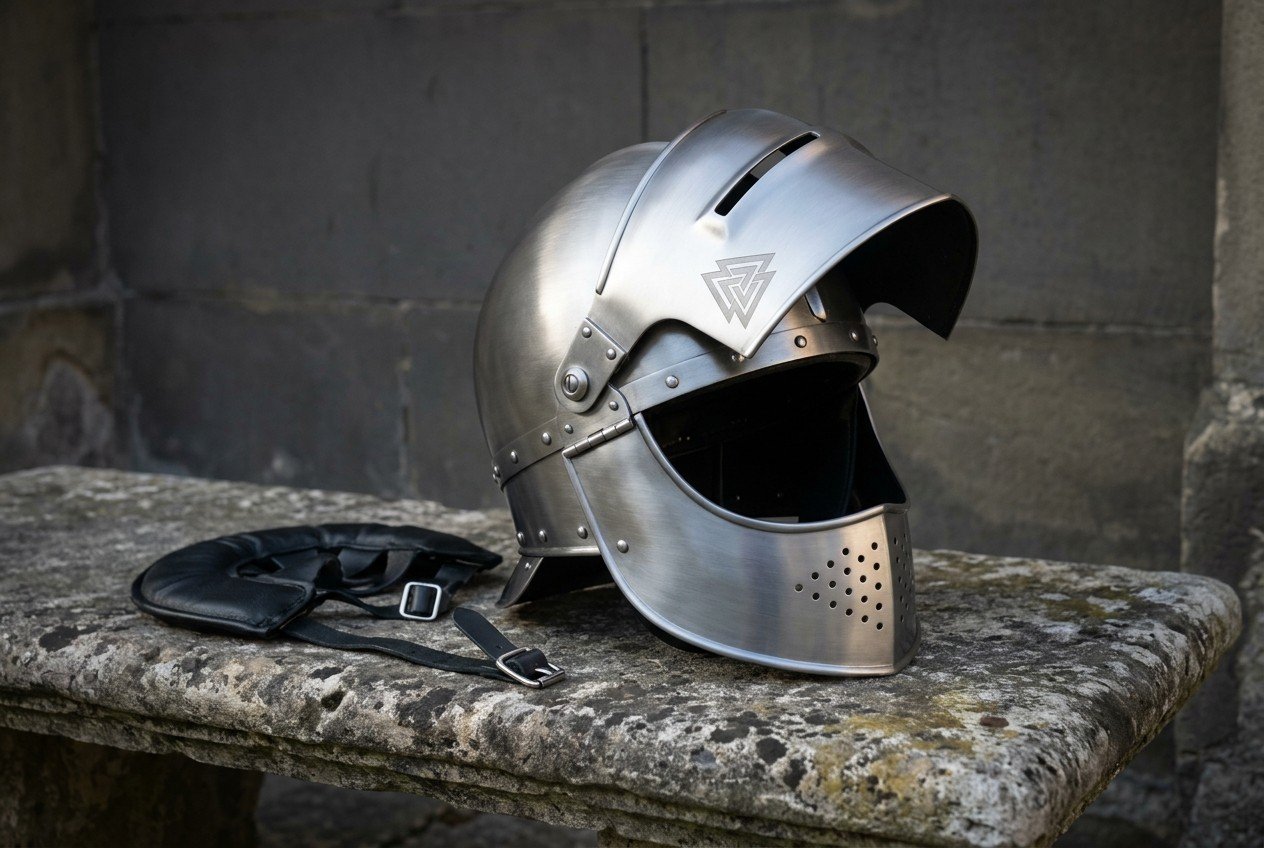
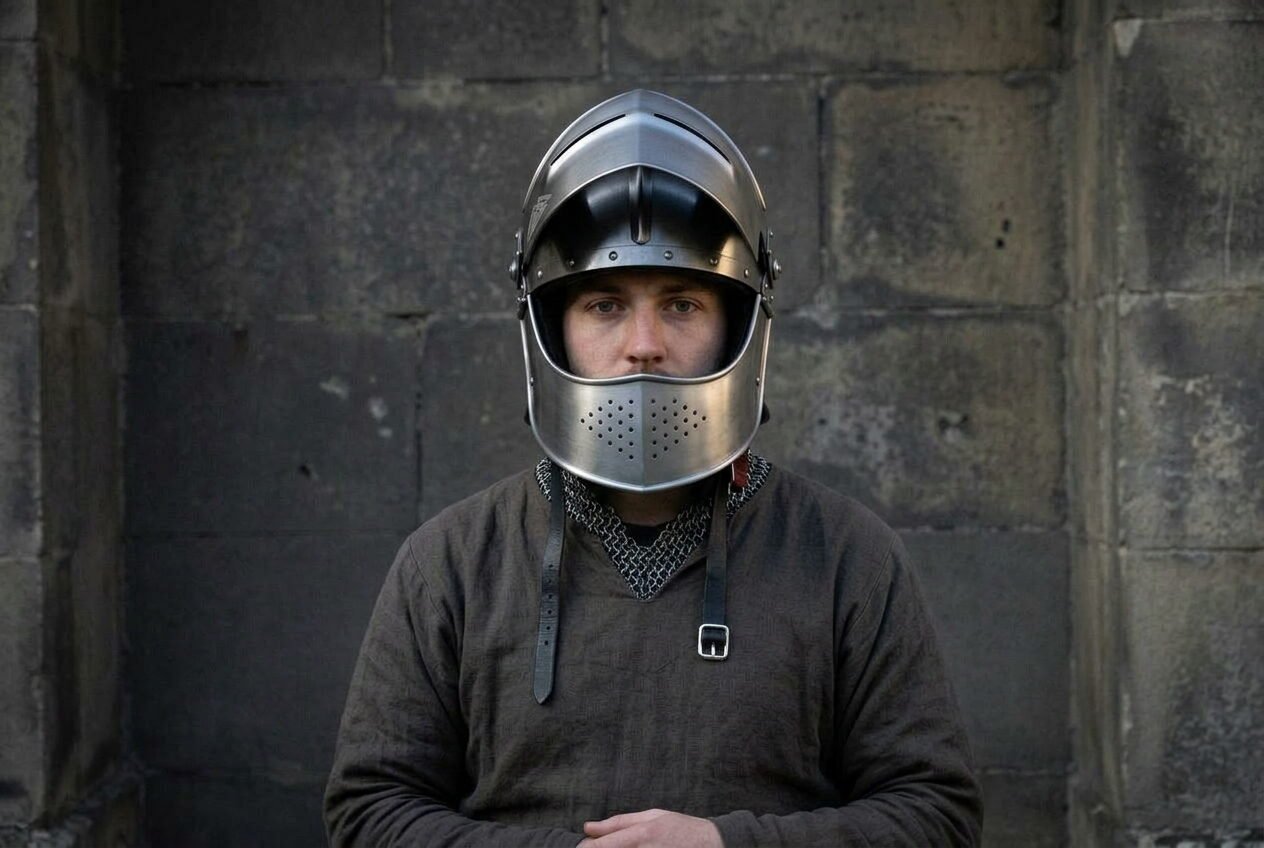
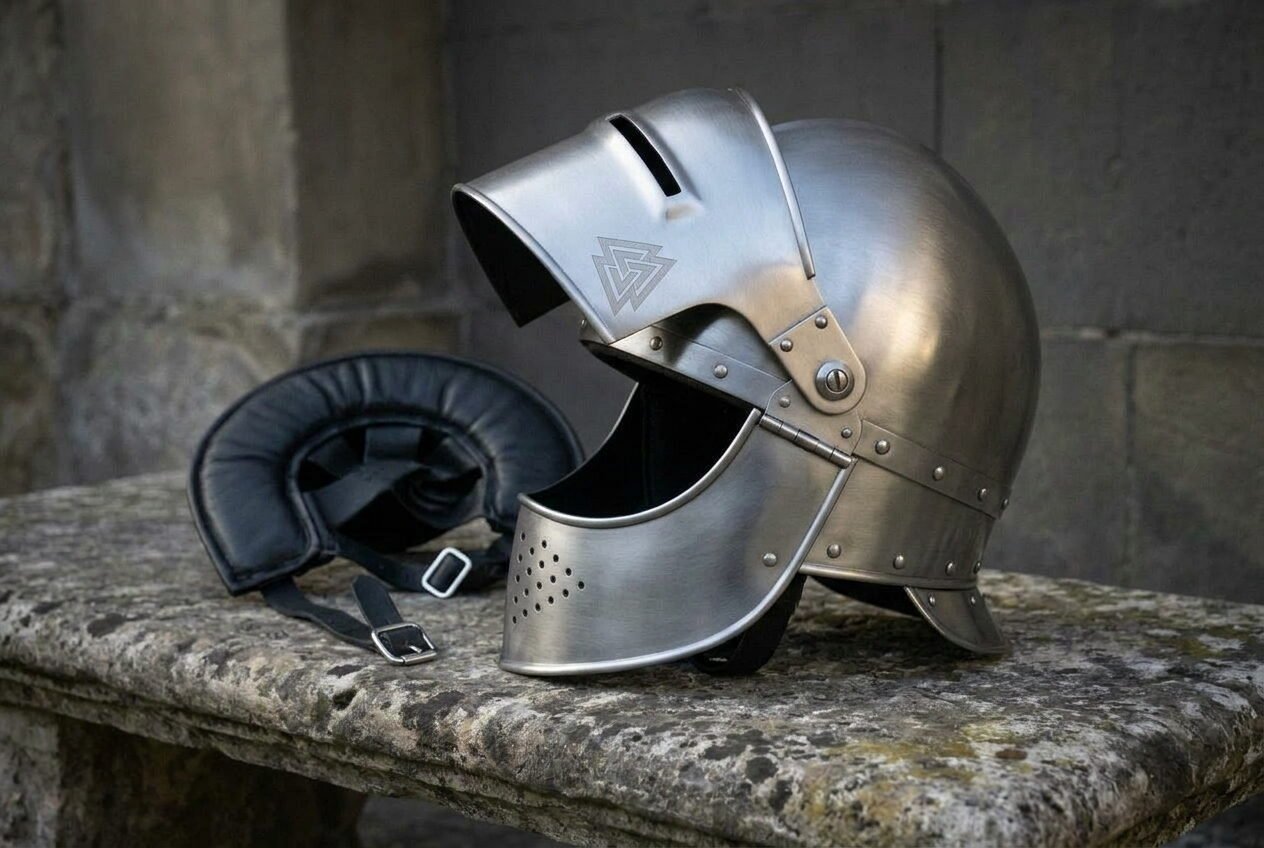
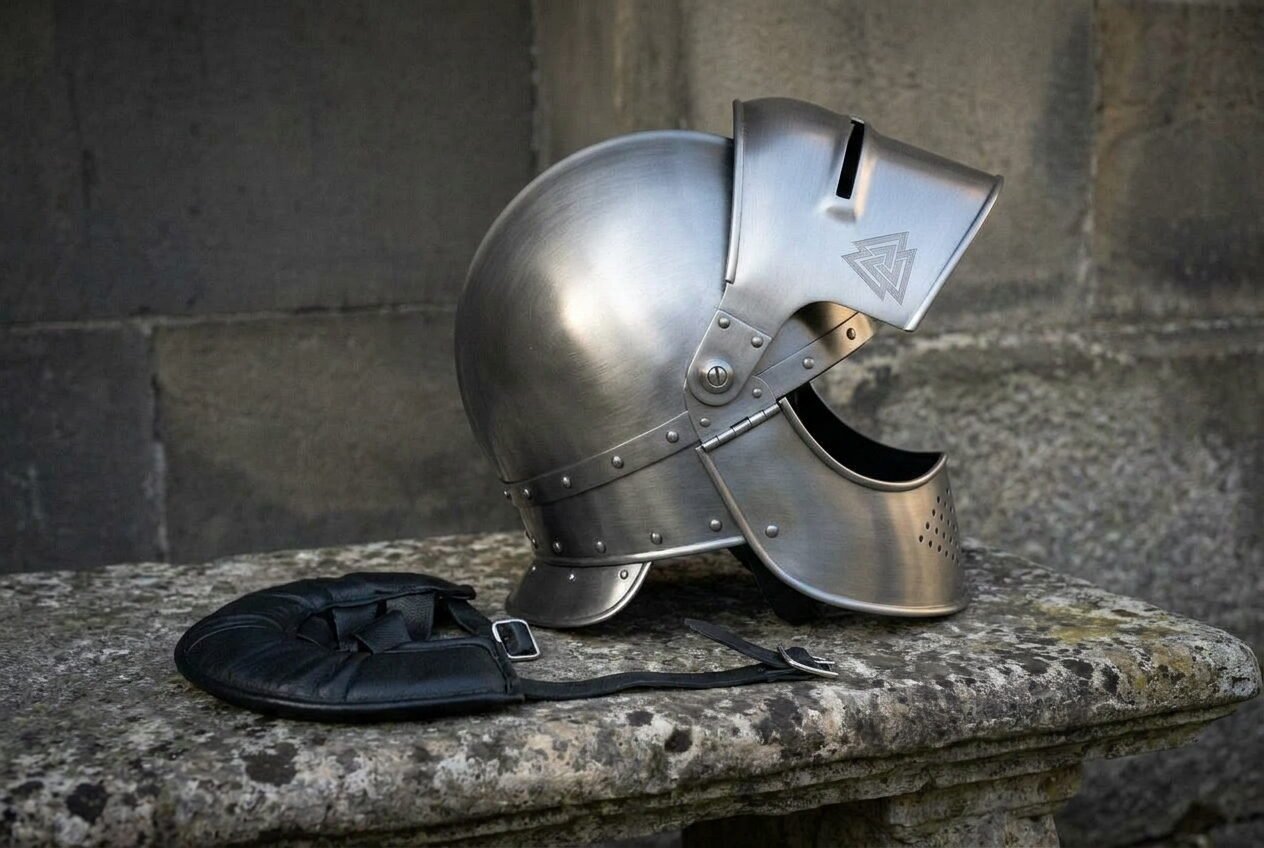
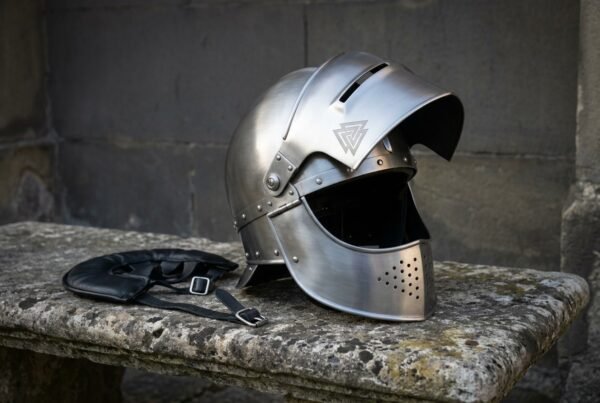
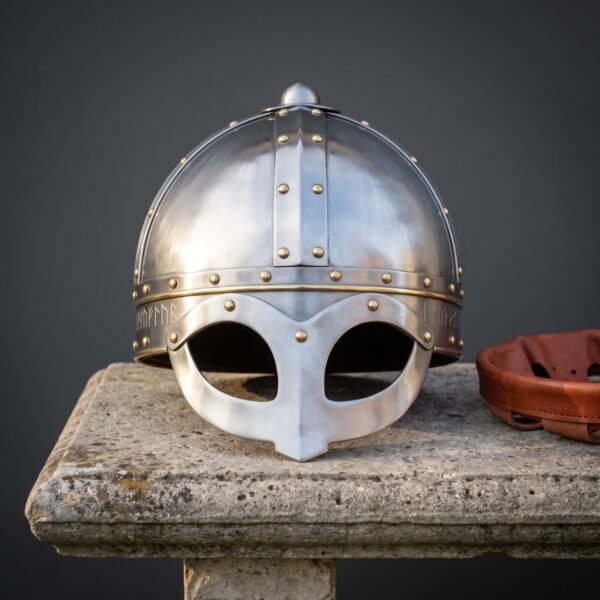
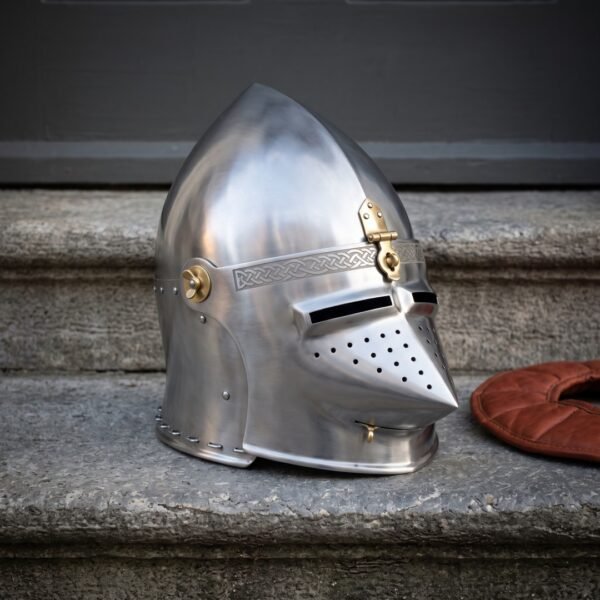
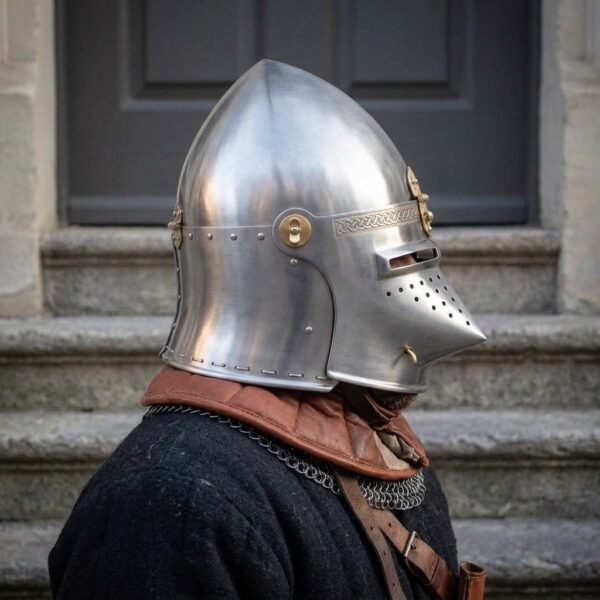
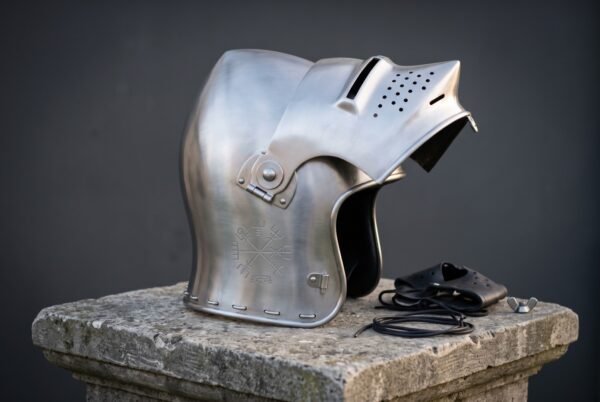
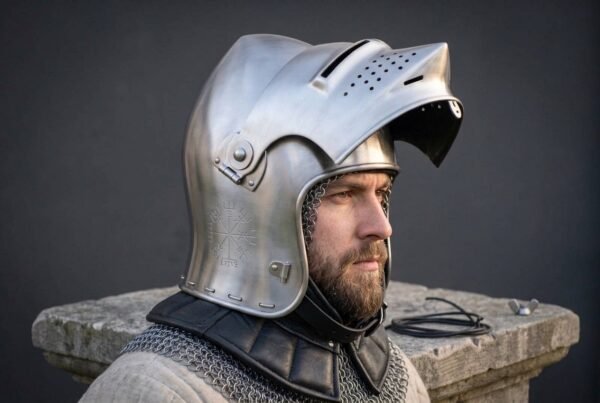
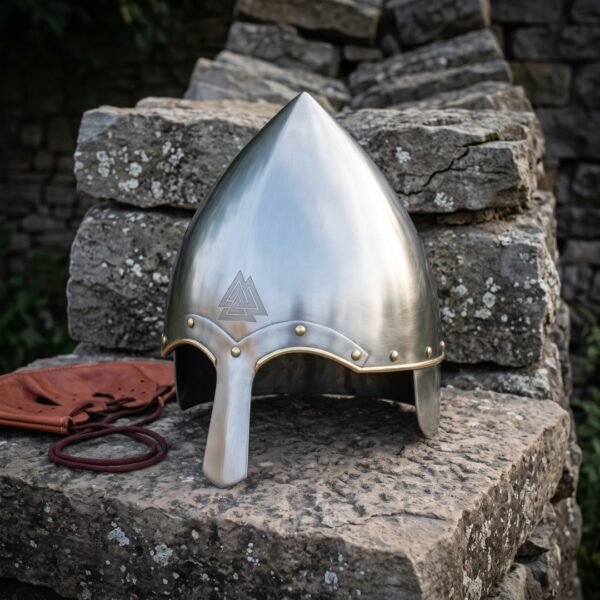
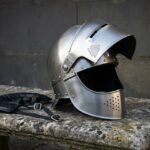
Ironvisor is a visored helm built on the logic of the late medieval close helm, with a brushed steel skull, a hinged brow plate carrying a single vision slit, a swept side wing that shields the temple, and a bevor rising from the chin with a field of drilled breath holes across it. The valknut is cut into the brow plate below the slit. It is worth saying up front that this is a design in the spirit of the period rather than a museum reproduction of a dated original. The proportions are drawn to suit a modern head and a camera, and the visor line is cleaner and more graphic than any surviving fifteenth century helm.
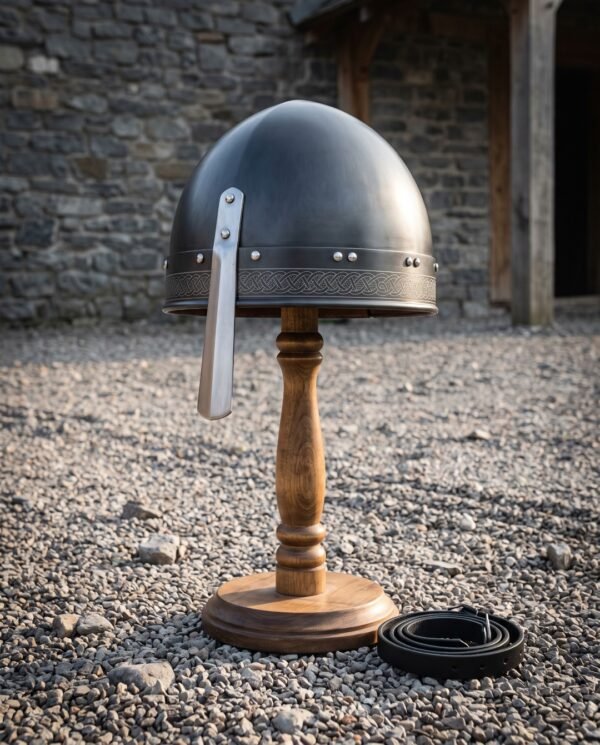
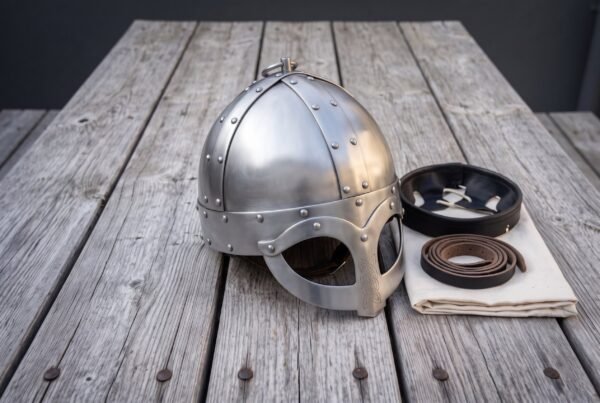
The one honest thing to know about any visored helm is how little you see out of it. A vision slit of this width gives you roughly the field a horse rider needs and almost nothing below your own hands, which is exactly why fifteenth century men at arms lifted the visor the moment the charge was over. Every Ironvisor is raised, dished, trimmed and riveted by hand in the Czech Republic. It ships with the padded leather liner and the buckled chin strap shown alongside it in the photograph, ready to fit. Free shipping inside the United States, one to two weeks processing, seven day returns, and a genuine lifetime warranty against defects in the forging, the grind, the heat treat and the fittings, with no end date and no receipt needed. Fit, steel gauge and the shapes worth avoiding are covered in our notes on buying a helmet.
Specifications
| Material | Mild steel, brushed satin finish |
|---|
| Gauge | 18 gauge mild steel throughout the skull and face plates |
|---|
| Construction | Rounded skull with a riveted brow band, hinged visor and riser bevor |
|---|
| Visor | Pivots on riveted bosses at the temples, single horizontal vision slit across the top |
|---|
| Bevor | Rises from the chin, hinged at the side, with a drilled breath field |
|---|
| Engraving | Valknut cut into the visor below the slit |
|---|
| Lining | Padded black leather liner, removable |
|---|
| Fittings | Domed steel rivets, black leather chin strap with a roller buckle |
|---|
| Size and fit | Made to a stated head circumference in inches |
|---|
| Intended use | Display, costume, film and light reenactment, not full contact steel |
|---|
| SKU | RK-1451 |
|---|
What 18 gauge actually means for a helmet
Gauge is a thickness number that runs backwards. A lower number is thicker steel. Eighteen gauge is a shade over a millimetre, which is the standard weight for display and light reenactment armour across the trade, and it is what this helm is made from. It holds its shape, it takes a knock, it photographs beautifully and it sits on a head all day without wearing your neck out.
What it will not do is stand up to full contact steel fighting. Groups that run heavy combat generally want 14 or 16 gauge on a helmet, with a thicker skull still, because a hard blow on 18 gauge will dent and a dent in a helmet is a dent in the space where your head is. So be honest with yourself about the event you are buying for. If you are dressing a display, running a photo shoot, walking a living history line or doing choreographed light work, Ironvisor is the right helm and it is a pleasure to wear. If your league weighs helmets at the gate, buy a heavy combat helm from a maker who will certify it for that use. This one is not certified armour and we are not going to pretend otherwise.
The steel, the finish and the fittings
The helm is mild steel. That is the correct material for armour and it is not the same thing as blade steel. Mild steel is soft enough to be raised and dished over a stake without cracking, and when it does take a hit it deforms rather than shattering, which is exactly the behaviour you want from something wrapped around a skull. The surface is left brushed rather than mirror polished, which reads far better on camera and hides handling marks between events.
The brow band is riveted rather than welded, which is how a period helm was assembled and which also means a rivet can be drilled out and replaced rather than a weld being ground away. The visor pivots on hinges at the temples so the brow plate can be lifted clear of the eyes. The liner is a padded leather harness that carries the weight on the crown rather than on the brow, and the chin strap runs through a roller buckle so it adjusts under the jaw.
Engraving, runes and your own design
Use the rune converter on this page to turn a name, a date or a short phrase into Elder Futhark and we will cut it into the steel or the leather. If you would rather have a Viking pattern than a rune line, choose your own design in the engraving option above the add to cart button and tell us where it goes. Where a piece already carries an engraved design, your chosen engraving replaces it rather than sitting alongside it. On this helm that means your engraving takes the place of the valknut on the brow plate unless you ask us to put it on the bevor instead. Full detail is on the engraving page.
Fit and sizing
Measure the circumference of your head with a soft tape, level, just above the ears and around the widest part of the back of the skull. Order to that number. If you fall between sizes, go up, because you can pad a helm down but you cannot make one bigger.
Two things change the number. Long or thick hair takes up real space inside a skull, and if you wear an arming cap or a mail coif under the helm, that goes inside too. Add for both before you choose. The liner is removable, so a helm that sits a little loose can be shimmed with felt or an extra pad, which is precisely what a fifteenth century armourer would have done as well.
Care
Wipe the helm down after every use, because sweat and salt attack the inside of a helmet far faster than weather attacks the outside. Pull the liner out and let it dry separately rather than leaving it damp against the steel. Once it is dry, wipe a thin film of light oil or paste wax over the outside and the inside of the skull. Store it upright on a stand or a shelf, not face down on a bench where the visor takes the weight. Feed the leather liner and strap with a neutral conditioner two or three times a year. Our steel care page covers oiling and rust removal in more detail. Steel headgear wants the same care as mail, set out in caring for chainmail and steel armour.
Made in the Czech Republic
This is a handmade piece from the Czech Republic, made in a workshop that still forges, grinds and finishes by hand instead of stamping parts out. The smiths there have kept the older way of working, and the wood, horn and leather are shaped and fitted by hand as well. Two pieces of the same design will never be identical, and that is part of what you are buying.
Ransack Viking is a United States company. We handle the import ourselves, look over every piece when it lands and ship from our warehouse in Chicago, Illinois. Engraving is done in the United States after the piece arrives, so your design goes on before we send it out.
A note on handmade variation
This helm is hand made and not machine made or bulk produced, so what arrives will not be a pixel for pixel copy of the photograph. Hammer texture across the skull, the exact tone of the brushed finish, rivet placement and the precise sweep of the side wing all vary because each one is worked by hand. The dimensions, the material and the build are the same every time. The character is not.
Frequently asked questions
Can I wear this for full contact reenactment?
No. At 18 gauge this is a display and light reenactment helm. Full contact steel groups want a heavier skull and a certified helmet, and most will reject this one at inspection. Use it for display, costume, film and choreographed light work.
How much can I see out of it?
Less than you expect, which is authentic. The slit gives you a horizontal band in front of you and very little downward vision. The visor lifts, and in practice you will wear it up between passes and drop it for the shot.
Does the visor stay up on its own?
Yes. The hinges are set with enough friction to hold the brow plate open where you leave it rather than dropping shut when you tip your head forward.
Will it fit over a mail coif?
Only if you size for it. A coif takes up real room inside a helm, so measure your head with the coif on and order to that figure rather than to your bare head measurement.
Will it rust?
Mild steel will rust if you leave it damp, and the inside of a helmet is the first place it starts. Dry it and the liner after use, oil the steel, and it will stay clean.
How long does it take to ship?
One to two weeks of processing because each helm is raised and fitted to your size, a little longer if you have ordered engraving. Shipping inside the United States is free.
What is in the box
- One visored medieval helmet in 18 gauge mild steel
- Padded black leather liner, fitted and removable
- Leather chin strap with a roller buckle
- Valknut brow engraving, or your own Elder Futhark line in its place
- Care and oiling notes
- Forged and finished in the Czech Republic
Explore the range
See more in medieval helmets, Viking helmets and plate armor, or read the guides for how to measure your head for a helm.
Worth a look beside this
Next along the rack is the Wyrmgaze Viking helmet. For a straight comparison, see the Browhold Viking helmet. Worth putting side by side with this is the Gazeward Viking helmet.
If you are putting a set together, the Nightcrux Medieval helmet sits alongside it. Or start from a blank sheet on the design your own page.




So happy I finally pulled the trigger on this one. Padding and straps make it comfortable to wear for hours. Fit is excellent and the steel gauge feels genuinely protective. Already telling my friends to check this out.
Bought this on a whim and it turned out to be one of my favorite purchases this year. Rivets and trim are all solid. Nothing feels flimsy. Padding and straps make it comfortable to wear for hours. Will definitely order again for another gift. Nice touch that it ships from within the US even though it’s crafted in the Czech Republic.
This thing is a beast in the best way. Looks incredible with the rest of my reenactment kit. It’s handmade in the Czech Republic but ships from a US warehouse so it arrived quicker than I expected. Already planning my next purchase from this shop.