Chinese arms divide into two families and this page holds both. The jian is the straight double edged sword, balanced close to the guard and light enough to change line without moving your shoulder. It was carried by scholars, officials and officers rather than issued to the ranks, which is where its reputation as the difficult sword comes from. The dao is the single edged saber, the sword the ordinary soldier actually got, easier to learn and far more forgiving of a rough swing.
The four swords here run 34 to 36 inches overall with 26 to 27 inches of blade, and listed weights sit between about 2 pounds and 2 pounds 6 ounces. Three are plain 1095 high carbon hardened to 54 to 58 HRC. One is Damascus of 1095 and 15N20, forge welded and acid etched, hardened to 58 to 60 HRC. Grips are wrapped or cord bound over a wooden core at 7.5 to 8.5 inches, fittings are brass or steel, and every piece ships with a scabbard.
If this is your first Chinese sword, take a dao and learn the cut before you learn the point.
Free US shipping
On most pieces. Heavier and oversized ones carry a flat charge.
Hand Forged
Heated, hammered and ground by hand.
Engraving available
Names, dates or Norse runes on most pieces.
Ships from Chicago
Inspected and dispatched from our Chicago warehouse. No import duty, no customs delay on US orders.
Jian & Dao Chinese Swords
Two families, two different problems
Almost everything in the Chinese sword tradition sorts into jian or dao. The jian is straight and sharpened on both sides. The dao is single edged and usually curved, though not always. That sounds like a small distinction until you pick both up, at which point it stops being a matter of taste and becomes a matter of what the sword is physically able to do.
A single edged blade can carry weight in its spine, because only one side has to come down to an edge. That thickness gives it stiffness for free, and it lets the maker leave mass out toward the tip where it helps a cut land hard. A double edged blade has no spine to hide steel in. It has to find rigidity in the shape of its cross section instead, which is why nearly every jian ever made runs either a diamond section or a fuller down the middle. The fuller on a jian does the same job as the one on a European arming sword. It takes steel out of the centre line, where it contributes almost nothing to stiffness, so the blade loses weight without going soft in the flex.
The Chinese swords in this collection
Four swords, three of them in plain high carbon and one in Damascus. Two are jian and two are dao, and one of the dao has a straight back rather than a curve, which puts it somewhere between the families.
The jian, straight and double edged
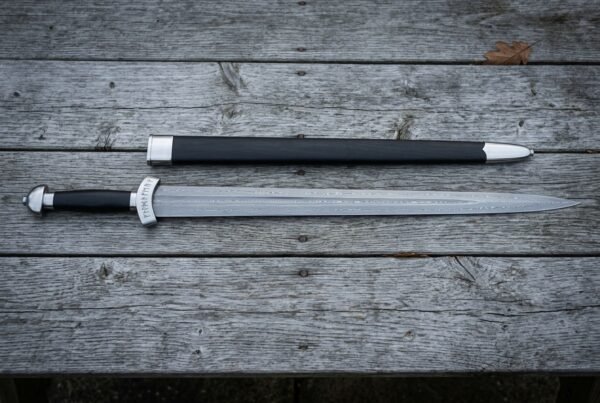
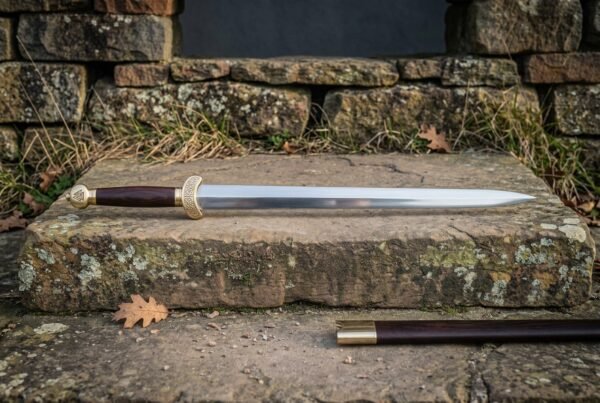
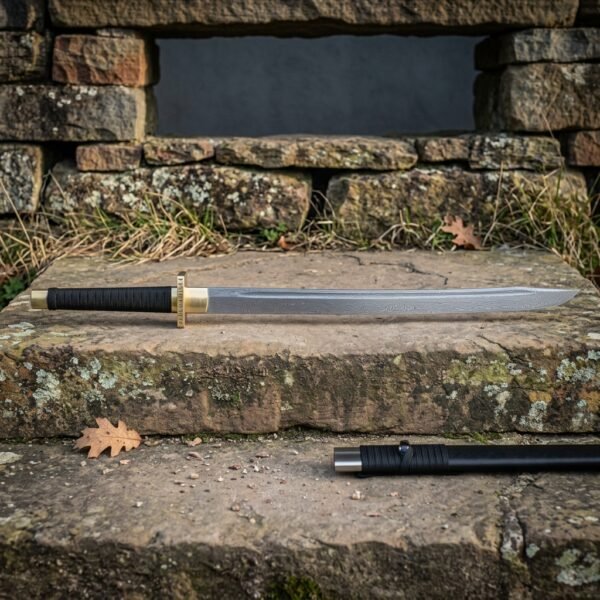
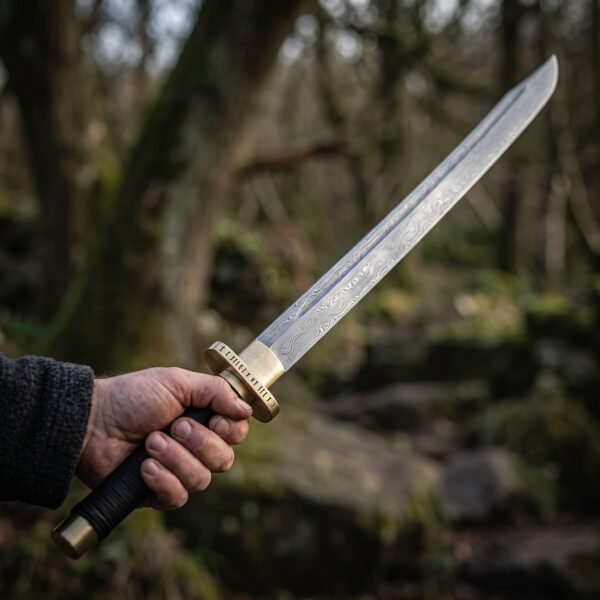
Both jian here are 1.7 inches wide at the guard, which is broad for the length, and both run a shallow fuller down the centre of the blade. The Damascus piece is 35 inches overall on a 27 inch blade with a wrapped grip 8 inches long and steel fittings at both ends, listed at about 2 pounds 6 ounces. The plain 1095 jian is a little shorter and lighter at 34 inches overall on a 26.5 inch blade, with a 7.5 inch grip, a brass ferrule and steel fittings, and a listed weight near 2 pounds 3 ounces. Its point widens slightly and then rounds off rather than tapering to a needle, which is an old choice rather than a shortcut. A fine point on a long thin blade bends on hard contact and is the first thing to break.
The dao, single edged
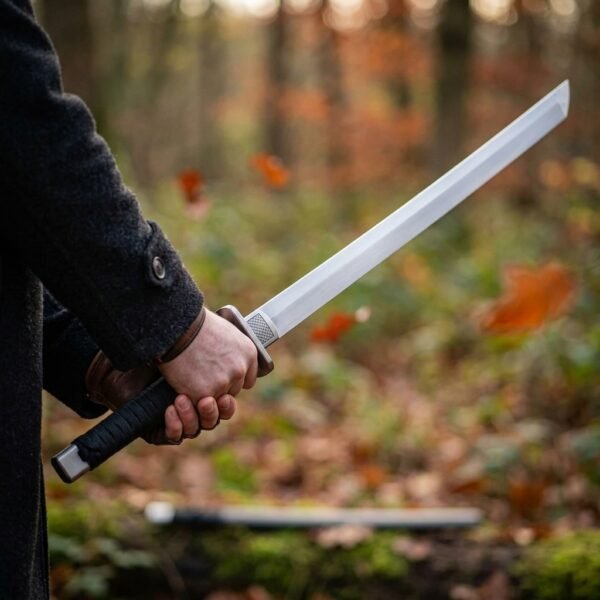
The curved dao is the longest sword on the page at 36 inches overall with a 27 inch blade, and at 1.4 inches wide it is the narrower of the two sabers. The grip is black cord wrapped over a core, 8.5 inches, with a brass ferrule and collar, and the listed weight is about 2 pounds 2 ounces. It is the piece to handle if you want to feel what a drawing cut is, because the curve does the work and your arm only has to supply the line.
The straight backed dao
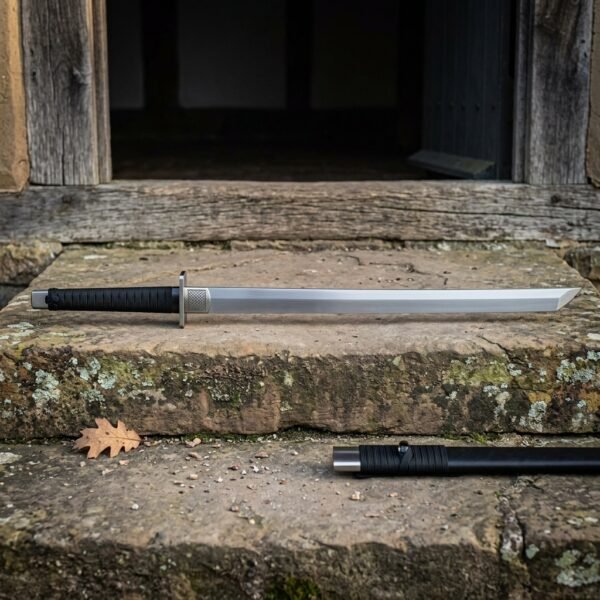
The fourth sword is single edged like a saber but the spine runs straight. It is 35 inches overall with a 26 inch blade, 1.3 inches wide, an 8.5 inch cord wrapped grip and plain steel fittings, listed at about 2 pounds. Straightening the spine brings the point up onto the same axis as your forearm, so you can put the tip where you are looking without correcting for the curve. You lose some of the slicing efficiency and you gain a sword that thrusts honestly. It is the most useful of the four for anyone who wants one blade to cover both jobs.
The one Damascus blade
Only one of the four is pattern welded, the longer jian. The billet is 1095 and 15N20 stacked, welded, drawn and folded, then forged out and acid etched so the layers read as light and dark bands along the flats. It runs harder than the plain blades at 58 to 60 HRC. If you want the pattern on other shapes, the wider Damascus swords collection carries it across the whole range.
Sizes, steel and fittings across the range
Every figure below comes from the specification panel of a sword on this page. These are forged and ground by hand, so read them as what to expect rather than as a promise to the millimetre.
| Sword | Steel and hardness | Overall length | Blade length | Blade width | Grip and fittings | Listed weight | Price |
|---|---|---|---|---|---|---|---|
| Damascus jian | 1095 and 15N20 at 58 to 60 HRC | 35 in | 27 in | 1.7 in at the guard | Wrapped grip 8 in, steel guard and pommel | About 2 lb 6 oz | 495 dollars |
| High carbon jian | 1095 at 54 to 58 HRC | 34 in | 26.5 in | 1.7 in at the guard | Dark grip 7.5 in, brass ferrule and steel fittings | About 2 lb 3 oz | 385 dollars |
| Curved dao | 1095 at 54 to 58 HRC | 36 in | 27 in | 1.4 in | Black cord wrapped grip 8.5 in, brass ferrule and collar | About 2 lb 2 oz | 395 dollars |
| Straight backed dao | 1095 at 54 to 58 HRC | 35 in | 26 in | 1.3 in | Black cord wrapped grip 8.5 in, plain steel fittings | About 2 lb | 370 dollars |
Scabbards are included on all four. The Damascus jian and both dao ship in black scabbards with steel fittings, and the plain jian comes in dark wood.
Sizing and fit
These are one handed swords with grips between 7.5 and 8.5 inches, which is long enough to add a second hand for a heavy cut without the sword being designed around it. Nothing here needs an unusual reach. Weight is the number that actually matters, and two pounds feels lighter in the hand than it reads on paper once the balance point sits close to the guard. At 34 to 36 inches overall a Chinese sword of this class suits most adults, and the difference between the shortest and the longest piece on the page is two inches, which you will notice as balance long before you notice it as length.
Steel and hardness
Two steels run through everything here and there is no third. Plain blades are 1095 high carbon hardened to 54 to 58 HRC. Damascus blades are 1095 and 15N20 forge welded and taken to 58 to 60 HRC. No proprietary alloys, no mystery grades.
1095 and 15N20 are paired for two reasons. They weld to each other cleanly, and they react differently to acid. In the etch the 1095 darkens and the nickel bearing 15N20 stays bright, which is the whole reason you can see the layers at all. The nickel also toughens the billet, which is why a Damascus blade can be run two points harder than a plain one without becoming brittle.
Stainless is not an option on a sword like this, and it is worth knowing why rather than taking it on trust. Chromium blocks a sound forge weld, so a pattern would never form. It refuses to take a contrasting etch. And in a long thin double edged blade the carbide structure that makes stainless hold an edge also makes it prone to snapping rather than bending. The honest cost of carbon steel is rust, and rust is handled with a cloth and a little oil. Our Damascus versus high carbon comparison sets the two side by side, and the steel and hardness page explains what an HRC number actually measures.
Handles, fittings and scabbards
Every grip here is a wooden core with something wrapped over it. Two are cord wrapped, one is a plain dark wrap and one is a wrapped grip with steel furniture at both ends. Chinese makers settled on wrapping for two practical reasons. It gives a surface that stays secure in a damp hand, and it lets the maker set the diameter to suit the owner by changing the thickness of what sits under the wrap rather than recutting the wood.
Fittings are brass or plain steel. Brass darkens over months and a metal polish brings it back. Where wood is exposed at a collar or a pommel, keep it out of dry heat and give it a wipe of oil once or twice a year, because a shrunken core is how a wrap goes loose.
Scabbards are included with every sword on this page. Leather and lined wood both hold moisture against steel, so a scabbard is for carrying a blade and not for storing it. If you need a spare or a replacement, look at scabbards and sheaths.
Sharpening, and why two edges is more than twice the work
On a single edged blade you sharpen one side, feel for a burr and take it off. On a jian you have to do that twice and, harder still, you have to do it symmetrically. Work one edge in sections on a medium stone and count your passes. Then do exactly the same number on the other. Refine both on a fine stone and strop the burr away at the end. If you lose count and take more off one side than the other, the blade stops cutting straight and starts wandering off line in a way that is very hard to feel until you use it.
Slow down where the two edges meet at the point. That is where a tip gets quietly rounded off by an enthusiastic hand, and once it is gone you are grinding the whole profile back to recover it. The curved dao needs the sweeping stroke that any curved edge needs, so the contact point travels along the curve through the pass rather than sitting in one spot. The straight backed dao sharpens like a straight knife.
1095 at 54 to 58 HRC comes back on a 1000 grit stone in a few minutes. Damascus at 58 to 60 HRC takes longer to move and holds the result longer. The method and the grit progression are covered on sharpening with a whetstone.
Rust, care and storage
Both steels rust. That is not a defect, it is the price of a blade that can be forge welded and hardened properly. Keep a light film of oil on the steel at all times, wipe the sword after handling, and pay attention to the fuller on the jian because dust and moisture collect in it and sit there.
Never take abrasive polish, wire wool or a rust eraser to the flats of the Damascus blade. The etch is a surface only. Scrub it and you will flatten the pattern permanently, and no amount of re polishing brings it back without a fresh etch. Light spotting lifts with oil and a soft cloth and patience. Grey patina is stable and does no harm at all.
Store a sword out of its scabbard if it is going to sit for months, somewhere with steady humidity rather than over a fireplace or in a garage. Our care guide covers the routine for blade, fittings and scabbard, and sword stands and displays holds the racks and hangers.
Engraving
Any of these can be engraved after they land in the United States. On a jian the flat beside the fuller is the natural place for a cut line, and a fresh cut reads bright against an etched pattern. On a dao the wide flat above the edge takes a line of text comfortably. Names, dates and short phrases all work, and Elder Futhark is a phonetic alphabet rather than a code, so a name is transliterated by sound and there is no rune for the letter C.
Text engraving is 19 dollars, a symbol is 39 dollars and a family crest is 49 dollars. Where a piece already carries an engraved design, your chosen engraving replaces it rather than sitting beside it. Engraving is permanent and an engraved sword cannot be returned, so send the exact spelling and then read it again before you order.
Where these come from and how they ship
Ransack Viking is a US company based in Chicago, Illinois. The pieces are handmade in the Czech Republic, then imported, inspected and shipped from Chicago. Engraving is done in the US after arrival.
Because these are forged, ground and fitted by hand, two swords of the same model will never be identical. Etch figure varies, grind lines vary, and wrap colour shifts between batches. Shipping inside the United States is free. If you want to know more about how the pieces are made and where they come from, the country of origin page sets it out plainly.
How to choose
Start with what you want the sword to do rather than with the pattern on the steel. If you are training or intend to, take a dao. It teaches the cut faster, it forgives a swing that arrives slightly off, and the grip tells your hand what it is doing. The curved dao is the purer saber and the straight backed dao is the one that also thrusts properly.
If you already know how a sword should feel and you want the harder instrument, take a jian. Both edges live, both edges cut, and neither one is going to help you by feel. The plain 1095 jian at 385 dollars is the sensible way in. The Damascus jian at 495 dollars is the same sword in a harder steel with a visible pattern, and it is the one to buy if it is going on a wall as much as in a hand.
Browse related categories
- Katana, the other great single edged tradition
- Wakizashi, shorter Japanese blades for indoor reach
- Sabres, the European answer to the curved cutting blade
- Scimitars and deeply curved cutting swords
- Arming swords, straight double edged and one handed
- Damascus swords in forge welded 1095 and 15N20
- Short swords for tighter spaces and lighter carry
- Sword stands and display racks
Guides worth reading first
- How to buy your first sword without regretting it
- Display sword or battle ready: what the difference really is
- Damascus vs high carbon steel: which blade should you buy
- What Damascus steel actually is, and what it is not
- The complete care guide: blade, handle and scabbard
Frequently asked questions
What is the difference between a jian and a dao?
The jian is straight and sharpened on both sides. The dao is single edged and usually curved. The jian is lighter in the point and can cut with either side, so it changes line freely and demands more from the person holding it. The dao slices harder for the same effort and tells your hand where the edge is.
Which one should a beginner buy?
A dao. It teaches a clean cut faster and it forgives a swing that lands slightly off angle. If you want one sword that both cuts and thrusts naturally, take the straight backed dao rather than the curved one.
Are these sharp when they arrive?
Yes. Every blade is ground and finished by hand and arrives with a working edge. They are not shaving sharp out of the box, because a very fine edge on a long sword chips on contact. A few passes on a 1000 grit stone will take any of them further if you want more.
Why is the point on one of the jian rounded?
Because a needle point on a long thin double edged blade is fragile. It bends on hard contact and it is the first part to break. Broad rounded points appear on historical jian and on Viking age European swords for exactly the same reason, and the blade still thrusts perfectly well.
What steel are these made from?
Three are plain 1095 high carbon hardened to 54 to 58 HRC. One is Damascus of 1095 and 15N20, forge welded and acid etched, hardened to 58 to 60 HRC. Nothing else is used and neither steel is stainless, so both need a light film of oil.
Can I sharpen a jian myself?
Yes, with more patience than a single edged blade needs. Count your passes on one edge and repeat exactly on the other, because an asymmetric edge makes the sword cut off line. Go slowly where the edges converge at the point, since that is where a tip gets rounded off by accident.
Does a scabbard come with the sword?
Yes. All four ship with a scabbard, black with steel fittings on three of them and dark wood on the plain jian. Use it for carrying rather than for long storage, because a lined scabbard traps moisture against the steel.
Where are these swords made?
Ransack Viking is a US company based in Chicago, Illinois. The pieces are handmade in the Czech Republic, then imported, inspected and shipped from Chicago. Engraving is done in the US after arrival.