
A sidesword is the single handed sword of the sixteenth century, the step between the medieval arming sword and the rapier. The Italians called it the spada da lato, the sword of the side, and the blade is the giveaway. It still cuts properly, with two real edges and enough width to mean it, while tapering far enough to thrust. That is what the phrase cut and thrust describes. The six on this page run from about 40 to 42 inches overall with blades of 33 to 35 inches, all in 51CrV4 spring steel hardened to 49 to 52 HRC.
What separates them is the hilt. Elmgarth and Skelvard carry finger rings forward of the cross. Valdris has a single side ring. Orveldt is a swept hilt with a counterguard bar running back to the pommel. Thanmir adds a counterguard loop under the hand. Brekavik is different again, a schiavona style basket of flat bars enclosing the whole hand.
Every edge here is a blunted flat land and every point is rolled and flared. These sit between the arming sword trainers and the rapiers in this line, and the guide comparing the two is the quickest way to work out which you want. The basket and shell hilt swords carry the sharp versions.
Most of these take a custom engraving on the blade, the ricasso or the pommel, chosen on the product page.
If you would rather have a single handed sword built to your own measurements, start with the sword builder and set the blade length, the taper, the guard, the pommel and the grip.
Free US shipping
On most pieces. Heavier and oversized ones carry a flat charge.
Hand Forged
Heated, hammered and ground by hand.
Engraving available
Names, dates or Norse runes on most pieces.
Ships from New York
Inspected and dispatched from our New York warehouse. No import duty, no customs delay on US orders.
HEMA Sideswords
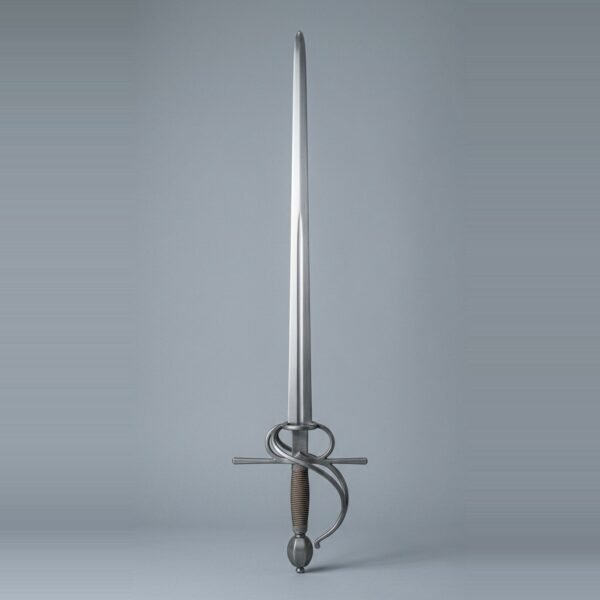
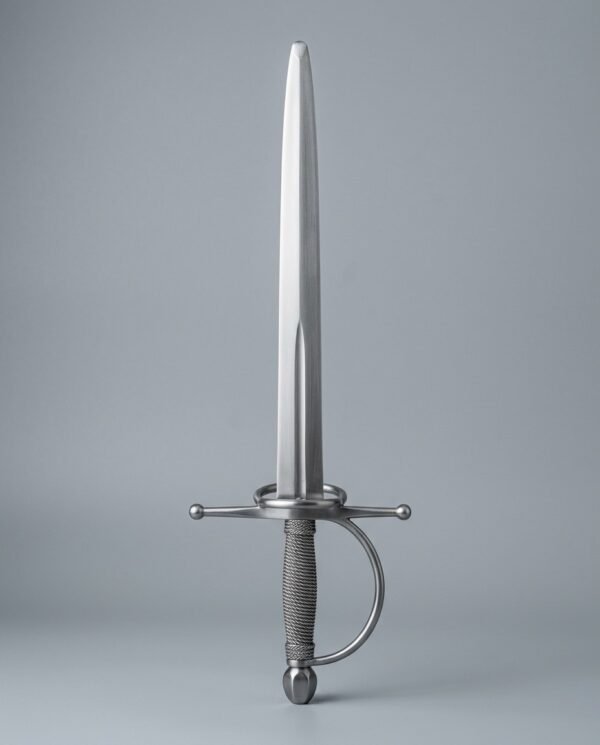
The sword of the side
The Italians called it the spada da lato, the sword of the side, and that is exactly what it was. An everyday civilian sword worn at the hip through the sixteenth century, single handed, double edged, and sized so that a man could carry it all day without thinking about it. Sidesword is a modern English translation of the Italian, coined so that English speaking fencers had a name for the thing that was clearly not an arming sword any more and clearly not yet a rapier.
The blade is what defines it. A sidesword blade still cuts properly. It has two real edges, enough width at the forte to carry a cut with authority, and often a fuller to keep the mass down. But it tapers hard enough through the last third that the point is a genuine threat rather than an afterthought. That combination is what the phrase cut and thrust describes, and it is the single thing that separates this family from what came before and what came after.
All six blades on this page are built to that profile. Elmgarth carries a fuller and sits furthest towards the cutting end. Skelvard tapers most sharply towards the point. The rest sit between, with blades of about 33 to 35 inches and overall lengths of 40 to 42 inches.
The Bolognese tradition and Achille Marozzo
The sidesword has one of the best documented traditions in the whole art behind it, and it comes out of Bologna. The school is usually named after Filippo Dardi, who taught in the city in the fifteenth century, and the body of surviving material from his successors is large enough that clubs run it as a complete system rather than as a set of fragments.
Achille Marozzo is the name most people meet first. His Opera Nova was printed in 1536 and it is the fullest of the Bolognese books, laying out guards, cutting lines, sequences of play and the whole progression a student works through. It covers the sword alone, the sword with a buckler, the sword with a dagger, the sword with a cloak and more besides, which tells you how the sidesword was actually carried and used. It was a civilian sword, not a battlefield one, and the offhand almost always had something in it.
The rest of the Bolognese writers
Antonio Manciolino printed earlier, in 1531, and his book is shorter and more direct, which many people find is the better place to start. Angelo Viggiani and Giovanni dall'Agocchie both wrote later in the century, dall'Agocchie in 1572, and both are useful for how they compress the material into something a student can be taught quickly. Read together, they give you a system with several independent witnesses to it, which is rare in this field and is a large part of why the sidesword has stayed popular.
The practical consequence for a buyer is that a sidesword is a sword you can actually train with a syllabus. The introduction to HEMA covers what the sources are and how clubs use them.
The road from the arming sword to the rapier
Put the three side by side and the line is obvious. The medieval arming sword is a plain cross, a broad blade and one hand. By the middle of the sixteenth century that cross has grown rings, a knuckle bow and bars, and the blade has narrowed and lengthened. By around 1540 the rapier proper is appearing, and it keeps going in the same direction until the smallsword displaces it by about 1715.
What drives the change is civilian carry rather than the battlefield. A sword worn in the street is used without a gauntlet and usually without armour, so the hand needs protecting by the hilt itself. That is the whole story of rings and bars. At the same time the fight happens at longer measure against an unarmoured opponent, which rewards the point over the edge, so the blade narrows and lengthens.
The rapier is where that logic ends up. Historical examples average around 104 cm of blade, Italian ones running past 115 cm and up to 130 cm, with blade widths of 2.5 cm or less. A rapier is a thrusting sword that can cut a little. A sidesword is a cutting sword that can thrust properly. That difference is not academic. It changes the footwork, it changes what the offhand does, and it changes which sword you should buy. The comparison guide sets it out, and the rapier trainers are the next step along.
Finger rings, side rings and counterguards
Hilt vocabulary is where most buyers get lost, and the terms are worth twenty minutes because they are the difference between two swords that look alike in a photograph.
How to read a hilt
A finger ring sits forward of the cross, on the blade side, and its job is to protect a finger hooked over the quillon for point control. It is often called an arm of the hilt. Elmgarth has two of these, and Skelvard has two as well.
A side ring stands out from the flat of the blade, roughly at right angles to the cross, and shields the hand from a blade sliding down the outside. Valdris carries one. Thanmir carries two. Orveldt has one over the outside face as part of a larger swept arrangement.
A knuckle bow is the bar that runs from the cross back towards the pommel to guard the fingers. Four of these six carry one that lands on or near the pommel. Skelvard is the odd one out, where the bow rises from the cross and finishes in a free scroll without joining the pommel at all, which is a genuine period form and not a fault.
A counterguard is any bar added on the inside of the hand, behind or beneath it, filling the space the rings leave open. Thanmir has a loop running back under the hand. Orveldt has a bar sweeping back to the pommel, which is what makes it a swept hilt rather than a ringed one.
Stack enough of these together and you stop having a sidesword and start having a rapier hilt. Enclose the hand completely with a lattice of bars and you have a basket.
The schiavona style basket
Brekavik is the one piece on this page that takes the enclosure to its conclusion. Instead of rings and bars it carries a full basket of flat steel bars wrapping the whole hand, in the style associated with the schiavona, the broadsword carried by the Schiavoni, the Balkan and Dalmatian troops in Venetian service from the sixteenth century onwards.
The schiavona sits slightly outside the Bolognese story, and it is included here because the blade is the same cut and thrust profile the rest of the category uses, and because it drills against them perfectly well. What differs is the hand. A basket protects far more, it takes a knock without you thinking about it, and it fixes your grip in one orientation rather than letting you change it freely. Some fencers love that and some find it constraining. It is worth handling one before committing if you can.
Brekavik carries a lobed cap pommel above the basket and a ribbed grip bound in black with a brass ferrule at each end. It is about 41 inches overall with a 34 inch blade. The sharp basket and shell hilted pieces live in the basket and shell hilt sword category.
Cut and thrust blade geometry
A blade that has to do both jobs is a compromise, and knowing where the compromise sits tells you how the sword will behave.
Width at the forte carries the cut. A broader blade near the hand puts mass where it can be driven through a target and gives the edge something to work with. Elmgarth is the broadest feeling of the six because it combines that width with a fuller, which removes steel from the centre of the section where it contributes least to stiffness and leaves it at the edges where it contributes most.
Taper through the last third carries the thrust. The faster a blade narrows towards the point, the less it wants to be swung and the more it wants to be aimed. Skelvard tapers hardest and is the most point oriented of the six.
The ricasso is the third variable and it is easy to miss. Three of these swords carry a short flat section immediately above the cross, unsharpened on a sharp sword, which is where a finger sits when it is hooked over the quillon. Thanmir, Orveldt and Valdris all have one. A ricasso and a finger ring belong together, and a sword with rings but no ricasso is telling you that the maker expected the hand to stay behind the cross.
None of these swords is sold with a stated weight or point of balance. Ransack Viking does not publish figures it has not measured on the individual piece, and these are forged and ground one at a time. Flex is given as a named tier instead. The flex guide explains what the tiers mean.
On sizing, the rapier fitting rule of standing the sword on its point and looking for the quillons at your navel does not transfer, because a sidesword is shorter by design. Choose by blade length and by what your club drills instead. About 34 inches is the middle of these six and suits most adults. A longer blade buys reach in the bind at the cost of speed in close measure, and a shorter one does the reverse.
Every sidesword on this page, side by side
Every figure in the table below is taken from the specification panel of a product on this page. Nothing is estimated. Sizes vary piece to piece because each blade is forged and ground by hand, so read a stated length as nominal rather than exact.
| Piece | Overall length | Blade type | Steel and hardness | Flex | Guard or tip note |
|---|---|---|---|---|---|
| Skelvard sidesword | About 40 inches | Double edged cut and thrust blade, tapering towards the point | 51CrV4 at 49 to 52 HRC | Not listed | Two finger rings and a side ring, knuckle bow ending in a free scroll, tip rolled about 15 mm |
| Valdris sidesword trainer | About 41 inches | Straight double edged cut and thrust blade with a short ricasso under the ring | 51CrV4 at 49 to 52 HRC | Medium, the tier most clubs issue for sidesword | Cross with turned ball finials, one side ring, knuckle bow to the pommel, tip rolled about 15 mm |
| Elmgarth Bolognese sidesword | About 41 inches | Fullered double edged cutting blade, cut and thrust profile | 51CrV4 at 49 to 52 HRC | Medium tier, the working range for cut and thrust | Two finger rings forward of the cross, knuckle bow to the pommel, tip rolled about 15 mm |
| Brekavik schiavona style basket hilt | About 41 inches | Straight double edged blunt, cut and thrust profile | 51CrV4 at 49 to 52 HRC | Medium tier, the working range for cut and thrust | Full basket of flat bars in the schiavona style, tip rolled about 15 mm |
| Orveldt swept hilt sidesword | About 42 inches | Double edged cut and thrust blade tapering from a short flat ricasso | 51CrV4 at 49 to 52 HRC | Medium, suited to drill and controlled sparring | Swept hilt, side ring over the outside, counterguard bar to the pommel, knuckle bow |
| Thanmir ringed sidesword | About 42 inches | Double edged cut and thrust blade with a flat ricasso beneath the rings | 51CrV4 at 49 to 52 HRC | Medium, for drill and controlled sparring | Two side rings, counterguard loop back under the hand, knuckle bow, tip rolled about 15 mm |
Blade lengths run from about 33 inches on Skelvard to about 35 inches on Orveldt and Thanmir. None of the six ships with a scabbard.
Browse related sword categories
- Rapier trainers, where the taper and the hilt keep going
- Arming sword trainers, the plain cross this family grew out of
- Basket and shell hilt swords with sharpened blades
- The full HEMA range, from feders to rapiers and sabres
- Smallswords and spadroons, the civilian sword that came next
- Messers, the single edged sword built on knife style hilt construction
- Rapiers in the main sword range, sharpened and for display
- Engraved and personalised pieces across the whole catalogue
Guides worth reading first
- Rapier or sidesword, and how to tell which you want
- What HEMA is, and what the sources actually are
- How to choose your first HEMA sword without wasting money
- HEMA sword flex explained, tier by tier
- Blunt against sharp training swords, and which one you need
- HEMA tournament gear rules and what the rulesets ask for
- Smallswords and spadroons, the civilian sword after the rapier
- Care and oiling for carbon and spring steel blades
Frequently asked questions
What is a sidesword?
It is the single handed civilian sword of the sixteenth century, sitting between the medieval arming sword and the rapier. The Italian name is spada da lato, the sword of the side. The blade has two real edges and enough width to cut, while tapering far enough to thrust properly, and the hilt carries rings and bars to protect an unarmoured hand.
What does cut and thrust mean?
It describes a blade built to do both jobs rather than specialising in one. Enough width and mass near the hand to carry a cut, enough taper through the last third to make the point a real threat. An arming sword leans towards the cut. A rapier leans hard towards the thrust. A sidesword sits deliberately in the middle, and all six blades here are built that way.
What is the difference between a sidesword and a rapier?
Blade width and length, mostly. Rapier blades average around 104 cm with Italian examples running past 115 cm, and widths of 2.5 cm or less, which makes them thrusting swords that cut only a little. Sidesword blades here run about 33 to 35 inches and stay broad enough to cut properly. The footwork, the measure and the use of the offhand all differ as a result.
Who wrote the sources for the sidesword?
The Bolognese school, usually traced to Filippo Dardi. Antonio Manciolino printed in 1531, Achille Marozzo printed Opera Nova in 1536, and Angelo Viggiani and Giovanni dall'Agocchie wrote later in the century. Marozzo is the fullest and covers the sword alone, with a buckler, with a dagger and with a cloak. Manciolino is shorter and many students find it the better starting point.
What is a finger ring and how is it different from a side ring?
A finger ring sits forward of the cross on the blade side and protects a finger hooked over the quillon for point control. A side ring stands out from the flat of the blade roughly at right angles to the cross and shields the hand from a blade sliding down the outside. Some swords here have one, some the other, and some both.
Is the schiavona style basket hilt a sidesword?
Strictly it belongs to a different tradition, the broadsword carried by Schiavoni troops in Venetian service. It is grouped here because the blade is the same cut and thrust profile as the rest and it drills against them perfectly well. The difference is at the hand, where a full basket protects more but fixes your grip in one orientation.
Can I use these in a tournament?
That depends on the event and its published ruleset, so read the ruleset rather than the listing. Tip shape is usually the deciding point, and some rulesets require a spatulated or rolled tip with a minimum diameter of 1.5 cm. All six here carry a rolled and flared tip of about 15 mm. Ransack Viking claims tournament legality for nothing without naming the ruleset.
Where are these made and how are they shipped?
They are made by hand in the Czech Republic and imported by Ransack Viking. Every one is checked for hilt tightness, pommel seating and blade straightness at the North Babylon, New York warehouse and shipped from there. Shipping inside the United States is free, returns run for seven days, and the lifetime warranty against defects in the forging, the grind, the heat treat and the fittings needs no receipt.
Featured pieces
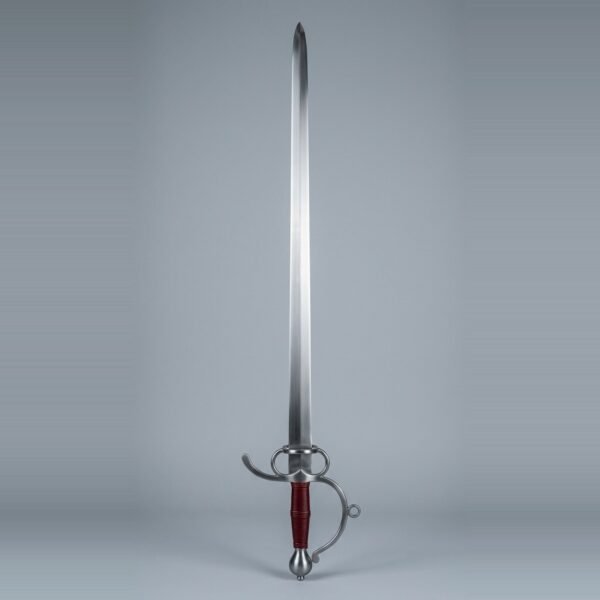 Skelvard Hand Forged 51CrV4 Spring Steel Sidesword with Finger Rings & Scrolled Knuckle Bow
$409.00
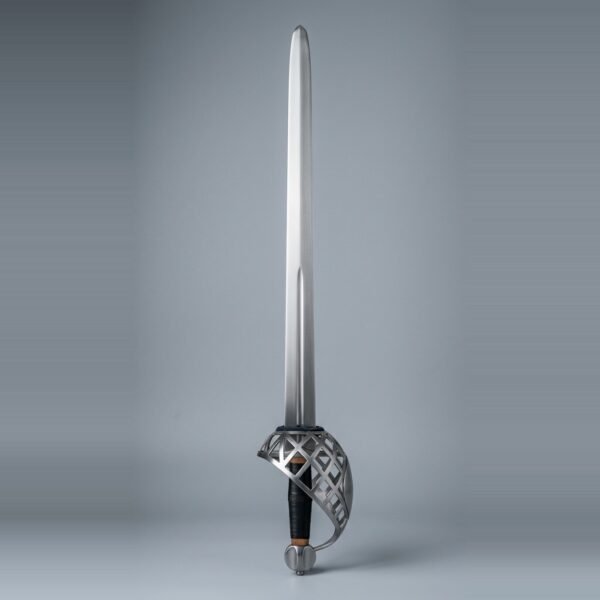 Brekavik Hand Forged 51CrV4 Schiavona Style Basket Hilt Sword with Bar Basket & Lobed Cap
$549.00
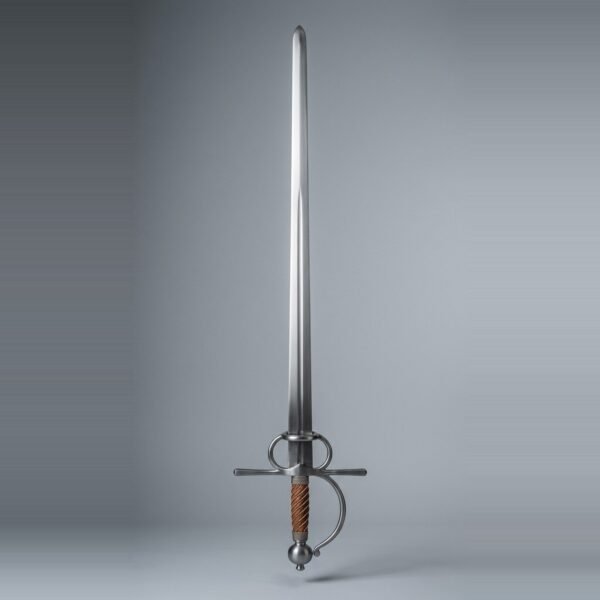 Elmgarth Hand Forged 51CrV4 Bolognese Sidesword Trainer with Two Finger Rings & Knuckle Bow
$419.00
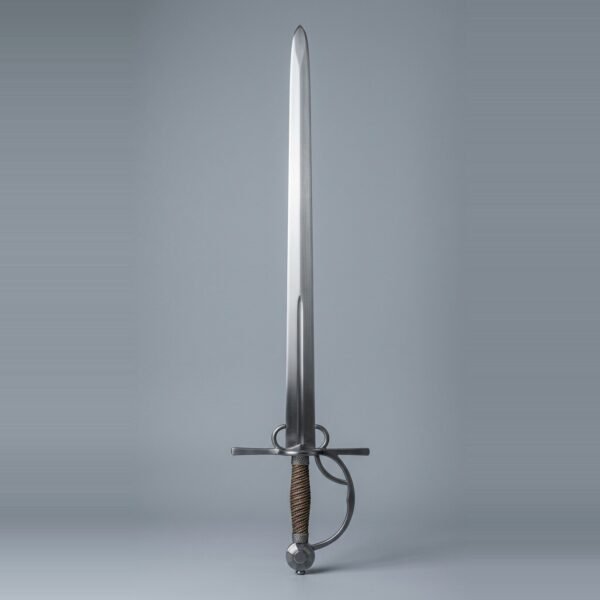 Thanmir Hand Forged 51CrV4 Ringed Sidesword Trainer with Two Side Rings & Counterguard Loop
$489.00