The Dane axe is the long hafted two handed axe of the late Viking age. Thin bit, wide sweeping edge, very little metal behind it. That last part is the trick. A head of about 2 lb spread across a 6 to 10 inch edge cuts deep for its weight, and because the mass sits far from your hands it arrives fast. The trade is reach and commitment, which is why the bearded axes stayed popular. Both hands are on the haft and there is no shield in the other one.
The pieces here run 28 to 34 inches overall with cutting edges of 6 to 10 inches, and head weights from about 2 lb to complete weights near 4 lb 6 oz. Every head is high carbon steel, hardened at the edge and left softer through the eye and the poll. Hafts are ash, straight grained, either oil finished, cord wrapped or wrapped full length in oiled leather. Three carry deep cut Elder Futhark rune bands with a frost blue fill, and one comes in a carved presentation case.
Take a longer haft if the axe is for display, a shorter one if you intend to swing it.
Free US shipping
On most pieces. Heavier and oversized ones carry a flat charge.
Hand Forged
Heated, hammered and ground by hand.
Engraving available
Names, dates or Norse runes on most pieces.
Ships from Chicago
Inspected and dispatched from our Chicago warehouse. No import duty, no customs delay on US orders.
Dane Axes
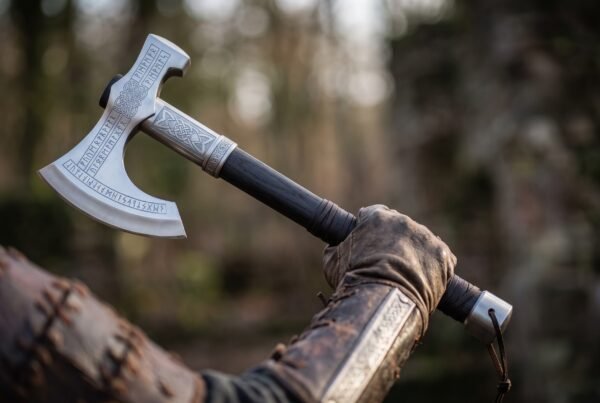
Runecask Hand Forged High Carbon Steel Norse Runic Bearded Axe with Knotwork Wooden Keepsake Box | Dark Leather Wrapped Ash Haft and 18 Inch Axe | Norse Bushcraft Gift | RK-1221
Original price was: $795.00.$636.00Current price is: $636.00.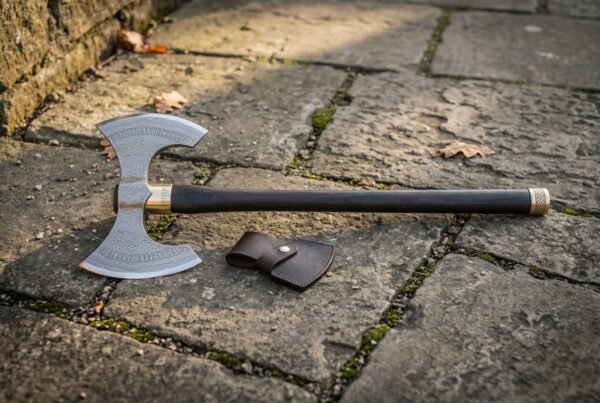
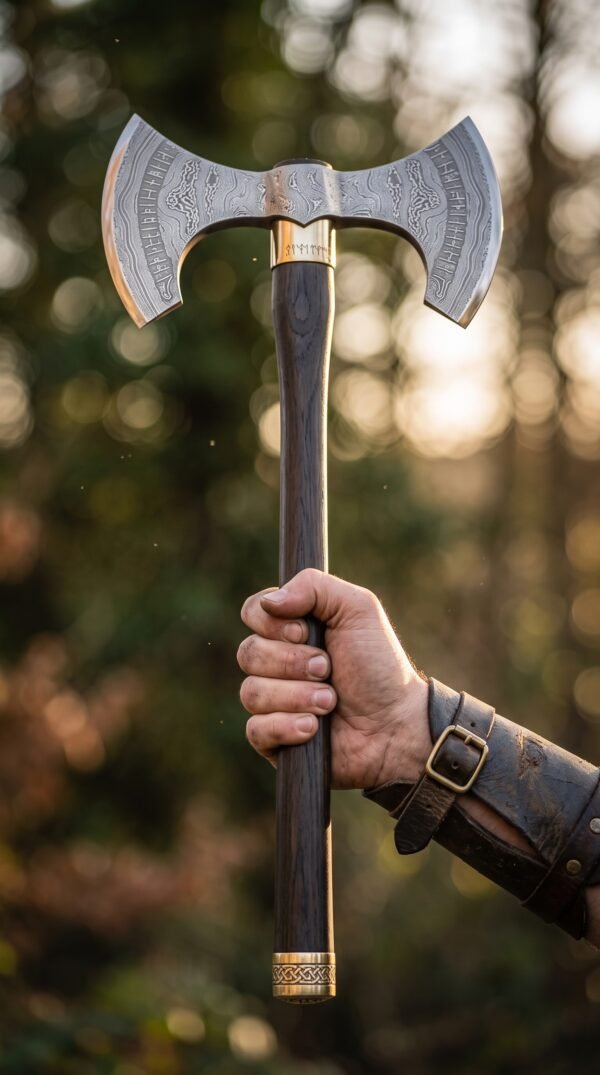
Langhewer Hand Forged Damascus Double Bit Viking War Axe | 28 Inch Overall with 6 Inch Cutting Edge | Norse Battle Collector Gift | RK-1213
Original price was: $285.00.$228.00Current price is: $228.00.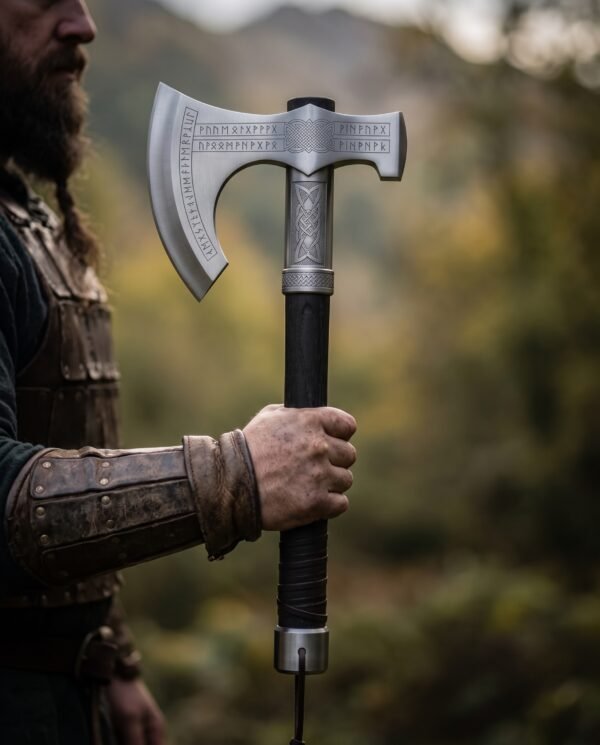
Hallwarden Hand Forged High Carbon Steel Norse Runic Bearded Axe with Rune Carved Wall Mount | Dark Leather Wrapped Ash Haft | Norse Battle Collector Gift | RK-1222
Original price was: $725.00.$580.00Current price is: $580.00.Why the Dane axe is so thin
Pick up a modern splitting axe and then pick up a Viking age axe head and the difference is startling. The splitting axe is a wedge with a thick cheek designed to force wood apart. The Viking head is a thin sheet of steel with a flared edge, and it weighs less than half as much.
That is not primitive construction. It is the correct answer to a different problem. Splitting wants a wedge. Cutting wants a thin section that enters cleanly and does not bind. Spread the same 2 lb of steel across a 6 to 10 inch edge and you get an axe that bites deep, keeps its speed through the cut and can be swung all day without wrecking your shoulders.
It also saved steel, which mattered when steel was expensive. Most Viking age heads were built with a body of softer iron or mild steel and a hardened cutting edge forge welded or wrapped into it. You get a hard edge exactly where you need one and a tough, forgiving body everywhere else, and the eye can take being hammered onto a haft without cracking. The pieces here follow the same logic, hardened at the edge and left deliberately softer through the eye and the poll.
The long haft is the last part of it. Two hands on a shaft of 28 inches or more means a long arc, a fast head and real reach. It also means no shield, which is why the long axe belonged to specific people in a formation rather than to everybody in it.
The axes in this collection
Five pieces sit on this page. They separate by edge length, by what is cut into the head, and by what comes with the axe.
Plain hafted working axes
Two pieces here are axes and nothing else. One is 28 inches overall with a 6 inch cutting edge in a wide sweeping profile, a head of about 2 lb, on a straight grained ash haft, hand shaped and oil finished, with a stitched leather head cover and a Norse knotwork panel engraved on the cheek. The other runs 32 inches overall with a 7 inch edge from horn to beard, a polished head with a cut knotwork panel on the cheek, steel langets over the haft below the eye, a wedged eye, a black cord wrap at the grip, and a complete weight of about 2 lb 6 oz. It ships with a brown leather edge guard.
The runic bearded axes
Three pieces share the same head. A broad bearded crescent bit, 11 inches horn to horn with a 10 inch cutting edge measured along the curve from beard to upper horn, deep cut Elder Futhark rune bands on both faces filled with frost blue, in 1095 hardened to 56 to 58 HRC at the edge and softer through the eye and poll. The finish is a hand rubbed dark satin with the edge bevels brightened. The haft on all three is dark stained American ash wrapped full length in oiled leather cord with a bound butt, at 34 inches overall.
What differs is what comes with them. One is supplied with a black leather head sheath, saddle stitched and copper riveted, with a strap and buckle behind the beard, at about 4 lb 6 oz. One arrives in a solid timber presentation case of 38 by 13 by 5 inches with a carved rune panel on the lid, solid brass hinges, a hook clasp and dark linen lining over a shaped bed, at about 14 lb boxed. The third comes with a carved solid timber wall plaque of 24 by 8 inches with a shaped and rune carved border, blackened steel cradle hooks and keyhole hangers routed into the back, with wall screws and plugs supplied, at about 7 lb once mounted.
Lengths, edges and weights across the range
Every figure below is taken from the specification panel of a piece on this page. Heads are forged and ground by hand, so read the numbers as what to expect rather than as a guarantee to the millimetre.
| Head and cut work | Overall length | Cutting edge | Steel and edge hardness | Haft | Weight and what comes with it |
|---|---|---|---|---|---|
| Wide sweeping bit, knotwork panel on the cheek | 28 in | 6 in | High carbon steel at 52 to 55 HRC, soft eye and poll | Ash, straight grained, oil finished | Head about 2 lb, stitched leather head cover |
| Polished bit, cut knotwork panel, steel langets | 32 in | 7 in horn to beard | 1095 at 54 to 58 HRC at the edge | Ash with a black cord wrap at the grip | About 2 lb 6 oz complete, brown leather edge guard |
| Bearded crescent, 11 in horn to horn, rune bands with blue fill | 34 in | 10 in along the crescent | 1095 at 56 to 58 HRC at the edge, softer eye and poll | Dark stained ash, oiled leather cord, bound butt | About 4 lb 6 oz, riveted black leather head sheath |
| Bearded crescent, 11 in horn to horn, rune bands with blue fill | 34 in | 10 in along the crescent | 1095 at 56 to 58 HRC at the edge, softer eye and poll | Dark stained ash, oiled leather cord, bound butt | About 14 lb boxed, carved timber case 38 by 13 by 5 in |
| Bearded crescent, 11 in horn to horn, rune bands with blue fill | 34 in | 10 in along the crescent | 1095 at 56 to 58 HRC at the edge, softer eye and poll | Dark stained ash, oiled leather cord, bound butt | About 7 lb mounted, carved wall plaque 24 by 8 in |
One figure needs care. Cutting edge on a bearded or crescent head is measured along the curve, so a 10 inch edge has noticeably less straight line reach than a 10 inch straight edge would. Judge these by the horn to horn figure as well as by the edge length.
Sizing, reach and honesty about the haft
Historical long axes carried hafts of four to five feet. Nothing on this page is that long. At 28 to 34 inches these sit between a one handed axe and a true long axe, which is a deliberate compromise, because a five foot haft is unmanageable in a room, awkward to ship and impossible to hang on most walls.
What you get instead is an axe you can use two handed, that fits above a fireplace, and that can be carried to an event without a dedicated case. If you want genuine long axe reach for reenactment, buy a longer haft separately and rehang the head. The eyes here are wedged in the normal way and a competent rehang is not a difficult job.
Choose the 28 or 32 inch pieces if the axe will be handled. Choose a 34 inch runic piece if it is going on a wall, because the leather wrapped haft and the rune bands are the thing people look at.
Steel, differential hardness and what the numbers mean
An axe wants two different properties in one head, which is why the hardness is not uniform. The edge is hardened so it holds a shape and resists rolling. The eye and the poll are left softer so the head absorbs shock without cracking, and so the eye can be wedged onto a haft without splitting.
The working band for an axe edge is 54 to 58 HRC. That is softer than a knife blade on purpose. Take an axe edge to 60 and it chips the first time it meets a knot or a nail, and a chipped axe edge is far more work to fix than a rolled one. The individual figures for each piece on this page are listed on its own product page and in the table above.
All of these heads are plain high carbon steel, three of them specified as 1095. None are stainless, and none are coated. The frost blue fill in the rune bands is a colour fill in the cut channels, not a plating, and the brightened edge bevels on the runic heads are polished steel rather than a different metal.
Sharpening and edge care
Sharpen an axe with a file first and a stone second. A double cut mill file removes a rolled or dented edge quickly, working from the middle of the bit out toward each horn, always pushing into the edge rather than dragging off it. Then a coarse and fine puck or a stone to take the file marks out and raise a burr.
Keep the convex profile. An axe edge is not a flat bevel and grinding one on with a bench grinder is the fastest way to ruin a head, because a flat bevel binds in the cut and the thin section behind it chips. Follow the curve the maker put on it.
Never take a hardened head to a high speed grinder. Heat is the enemy. If the steel turns blue, the temper in that spot is gone and no amount of sharpening brings it back. A file and ten minutes will always be better than a grinder and two.
Rust, hafts and storage
Every head here is carbon steel and will rust if you let it. Wipe fingerprints off after handling, because the salt in a print etches into polished steel within days, and leave a light film of oil or paste wax on the head. Camellia oil, mineral oil or a hard wax all work.
Four of the five ship with a leather head cover, sheath or edge guard. Use them for transport and against dust, but do not store a head in leather for months, because leather holds moisture against steel and a covered head in a damp room will spot when a bare one would not. Oil the head and take the cover off for long storage.
Ash hafts want oil once or twice a year, and the leather cord wrapped hafts want a wipe of leather conditioner on the same schedule. Wood moves with humidity, so check the head for movement by holding the haft and giving it a firm twist. If there is any play, stop and have the wedge re set. A loose head on a long haft is not a small problem, and it never gets better on its own.
Store axes hanging or flat, not standing on the edge, and keep them off concrete floors, which wick moisture straight into steel and timber.
Runes, engraving and the presentation pieces
Three of the heads here carry deep cut Elder Futhark rune bands on both faces with a frost blue fill, and two of the plainer heads carry cut Norse knotwork panels on the cheek. On one of them the engraved panel can be replaced with a design of your own.
Further engraving is added in the United States after the pieces arrive. A name, a date or a short rune line goes onto the cheek or the poll. Text engraving is 19 dollars, a symbol is 39 dollars and a family crest is 49 dollars. Elder Futhark is a phonetic alphabet rather than a cipher, so names are transliterated by sound and there is no rune for the letter C. Read the rune guide before you send a spelling.
Engraving is permanent and an engraved piece cannot be returned. Read the spelling twice. If the axe is a gift, the presentation case version arrives ready to hand over, which saves the awkward business of gift wrapping an axe.
Where these come from and how they ship
Ransack Viking is a US company based in Chicago, Illinois. The pieces are handmade in the Czech Republic, then imported, inspected and shipped from Chicago. Engraving is done in the US after arrival.
Because each head is forged and each haft is fitted by hand, two axes of the same name will differ slightly in the curve of the bit, in the grain of the ash and in the depth of the rune cuts. The listed dimensions stay the same. The boxed piece is heavy at about 14 lb and ships as a single long parcel, so allow a little extra time on delivery.
How to choose
If you want an axe that gets used, take the 28 or 32 inch head with a plain or cord wrapped haft. They are the lightest here at around 2 lb to 2 lb 6 oz, and they come with a cover or an edge guard so you can carry one without wrapping it in a coat.
If it is going on a wall in a hall, a bar or a study, take one of the runic bearded pieces. The wall mounted version arrives with its plaque, its cradle hooks and its fixings, so there is nothing to work out on the day.
If it is a gift, take the cased version. A carved timber box with a rune panel on the lid does more work than any wrapping paper, and the axe inside is the same as the other two.
Browse related collections
- Bearded axes in one handed sizes
- Battle axes across the Norse and medieval range
- War axes with heavier heads
- Viking axes, the full collection
- Axe handles and hafts for a rehang
- Round shields to go with a long axe
- Stands and displays for long pieces
Guides worth reading first
- The Dane axe, what it was and how it was used
- What is a bearded axe and why the beard is there
- How to choose a Viking axe
- How to sharpen an axe without ruining the profile
- How to remove rust from a forged head
- How to display swords and axes on a wall
Frequently asked questions
What is a Dane axe?
The long hafted two handed axe of the late Viking age, with a thin wide bit and very little metal behind the edge. The mass sits far from your hands, so it arrives fast and cuts deep for its weight. The cost is that both hands are on the haft, which means no shield.
Are these full length Dane axes?
No. Historical long axes carried hafts of four to five feet, and these run 28 to 34 inches overall. That is a deliberate compromise for handling, shipping and wall space. The eyes are wedged in the normal way, so a longer haft can be fitted if you want true long axe reach.
Why is the head not hardened all the way through?
Because an axe needs two properties at once. A hardened edge holds its shape, and a softer eye and poll absorb shock without cracking and let the head be wedged onto a haft. Uniform hardness gives you a head that either dulls fast or splits at the eye.
How sharp are they on arrival?
They arrive with a working edge, hand ground and finished. They are not razors, because a very thin edge on an axe chips against a knot. A file and a puck will take any of them further if you want more.
How do I sharpen one?
File first, stone second, and keep the convex profile the maker put on. Work from the middle of the bit out toward each horn, pushing into the edge rather than dragging off it. Never use a high speed grinder, because if the steel turns blue the temper in that spot is gone for good.
Will the head rust?
Yes. These are bare high carbon steel with no plating and no lacquer. Wipe fingerprints off and leave a light film of oil or paste wax on the head. Do not store the head inside its leather cover for months, because leather holds moisture against steel.
What is the blue in the rune bands?
A colour fill sitting in the deep cut channels of the rune band, on both faces of the head. It is a fill rather than a plating or an enamel firing, and the brightened edge bevels alongside it are simply polished steel.
Where are these made?
They are handmade in the Czech Republic, then imported, inspected and shipped by Ransack Viking from Chicago, Illinois. Engraving is added in the US after arrival.
Featured pieces
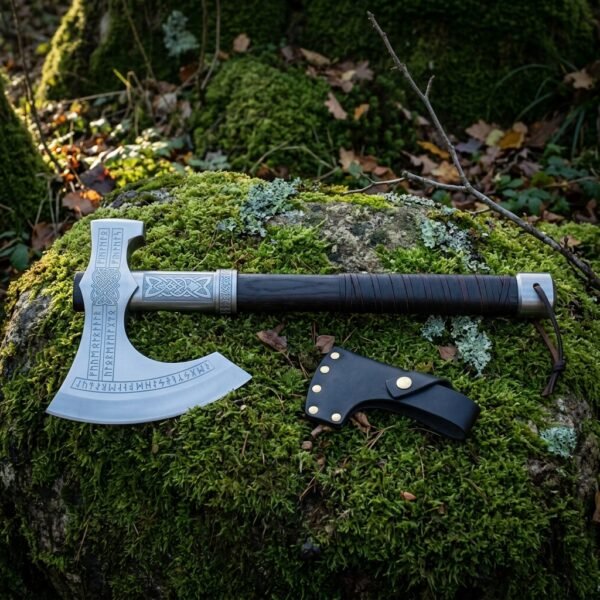 Frostrune Hand Forged High Carbon Steel Norse Runic Bearded War Axe
Original price was: $645.00.$516.00Current price is: $516.00.
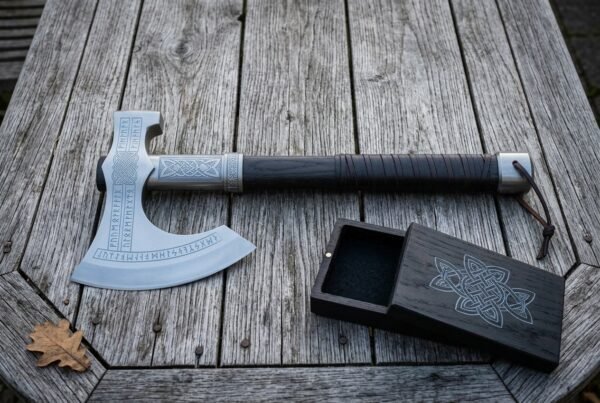 Runecask Hand Forged High Carbon Steel Norse Runic Bearded Axe with Knotwork Wooden Keepsake Box
Original price was: $795.00.$636.00Current price is: $636.00.
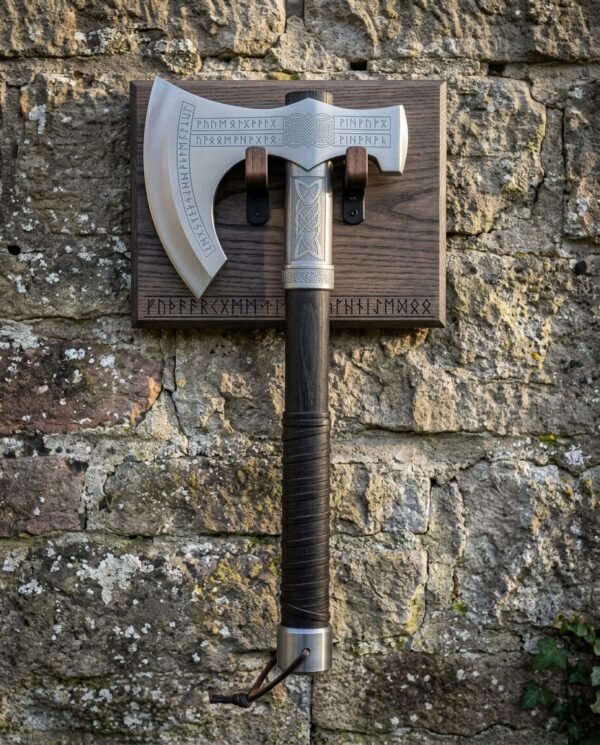 Hallwarden Hand Forged High Carbon Steel Norse Runic Bearded Axe with Rune Carved Wall Mount
Original price was: $725.00.$580.00Current price is: $580.00.
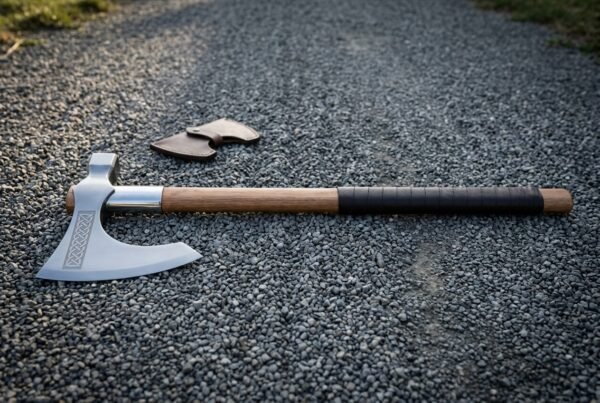 Langbeard Hand Forged 1095 Steel Bearded Axe
Original price was: $299.00.$239.20Current price is: $239.20.