
Claymore comes from the Gaelic claidheamh mor, great sword, and the word covers two different swords rather than one. The first is the two handed Highland sword of the fifteenth and sixteenth centuries, with a long blade and forward sloping quillons ending in pierced quatrefoils. The second is the basket hilted broadsword that replaced it, worn by Highland soldiers into the eighteenth century and still carried by Scottish regiments today. That second sword is the one most people picture, and it is the one on this page.
The piece here runs approximately 38 inches overall with a 32 inch double edged blade in 1095 high carbon steel, hardened and tempered to 54 to 58 HRC so it springs back rather than taking a set. The blade carries twin narrow fullers for stiffness without weight. The hilt is a pierced steel basket built bar by bar, welded, filed and polished, lined in the traditional red cloth over leather, over a shaped wooden core, with a bun shaped pommel and capstan peened over the tang. A black scabbard with a steel throat and chape is included.
The basket is the whole point. Everything else is a sword.
Free US shipping
On most pieces. Heavier and oversized ones carry a flat charge.
Hand Forged
Heated, hammered and ground by hand.
Engraving available
Names, dates or Norse runes on most pieces.
Ships from Chicago
Inspected and dispatched from our Chicago warehouse. No import duty, no customs delay on US orders.
Claymores
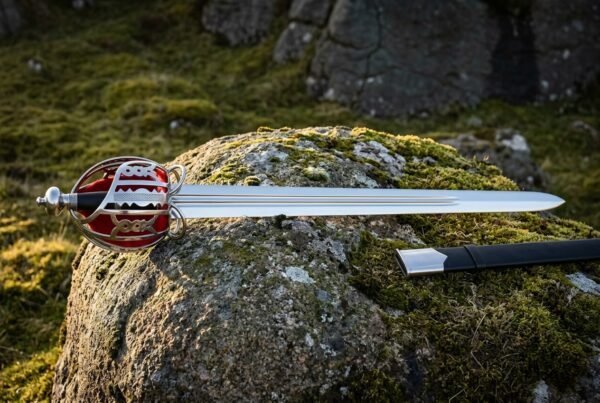
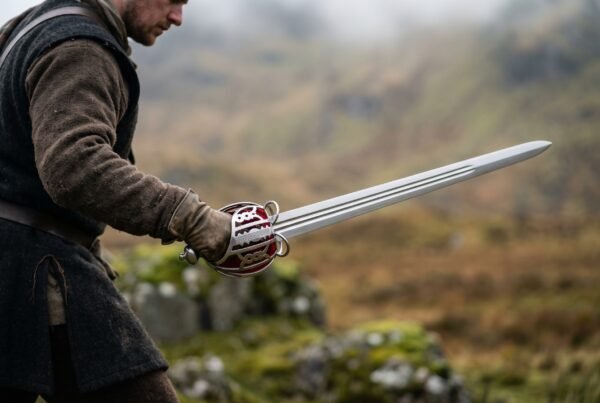
Bramblehilt Hand Forged 1095 Steel Basket Hilt Broadsword | 38 Inch Overall with a 32 Inch Blade | Pierced Steel Basket, Red Liner and Black Scabbard | Highland Collector Gift | RK-1738
Two swords, one name
Almost every argument about claymores is an argument about definitions, so it is worth settling first. Claidheamh mor is Gaelic for great sword. It was applied first to the two handed Highland sword of the fifteenth and sixteenth centuries, the one with a blade of four feet or more, a long grip and quillons that slope forward towards the point and finish in pierced quatrefoils. That is the sword on the West Highland grave slabs and it is unmistakable.
By the seventeenth century that sword had gone out of use and the name transferred to its replacement, the basket hilted broadsword. Shorter, one handed, double edged, and built around a cage of steel bars that encloses the whole hand. Highland soldiers carried it through the Jacobite risings and Scottish regiments carry a descendant of it on parade to this day. Purists will tell you only the two hander deserves the name. Three hundred years of Scottish usage disagrees with them, and the basket hilt is what most people mean when they say claymore.
The piece on this page is the second sword. It is a basket hilted broadsword and the description says so plainly rather than leaning on the more dramatic silhouette.
What the basket actually does
A crossguard protects your hand from a blade travelling down your own edge. It does very little against a thrust from an angle or a cut that comes in over the top, which is why the crossguard slowly grew hooks, rings, side bars and finally a full cage. The basket hilt is the end of that development and it is one of the most complete hand defences ever built into a sword.
The effect on how the sword is used is larger than it looks. With the hand fully enclosed you can hold a much stronger, more forward grip, because you are not holding anything back to keep your fingers out of the way. You can also parry with the hilt itself rather than only with the blade, and a steel cage against an incoming edge is a far more reassuring thing than a knuckle bow. What you give up is subtlety. A basket restricts how far your wrist can roll inside it, so the fine finger control that a rapier grip allows is simply not available.
The other consequence is fit. A basket is a fixed enclosure and your hand either fits inside it comfortably or it does not. That is worth reading twice before you order, and there is a section on it further down.
The liner, and why it is red
Inside the basket of a Scottish broadsword sits a liner, traditionally red cloth over leather, and it exists for two practical reasons that have nothing to do with looking good.
The first is that a bare steel cage against the back of your hand is unpleasant. Every knock the basket takes arrives at your knuckles, and a padded liner spreads and softens that. The second is corrosion. A liner keeps the sweat off the inside of the bars, which is the surface nobody can reach to clean and the first place a basket hilt starts to rust.
Red is the traditional colour and it stayed traditional because it is what regimental swords used. There is no deeper meaning to it. The liner on this sword is red cloth over leather, set inside the basket in the usual way.
The sword in this collection
One piece sits on this page. It is a functional basket hilted broadsword built to the pattern described above, and every figure below comes from its own specification panel.
The pierced basket hilt broadsword
Approximately 38 inches overall with a blade of approximately 32 inches, double edged, carrying twin narrow fullers. A fuller is a groove ground along the flat of a blade, and the reason for two narrow ones rather than one wide one is stiffness. Removing steel from the centre of the section while leaving the edges and the spine intact keeps the blade rigid and takes weight out of the part that does no cutting. On a 32 inch double edged blade that difference is what stops the sword feeling dead in the hand.
The steel is 1095 high carbon, hardened and tempered to 54 to 58 HRC, which is the house spec for a sword and is chosen so the blade springs back rather than taking a permanent bend. The finish is a satin polish on the blade with the hilt bars filed and polished.
The hilt is a pierced steel basket of wide flat bars, built bar by bar, welded and filed rather than cast in one piece. That is the difference between a basket that reads as a structure and one that reads as a lump. Inside it is the red cloth over leather liner. The grip is wrapped over a shaped wooden core inside the basket, and the pommel is bun shaped with a capstan, peened over the tang so it cannot loosen.
It is sharpened and sold as a collector and display sword. It comes with a black scabbard fitted with a steel throat and chape.
Lengths, steel and fittings
Every figure below is taken from the specification panel of the piece on this page. It is forged, ground and assembled by hand, so read the numbers as what to expect rather than as a guarantee to the millimetre.
| Sword | Steel and hardness | Overall length | Blade | Hilt and grip | Scabbard |
|---|---|---|---|---|---|
| Pierced basket hilt broadsword | 1095 high carbon, hardened and tempered to 54 to 58 HRC | About 38 in | About 32 in, double edged, twin narrow fullers, satin polished | Pierced steel basket of wide flat bars, welded and filed, red cloth over leather liner, grip over a shaped wooden core, bun shaped pommel with a capstan peened over the tang | Black with a steel throat and chape |
Two numbers do most of the work there. Thirty eight inches overall is a one handed length you can actually move with, and 54 to 58 HRC is the hardness range that lets a long double edged blade flex and return.
Sizing, fit and how it handles
The measurement that matters on a basket hilt is not the blade, it is your hand. A basket is a fixed cage and there is no adjusting it. If you have large hands, or you intend to wear a glove, check the internal dimensions against your own measurements before ordering rather than after. Most adults fit a standard Scottish basket without trouble, but the people who do not find out at a bad moment.
Overall length of about 38 inches puts this in the same class as a military broadsword rather than a great sword. It is used one handed, with the sword held out in front rather than cocked back, and the balance of a fullered double edged blade of 32 inches sits far enough forward to cut and far enough back to recover. That is the whole design brief of the type.
If you want a two handed Highland sword rather than this one, that is a different form and a much longer object. The zweihanders page carries the two handed swords at 48 inches and above, and the longswords page sits between the two.
Steel and hardness
Plain 1095 high carbon steel hardened and tempered to 54 to 58 HRC. That is one of only two steels we use, and on a sword it is the right one. High carbon steel at that hardness takes and holds an edge, polishes cleanly, and stays springy enough that a long thin blade bends and comes back instead of breaking. Push the hardness higher and the edge lasts marginally longer while the blade becomes brittle, which is a terrible trade on a 32 inch blade.
The alternative in our range is Damascus of 1095 and 15N20, forge welded and acid etched, hardened to 58 to 60 HRC. That is a pattern and a look rather than a different class of performance, and it lives on the Damascus swords page.
1095 is not stainless. It rusts if left wet or fingerprinted and it will take on a grey patina over years, which is stable and harmless. Our steel and hardness page explains what an HRC figure actually measures if the number means nothing to you yet.
Care, and the problem with baskets
The blade is easy. Wipe it after handling, because skin oil is mildly acidic and a fingerprint left on bare 1095 will etch into a satin polish within days. Then a light film of camellia, mineral or any food safe oil.
The basket is the part that needs thought, because it has dozens of interior surfaces you cannot see and cannot easily reach. Sweat sits in the corners where bars meet and that is where rust starts on every basket hilted sword that has ever been neglected. Use a soft cloth wrapped around a chopstick or a cotton bud to get oil into the junctions, and pay particular attention to the underside of the bars near the grip.
Do not soak the liner and do not let it stay damp. Red cloth over leather holds water exactly as well as leather does, which is to say far too well, and a damp liner sitting against steel is the fastest way to spoil the inside of a hilt.
Store the sword out of the scabbard if it is going to sit for months. Leather holds moisture against steel. Our care guide covers rust removal, and our stands and wall mounts page covers hanging it properly.
Engraving
The flats of the blade and the plain steel of the basket bars both take engraving, done in the US after the sword arrives. Names, dates, a regimental year or a line of Elder Futhark runes are the usual requests. Text engraving is 19 dollars, a symbol is 39 dollars and a family crest is 49 dollars.
A crest is the common choice on this particular sword, for obvious reasons, and the ricasso or the upper flat of the blade is where it sits best. Elder Futhark is a phonetic alphabet rather than a cipher, so a name is transliterated by sound and not letter for letter, and there is no rune for the letter C. Engraving is permanent and an engraved piece cannot be returned, so send the exact spelling and read it twice before you order.
Where this comes from and how it ships
Ransack Viking is a US company based in Chicago, Illinois. The sword is forged, ground, welded, filed, fitted and polished by hand in the Czech Republic, then imported, inspected and shipped from Chicago. Engraving is done in the US after arrival.
A pierced basket is the most labour intensive hilt we sell, because every bar is cut, bent, welded and filed individually before the whole thing is polished. That also means no two baskets are exactly alike. Small differences in the sweep of a bar or the shape of a pierced opening are normal and are the mark of the thing having been made rather than moulded.
How to choose
If what you want is the sword a Highland soldier actually carried, the one with the cage around the hand and the red liner inside it, this is the piece. It is a functional broadsword in the house steel with a fitted scabbard, and it is the most historically specific hilt on the site.
If what you want is the enormous two handed silhouette from the films, this is not it, and we would rather say that here than have you find out when the box arrives. Look at the zweihanders instead. If you want the basket without the Scottish pattern, our basket and shell hilt swords page carries the wider family, and broadswords covers the straight double edged blades with simpler hilts.
Browse related categories
- Swords, the full range
- Basket and shell hilt swords
- Broadswords with straight double edged blades
- Zweihanders, the two handed swords
- Longswords
- Anglo Saxon and Celtic pieces
- Sword stands and wall mounts
- Scabbards and sheaths
Guides worth reading first
- How to buy your first sword
- Display sword or battle ready, and what the terms mean
- Steel and hardness: what an HRC number tells you
- How to display swords and axes safely
- Full tang and partial tang explained
Frequently asked questions
Is a claymore two handed or one handed?
Both, depending on which sword you mean. The name applied first to the two handed Highland sword with forward sloping quillons, then transferred in the seventeenth century to the one handed basket hilted broadsword that replaced it. The sword on this page is the basket hilted one.
What is the basket for?
It encloses the whole hand, which is a far more complete defence than a crossguard. It also lets you take a stronger forward grip, because you are not holding back to keep your fingers clear, and it lets you parry with the hilt itself rather than only with the blade.
Why is the liner red?
Tradition, following regimental practice. The liner itself is there for two practical reasons: it softens the knocks the basket takes before they reach your knuckles, and it keeps sweat off the inside of the bars, which is the surface nobody can reach to clean.
What are the twin fullers for?
Stiffness without weight. A fuller is a groove ground along the flat of the blade, and taking steel out of the middle of the section while leaving the edges and spine intact keeps the blade rigid while removing mass from the part that does no cutting.
Will the basket fit my hand?
Almost certainly, but check rather than assume. A basket is a fixed cage with no adjustment, so if you have large hands or intend to wear a glove, measure against the internal dimensions before ordering.
Is it sharp?
Yes. It is sharpened and sold as a collector and display sword, in 1095 high carbon steel hardened and tempered to 54 to 58 HRC so the blade springs back rather than taking a set.
How do I stop the basket rusting?
Get oil into the junctions where the bars meet, using a soft cloth around a chopstick or a cotton bud, and pay attention to the underside of the bars near the grip. Never let the liner stay damp, and store the sword out of its scabbard if it will sit for months.
Where is it made?
Ransack Viking is a US company based in Chicago, Illinois. The sword is handmade in the Czech Republic, then imported, inspected and shipped from Chicago, with engraving added in the US after arrival.