Blog
Full Tang vs Partial Tang: Why It Matters in a Knife

A full tang is not magic. It is just more steel in the place where knives break. The tang is the part of the blade that extends into the handle: a full tang runs the whole length and width of the grip, with the scales pinned to a solid slab of steel, while a partial tang is anything less, a shorter or narrower extension glued, pinned, or wedged into the handle material. For hard-use fixed blades, full tang is the stronger construction and the safe default. But “full tang good, partial tang bad” is a slogan rather than an answer, and knowing where the difference actually matters will save you from both broken knives and weight you had no reason to carry.
What a Tang Actually Does
Every force you put through a knife, chopping, twisting, prying, batoning, travels from the edge, through the blade, into the tang, and out through your hand. The tang is the structural bridge between cutting steel and grip. If that bridge is a full-width slab of the same steel as the blade, stress spreads across a large cross-section. If the bridge narrows to a thin rod or stub, stress concentrates at the transition point, which is exactly where partial-tang knives break when they fail. Tang design is therefore a strength decision first and a balance decision second. Every claim made about it in a product listing sits downstream of those two.
Full Tang: Strengths and Trade-Offs
In a full-tang knife you can usually see the steel sandwiched between the handle scales, running as a visible spine of metal around the whole grip. That visibility is itself a quality signal. Nothing is hidden, so nothing has to be taken on faith. Full tang gives maximum resistance to bending and snapping at the handle junction, keeps working even if the handle scales crack off (the bare tang is still a usable grip), and adds rearward weight that many users feel as solid, confident balance. The trade-offs are modest: more weight overall, exposed steel that can feel cold in winter, and, on carbon-steel knives, a bit more metal to keep oiled. Nearly all serious fixed blades use it, from hunting knives and Bowie knives to camp workhorses.
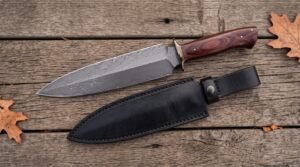
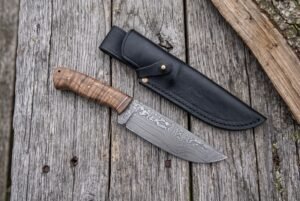 Vampire Hand Forged Damascus Skinner Knife with Stabilized Wood Handle and Fiber and Brass Spacers & Leather Sheath | Full Tang Hunting Camping and Anniversary Gift | RK-330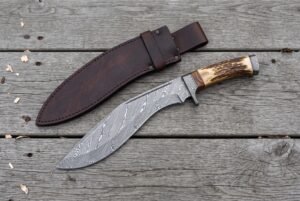
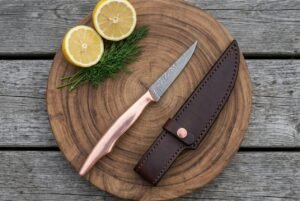
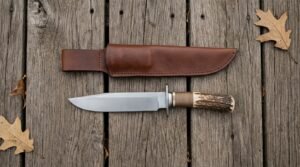 Hollowfell Hand Forged High Carbon Steel Camp Knife with Stag Horn and Hollow Thread Wrapped Handle and Steel Guard and Bolster | Survival Camping Gift | RK-585
Partial Tang Types, Ranked Roughly by Strength
Hidden tang (through tang)
A substantial tang runs most of the way through a solid handle and is often secured with a pin or a pommel nut. Done well, as on traditional hunting knives, many Viking seax knives, and countless historical swords, a hidden tang is strong enough for real work while allowing beautiful one-piece handles of wood, bone, or horn. History’s hardest-working blades were mostly hidden tang; the design is proven, but its strength depends entirely on the maker’s fit and the tang’s actual size, which you cannot see.
Push tang / stub tang
A shorter tang inserted partway into the handle and secured with adhesive or a pin. Fine for light-duty cutting; vulnerable if the knife is used for chopping or prying.
Rat-tail tang
The tang narrows into a thin threaded rod running to a pommel nut. This is the weakest common construction, and the one behind most “the handle snapped off” stories on cheap display swords. On a piece bought for the wall it is acceptable. On anything you actually intend to cut with, it is a red flag.
Full Tang vs Partial Tang at a Glance
| Factor | Full Tang | Partial / Hidden Tang |
|---|---|---|
| Strength at handle joint | Maximum, solid steel slab | Good to poor, depending on tang size and fit |
| Failure behavior | Scales may crack; steel survives | Can snap at the tang transition under abuse |
| Weight | Heavier, rear-balanced | Lighter, blade-forward or neutral |
| Handle options | Two scales pinned to steel | One piece wood, bone, horn, or stacked handles |
| Verification by eye | Steel visible around the grip | Hidden, you trust the maker |
| Best for | Hard-use fixed blades, survival, batoning | Hunters, kitchen knives, traditional and lighter tasks |
Does Full Tang Always Win?
No. This is the point where honest advice and product copy part company. For a survival knife you may baton through firewood, full tang is the right call, period. But a well-made hidden-tang hunting knife is entirely strong enough for skinning and processing game, and its solid handle can be warmer, more comfortable, and more traditional in the hand. Kitchen knives almost never need full-tang strength. Nobody batons through a carrot, and balance and comfort matter far more at a cutting board. And folding knives sit outside the debate entirely, a folder’s pivot, not a tang, is its structural limit, which is why even well built folding pocket knives should never be pried with. Match the construction to the job, not to a slogan.
How to Check What You’re Buying
On a claimed full-tang knife, look for the steel line running around the entire handle perimeter and for pins or bolts passing through scales and steel together. Beware of “false full tang” builds where a skeletonized or partial core is hidden under wraparound handle material, if you cannot see the steel edge-on anywhere, ask the maker directly. For hidden-tang knives, the honest questions are: how far does the tang run, how thick is it, and how is it secured? A maker proud of the construction answers precisely. A vague answer is also an answer. Product photos that show the tang before handle assembly are the gold standard of transparency; it is one reason hand-forged makers often photograph blades in progress, whether for a skinner or for larger forged pieces like Viking axes, where the equivalent question is how the head is hung on the haft.
Full Tang vs Partial Tang FAQ
What does full tang mean on a knife?
Full tang means the blade steel continues through the entire handle at (or near) its full width and length, with handle scales attached to either side of the steel. You can usually see the tang as a line of metal running around the perimeter of the grip.
Is a full tang knife really stronger?
At the handle junction, yes, and only there. A full-width steel slab resists bending and snapping far better than a narrowed tang, and if the scales break off you still have a usable knife, albeit an uncomfortable one. That is why survival and hard-use fixed blades are almost universally full tang. It does nothing at all for the edge.
Are partial tang knives bad?
Not inherently. A properly fitted hidden tang has served hunters and swordsmen for centuries and is plenty strong for cutting tasks. The problem designs are short stub tangs and thin rat-tail tangs on knives sold for heavy outdoor work, which concentrate stress in exactly the spot you would least like it concentrated.
How can I tell if a knife is full tang?
Look for exposed steel running around the whole handle between the scales, plus pins or bolts passing through both. If the handle wraps the steel completely and no tang is visible anywhere, you cannot verify the construction by eye, ask the seller what is inside.
Is full tang important in a kitchen knife?
Less than in a field knife. Kitchen work never stresses a handle joint the way batoning or chopping does, so balance, comfort, and blade quality matter more. Many excellent kitchen knives use partial tangs deliberately to shift balance toward the blade.
Do folding knives have a tang?
Only a vestigial one. The blade ends at the pivot, and the pivot is the folder’s real structural limit. No folding knife, however well built, matches a full-tang fixed blade for prying or chopping, which is why a folder used as a crowbar tends to become two separate objects.
Tang construction is only one of the things to check, and the rest are in our knife buying guide. A gut hook shows why the tang matters under load, covered in the gut hook knife. For the steel itself, see what Damascus steel is and the steel terms glossary.
From the shop
The catalogue carries the Inkbraid kukri and the Coalspine kukri. So do the Greyfell skinner knife and the Ebonknot tanto knife.
An argument you can skip
Tang questions get very quiet when the whole sword is one piece of leather. The Reifholm leather dussack has an integral leather grip and a cut through hand hole, and the dussack guide explains why people train with one. The steel versions sit under HEMA sabres.
Shop the range
Vampire Hand Forged Damascus Skinner Knife with Stabilized Wood Handle and Fiber and Brass Spacers & Leather Sheath | Full Tang Hunting Camping and Anniversary Gift | RK-330Hollowfell Hand Forged High Carbon Steel Camp Knife with Stag Horn and Hollow Thread Wrapped Handle and Steel Guard and Bolster | Survival Camping Gift | RK-585