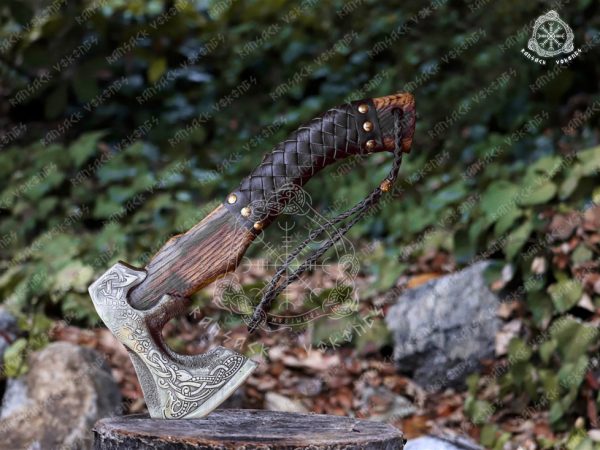
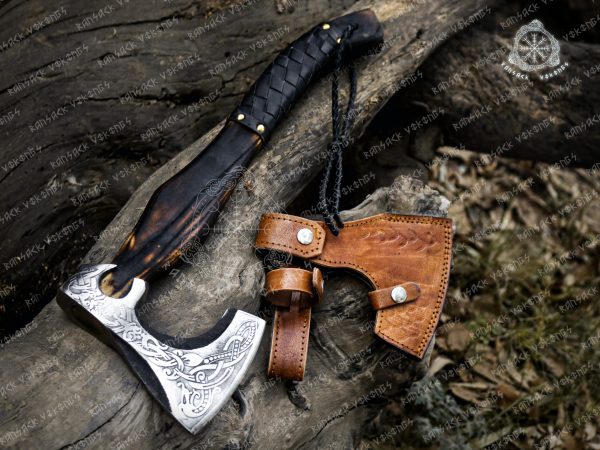
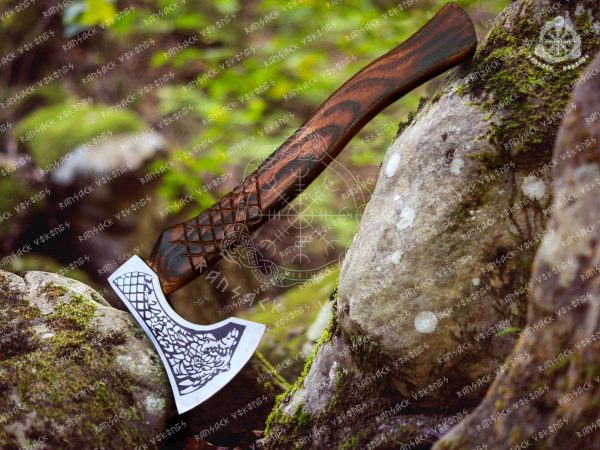
The Viking axe was the common tool of the North. It felled timber, split firewood, shaped planks for a hull and, when it had to, went to the shield wall. This collection follows that spread, from 14 inch hatchets and hand axes through bearded axes at 15 to 22 inches, up to Dane axes on 32 to 34 inch hafts, plus throwing axes, tomahawks, felling axes and wall mounted display pieces.
Heads are forged in plain 1095 high carbon, hardened to 54 to 58 HRC at the edge with a softer eye and poll, or in 1095 and 15N20 Damascus at 58 to 60 HRC. Cutting edges run from 3.5 inches on a throwing axe to 10 inches on a long bearded crescent. Hafts are ash, hickory, birch, oak, walnut or rosewood, wedged or pinned through the eye, and most axes ship with a leather blade cover.
For a hand forged Viking axe you will actually pick up and use, start at 15 to 19 inches overall. Go past 26 inches only if the piece is going on a wall or into a reenactment kit. If you are weighing a full sized axe against something smaller for camp, the difference between an axe and a hatchet comes down to haft length and how you grip it.
Most axes here take a custom engraving on the head or haft, chosen on the product page before checkout.
Free US shipping
On most pieces. Heavier and oversized ones carry a flat charge.
Hand Forged
Heated, hammered and ground by hand.
Engraving available
Names, dates or Norse runes on most pieces.
Ships from Memphis
Inspected and dispatched from our Tennessee warehouse. No import duty, no customs delay on US orders.
Viking Axes
What makes an axe a Viking axe
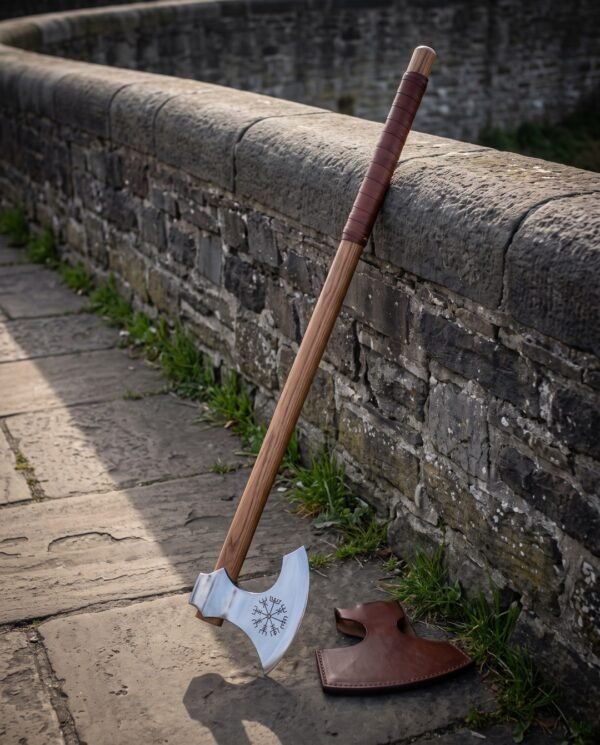
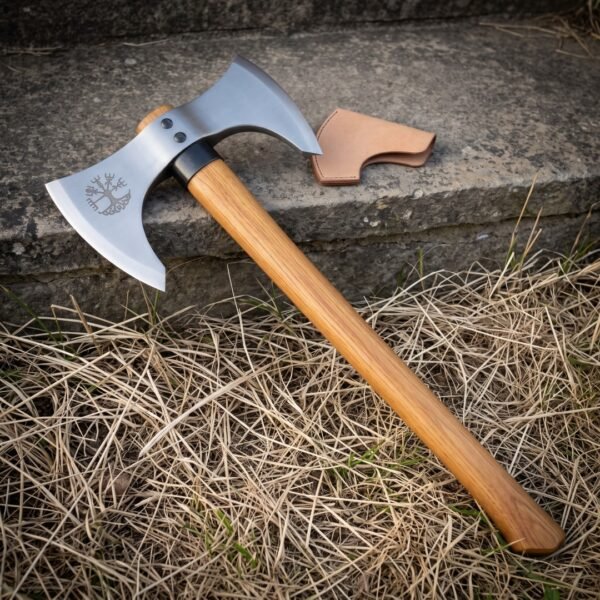
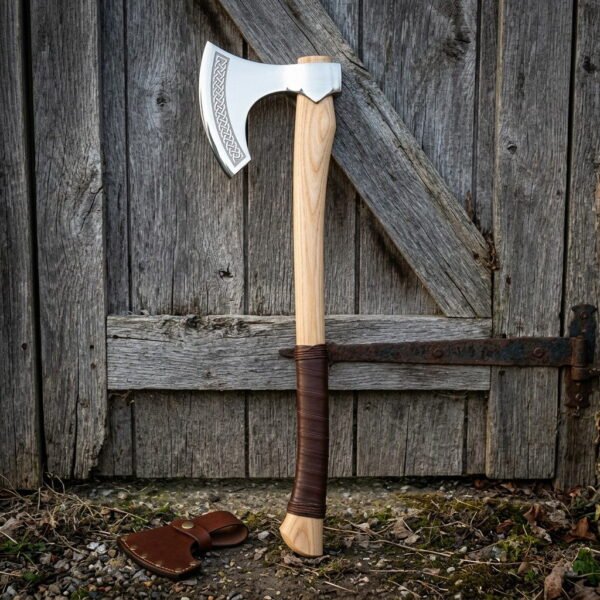
Norse axe heads share a set of features that have nothing to do with decoration. The head is thin through the cheeks and light for its cutting width, because iron was expensive and a heavy head is tiring on a long day. The eye is a wrapped socket rather than a drilled hole. And the edge is very often bearded, meaning the lower corner of the bit drops below the eye and hangs down as a hook of steel.
The beard earns its keep. It buys cutting edge without adding weight, so a small light head still takes a long bite. It leaves a gap behind the edge so you can choke up and grip the haft under the head for fine work. And it gives you a hook for pulling a shield rim, a branch or a plank towards you. That is why the bearded axe, the skeggox in Old Norse, is the profile most people picture when they think of a Norse axe.
Size varied more than people expect. A Viking farm axe was a modest tool on a short haft. At the other end sat the Dane axe, a broad crescent bit on a haft past 30 inches, used two handed by huscarls and shown on the Bayeux Tapestry. Both are here, and they are not interchangeable.
The types in this collection
Nine families cover the range. Once you know which one you want, the remaining decisions are haft length, steel and whether you want the head engraved.
Bearded axe
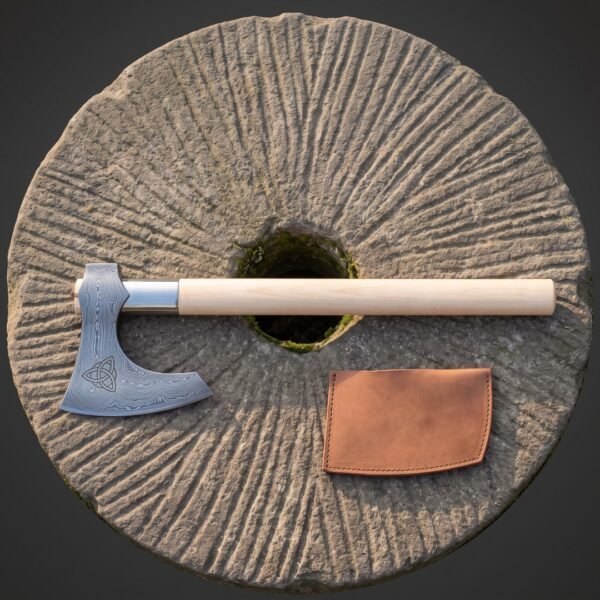
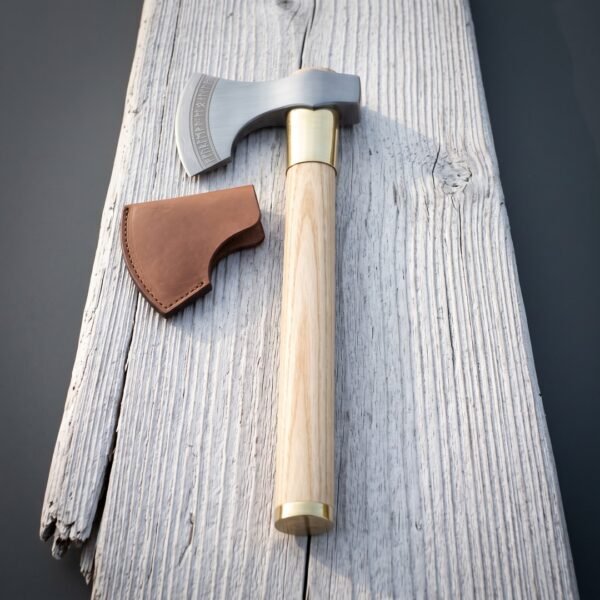
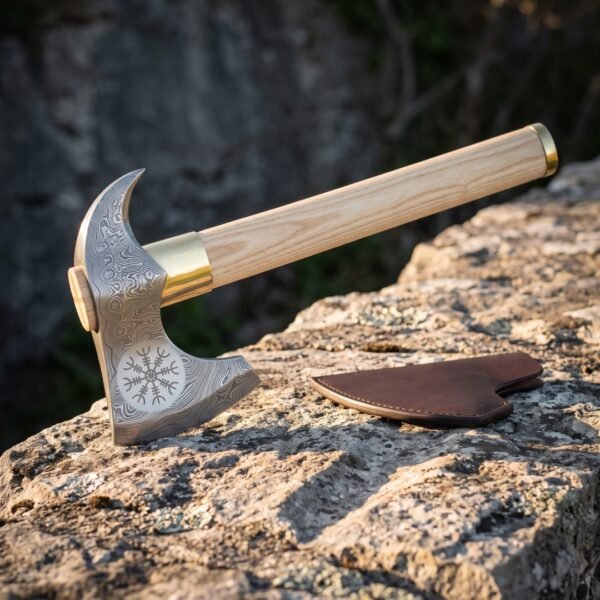
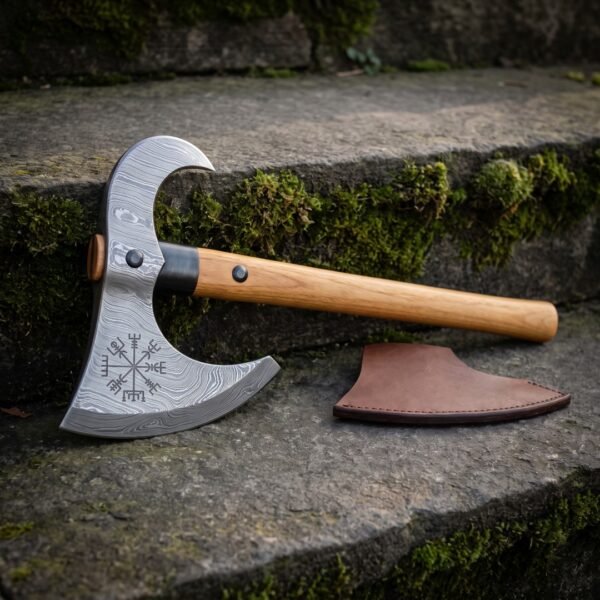
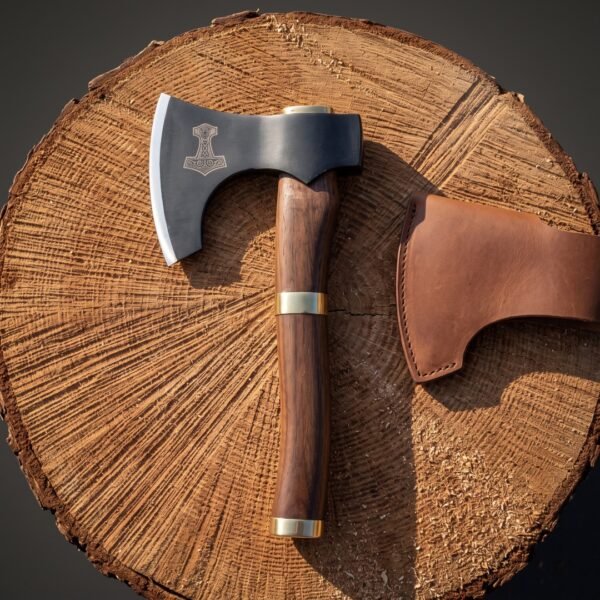
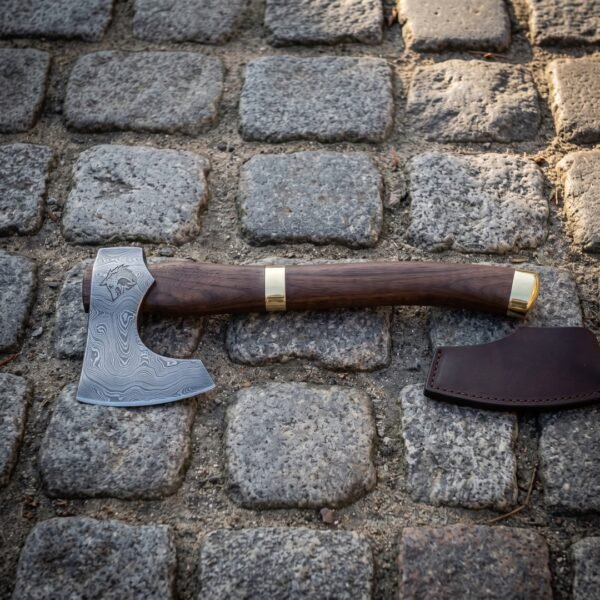
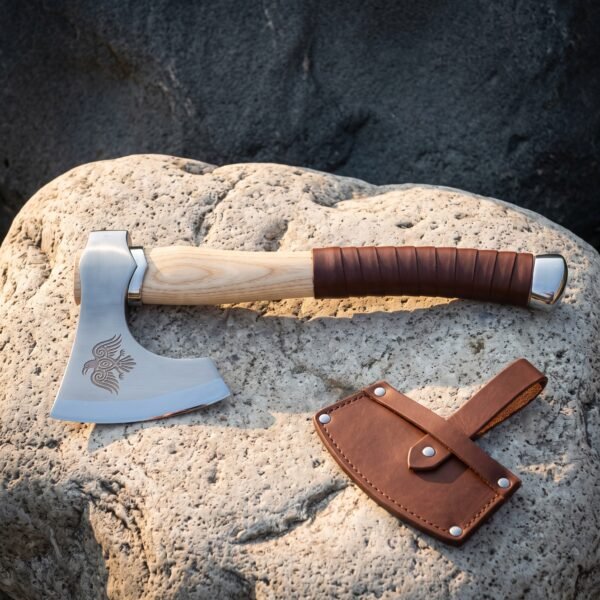
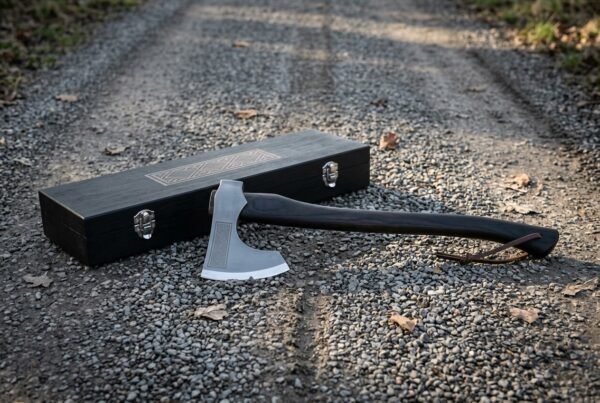
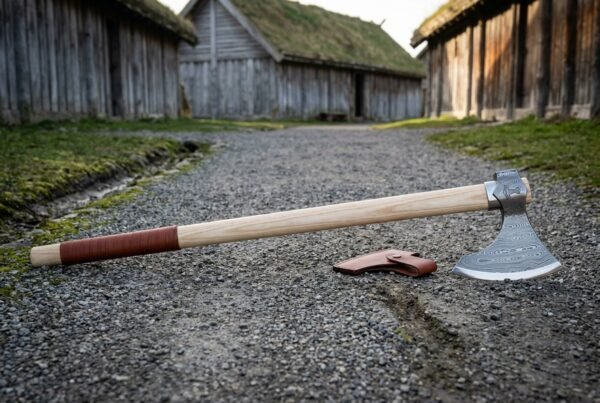
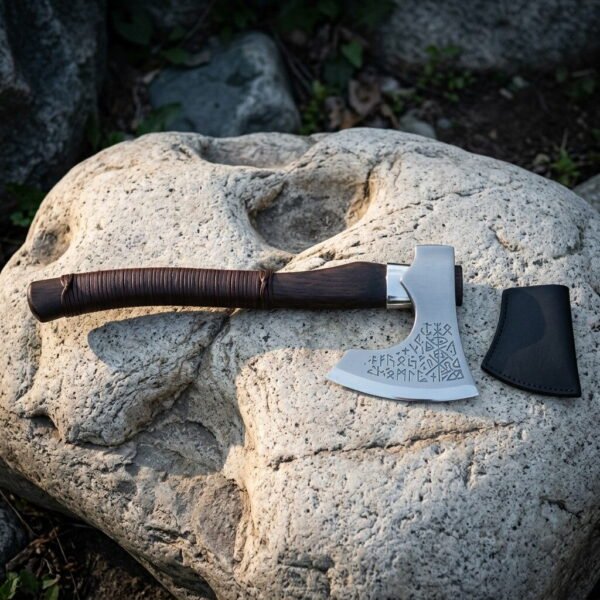
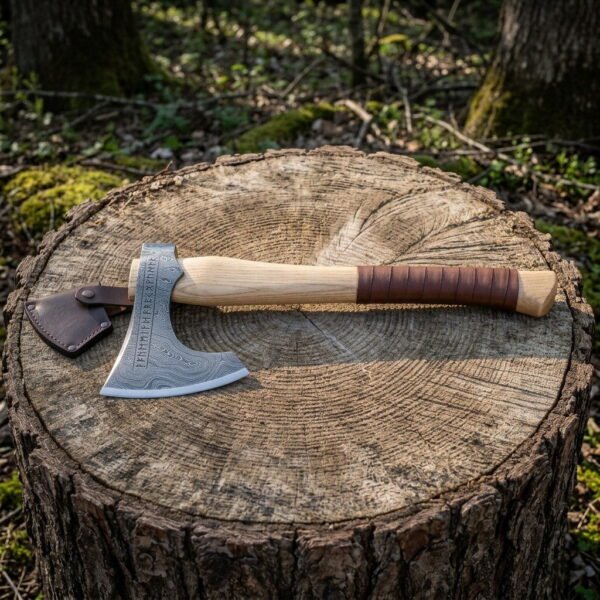
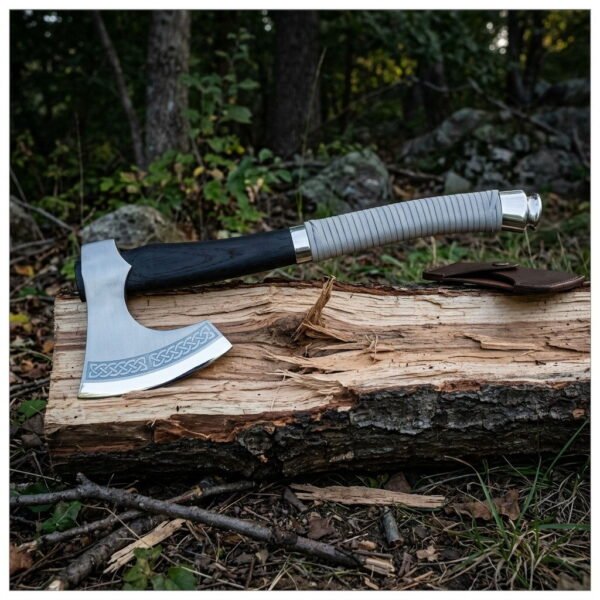
The largest group and the natural starting point. One handed bearded axes here run 15 to 20 inches overall with 4 to 5.75 inches of cutting edge from horn to beard tip. Longer hafted versions reach 22 to 28 inches with 4.5 to 6 inches of edge. Heads come in 1095 at 54 to 58 HRC or Damascus at 58 to 60, and many are engraved on the cheek with a valknut, triquetra, vegvisir, wolf head, longship or rune band. Hafts include ash, birch, oak, walnut and rosewood, some with a brass collar at the eye or a leather wrapped grip.
Dane axe
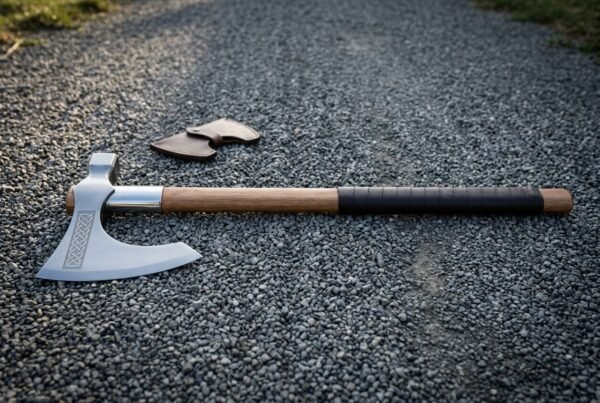
The long one. Dane axes here measure 28 to 34 inches overall with 6 to 10 inches of curved cutting edge, on straight ash hafts often cord or leather wrapped. The broad crescent versions carry a bit 11 inches from horn to horn with a deep cut Elder Futhark rune band on both faces, hardened to 56 to 58 HRC at the edge with a soft eye and poll, and weigh around 4 lb 6 oz. A two handed piece with real reach, bought for display and living history rather than for splitting logs.
Battle axe and war axe
Heavier heads on medium to long hafts, from 21 inches up to 32, with 5 to 6 inches of edge and complete weights of about 2 lb 10 oz to 3 lb 4 oz. Several are hammer finished across the cheeks rather than polished, so the forging marks stay visible. Hardness is usually 52 to 55 HRC at the edge with a soft eye and poll, the right choice for a head that takes impact rather than only cutting wood.
Hand axe and Viking hatchet
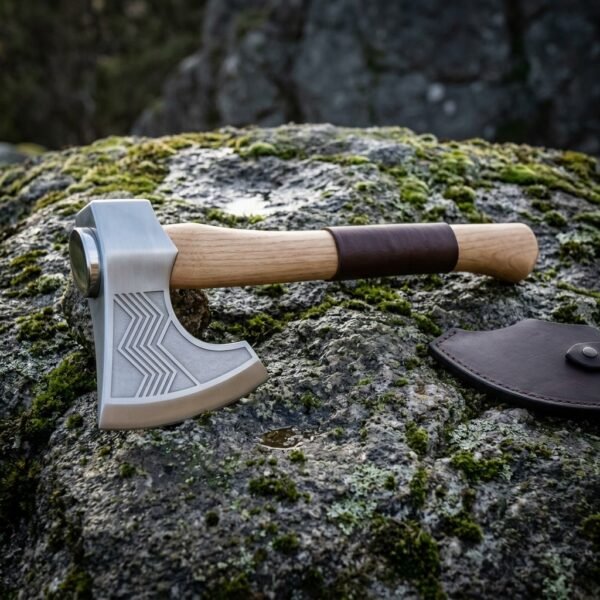
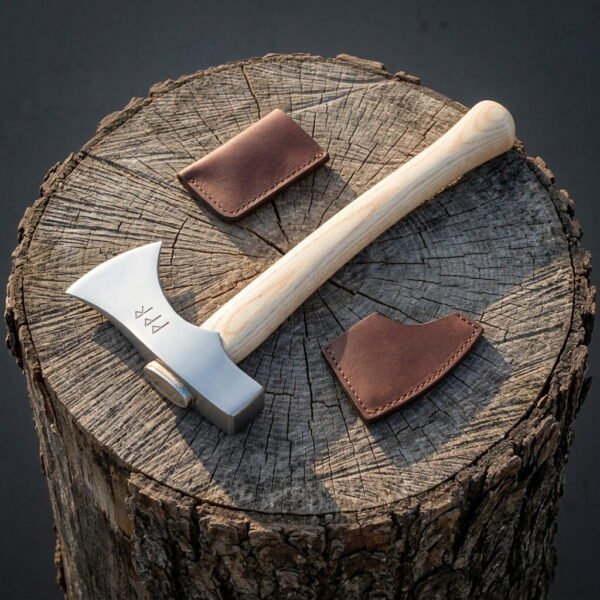
The practical end of the collection. A Viking hatchet here runs 14 to 16 inches overall with about 4 inches of usable edge, weighing near 1 lb 10 oz to 1 lb 14 oz. Hafts are curved hickory or straight grained ash with a swelled heel, wedged with wood and sometimes a bronze pin. This is the size that goes in a pack, splits kindling and still looks right on a belt at an event.
Double headed axe
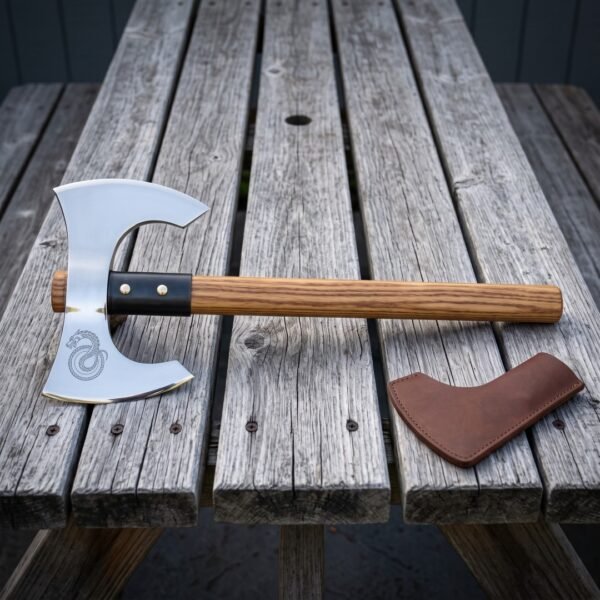
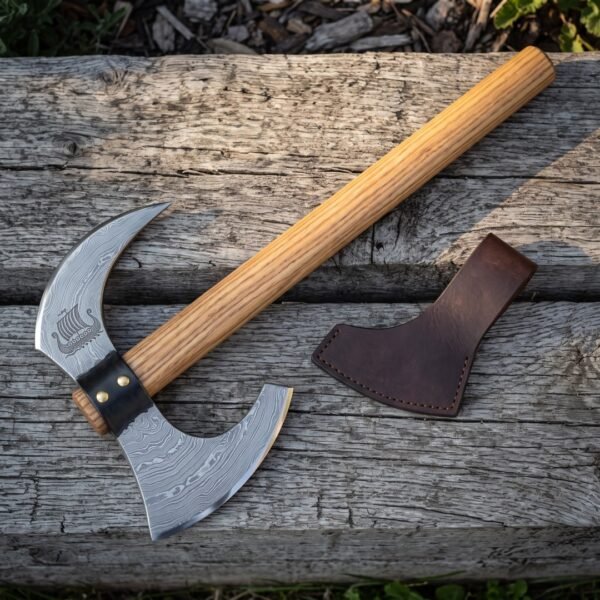
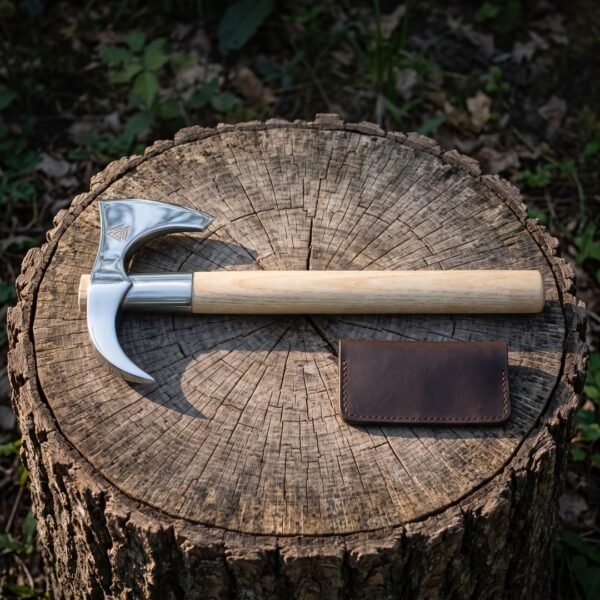
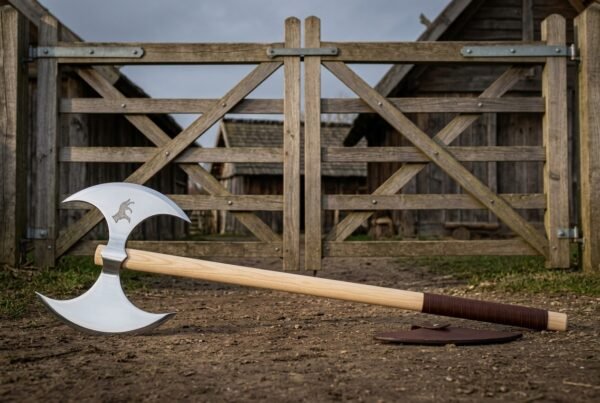
Two bits on one head, either a matched pair of crescents or a bearded forward bit with a hooked rear beak. Sizes run 19 to 34 inches overall, the largest carrying two crescent bits of roughly 7 inches of arc each at about 4 lb 8 oz. Compact 19 inch versions list around 9 inches of combined edge at 1.53 kg. The double bit is not a Norse form, it is a much later logging pattern, so buy one for the symmetry rather than the accuracy.
Throwing axe and tomahawk
Built to be thrown, and tuned for it. The throwing set of three is 15 inches each with a 3.5 inch edge, left softer at 50 to 53 HRC because a hard edge chips when it hits a knot or the frame. Tomahawks run 14 to 20 inches overall with 3.5 to 5.5 inches of edge, in 1095 at 54 to 56 HRC with a blackened finish, or Damascus at 58 to 60 on a rosewood haft. Throwing eats hafts, so buy a spare.
Felling and splitting axe
Working axes with no Norse styling. Felling patterns are 28 inches overall on straight grain hickory hung with a wooden wedge, with a 4 inch bit at 54 to 56 HRC and a softer body and eye. A shorter forest axe runs 20 to 21 inches with a 4 to 4.5 inch edge on a curved hickory haft with a lanyard hole. If the axe will meet wood every week, buy from this group rather than the engraved display pieces.
Display axes and wall plaques
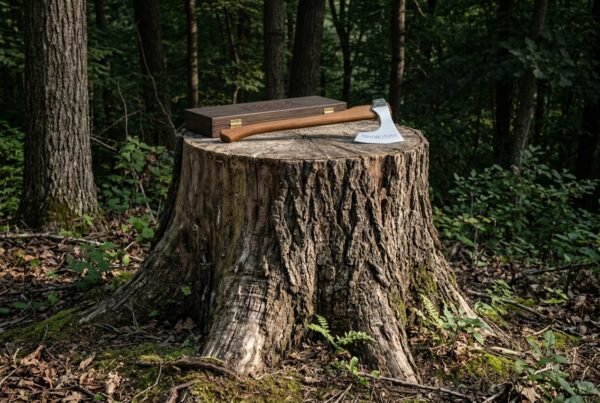
Bearded heads mounted on solid oak or walnut boards, some with carved raven detail, some with a rune carved mount or a presentation box. The heads are forged high carbon at 54 to 58 HRC, not castings. They are the easiest pieces here to give as a gift, since they arrive ready to hang with nothing else to buy.
Pizza axe
A kitchen tool wearing an axe shape, with a 12 inch curved stainless blade on an olive wood handle. Stainless is the right call here for the same reason it is on a kitchen knife, since the blade lives near water. It cuts a pizza in one rocking pull, and it is the safest gift on the site for someone who already owns knives.
Sizes and steel across the range
Every figure below comes from the specification panel of a product on this page. Heads are forged and ground by hand, so read these as ranges rather than promises.
| Type | Overall length | Cutting edge | Steel and hardness | Haft | Best for |
|---|---|---|---|---|---|
| Bearded axe, one hand | 15 to 20 in | 4 to 5.75 in | 1095 at 54 to 58 HRC, or Damascus at 58 to 60 | Ash, birch, oak, walnut, rosewood | General use, gifts, engraving |
| Bearded axe, long haft | 22 to 28 in | 4.5 to 6 in | 1095 at 54 to 58 HRC, or Damascus at 58 to 60 | Ash or dark hardwood, leather wrapped grip | Two hand display and reenactment |
| Dane axe | 28 to 34 in | 6 to 10 in | 1095 at 56 to 58 HRC at the edge, soft eye | Ash, straight, cord or leather wrapped | Long reach display pieces |
| Battle axe | 21 to 32 in | 5 to 6 in | High carbon at 52 to 55 HRC at the edge | Ash or hardwood, oiled, leather butt | Reenactment and wall display |
| Hand axe and hatchet | 14 to 16 in | About 4 in | 1095 at 54 to 58 HRC | Curved hickory or straight ash, wedged | Camp work and kindling |
| Double headed axe | 19 to 34 in | 7 to 9 in across both bits | 1095 at 54 to 58 HRC, or Damascus at 58 to 60 | Ash, walnut, dark hardwood | Display and collecting |
| Throwing axe | 15 in each | 3.5 in each | High carbon at 50 to 53 HRC, softer on purpose | Hardwood | Target throwing |
| Tomahawk | 14 to 20 in | 3.5 to 5.5 in | 1095 at 54 to 56 HRC, or Damascus at 58 to 60 | Rosewood or hardwood | Throwing and camp use |
| Felling and splitting axe | 20 to 28 in | 4 to 4.5 in | 1095 at 54 to 56 HRC at the bit, soft body | American hickory or ash, wedged | Cutting and splitting wood |
| Pizza axe | Not listed | 12 in blade | Stainless, as stated on those pieces | Olive wood | Kitchen |
Complete weights run from about 1 lb 10 oz for a small hand axe to 4 lb 8 oz for the largest double headed piece, with most bearded axes near 1.23 kg, roughly 2 lb 11 oz. Weight matters more than length for how an axe feels. A 19 inch head heavy axe tires you faster than a 22 inch one with a lighter bit.
Steel, hardness and why the eye is soft
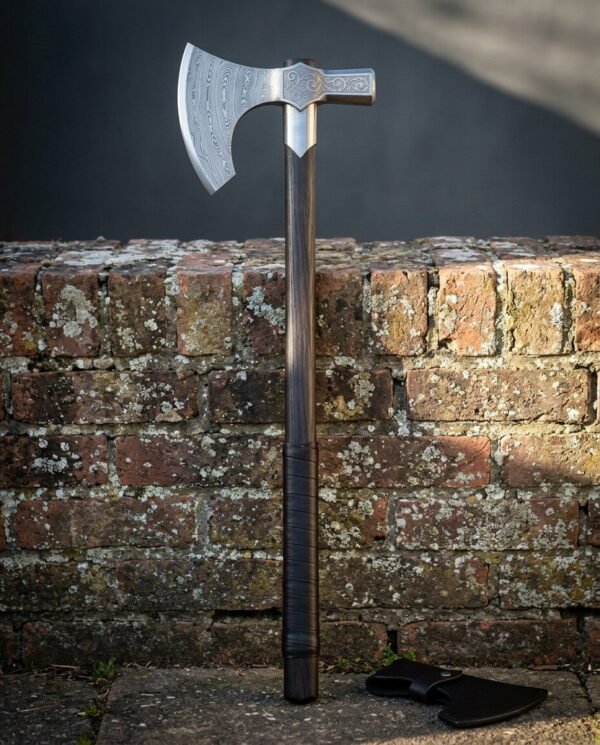
Two steels appear across the collection. Plain 1095 high carbon, hardened to 54 to 58 HRC, is the standard head. Damascus of 1095 and 15N20, forge welded and acid etched, runs 58 to 60 HRC and shows the layered pattern across the cheeks. A few heads sit lower, at 50 to 55 HRC, and that is deliberate.
Hardness on an axe is not a score to maximise. A bit at 60 HRC holds an edge beautifully and chips when it meets a knot or a nail. That is fine on a knife and a problem on a tool you swing. The traditional answer, used on most of these heads, is a hard edge and a soft body: the bit hardened where it cuts, the eye and poll left softer so the head absorbs shock without cracking around the socket. Several products state exactly that. Throwing axes go further and sit at 50 to 53 HRC across the head, because every throw is an impact.
So do not read a 52 to 55 HRC battle axe as inferior to a 58 to 60 HRC Damascus one. They are heat treated for different jobs. If you are buying to cut wood, a softer, tougher head is the better tool. If you are buying for the pattern and the wall, take the Damascus.
Hafts, hanging and what to check
Haft material is not decoration. Ash and hickory are the timbers used for striking tools everywhere, because they are strong along the grain and bend rather than snap. Ash is lighter and springier, hickory denser and better under shock. Birch, oak, walnut and rosewood appear mostly on display and gift pieces, and they look better than they perform under repeated impact.
Check two things on any axe you mean to swing. First, grain orientation, read from the butt of the haft: you want the growth rings running roughly parallel to the bit, not across it. Second, the hang. Most of these are wedged with wood, some pinned with steel or bronze, a few with a collar at the eye. A head should not move when you grip the haft and twist.
Wood shrinks in dry indoor heat, which loosens a hang. If an axe has spent a winter next to a radiator and the head feels slightly loose, that is normal and fixable. Drive the wedge deeper, or soak the head end briefly and let it dry. Never keep swinging a loose head. Replacement hickory hafts are available.
Sharpening, rust and storage
An axe edge is sharpened with a file and a stone, not on a bench grinder. A grinder builds heat fast and heat pulls the temper out of the bit, which is the one damage you cannot undo at home. Use a mill file for the coarse work, following the existing bevel, then a round puck stone in circles on each side, and a strop if you want the edge to shave. A felling axe wants a slightly convex edge. A camp axe can take a thinner one.
High carbon steel rusts, and the eye and the area under a leather cover are where it starts. Wipe the head dry, leave a light film of oil on the steel, and do not store an axe with a damp cover strapped over the bit for months. If orange spotting has appeared, fine abrasive and oil lift it. Grey patina is stable and can be left.
Engraving and gifts
Most axes here can be engraved in the United States after they arrive, which is where the rune bands, valknuts, names and dates on the cheeks come from. Elder Futhark is phonetic, so a name is transliterated by sound and there is no rune for the letter C. Engraving is permanent and an engraved piece cannot be returned, so send the exact spelling and read it twice. A bearded axe with a wedding date on the cheek is a common groomsman gift, and unlike most gifts of that kind it gets used.
Where these axes are made
Every head on this page is forged by hand in the Czech Republic and hung there. Finished axes are imported to the United States, inspected by Ransack Viking in Memphis, Tennessee, and shipped from there, with engraving added after arrival. Because each head is made individually, two axes of the same name differ slightly in bit shape, hammer finish and haft colour.
Browse related categories
- Bearded axes with the classic dropped Norse beard
- Battle axes on medium and long hafts
- Dane axes with broad crescent bits
- Double headed axes with two cutting bits
- Throwing axes tuned softer for impact
- Tomahawks for throwing and camp use
- Splitting and felling axes for real wood work
- Replacement hickory axe handles and hafts
- Viking knives to pair with an axe on the belt
Guides worth reading first
- How to choose a Viking axe: head, haft and what it is for
- What is a bearded axe? The Viking axe shape explained
- Battle axe vs bearded axe: which one do you want
- The Dane axe: the long axe of the huscarls
- How to sharpen an axe with a file, stone and strop
- Axe against hatchet, where the line actually falls
Frequently asked questions
What is a Viking axe called?
The Old Norse word for axe is ox, and the bearded form is the skeggox, from skegg meaning beard. The long two handed axe carried by huscarls is called a Dane axe in English. Old Norse names other types too, such as the breidox or broad axe, though modern sellers use those labels far more loosely than the sources do.
What is the difference between a bearded axe and a battle axe?
Bearded axe describes the shape of the head, with the lower corner of the bit dropping below the eye. Battle axe describes the intended use, and says nothing about profile. Plenty of bearded axes are battle axes and plenty are farm tools. In this collection the bearded axes are generally lighter with 4 to 6 inches of edge, while the pieces listed as battle axes are heavier heads on 21 to 32 inch hafts.
What is the difference between a Viking axe and a hatchet?
Length and intent. A Viking hatchet here is 14 to 16 inches overall with about 4 inches of edge, made to be used one handed for kindling and camp jobs. A Viking axe in the broader sense covers anything from that up to a 34 inch Dane axe. A hatchet is a tool you pack. A 30 inch axe is not.
Do these axes arrive sharpened?
Yes. Every bit is ground and honed by hand and arrives with a working edge that will cut wood out of the box. It is not a razor edge, and it should not be, because a thin edge on an axe chips the first time it meets a knot. A file and a puck stone will take any of them further.
Are these axes battle ready?
They are hand forged high carbon heads, properly heat treated, hung on solid hafts, so they are functional tools rather than cast display copies. They are sold for cutting, throwing, collecting, display and reenactment. Ransack Viking does not test or certify any piece for contact use against another person, and nothing here should be swung at anyone.
Can I use a Viking axe for camping or splitting wood?
Yes, and the hand axes, hatchets and felling axes are made for exactly that. Choose one of those rather than a Damascus display axe, since a 58 to 60 HRC edge is more likely to chip on a knot than a softer working bit. Keep the head tight in the eye and keep the edge covered when it is in a pack.
Can I get a name or runes engraved on the head?
Yes, on most axes here. Engraving is done in the United States after the axe arrives from the maker. Elder Futhark is a phonetic alphabet, so names are transliterated by sound and there is no rune for the letter C. Engraved pieces cannot be returned, so check the spelling before you order.
Where are these axes made?
They are forged and hung by hand in the Czech Republic, then imported, inspected and shipped by Ransack Viking from Memphis, Tennessee, with engraving added in the United States after arrival.