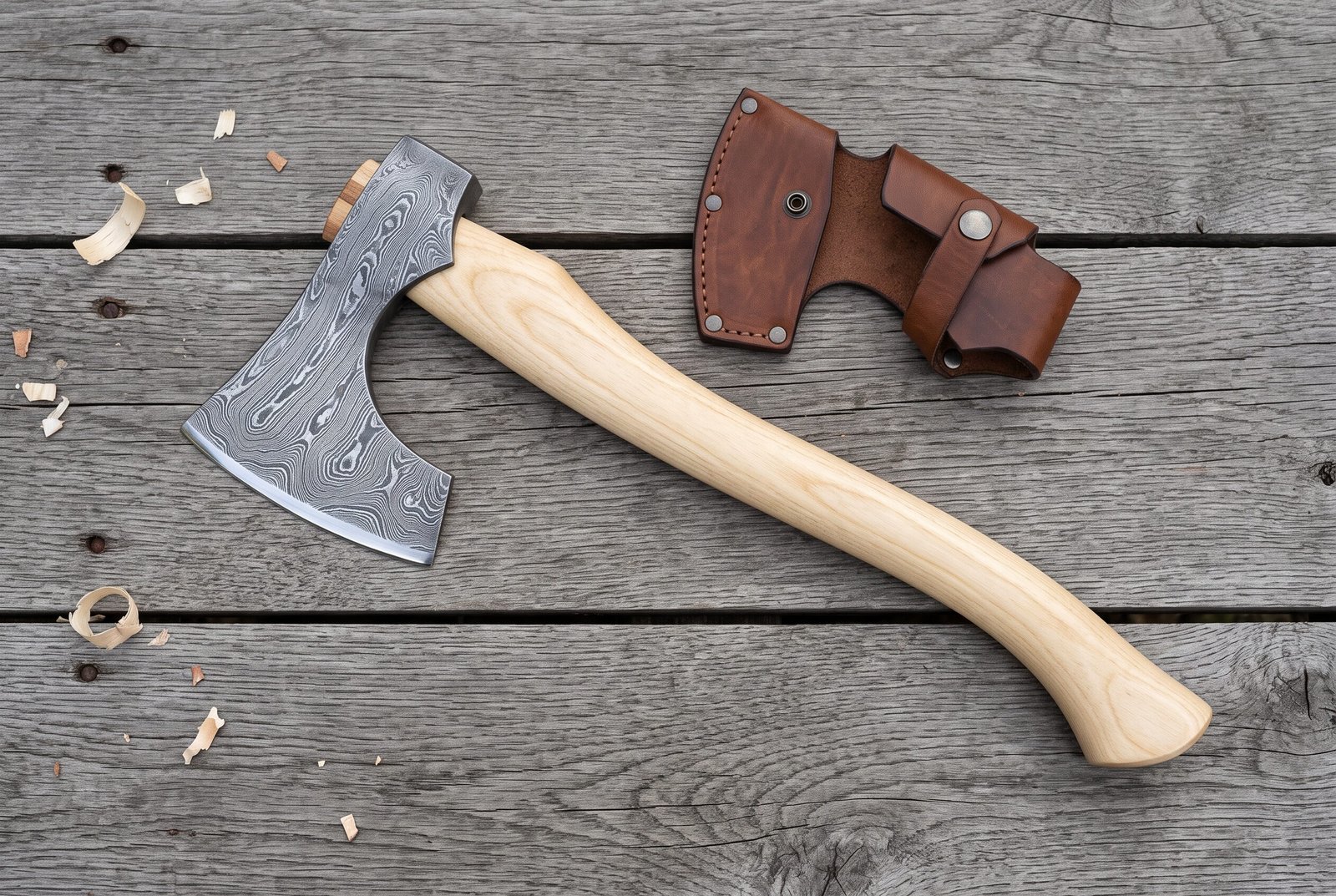
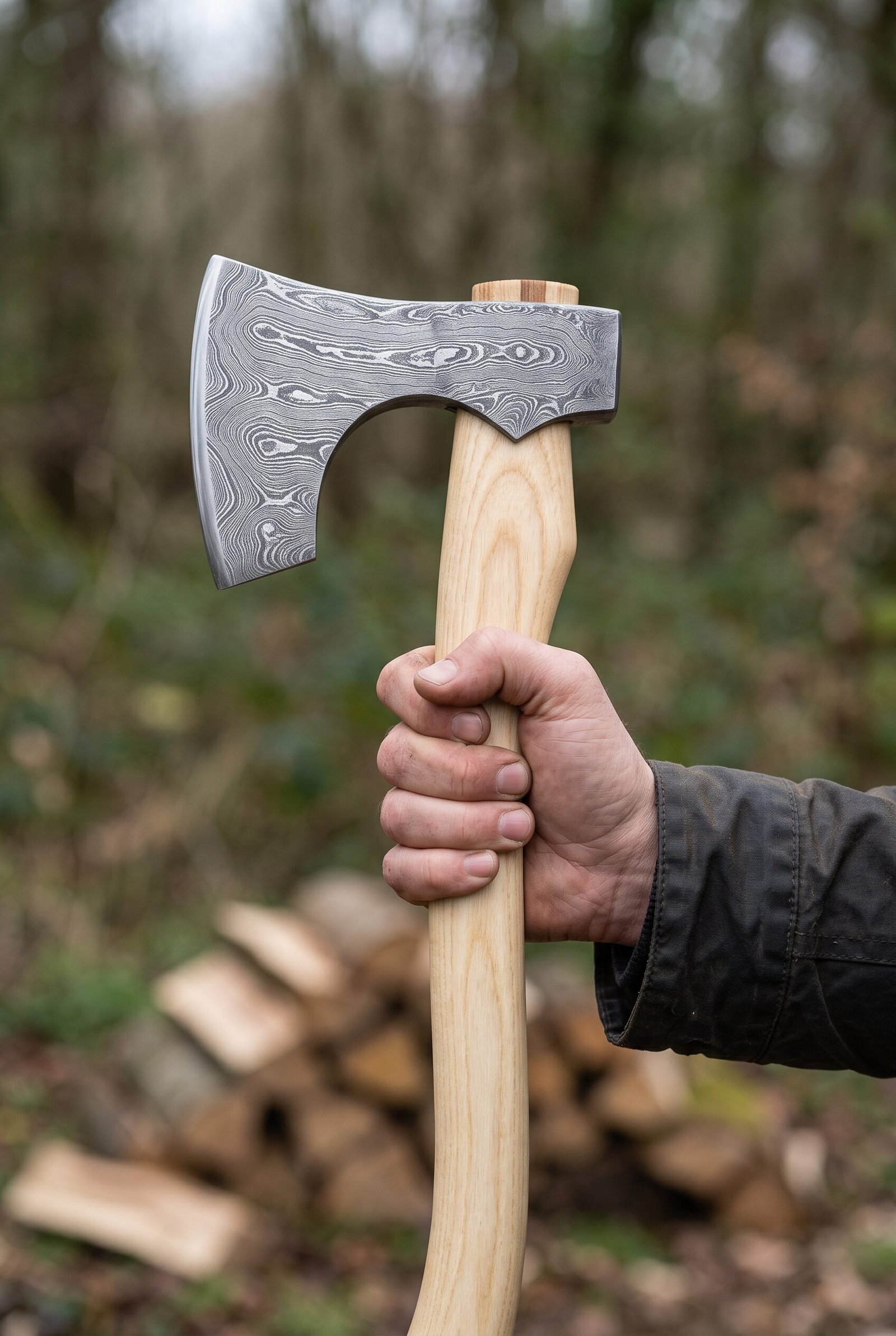
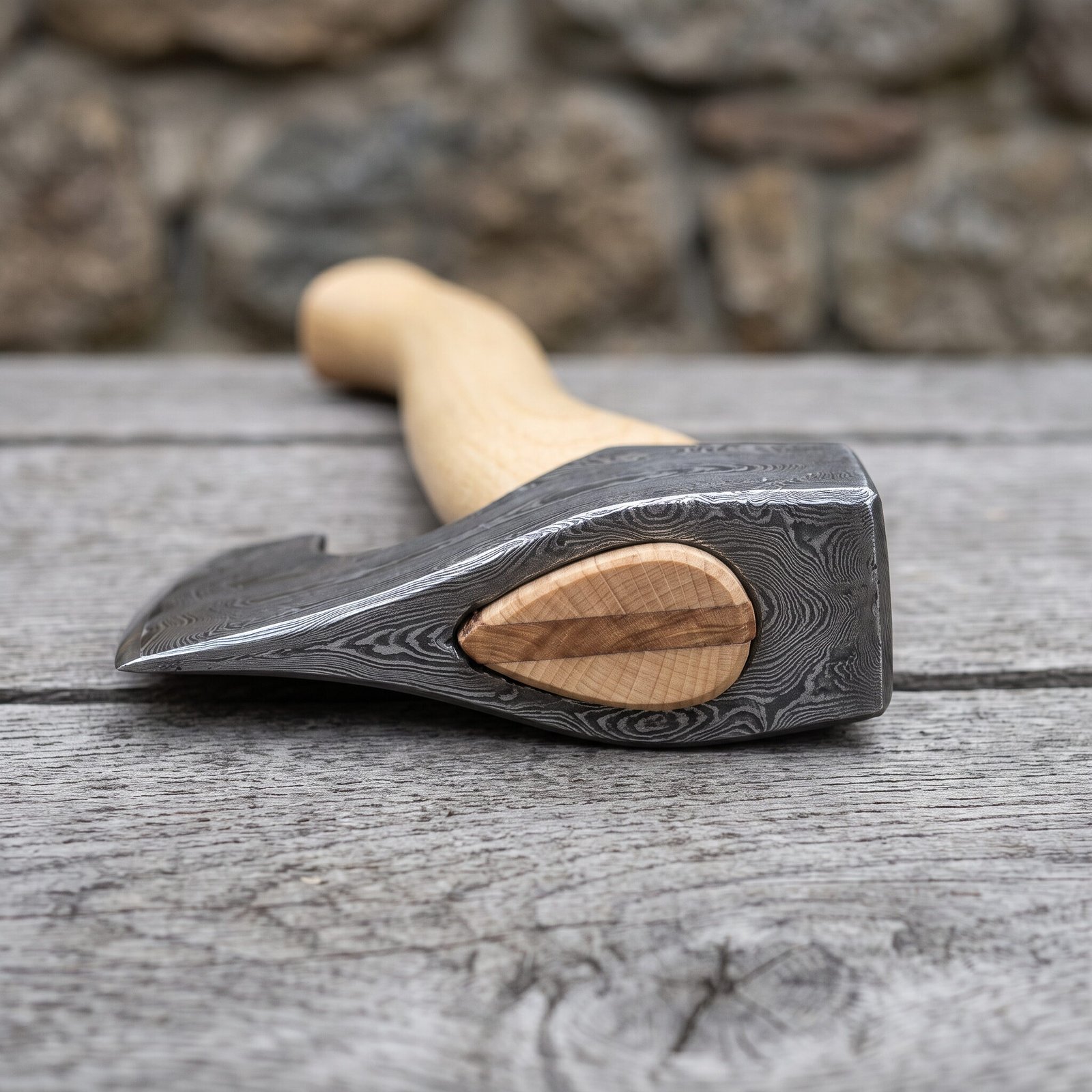
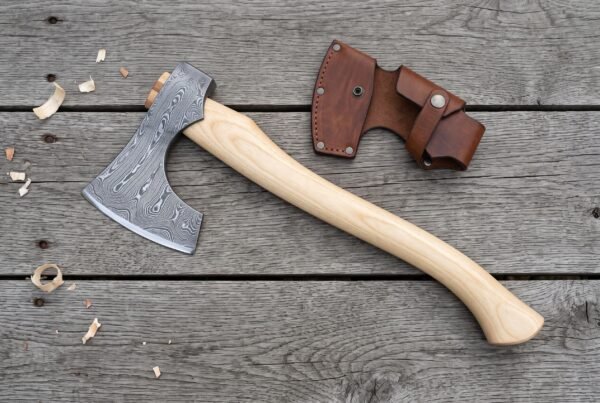
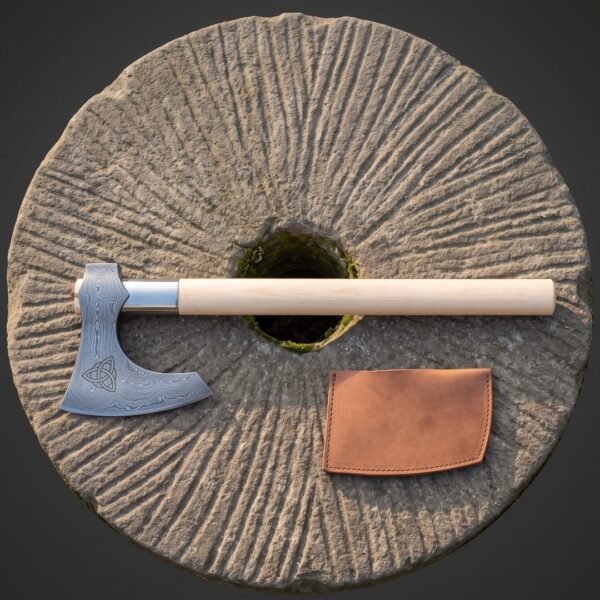
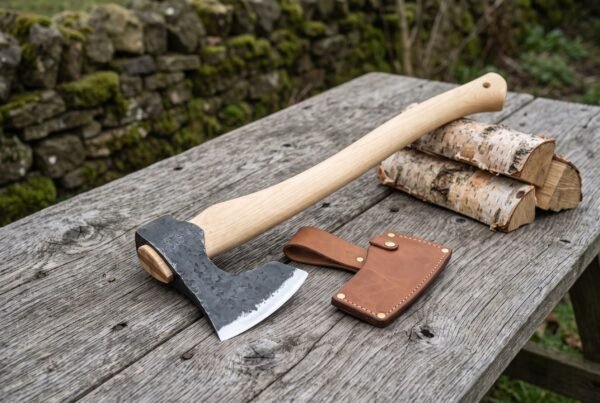
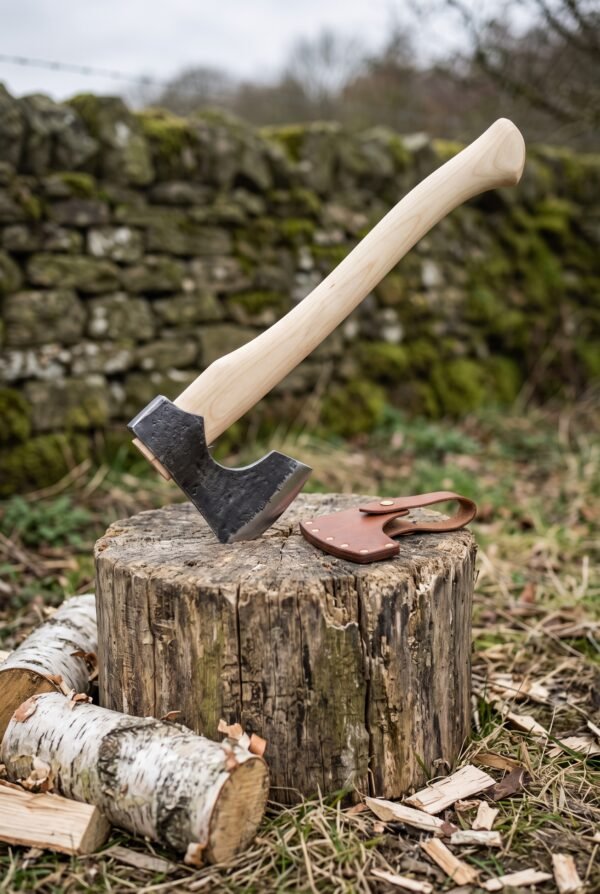
There is no cast head on the Palefrost. The Damascus is forge welded, drawn out and shaped under the hammer, the eye is punched and drifted, and the finished head is hung on a birch wood handle and wedged tight. It carries a 5.3 inch cutting edge on a 19 inch haft and weighs 1.23kg. Pattern welded steel wants oil and attention, and Damascus steel care covers exactly how much.
Layered steel is not a modern novelty in a Norse context, which is part of why this piece sits so well as a collector and wedding gift. Migration and Viking age smiths in northern Europe pattern welded blades on purpose, twisting and forge welding rods of iron with different phosphorus content so that when the finished blade was polished and etched the surface showed herringbone, chevron and serpentine figures. They were solving a materials problem, since bloomery iron came out of the furnace inconsistent and welding several bars together evened it out, but they clearly also cared how it looked, because the patterned rods were laid on the outside where they would show. When European steel making improved the technique died out. What is on this axe is the same idea, done for the same two reasons.
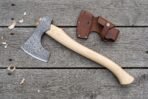
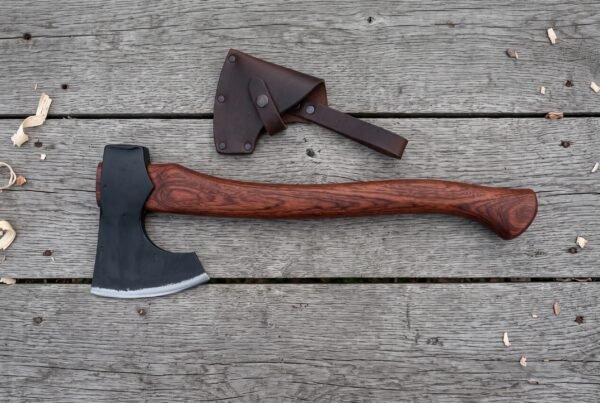
The axe is forged, ground, hung and covered in the Czech Republic. It ships with a leather blade cover and a gift box, free within the United States, with the edge already set.
Specifications
| Steel | Hand forged Damascus, 1095 and 15N20 forge welded |
|---|
| Hardness | 58 to 60 HRC |
|---|
| Overall length | 19 inches |
|---|
| Cutting edge | 5.3 inches |
|---|
| Weight | 1.23kg |
|---|
| Handle | Birch wood |
|---|
| Sheath | Leather blade cover, gift box included |
|---|
| SKU | RK-351 |
|---|
Reading a bearded head: toe, heel, beard and poll
An axe head has four parts worth naming, and knowing which is which changes how you use one.
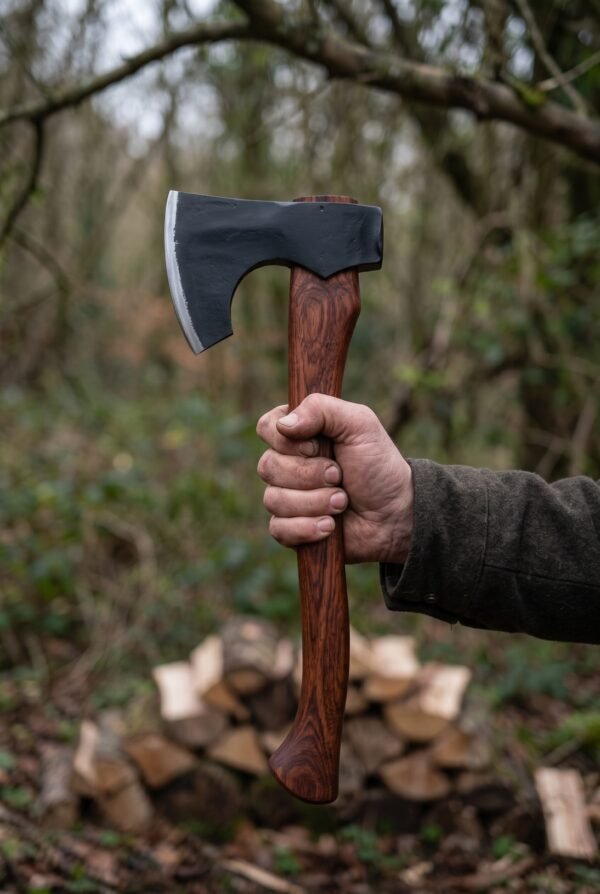
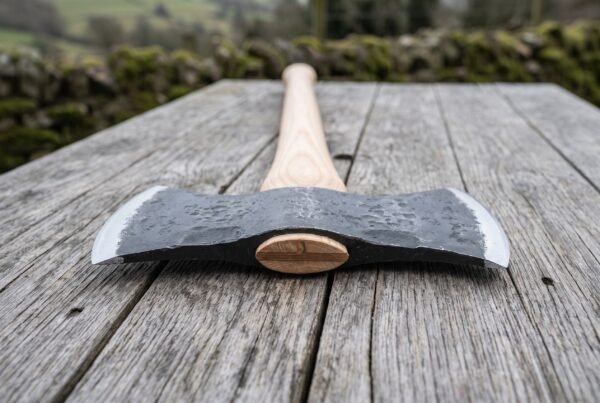
The toe is the upper corner of the bit, and it is the part you cut with more often than you think. Angled cuts into standing wood, limbing, and starting a notch all happen on the toe, because a corner concentrates the force into a small length of edge and bites where the full edge would skate.
The heel is the lower corner, at the bottom of the beard. It is the part that reaches into a notch you have already started and the part that takes the damage if the axe is hung badly, because a poorly hung head lands heel first and glances.
The beard is the section of edge that hangs below the eye. It gives you cutting length without head weight and it leaves the gap under the bit that lets you choke up and carve. It is also the part that will hook a log, a branch or a pot bail when you want to pull rather than cut.
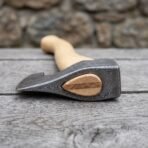
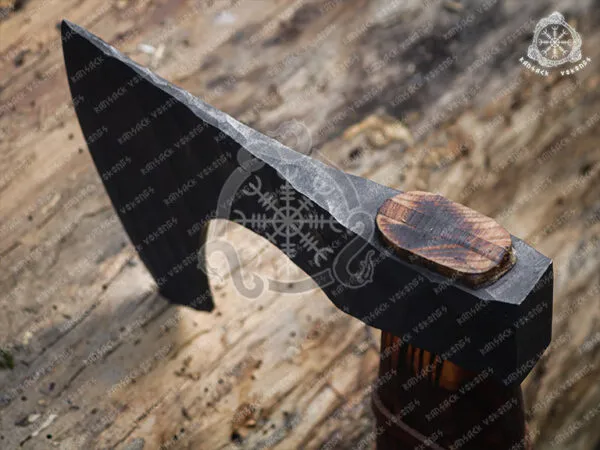
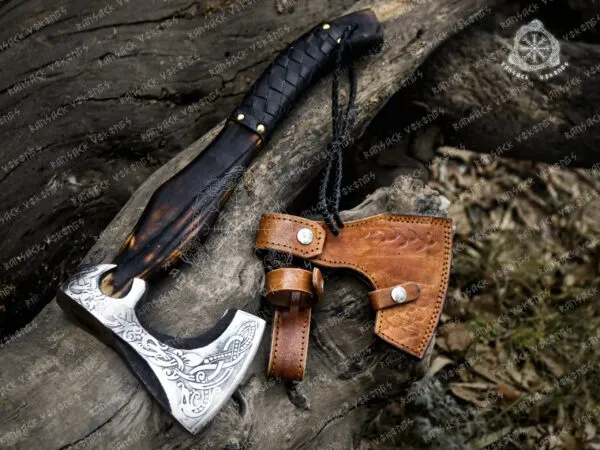
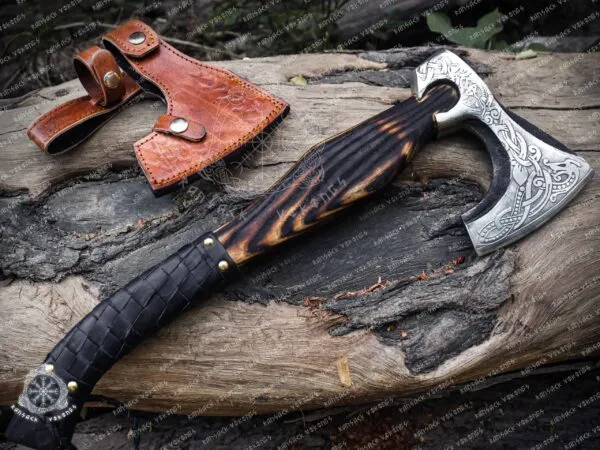
The poll is the flat back of the head. On this axe it is small, which is correct for a Norse profile and worth understanding. A poll is a counterweight, not a hammer. It has not been hardened, and driving steel wedges or tent pegs with it will mushroom the metal and can crack the eye. Use a mallet or the flat of a maul and the axe will last decades longer.
One more piece of anatomy that matters: the bit here is thin with flat cheeks, which is what makes it slice through green wood so well and why it will bind in a seasoned round. It is a cutting axe, not a splitter.
Why Damascus and not stainless
The billet is built from alternating layers of 1095 high carbon steel and 15N20 nickel steel, forge welded, folded and drawn down before the head is shaped from it. Because the layers run through the material rather than sitting on it, grinding the bevels reveals the pattern instead of removing it, and every sharpening the axe ever gets leaves it intact.
Stainless has one advantage over this and it is worth naming honestly: it will not rust if you neglect it. Everything else favours the carbon Damascus. At the hardness a bit needs, stainless is more inclined to chip than to roll when the edge meets a knot or a stone, and a chip costs you edge life while a roll costs you two minutes with a file. Stainless is also slower to bring back with a file, which matters on a tool you sharpen away from a bench. Carbon steel greys over with a patina that protects the surface, and it asks only that you dry it and oil it. The full argument is in Damascus versus stainless, and if you want to be sure any Damascus you buy is real rather than printed, the checks are in real versus fake Damascus.
The birch handle
Birch is the northern handle wood, used across Scandinavia for tool hafts for as long as there have been tools there. It is light, pale, stiff and fine grained, and on a 19 inch axe the lightness does something useful: it keeps the balance point forward near the head, which is what gives an axe its bite. A heavy haft makes a light axe feel dead in the hand.
Pale birch also sets off a dark etched Damascus head better than almost anything else, which is a large part of why this combination is chosen as a wedding and anniversary piece. Birch is more open grained than rosewood, so it wants feeding: a light coat of boiled linseed or plain mineral oil once or twice a year keeps the fibres from shrinking and the wedge tight. The routine takes five minutes and is written up in wooden handle care.
Engraving, runes and your own design
Use the rune converter on this page to turn a name, a date or a short phrase into Elder Futhark and we will cut it into the steel or the handle. If you would rather have a Viking pattern than a rune line, choose your own design in the engraving option above the add to cart button and tell us whether it goes on the blade or the handle. Where a piece already carries an engraved design, your chosen engraving replaces it rather than sitting alongside it. On this axe the pale birch takes a longer inscription with excellent contrast, which is why two names and a date on the handle is the most common wedding request, while a short rune line sits well on the cheek. Everything about placement and lettering is on the engraving page.
Care and sharpening
An axe edge comes back with a file faster than with any stone. Clamp the head, run a mill file from the toe of the bit towards the heel following the bevel already there, keep it convex, then refine with a puck or a coarse stone and finish fine. A convex edge on an axe resists chipping where a flat knife grind does not. Stay off a bench grinder unless you can keep the steel cool, because blued steel has been drawn and has to be filed away before the edge holds again.
Keep the head lightly oiled, keep the cover on the bit and feed the handle twice a year. Damascus is carbon steel under the pattern and behaves like it, so dry it after green wood and store it out of a damp shed. Oils, patina and rust removal are covered in steel care, and the edge geometry behind all of it is in sharpening with a whetstone.
Made in the Czech Republic
Every piece we sell is made by hand in the Czech Republic. The smiths there work the way the trade has been worked for a long time, heating and hammering the steel, taking the bevels down by eye, and fitting the handle and the leather one at a time. There is no automated line anywhere in it, so small differences from one piece to the next are normal and expected.
Ransack Viking is a United States company based in Chicago, Illinois. We bring the pieces in ourselves, inspect them on arrival and ship them from our own warehouse. If you add engraving, that is carried out here in the United States before your order goes out.
A note on handmade variation
This axe is hand forged, not machine made and not bulk produced, so the one that arrives will not be a pixel for pixel copy of the photograph on this page. Every billet moves differently under the hammer, so the way the Damascus layers swirl across the cheek and wrap around the beard belongs to your head alone. Birch is a natural material and boards differ, so one handle can run almost white and straight grained while the next carries darker flecking, and each takes the oil at its own rate. The exact sweep of the beard and the width of the bevel move by a hair because they are worked by eye.
The dimensions are the same every time, the steel is the same every time and the build is the same every time. The character is not, and on a piece bought to mark something that is usually the point.
Frequently asked questions
Is this a good wedding or anniversary gift?
It is one of the most requested pieces for exactly that, largely because the pale birch takes two names and a date clearly and the Damascus pattern makes each one genuinely singular. Allow one to two weeks of processing plus engraving time and transit when you plan the date.
Is the Damascus real, or is the pattern etched on the surface?
It is forge welded from 1095 and 15N20 and the layers run all the way through the head. A printed or laser etched pattern disappears the moment a file touches it. This one does not.
Can I hammer with the back of the head?
No. The poll on a Norse profile is a counterweight and it is not hardened for striking. Driving wedges or pegs with it will mushroom the steel and can crack the eye. Use a mallet.
Is it sharp when it arrives?
Yes. The bit is filed and honed before boxing and will cut wood on day one.
Will the pattern on my axe match the photograph?
No, and that is the nature of pattern welded steel. Yours will be recognisably the same style of layering and it will be arranged differently, because no two billets draw out the same way.
Can I choose engraving on the handle rather than on the steel?
Yes. Tell us which you want when you order. On birch a longer inscription usually reads better on the handle, and a short rune line works well on the cheek of the head.
What is in the box
- One Palefrost Damascus Viking bearded axe, 19 inches overall
- Leather blade cover
- Gift box
- Protective packaging
- Forged and finished in the Czech Republic
Explore the range
Related pieces sit in Viking axes, bearded axes, engraved and personalised pieces and Norse arms. The background on pattern welding and heat treat is in the guides.
Near neighbours in the shop
If this one is not quite right, there is the Rosethane Viking axe, high carbon steel. Also in this group is the Odin Viking axe, pattern welded Damascus. Sitting beside it in the catalogue is the Twinfang Viking axe, high carbon steel.
From the same corner of the shop, there is the Frostrune Dane axe. You can have this made your way instead on the custom Viking axe page.


Can’t stop showing this off to everyone who comes over. Fit and finish is museum quality. You can tell real craftsmen made this by hand. 10/10 would buy again.
Bought this on a whim and it turned out to be one of my favorite purchases this year. Weight and balance make it feel like a real functional piece not some cheap replica. Already telling my friends to check this out.
Got this as a birthday gift and the reaction was priceless.