
Two games share this page and they have almost nothing in common except who played them. Hnefatafl is an indoor board game and it is not chess. The two sides are not equal. A king sits on the centre square with twelve defenders packed around him in a cross, twenty four attackers sit in four groups against the middle of each edge, and the king is trying to reach a corner while the attackers are trying to surround him. Kubb is played on grass with wooden blocks and throwing batons, and it is loud.
The boards here are about 16 inches square, either solid oak with an engraved eleven by eleven grid and a burned knotwork border, or a black walnut frame with a hard maple field inlaid into it and an Elder Futhark row cut around all four edges. Both come with a full set of turned hardwood pieces, a pouch and a printed rule sheet.
The kubb sets are 21 pieces in hard maple or European beech, left unsealed because they live outdoors. Nobody has ever finished a game of kubb quietly. Both boards sit with the home decor.
Free US shipping
On most pieces. Heavier and oversized ones carry a flat charge.
Hand Forged
Heated, hammered and ground by hand.
Engraving available
Names, dates or Norse runes on most pieces.
Ships from Chicago
Inspected and dispatched from our Chicago warehouse. No import duty, no customs delay on US orders.
Hnefatafl & Viking Games
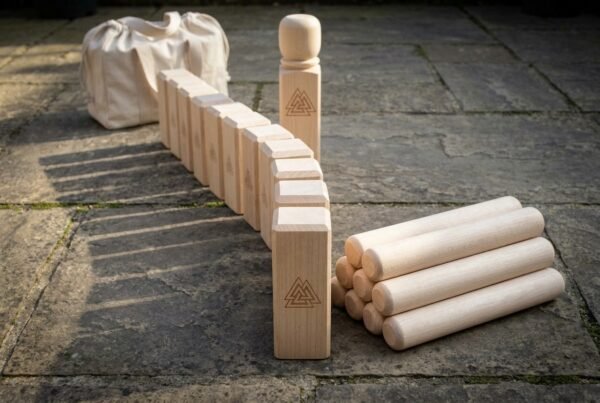
Oathfall Hand Made Maple Kubb Viking Lawn Game Set | 21 Pieces with Valknut Engraved King | Canvas Carry Bag and Field Markers | Outdoor Family Gift | RK-1755
Original price was: $149.00.$119.20Current price is: $119.20.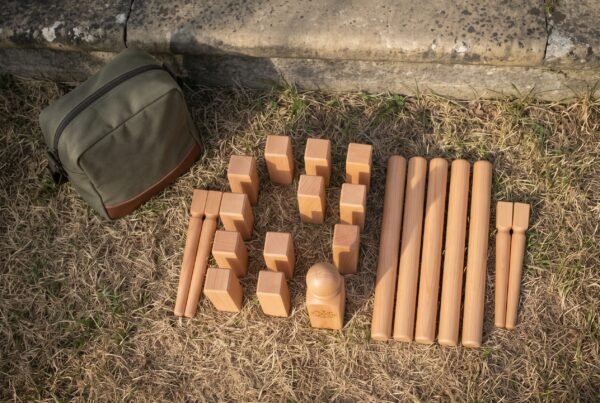
Meadowfell Hand Made Beech Kubb Viking Lawn Game Set | 20 Pieces with Vegvisir Engraved King | Waxed Canvas Bag and Leather Base | Outdoor Garden Gift | RK-1762
Original price was: $169.00.$135.20Current price is: $135.20.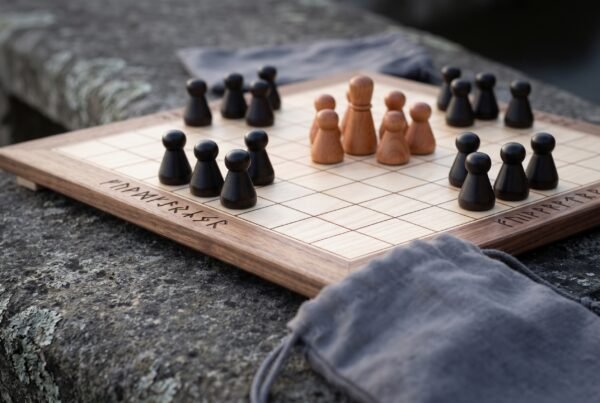
Kingsflight Hand Made Walnut and Maple Hnefatafl Viking Board Game | Solid Hardwood Board with Turned Playing Pieces and Elder Futhark Border | Norse Family Gift | RK-1732
Original price was: $189.00.$151.20Current price is: $151.20.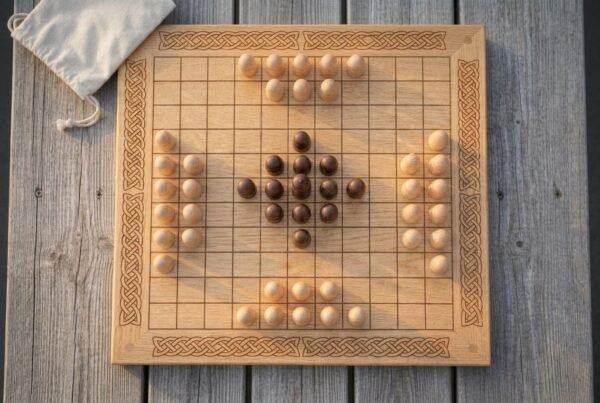
Kingsnare Hand Made Oak Hnefatafl Viking Chess Board Game | 11 by 11 Grid with 37 Turned Pieces | Burned Celtic Knotwork Border and Canvas Pouch | Norse Family Gift | RK-1752
Original price was: $199.00.$159.20Current price is: $159.20.Hnefatafl is not Viking chess
People reach for chess as the comparison and it is the wrong one, because chess is symmetrical. Both players start with the same army, the same options and the same goal, and the whole game is about who uses an identical position better. Hnefatafl is built the other way round. One side has twenty four attackers and wants to trap a single piece. The other side has twelve defenders and a king and wants to get that king off the board at a corner. Different numbers, different objectives, different ways of thinking.
That asymmetry is the reason the game holds up. Playing attacker teaches you to close a net without leaving a gap. Playing defender teaches you to open a lane and force a choice. Neither skill transfers cleanly to the other, which means two people who have played twenty games against each other still have something to learn by swapping sides. Most house rules require players to alternate for exactly that reason.
The game is genuinely old. Board fragments and gaming pieces turn up across Scandinavia, Ireland and the north of Britain, and tafl games were being played long before chess reached northern Europe. What did not survive is a complete rule set. The rules everybody uses today are reconstructed from a handful of references, an eighteenth century account of a related game from Lapland, and a lot of argument, so treat any printed rule sheet as one workable version rather than as the original.
How the game is played
The king starts on the centre square, called the throne, with his twelve defenders packed around him in a cross. The twenty four attackers sit in four groups of six against the middle of each edge. Everything moves like a rook in chess, any number of empty squares along a rank or a file, and nothing jumps anything.
Capture is by sandwiching. Move a piece so that an enemy piece is trapped between two of yours along a rank or a file and it comes off the board. You can move into a gap between two enemy pieces safely, so it is the act of closing the sandwich that captures, not simply standing between them. The king takes more effort, usually needing to be surrounded on all four sides, and the exact rule varies between versions.
The attacker wins by capturing the king. The defender wins by getting the king to any corner square. That is the whole game, and it takes about two minutes to teach and considerably longer to play well.
The boards and sets in this collection
Four pieces. Two for a table, two for a lawn.
Hnefatafl boards
The oak board is a single solid piece about 16 inches square, with the eleven by eleven grid engraved into the surface rather than printed on it, so the lines cannot wear off. A Celtic knotwork border is burned into all four edges by pyrography, which means the pattern is scorched into the timber rather than stained onto it. It comes with the full 37 pieces, twenty four pale attackers, twelve dark defenders and a king, turned from hardwood, plus a natural cotton canvas pouch with a drawstring and a printed rule sheet. The whole thing is finished in a food safe hardwax oil.
The walnut and maple board is built rather than cut from one board. The frame is solid American black walnut mitred at the corners, and the playing field is hard maple inlaid into it, with the grid scored and inked so the lines sit dark against pale timber. Elder Futhark runs around all four edges of the walnut frame. The pieces are turned hardwood, dark stained attackers against natural defenders, with the king marked by an incised ring so nobody has to remember which one he is. Four brass feet are set into the underside, which keeps the frame off a table and stops it rocking on an uneven surface. Walnut takes a hard wax oil and the maple field takes a clear oil.
Kubb sets
Both sets are 21 pieces and both have the same dimensions. Ten kubbs, each about 6 inches tall with a 2.75 inch square section. One king, about 12 inches tall with a turned crown. Six batons, turned dowels about 12 inches long. Four short corner stakes for marking the pitch. Edges are eased and the timber is left unsealed, because a sealed surface on an outdoor game gets slippery when wet and chips when it is hit.
The difference is the timber and the bag. One set is solid hard maple, kiln dried, pale and dense, with a Valknut burned into one face of the king and a cotton canvas carry bag with a strap. The other is solid European beech, kiln dried, slightly warmer in tone, with a Vegvisir burned into the king and a waxed green canvas bag with a leather base and a webbing strap. The waxed bag is the one to choose if the set is going to be thrown into a car boot after a damp afternoon.
Sizes, contents and materials across the range
Every figure below comes from the specification panel of a piece on this page. These are turned and finished by hand, so read dimensions as what to expect rather than as a guarantee to the millimetre.
| Piece | Game | Timber | Size | Contents | Detail |
|---|---|---|---|---|---|
| Kingsnare | Hnefatafl | Solid oak, hardwax oil | About 16 in square, eleven by eleven grid | Board, 37 turned pieces, canvas pouch, rule sheet | Burned Celtic knotwork border, engraved grid |
| Kingsflight | Hnefatafl | Black walnut frame, hard maple field | Not listed | Board, full set of turned pieces, cotton pouch, rule card | Elder Futhark cut into all four edges, brass feet |
| Oathfall | Kubb | Solid hard maple, kiln dried, unsealed | Kubbs about 6 in, king about 12 in, batons about 12 in | 21 pieces, cotton canvas bag with strap, rule sheet | Valknut burned into the king |
| Meadowfell | Kubb | Solid European beech, kiln dried, unsealed | Kubbs about 6 in, king about 12 in, batons about 12 in | 21 pieces, waxed canvas bag with leather base, rule sheet | Vegvisir burned into the king |
The figure worth noting is the kubb block section, 2.75 inches square. That is heavier than the garden sets sold in supermarkets, which matters because a light kubb blows over in wind and a heavy one does not.
Playing hnefatafl reasonably well
As the defender, do not shuffle. Every move that does not open a route towards a corner is a move the attacker gets for free, and the attacker only needs to close one gap at a time. Push a defender out early to open a lane, accept that you will lose pieces doing it, and remember that the king is the only piece that matters. Losing eight defenders to get the king two squares from a corner is a good trade.
As the attacker, do not chase. The king cannot be caught by following him, only by being waited for, so the game is about building a ring that never has two adjacent gaps in it. Watch the diagonals, because that is where a defender lane usually opens. Cover the corners early even though they look far away.
Both sides should count moves out loud when learning. Most beginner losses come from not noticing that a piece can travel the whole length of the board in one move.
How kubb is played, and one honest note
Mark a rectangle about five metres wide and eight metres long using the four corner stakes. Each team lines five kubbs along its own baseline. The king stands in the centre. Teams take turns throwing the six batons underarm at the opposing kubbs. Knocked kubbs get thrown back into the opponent's half and stood up where they land, which is the part that makes the game interesting, because those field kubbs must be cleared before the baseline ones can be attacked. Knock the king over before the rest and you lose immediately. Knock him over last and you win.
The honest note is about the name. Kubb is often sold as a Viking game and there is no evidence at all that the Norse played it. The game as we have it comes from Gotland in the twentieth century, and it spread from there in the nineteen nineties. It is a genuinely good game. It is not an old one, and we would rather say so than repeat a story that gets copied around the internet.
Throwing a baton properly
Hold the baton at one end rather than in the middle. Let it hang straight down beside your leg, swing it forward underarm, and release at about knee height. The baton should turn end over end in a vertical plane, like a wheel rolling away from you, and it should land flat rather than spearing into the turf.
If it helicopters sideways you are releasing across your body rather than in line with the target, and the throw becomes unpredictable. Sideways spin is also the fastest way to break a baton, since it lands on a corner instead of along its length. Beginners overthrow almost every time, so aim short and let the baton skip.
Timber, finishes and why indoors and outdoors differ
The boards are finished because they live on a table and get handled. A hardwax oil sits in the timber instead of forming a film on the surface, so it does not craze, it can be repaired with a rub of more oil, and on the oak board it is a food safe grade, which matters because these things end up on a table with drinks on them. Walnut takes the oil to a low sheen and the maple field takes a clear oil so the pale colour stays pale.
The kubb sets are the opposite and deliberately so. They are sanded smooth, the edges are eased so they do not split on impact, and then they are left unsealed. A varnished block goes slippery in dew, and every chip in a sealed surface lifts a flake and lets water underneath. Bare kiln dried timber greys evenly, absorbs a hit and dries out again. Maple is dense and pale and stays crisp. Beech is a little softer and warmer in colour and marks more readily, which some people prefer because a marked set looks played.
Care and storage
Boards want a dry cloth and a wipe of furniture oil once a year, and nothing more. Keep them off radiators and out of direct sun, because timber shrinks in dry heat and an inlaid field and its frame move at slightly different rates. Store the pieces in their pouch rather than loose in the box, since turned pieces rolling against each other is how the ink in a scored grid gets scuffed.
Kubb sets should be brought in after play, not left out overnight. Wet timber left on grass grows mould at the end grain. Stand the pieces on end to dry rather than laying them flat, and let a waxed canvas bag dry open before it is closed. Grey weathering is normal and does no harm. If a baton splinters at the end, sand it back and carry on.
Engraving
The kubb kings have a broad flat face and the boards have a frame or a border, so all four take a cut. A name, a date, a family motto or a rune line are the usual requests. Elder Futhark is a phonetic alphabet rather than a cipher, so a name is transliterated by sound and there is no rune for the letter C. Where a piece already carries an engraved or burned design, your engraving replaces it rather than sitting alongside it. Text engraving is 19 dollars, a symbol is 39 dollars and a family crest is 49 dollars. It is permanent, an engraved piece cannot be returned, and the spelling you send is the spelling that gets cut.
Where these come from and how they ship
Ransack Viking is a US company based in Chicago, Illinois. The pieces are handmade in the Czech Republic, then imported, inspected and shipped from Chicago. Engraving is done in the US after arrival. Every board is cut from natural timber and every piece is turned individually, so grain, colour and the exact depth of a burned border vary between two sets of the same name. Dimensions, contents and the rules are the same every time.
How to choose
Buy a hnefatafl board if you want a game that fits on a table and rewards being played badly a few times first. Take the oak board for a single slab of timber with a burned border, and the walnut and maple board if you want the inlaid field, the rune row and the brass feet. Buy a kubb set if the garden is the point, and take beech with the waxed bag if the set will get rained on, maple if you want the pale blocks to stay crisp.
Browse related categories
- Viking home decor for the room the board lives in
- Drinking horns to make a long game longer
- Runestones and Elder Futhark rune sets
- Horn mugs and tankards
- Wedding and groomsmen gifts
- Everything we can engrave to order
Guides worth reading first
- The hnefatafl board, the rules and what survives of them
- Elder Futhark runes and how a name is transliterated
- The Valknut and what the three knots mean
- The Vegvisir and where the stave really comes from
Frequently asked questions
Is hnefatafl the same as chess?
No. Chess is symmetrical and both players want the same thing. In hnefatafl one side has twenty four attackers trying to trap a king, and the other has twelve defenders trying to get that king to a corner. Different numbers and different objectives on each side.
How many pieces come with a board?
The oak board ships with 37, made up of twenty four pale attackers, twelve dark defenders and one king. The walnut and maple board ships with its full set of turned pieces, dark stained attackers against natural defenders, with the king marked by an incised ring.
Are the rules included?
Yes. Each board comes with a printed rule sheet or card. Bear in mind that no complete original rule set survives, so what you get is one workable modern reconstruction rather than a rediscovered original, and house variations are normal.
Did Vikings really play kubb?
There is no evidence for it. Kubb as it is played today comes from Gotland in the twentieth century and spread widely in the nineteen nineties. It is a good garden game with a Norse name attached to it, and we would rather say that than invent a history.
How much space does kubb need?
A rectangle about five metres wide and eight metres long, marked with the four corner stakes supplied. Grass is ideal. It plays on sand and on hard packed dirt, and it is unpleasant on concrete because a dropped baton bounces and eventually splits.
Can the kubb sets be left outside?
Bring them in. The timber is deliberately left unsealed so it absorbs a hit and dries out, but bare wood sitting wet on grass overnight will mould at the end grain. Stand the pieces on end to dry and leave a waxed bag open until it is dry too.
What is the difference between the maple and beech kubb sets?
Dimensions and contents are identical. Maple is denser and paler and keeps its edges crisp. Beech is a little softer and warmer in tone and marks more readily. The beech set also comes with a waxed canvas bag on a leather base rather than plain cotton canvas.
Where are these made?
They are handmade in the Czech Republic, then imported, inspected and shipped by Ransack Viking from Chicago, Illinois. Engraving is added in the US after arrival.
Featured pieces
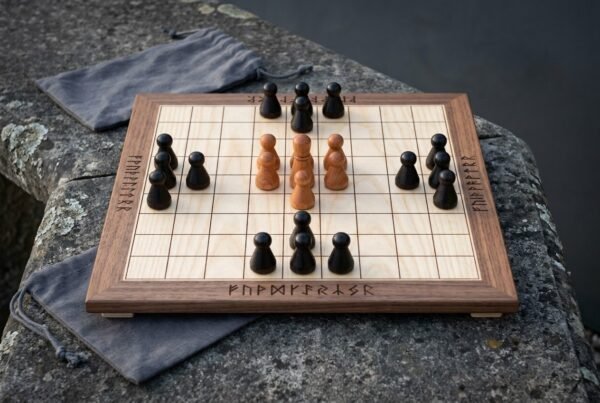 Kingsflight Hand Made Walnut and Maple Hnefatafl Viking Board Game
Original price was: $189.00.$151.20Current price is: $151.20.
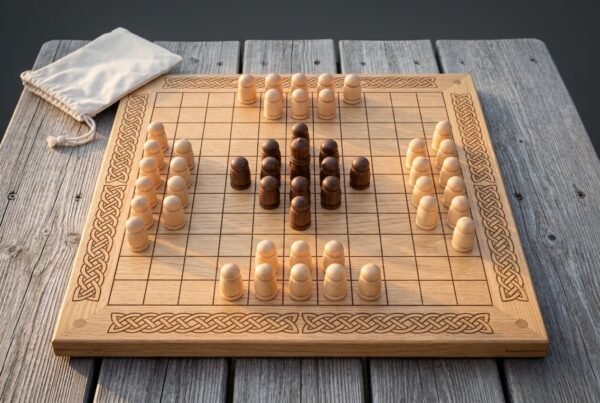 Kingsnare Hand Made Oak Hnefatafl Viking Chess Board Game
Original price was: $199.00.$159.20Current price is: $159.20.
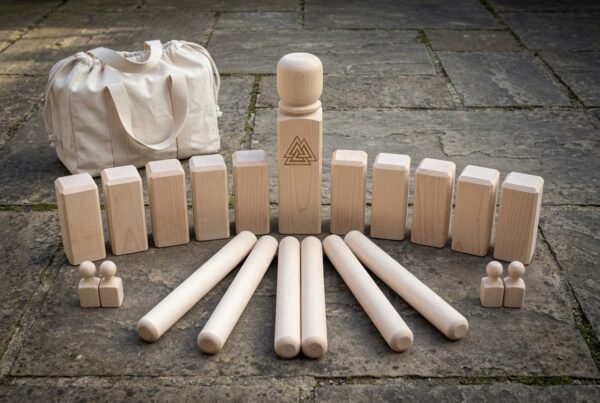 Oathfall Hand Made Maple Kubb Viking Lawn Game Set
Original price was: $149.00.$119.20Current price is: $119.20.
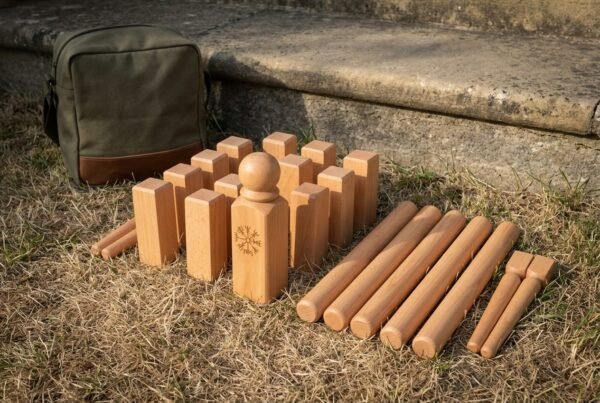 Meadowfell Hand Made Beech Kubb Viking Lawn Game Set
Original price was: $169.00.$135.20Current price is: $135.20.