
Blog
The Valknut: Where It Appears and What We Actually Know

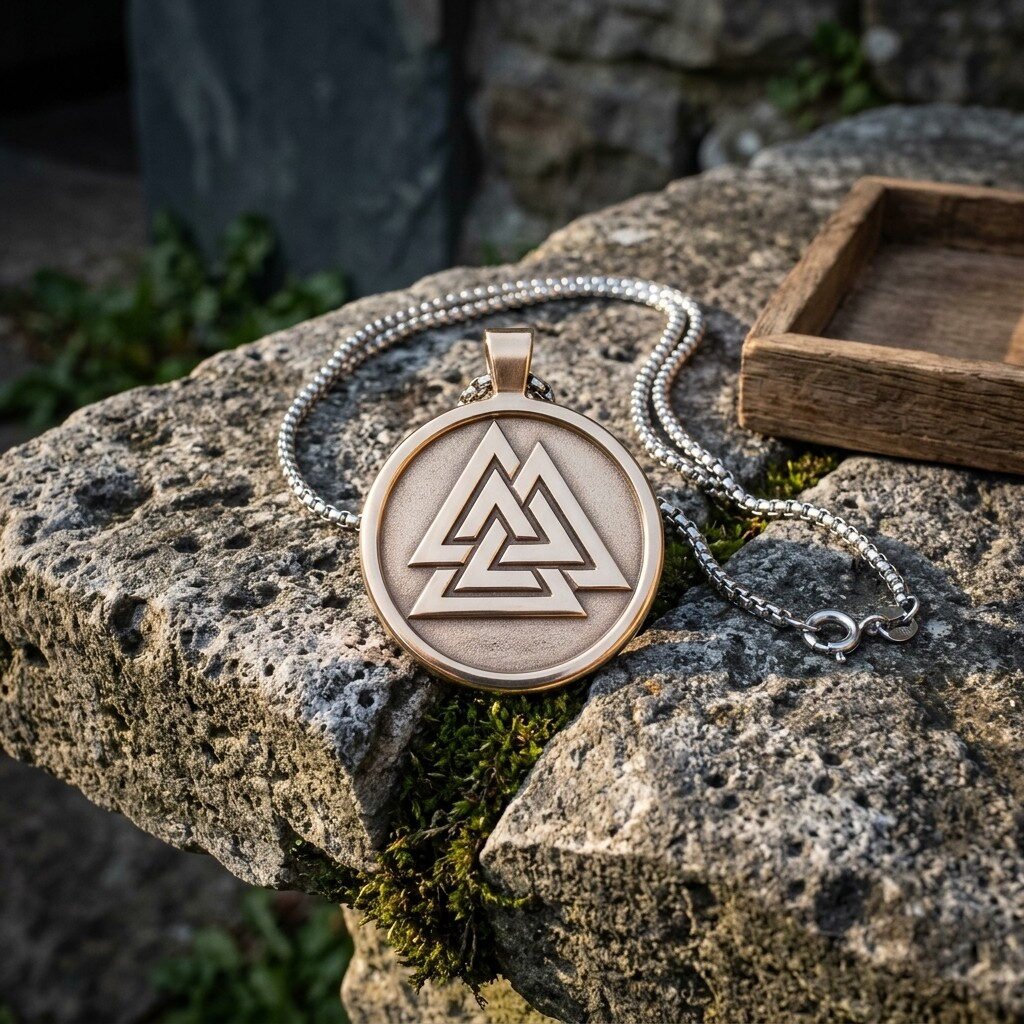
The valknut is a knot of three interlocked triangles. Unlike most Norse symbols sold today, it really is Viking Age: it is carved on Gotland picture stones and on wood from the Oseberg ship burial, nearly always beside scenes of death. What it meant was never written down. Nobody knows, and everybody selling one will tell you anyway.
That gap between the object and the explanation is the whole subject. We have the carvings. We do not have a single line of Old Norse prose or verse that names this shape or tells us why it was cut. This post separates the two: first what survives, then what scholars have argued about it, then what people do with it now.
What the shape actually is
Three triangles, locked together. Drawn one way it is a single unbroken line that crosses itself and returns to its starting point. Drawn another way it is three separate triangles woven through each other so that no two of them are directly joined. Both versions turn up on Viking Age objects, and the carvers do not seem to have treated one as more correct than the other.
The one line version
The unicursal form is a single closed path. Follow it with a fingertip and you never lift off and never repeat a stretch. This is the form on the Stora Hammars stones. It is harder to cut cleanly than it looks, because the over and under crossings have to stay consistent all the way round or the illusion of woven bands collapses.
The three ring version
The other form is three distinct triangles arranged so that they hold together only as a set. Pull any one of them away and the remaining two simply fall apart, because they were never linked to each other directly. Mathematicians call this a Borromean arrangement, after the Borromean rings. Whether the carvers understood that property or just liked the pattern, nobody can say. It does mean the symbol has a built in idea of three things that only work together, which is probably why the reading has proved so attractive to modern writers with a point to make.
Where it appears
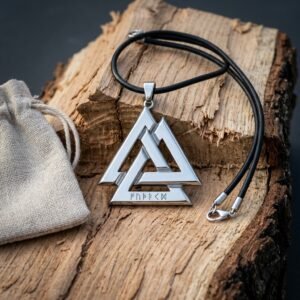 Thricebound Hand Made Polished Steel Valknut Pendant with Elder Futhark Rune Band & Black Leather Cord | Norse Gift | RK-1634
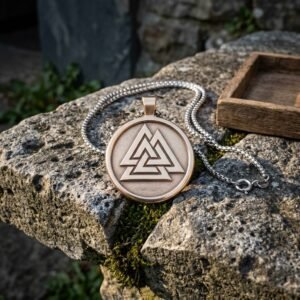 Kinbound Hand Made Bronze Tone Valknut Pendant with Raised Triple Triangle & 22 Inch Box Chain | Norse Memorial Gift | RK-1601
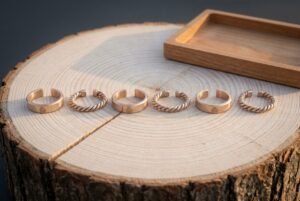 Runeband Hand Made Bronze Tone Viking Ring Set with Valknut Bands & Twisted Open Cuffs | Six Piece Adjustable Gift | RK-1617
Stora Hammars I, Gotland
The picture stone known as Stora Hammars I, from Larbro parish on Gotland, is the example everyone reaches for. Its panels show a run of scenes: a figure lying across what looks like an altar, another figure holding a spear above him, a man hanging from a tree, birds in the air, armed men below. A valknut sits inside that panel. Picture stone dating is argued over, and this one is usually placed in the eighth century, at the front edge of the Viking Age or just before it.
Tangelgarda, Gotland
The Tangelgarda stone, also Gotland, shows a rider on a horse in a procession of armed figures. Valknuts are cut beneath the horse. The pairing of the symbol with a horse and a body of fighting men is one of the things that pushed scholars toward reading it as something to do with the dead and their journey.
The Oseberg ship burial
The Oseberg burial in Norway gives the clearest wooden example. The ship itself was built around 820 by dendrochronology and the burial is dated to 834, and the grave goods include richly carved beds. A valknut appears in that carved woodwork. Oseberg is the burial of two women of very high status, which sits awkwardly with any reading that ties the symbol strictly to fallen fighting men.
A handful of other objects get brought into the discussion, including stamped designs on Anglo-Saxon cremation urns from England. Not every specialist accepts those as the same symbol rather than a related triangular interlace, so treat them as a maybe rather than a fact.
Even the name is modern
Nobody in the Viking Age called it a valknut, as far as we can tell. The word is a modern Norwegian compound, from valr, the slain, and knut, knot, and it was applied to the symbol by later scholars and writers. No surviving Old Norse text gives us a period name for the shape at all. When a product description tells you the Norse called it the knot of the slain, that description is quoting a nineteenth or twentieth century label back at you and charging you for it.
What scholars have argued
The Odin reading
The most common academic position connects the symbol to Odin and to the cult of the dead. The reasoning is contextual rather than textual, which is a polite way of saying it is inference. The valknut keeps company with hanging scenes, spears, horses and birds, and those are the images that cluster around Odin in the written sources: the god who hangs on the tree in Havamal, who takes half the slain, who is followed by ravens. Hilda Ellis Davidson and Rudolf Simek both discuss the symbol along these lines, and Simek’s reference work on Northern mythology treats a link to a death cult of Odin as likely rather than proven. Likely is the operative word.
Hrungnir’s heart
There is one tempting textual hook. In Skaldskaparmal, part of the Prose Edda that Snorri Sturluson put together around 1220, Snorri describes the heart of the giant Hrungnir as made of hard stone with three sharp corners, and says the carved figure called Hrungnir’s heart takes its shape from it. Some scholars have proposed that Snorri is describing our symbol under a name that was still current in his day. Others point out that a three cornered stone is a triangle and that Snorri says nothing about interlacing or about three of them. The proposal is worth knowing and it is nowhere near settled.
Binding
A third line of argument leans on the knot itself. Odin in the sources binds and looses: he can lay a fetter of terror on fighting men, and he can loosen bonds for those who know the right verses. A knot cut beside a corpse or a hanged man could carry that idea of binding the dead or releasing them. This is an interpretation built on a metaphor. It fits the material and it cannot be tested against it.
Why nobody can go further
Norse religion left almost no doctrinal writing, which has never slowed anybody down. What we have is poetry that was copied down in Christian Iceland centuries later, Snorri’s handbook for poets, sagas with their own literary agendas, and the archaeology. None of those tell us what a carver on Gotland was thinking. Anyone who says flatly that the valknut means the nine worlds, or the bond between the living and the dead, or the cycle of rebirth, is telling you their reading and leaving out the part where they made it up. Our wider guide to Viking symbols and their meanings takes the same line across the whole set, and the piece on what Mjolnir meant shows how different the picture looks when a symbol does have text and hundreds of finds behind it.
What it is not
It is not a rune, and it is not made of runes, whatever the listing says. It is not recorded as a symbol of the nine worlds. The count of nine points is real geometry and the connection to the nine worlds is a modern association with no medieval source behind it. It is not a protective stave in the Icelandic grimoire tradition, which is a much later and separate body of material. And it is not a general purpose good luck mark. Everything the archaeology gives us puts it in the company of death.
The valknut now
Modern heathen and Asatru groups use it, often as a mark of dedication to Odin. It is common as a memorial tattoo, and given where it appears on the stones, that use has more in common with the original context than most modern applications of Norse art do. It has also been picked up by extremist groups, and the Anti-Defamation League lists it in its database of symbols that have been appropriated that way. That does not make the symbol theirs. The overwhelming majority of people wearing one are interested in the Viking Age, in a lost family member, or in the shape itself.
Wearing and displaying one
We make a fair number of pieces around this symbol, and we would rather sell them with the honest history attached. The valknut turns up across our Norse pendants and through the wider Damascus steel jewellery range as rings, arm rings and beard beads, and on larger items in Viking home decor such as candle holders and slate plaques. If you want a name, a date or a line of Elder Futhark added, our engraved and personalised pieces cover that, and the process is set out on the custom engraving page. One thing to be clear about, because customers ask: Ransack Viking is a US company in Chicago, Illinois, every piece is handmade in the Czech Republic the old way, then imported, inspected and shipped from Chicago, and the engraving is done here in the US after the piece arrives. On the blades that carry the symbol the steel is plain 1095 at 54 to 58 HRC, or Damascus of 1095 and 15N20 forge welded at 58 to 60 HRC, which is explained in more detail on our steel and hardness page.
How to judge a valknut carving
Look at the crossings. On a well cut piece the over and under alternates correctly all the way round, so the bands read as woven. On a cheap one the crossings are inconsistent or the whole thing is engraved as flat outline with no sense of one band passing beneath another. On stamped or cast jewellery, check that the three triangles are the same size and that the interior angles match, because a drooping triangle is the first sign of a worn die. If a maker has chosen the three ring form, the pieces should look separable. If they have chosen the one line form, you should be able to trace the whole figure with a fingertip without a break.
Who the symbol points to is covered in the Norse gods explained, and the birds that travel with him have their own page in Huginn and Muninn.
Questions people ask
Is the valknut a real Viking Age symbol?
Yes. It is one of the few that is. It appears on Gotland picture stones including Stora Hammars I and Tangelgarda, and in the carved woodwork of the Oseberg ship burial in Norway, which is dated to 834. That puts it firmly in the period, unlike the Vegvisir and the modern drawing of the Helm of Awe, which both come from far later Icelandic manuscripts.
What does the valknut mean?
No source tells us. The carvings survive, the explanation does not. Most scholars connect it to Odin and to the dead, because it appears beside hanging scenes, spears, horses and birds, which are all Odin’s territory in the written sources. That is a reasonable inference drawn from context, not a recorded meaning. Anyone who states it as fact is selling you something.
Did the Vikings call it a valknut?
Almost certainly not. Valknut is a modern Norwegian word built from valr, meaning the slain, and knut, meaning knot. It was attached to the symbol by later scholars. No surviving Old Norse text gives a period name for the shape, so we have a symbol with no recorded name and no recorded meaning, which is unusual, and worth saying out loud rather more often than it is.
Is the valknut connected to Hrungnir’s heart?
It might be. Snorri Sturluson, writing around 1220 in Skaldskaparmal, describes the giant Hrungnir’s heart as hard stone with three sharp corners and says a carved figure called Hrungnir’s heart takes its shape from it. Some scholars read that as a reference to this symbol. Others note that Snorri mentions three corners rather than three interlocked triangles. The question is open.
Does the valknut represent the nine worlds?
Not in any medieval source. The figure has nine points, and the Norse cosmos has nine worlds, so people have joined the two. That link first appears in modern writing. It is a pleasing idea with no support in the Poetic Edda, the Prose Edda, skaldic verse or the archaeology, so it will not appear on a product page here as fact.
Can I have a valknut engraved on a piece?
Yes. Engraving is done in the US after the piece has been imported and inspected in Chicago, so you can add the symbol along with a name, a date or a short Elder Futhark inscription. Curved surfaces such as ring bands and horn take a shallower cut than flat steel, so send us the exact wording and we will tell you what will read well at that size.
The shop side of this
Carried in the shop, the Kinbound Valknut pendant and the Knotwarden Valknut axe. The Sootbrand Valknut arming sword and the Amberdraught horn oak stand sit with them.
Shop the range
Thricebound Hand Made Polished Steel Valknut Pendant with Elder Futhark Rune Band & Black Leather Cord | Norse Gift | RK-1634Kinbound Hand Made Bronze Tone Valknut Pendant with Raised Triple Triangle & 22 Inch Box Chain | Norse Memorial Gift | RK-1601Runeband Hand Made Bronze Tone Viking Ring Set with Valknut Bands & Twisted Open Cuffs | Six Piece Adjustable Gift | RK-1617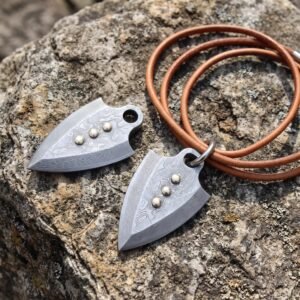 Arrowward Handcrafted Damascus Steel Pendant Pair with Leather Cord | Viking Jewellery Gift for Men and Women | RK-645
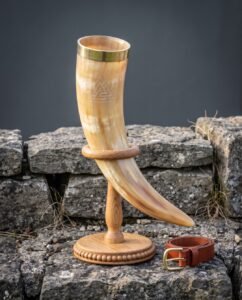 Amberdraught Hand Made Valknut Drinking Horn and Oak Stand | Pale Natural Ox Horn | Solid Brass Rim Band with Tan Leather Belt | Norse Wedding Gift | RK-1685
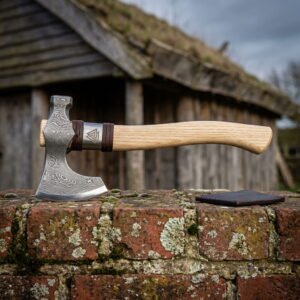 Knotwarden Hand Forged Damascus Valknut Axe | Pattern Welded Head with Hammer Poll | Engraved Valknut Collar and Curved Ash Haft | Norse Collector Gift | RK-1804