
Blog
What Norse Mythology Actually Is

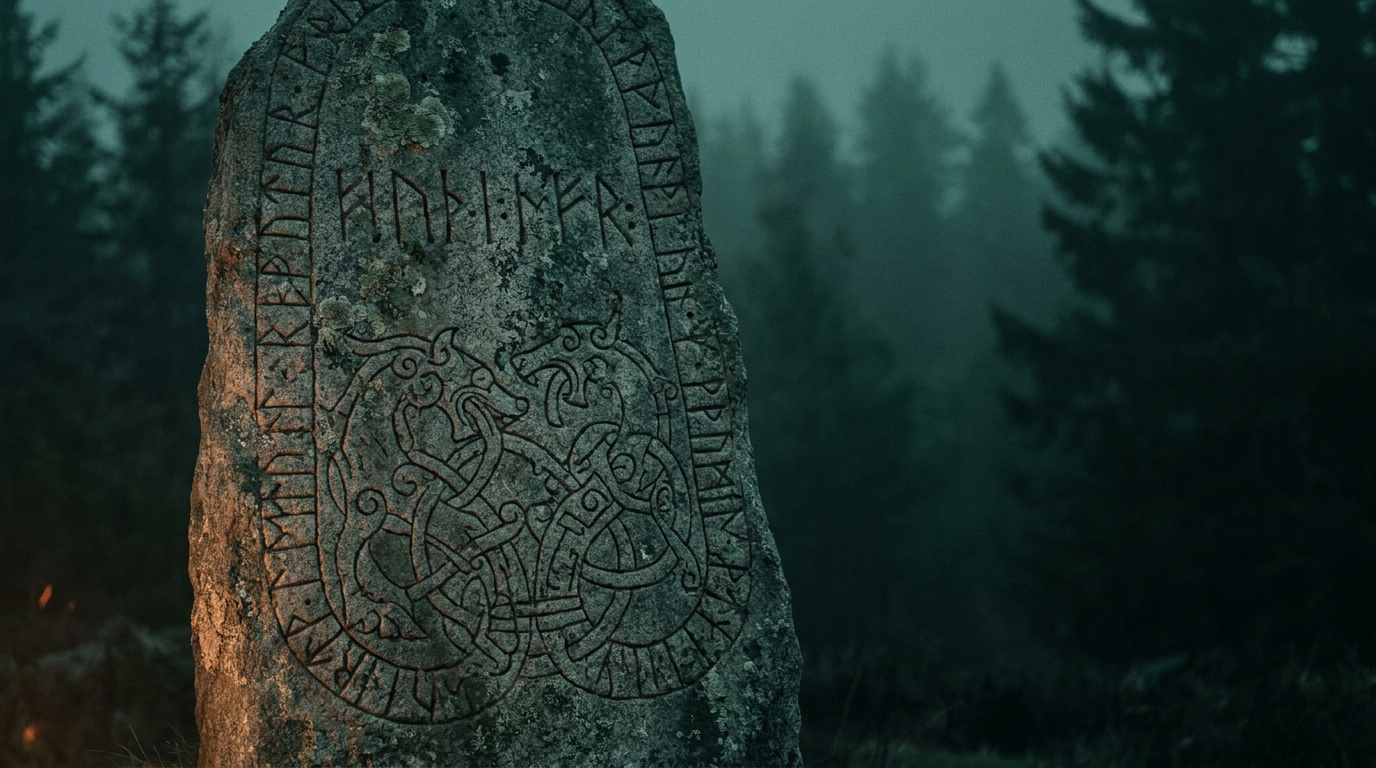
Norse mythology is a set of stories about gods, giants and the end of the world, told in the Scandinavian north and its colonies, and written down almost entirely by Christians two centuries after the people who believed it had stopped. That last clause is the important one, and it is the part usually left out.
What survives is not a religion’s scripture. It is a literary salvage operation, carried out by educated Icelanders who wanted to preserve the poetic tradition their culture depended on, and who were working from oral material they had inherited rather than practised. This page sets out what those sources are, what they can and cannot tell us, and where the modern religion that uses the same names actually came from.
What we are actually working from
The Poetic Edda
A collection of about thirty anonymous poems, preserved mainly in a single Icelandic manuscript called the Codex Regius, written around 1270. The poems themselves are older than the manuscript, some of them probably considerably older, and a handful may go back to the tenth century or earlier. Nobody can date them precisely.
Voluspa, the prophecy of the seeress, gives the creation and the end. Havamal gives advice attributed to Odin, along with the account of his hanging on the tree. Grimnismal, Vafthrudnismal and Lokasenna each deliver information in the form of a contest or an argument, which is a normal way for this poetry to work.
These are the closest thing to primary material. They are also compressed, allusive, and written for an audience that already knew the stories, which means they frequently mention things without explaining them.
The Prose Edda
Written around 1220 by Snorri Sturluson, an Icelandic chieftain, lawyer and politician who was also one of the sharpest writers of the European Middle Ages. He wrote it as a handbook for poets, because skaldic verse depended on mythological allusion and young poets were losing the references.
It is where most of the narrative detail lives. The binding of Fenrir, the fishing trip, the death of Baldur, the building of Asgard’s wall, the trip to Utgarda-Loki. Roughly everything anyone can retell comes from Snorri.
And Snorri was a Christian writing about paganism at a two hundred year remove, with a classical education and a framing device that treats the gods as deceived humans from Troy. He systematises. He fills gaps. He occasionally tells you when he is choosing between competing versions, which is more honesty than the genre required. Where a detail appears only in the Prose Edda, that fact is worth flagging, and this site flags it.
Skaldic verse
Court poetry, composed by named poets for named patrons, in metres so tightly constrained that later scribes could not easily alter them without breaking the form. That constraint makes skaldic verse unusually reliable evidence for dating.
It rarely tells stories. It refers to them, through kennings, so that a ship becomes a sea-horse and gold becomes Sif’s hair. Every kenning is proof that its audience knew the underlying story. Skaldic poetry from the tenth century that alludes to Thor and the serpent tells us the myth existed then, even where the poem itself gives no narrative.
Sagas, chronicles and outside observers
The Icelandic sagas describe religious practice in passing, though they were written down in the thirteenth century and later about events centuries earlier. Saxo Grammaticus wrote his Latin Gesta Danorum in Denmark around 1200, giving versions of several myths that differ radically from the Icelandic ones.
Foreign observers add a little. Tacitus described Germanic religion in the first century, far too early and too far south to be direct evidence for the Viking Age. Adam of Bremen, writing in the 1070s, described a temple at Uppsala with three images and a sacrificial grove, from second-hand report and with a churchman’s motive for making it lurid. Ibn Fadlan watched a Rus funeral on the Volga in 922 and left the single most detailed eyewitness account we have of a Norse ritual, from a Muslim envoy’s perspective and about a group whose practices may not have matched those at home.
Archaeology
The part that does not depend on anyone’s memory. Thor’s hammer amulets survive in the hundreds across Scandinavia and the settlements, which is the strongest single evidence for which god ordinary people actually cared about. Picture stones on Gotland show scenes that match written myths. Ship burials at Oseberg and Gokstad show the scale of what a funeral could involve, and those hulls are described on the page about Viking ships and the longship. Place names carrying divine names map where cults were.
Archaeology tells us what people did. It almost never tells us what they thought while doing it. Both halves of that sentence matter.
What is attested, and what is reconstruction
A rough division, because the line is worth drawing explicitly.
 Slatestave Hand Made Engraved Pale Grey Rune Stone with Full Elder Futhark Row & Knotwork Arch | 10 Inch Standing Height | Solid Oak Display Base | Norse Home Decor Gift | RK-1705
 Stonecast Hand Made Elder Futhark Rune Set | 24 Engraved Casting Stones | Tumbled Stone with Tan Leather Drawstring Pouch | Norse Divination Gift | RK-1780
 Fatecast Hand Made Engraved Slate Rune Set with 24 Elder Futhark Casting Stones | Complete Rune Row in Three Aettir | Leather Drawstring Pouch and Guide Card | RK-1695
Solidly attested: the major gods and their principal stories, the creation from Ymir’s body, Ragnarok, the world tree, the practice of sacrifice at fixed times of year, the hammer amulet, ship burial, the rune rows, cremation and inhumation both in use.
Attested but thin: the nine worlds as a set, the internal geography of the afterlife, the roles of most of the minor goddesses, the meaning of the valknut, the existence of an organised priesthood.
Reconstruction or later invention: the tidy nine-realm diagram, the Vegvisir and the Helm of Awe as Viking symbols, the modern divinatory meanings of the runes, the Nine Noble Virtues, blood eagle executions as established practice, and horned helmets, which are a nineteenth century stage design and are dealt with on the page about the horned helmet myth.
The pattern is consistent. The further a claim is from a manuscript or an object in the ground, the more likely it arrived in the last two hundred years. Several individual cases are worked through on the pages for the Vegvisir and the valknut.
Was there a Norse pagan religion at all
Yes, but not in the shape the word religion now suggests. There was no scripture, no creed, no central authority and no word for the system as a whole. The Old Norse term that appears once conversion made a contrast necessary is forn sidr, the old custom. Custom, not faith.
Practice was local and domestic. Offerings at a household level, seasonal blot sacrifices with meat and drink shared between people and gods, oaths sworn on rings, burial with goods. A chieftain might hold religious authority as part of holding political authority, which is what the word godi describes, rather than as a separate profession.
Nobody was required to believe anything in particular. People had personal patrons, and the evidence points to Thor for most of them, on the strength of amulets, place names and the sheer volume of personal names built on his. Odin looks like a god of kings and poets. That distribution is set out on the page for the Norse gods.
Conversion took centuries and was often political. Iceland’s decision in the year 1000 was taken at the Althing as a legal compromise, with private sacrifice allowed to continue for a period. That is not a story of belief being replaced. It is a story of law changing while habits took longer.
Modern Asatru
This is a separate subject and deserves separating.
Asatru means loyalty to the Aesir, and it is a modern religion, founded in the twentieth century, which reconstructs practice from the same sources this page has described. It is not a survival. There is no unbroken line from the Viking Age, and the serious practitioners do not claim one.
The Icelandic organisation Asatruarfelagid was founded in Reykjavik in 1972 and recognised by the Icelandic state as a registered religious body in May 1973. Its first allsherjargodi was Sveinbjorn Beinteinsson, a farmer and a traditional poet, who held the position until his death in 1993. Membership was 570 in 2002 and stood at around 6,250 in 2025. A temple building at Oskjuhlid in Reykjavik has been under construction since 2015.
In the United States the Asatru Free Assembly was founded by Stephen McNallen, and in Britain the Odinic Rite dates from the 1970s and produced the Nine Noble Virtues, an ethical list assembled in the twentieth century from saga material rather than found in any source. Related terms in use include Heathenry, which academics tend to prefer, and Forn Sed, the old custom, common in Scandinavia.
Scholarly estimates put worldwide numbers at no more than about twenty thousand. The movement has a documented and serious split. The universalist position holds that the gods can call anyone. The folkish position treats the religion as belonging to a supposed biological group, and has attracted far-right involvement. Surveys have found universalists in the majority, and folkish organisations more visible. Anyone approaching modern Heathenry should know that division exists before choosing who to read.
Where to start
Read Voluspa first, in a translation with notes, and be prepared for it to be difficult. Then Snorri’s Gylfaginning, which is genuinely enjoyable and should be read knowing who wrote it and when. Then decide whether you want the poetry or the archaeology, because they are different pleasures.
The individual entities have their own pages here: the nine realms, the Norse goddesses, Ragnarok and Yggdrasil among them.
Carrying it
Ransack Viking is a US company in Chicago, Illinois. Pieces are handmade in the Czech Republic, then imported, inspected and shipped from Chicago, with engraving cut here after arrival. Plain 1095 runs 54 to 58 HRC and Damascus of 1095 and 15N20 runs 58 to 60. US orders ship free and tracked with no import duty, and there is a lifetime warranty against defects. The ranges most often chosen are runestones and rune sets, Norse pendants and drinking horns. The rest of the writing is in the guides.
Questions people ask
What is Norse mythology?
The body of stories about gods, giants, the creation and the end of the world told in the Scandinavian north and its settlements before Christianity. It survives mainly in two Icelandic books, the Poetic Edda and Snorri Sturluson’s Prose Edda, both written in the thirteenth century by Christians recording a tradition that had already stopped being practised.
Where does what we know about Norse mythology come from?
Four kinds of evidence. The Poetic Edda, a collection of older anonymous poems preserved in a manuscript of around 1270. The Prose Edda, written around 1220 by Snorri Sturluson as a handbook for poets. Skaldic court verse, whose strict metre makes it hard to alter and therefore useful for dating. And archaeology, including amulets, picture stones, burials and place names.
Is Norse mythology historically accurate?
It is not history and was not meant to be. As evidence for what people believed it is uneven, because the written sources come two centuries after conversion and are shaped by their Christian authors. Archaeology confirms parts of the picture, such as the popularity of Thor and the reality of sacrifice and ship burial, without telling us what anyone thought.
What was the Norse pagan religion actually like?
Local, domestic and unsystematic. No scripture, no creed, no central authority and no word for the religion as a whole until conversion made a contrast necessary, when the term used was forn sidr, the old custom. Practice meant seasonal sacrifice, offerings at home, oaths sworn on rings, and burial with goods, with religious authority usually held by whoever held political authority.
What is Asatru?
A modern religion, founded in the twentieth century, that reconstructs Norse practice from the surviving sources. The name means loyalty to the Aesir. The Icelandic organisation Asatruarfelagid was founded in 1972 and recognised by the state in 1973, with the poet Sveinbjorn Beinteinsson as its first leader. It is a reconstruction rather than a survival, and its serious practitioners say so.
How many people practise Asatru or Heathenry?
Scholarly estimates put the worldwide figure at no more than about twenty thousand. Iceland’s Asatruarfelagid had around 6,250 registered members in 2025, up from 570 in 2002. Numbers are hard to pin down because many groups are small and independent and registration practices differ by country.
Did Vikings worship Odin most?
The evidence points to Thor. Hammer amulets survive in large numbers, personal names built on Thor are extremely common, and place names naming him are widespread across Scandinavia. Odin appears in place names and in poetry connected with rulers and poets, which suggests a cult of the powerful rather than of the farm.
What in Norse mythology is modern invention?
The tidy nine-realm diagram, the Vegvisir and Helm of Awe as Viking Age symbols, modern divinatory rune meanings, the Nine Noble Virtues, and horned helmets. Each of those has a traceable origin in the last two centuries. The rule of thumb is that the further a claim sits from a manuscript or an object in the ground, the later it arrived.
Things you can actually hold
On the shelf in the same spirit, the Thricebound Valknut pendant and the Emberkeel Norse sword. Next to those, the Fatecast engraved slate rune and the Emberward Viking round shield.
Shop the range
Slatestave Hand Made Engraved Pale Grey Rune Stone with Full Elder Futhark Row & Knotwork Arch | 10 Inch Standing Height | Solid Oak Display Base | Norse Home Decor Gift | RK-1705Stonecast Hand Made Elder Futhark Rune Set | 24 Engraved Casting Stones | Tumbled Stone with Tan Leather Drawstring Pouch | Norse Divination Gift | RK-1780Fatecast Hand Made Engraved Slate Rune Set with 24 Elder Futhark Casting Stones | Complete Rune Row in Three Aettir | Leather Drawstring Pouch and Guide Card | RK-1695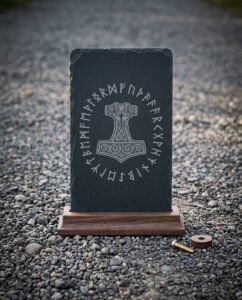 Thundermark Hand Made Engraved Slate Rune Plaque with Mjolnir and Full Elder Futhark Ring | 10 by 7 Inch Riven Slate | Solid Walnut Display Base | Norse Home Gift | RK-1714
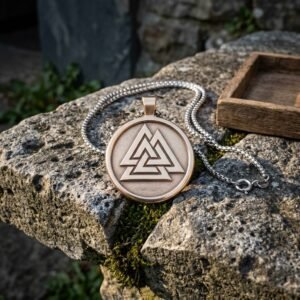 Kinbound Hand Made Bronze Tone Valknut Pendant with Raised Triple Triangle & 22 Inch Box Chain | Norse Memorial Gift | RK-1601
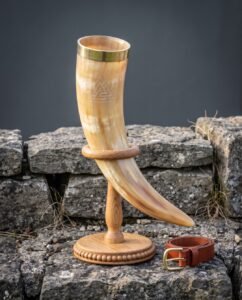 Amberdraught Hand Made Valknut Drinking Horn and Oak Stand | Pale Natural Ox Horn | Solid Brass Rim Band with Tan Leather Belt | Norse Wedding Gift | RK-1685