A bastard sword is the one that refuses to pick a side. It is too long and too heavy to be a comfortable one handed sword and too short to be a proper two hander, and the grip is deliberately sized so a second hand can join in when you want more leverage and stay off when you want reach. Hand and a half is the more polite name for the same thing. The sword changes character depending on how you hold it, which is why people kept buying them for three hundred years.
The three here run 37 to 43 inches overall with blades of 30 to 33 inches and grips of 7 to 9 inches. Blade width is 2 to 2.1 inches at the guard, and the two listed weights are about 2 pounds 14 ounces and 3 pounds 6 ounces. One is plain 1095 high carbon at 54 to 58 HRC. Two are forge welded Damascus of 1095 and 15N20 at 58 to 60 HRC. All three carry a straight steel cross, a disc or wheel pommel and a leather scabbard.
Measure the wall before you fall in love with the 43 inch one.
Free US shipping
On most pieces. Heavier and oversized ones carry a flat charge.
Hand Forged
Heated, hammered and ground by hand.
Engraving available
Names, dates or Norse runes on most pieces.
Ships from Chicago
Inspected and dispatched from our Chicago warehouse. No import duty, no customs delay on US orders.
Bastard Swords
The sword that will not choose
Every sword is a compromise between reach, weight and control, and most of them settle the argument one way or the other. A one handed sword gives up reach to stay quick and to leave a hand free for a shield. A two hander gives up everything else for leverage and mass. The bastard sword refuses to settle, and the grip is where the refusal lives.
Add three inches to a grip and you have not just given the second hand somewhere to sit. You have changed the mechanics of everything the sword does. With one hand the sword pivots around your wrist and the whole blade has to be moved by a joint that is not built for it. Put a second hand on the pommel end and you now have two contact points several inches apart, which means you can push with one and pull with the other. That is a couple, in the mechanical sense, and it turns the sword much faster than a wrist ever could. It also means the point can be held steady against pressure, which one hand cannot do for long.
The name is not flattering and it was not meant to be. These swords were called bastards because they belonged to neither family, and the term stuck. Hand and a half is the same sword described politely.
The swords in this collection
Three swords, one plain and two in pattern welded steel. The grip lengths are the thing to compare, because that is what decides how each one behaves.
The high carbon bastard sword
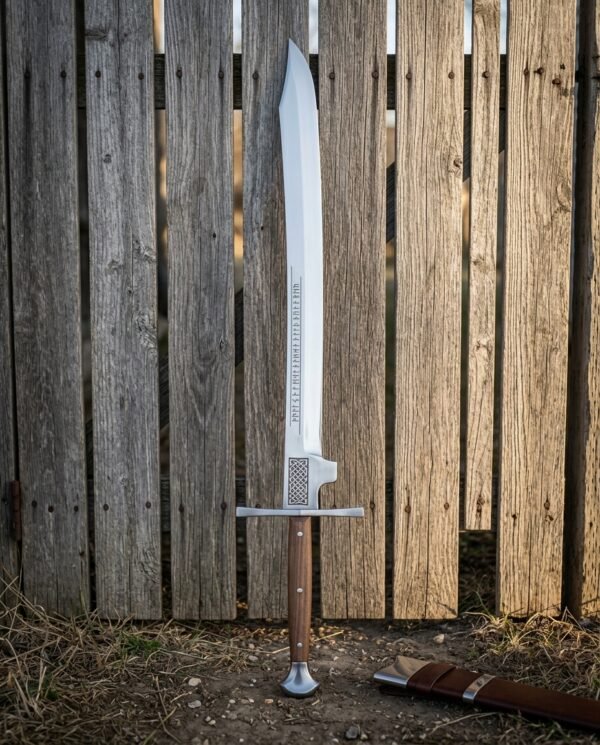
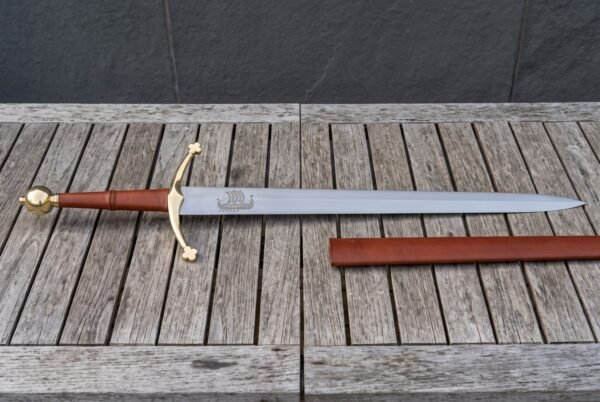
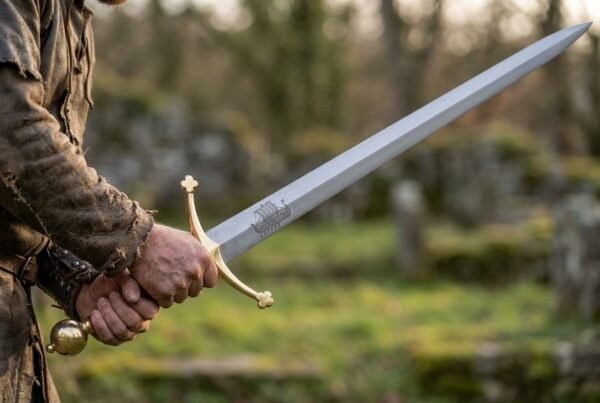
Forty one inches overall on a 31 inch blade, 2.1 inches wide at the guard, in 1095 high carbon hardened to 54 to 58 HRC. The grip is hardwood at 9 inches, which is the longest here and the most genuinely two handed, with a straight steel cross guard and a disc pommel. An engraved panel sits above the ricasso, and it comes with a leather scabbard. It weighs about 3 pounds 6 ounces, which makes it the heaviest of the three, and at 465 dollars it is also the least expensive.
The disc pommel is worth a paragraph on its own, because people look at a pommel and see a decorative cap. It is a counterweight. Thirty one inches of blade puts a great deal of mass in front of your hands, and without something behind them the sword would feel like a shovel. Adding weight at the far end of the grip pulls the balance point back toward the cross, which is the difference between a sword that hangs in the hand and one that drags.
The Damascus with the central fuller
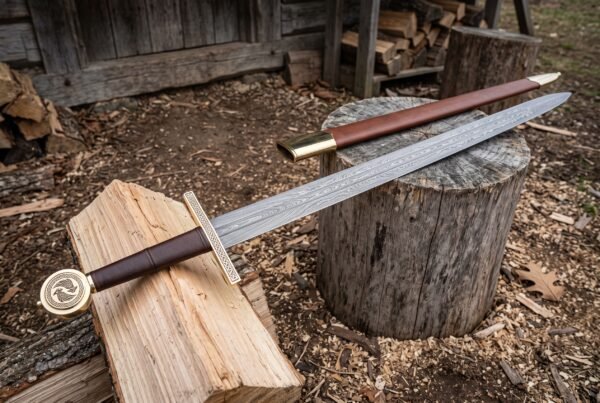
Thirty seven inches overall on a 30 inch blade, 2 inches wide at the guard, in forge welded 1095 and 15N20 at 58 to 60 HRC with a central fuller and an etched layered pattern. The hardwood grip is 7 inches with a steel cross guard and a large disc pommel, and it weighs about 2 pounds 14 ounces, the lightest here. A leather scabbard is included. At 595 dollars it is the shortest and the quickest of the three and the easiest to handle one handed.
About that groove down the middle of the blade. It is a fuller, it is not a blood groove, and it has nothing to do with suction or breaking a vacuum. It is a stiffening rib in reverse. Steel sitting on the neutral axis at the centre of a blade contributes almost nothing to stiffness, so removing it costs you very little rigidity and saves real weight. Every structural engineer who has ever specified an I beam is working from the same principle.
The Damascus bastard with the Valknut
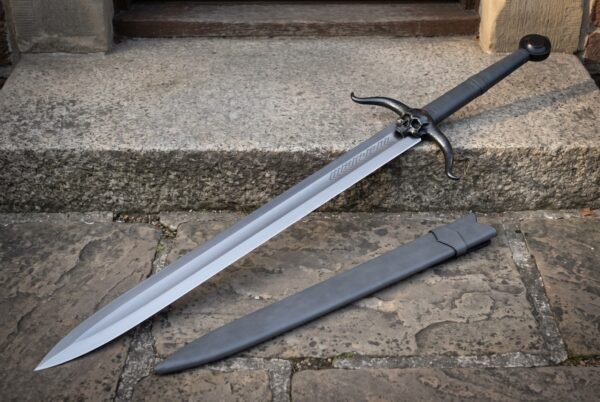
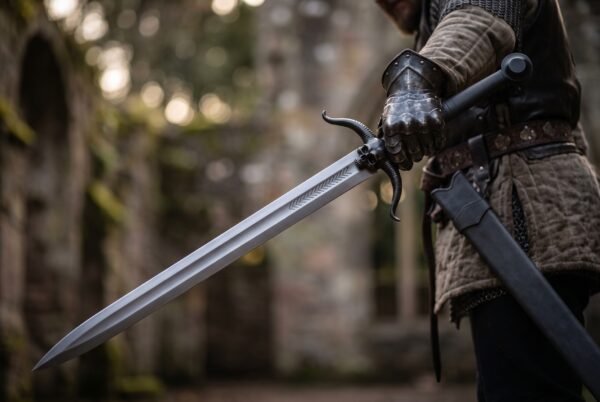
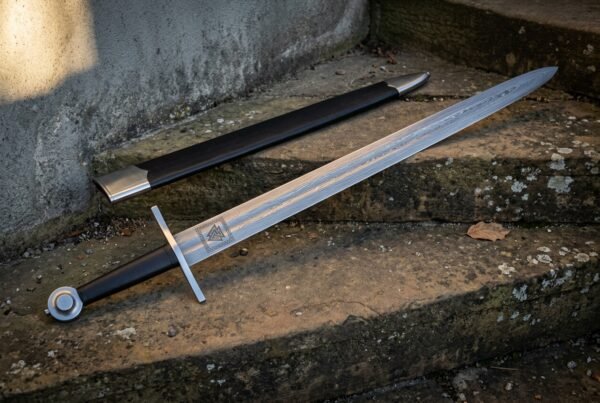
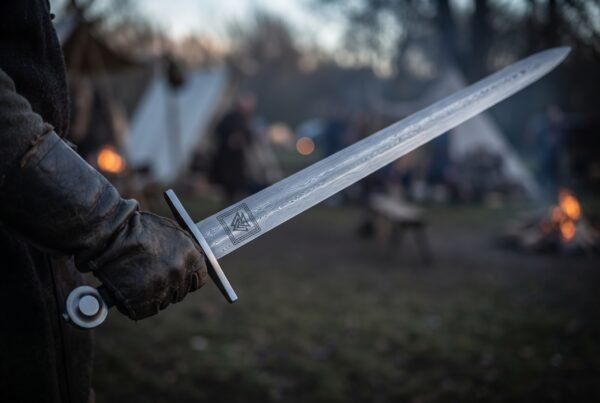
Forty three inches overall on a 33 inch blade, the longest here, in forge welded 1095 and 15N20 at 58 to 60 HRC with a hand etched flowing pattern and an etched Valknut in a bordered panel at the forte. The grip is 7.5 inches of black leather wrapped over a shaped core, with a straight steel cross and a turned steel wheel pommel. The tang runs the full length and is peened over the pommel. The scabbard is black leather with a steel throat and a steel chape. At 625 dollars it is the most expensive piece on the page and the one that looks it.
Peened over the pommel is the detail that matters. It means the tang passes through the pommel and is hammered over on the outside, so the whole assembly is locked together by deformed steel rather than by a thread that can loosen. It is how these were made and it is how they should still be made.
Lengths, steel and fittings across the range
Every figure below is taken from the specification panel of a sword on this page. These are forged and ground by hand, so read them as what to expect rather than as a promise to the millimetre.
| Sword | Steel and hardness | Overall length | Blade length | Blade width | Grip and fittings | Listed weight | Price |
|---|---|---|---|---|---|---|---|
| High carbon bastard | 1095 at 54 to 58 HRC | 41 in | 31 in | 2.1 in at the guard | Hardwood grip 9 in, straight steel cross, disc pommel | About 3 lb 6 oz | 465 dollars |
| Damascus with central fuller | 1095 and 15N20 at 58 to 60 HRC | 37 in | 30 in | 2 in at the guard | Hardwood grip 7 in, steel cross, large disc pommel | About 2 lb 14 oz | 595 dollars |
| Damascus bastard with Valknut | 1095 and 15N20 at 58 to 60 HRC | 43 in | 33 in | Not listed | Leather wrapped grip 7.5 in, straight steel cross, turned wheel pommel | Not listed | 625 dollars |
All three include a leather scabbard, and the Valknut sword adds a steel throat and chape at the mouth and the tip. A chape is not decoration either. It stops the point wearing through the end of the scabbard, which is where an unprotected leather scabbard always fails first.
Sizing and fit
Grip length is the number that tells you how the sword behaves, and it varies more here than blade length does. Nine inches is a proper two handed grip with room for both hands and the pommel underneath. Seven inches is hand and a half in the tightest sense, enough for a second hand to add leverage but not enough to be comfortable there all day. Seven and a half sits between the two.
Weight matters less than balance and people consistently get this backwards. Three pounds six ounces sounds heavy and is not, because the disc pommel pulls the balance point back to within a few inches of the cross. A badly balanced sword of two pounds is more tiring than a well balanced one of three and a half. If you get a chance to handle a sword before buying, ignore the scales and check where it wants to hang.
For display, measure first. A 43 inch sword needs about four feet of clear wall with a mount at two points, and a horizontal hang wants more space than people expect once the cross is included. Racks and hangers are in sword stands and displays, and how to display swords and axes covers doing it without pulling a fixing out of the plaster.
Steel and hardness
Two steels run through everything here and there is no third. Plain blades are 1095 high carbon hardened to 54 to 58 HRC. Damascus blades are 1095 and 15N20 forge welded and taken to 58 to 60 HRC.
The two are paired because they weld to each other cleanly and take acid differently. In the etch the 1095 goes dark and the nickel bearing 15N20 stays bright, and that contrast is the only reason you can see the layers. The nickel also toughens the billet, which is why a pattern welded blade can be run harder than a plain one without becoming brittle.
Stainless is not an option on a sword of this length and it is worth knowing why. Chromium blocks a sound forge weld so no pattern would form, it refuses to take a contrasting etch, and in a long blade its carbide structure makes fracture a real risk rather than a theoretical one. The honest cost of carbon steel is rust, and rust is handled with a cloth and a little oil. Our Damascus versus high carbon comparison sets the two side by side and the steel and hardness page explains what an HRC number measures.
Grips, pommels and tangs
Two of these have hardwood grips and one is leather wrapped over a shaped core. Both approaches work and they age differently. Wood polishes and darkens with handling and wants a wipe of oil once or twice a year, and it should be kept out of dry heat because a shrunken grip is how a sword starts to rattle. Leather takes hand oil, darkens faster and grips better when a hand warms up.
The Valknut sword states a full length tang peened over the pommel. That is the construction you want on any sword you intend to handle. A tang that stops halfway up the grip, or one held by a threaded nut, is a display fitting rather than a structural one. Our guide to full tang and partial tang construction explains what to look for and why it matters.
Sharpening and edge care
A sword is not a kitchen knife and should not be treated like one. Work in short sections along the edge with a medium stone, count your passes, and repeat the same count on the other side so the edge stays centred. An asymmetric edge on a long blade makes the sword track off line in a way that is very hard to feel until you notice the cuts are wandering.
1095 at 54 to 58 HRC comes back on a 1000 grit stone in a few minutes. Damascus at 58 to 60 HRC takes longer to move and holds the result longer. The grit progression is on sharpening with a whetstone, and the method scales up.
Rust, scabbards and storage
Both steels rust. Keep a light film of oil on the blade at all times, wipe it after handling, and pay particular attention to the fuller where dust and moisture collect and then sit there unnoticed.
Never take abrasive polish, wire wool or a rust eraser to the flats of a Damascus blade. The etch is a surface only and scrubbing flattens the pattern for good. Light orange spotting lifts with oil, a soft cloth and patience, and grey patina is stable and does no harm at all.
Store the sword out of its scabbard if it is going to sit for months. Leather holds moisture against steel, and a damp scabbard is the most common reason a well kept blade still ends up spotted. Somewhere with steady humidity is worth more than any particular oil, and a garage or a spot above a fireplace is worth less than nothing. Our care guide covers blade, grip and scabbard, and replacements are in scabbards and sheaths.
Engraving
Any of these can be engraved after they arrive in the United States. The flat above the ricasso is the natural place on a sword of this shape, and two of these already carry a cut or etched panel there. Where a piece already carries an engraved design, your chosen engraving replaces it rather than sitting beside it. On the Damascus blades a fresh cut reads bright against the etched pattern.
Text engraving is 19 dollars, a symbol is 39 dollars and a family crest is 49 dollars. Elder Futhark is a phonetic alphabet rather than a code, so a name is transliterated by sound and there is no rune for the letter C. Engraving is permanent and an engraved sword cannot be returned, so read the spelling twice before you order it.
Where these come from and how they ship
Ransack Viking is a US company based in Chicago, Illinois. The pieces are handmade in the Czech Republic, then imported, inspected and shipped from Chicago. Engraving is done in the US after arrival.
Because these are forged, ground and fitted by hand, two swords of the same model will differ slightly in etch figure, grind lines and the colour of the grip. A 43 inch sword ships in a long box, so allow somewhere to open it and check the scabbard fit before you hang anything.
How to choose
If you want the sword that actually behaves like a bastard sword, take the high carbon piece at 465 dollars. The 9 inch grip is the only one here that gives both hands room, the disc pommel balances the 31 inch blade properly, and plain 1095 is the easiest steel on the page to maintain. It is also the least expensive, which is an odd but welcome piece of arithmetic.
If you want a pattern welded blade you can still handle comfortably in one hand, take the fullered Damascus at 595 dollars. Thirty seven inches and 2 pounds 14 ounces makes it the quickest here, and the fuller down the centre is the reason it is light without being whippy.
If the sword is going on a wall and you want the one that stops conversations, take the Valknut Damascus at 625 dollars. Forty three inches, a hand etched flowing pattern, a wheel pommel, a peened full length tang and a leather scabbard with steel furniture at both ends. It is the most complete object here and it is priced accordingly.
Browse related categories
- Longswords with full two handed grips
- Arming swords, the one handed cousin
- Broadswords with wider cutting blades
- Claymores, the Scottish two hander
- Zweihanders for anyone who wants more of everything
- Damascus swords in forge welded 1095 and 15N20
- Sword stands and display racks
- Leather scabbards and replacements
Guides worth reading first
- How to buy your first sword without regretting it
- Display sword or battle ready: what the difference really is
- Full tang or partial tang, and why it decides everything
- How to display swords and axes without ruining a wall
- Damascus vs high carbon steel: which blade should you buy
Frequently asked questions
What is a bastard sword?
A sword with a grip long enough for a second hand but short enough to use in one. It sits between a one handed arming sword and a full two hander, and the name comes from it belonging to neither family. Hand and a half is the same sword described politely.
What does the extra grip length actually do?
It gives you two contact points several inches apart instead of one. You can push with one hand and pull with the other, which turns the sword far faster than a wrist alone can and lets you hold the point steady against pressure. That is why the grip length matters more than the blade length.
What is the groove down the middle of the blade?
A fuller. It is not a blood groove and it has nothing to do with suction. Steel at the centre of a blade contributes almost nothing to stiffness, so removing it saves real weight at very little cost in rigidity. It is the same reasoning that produces an I beam.
Are these swords sharp when they arrive?
Yes. Every blade is ground and finished by hand and arrives with a working edge. They are not shaving sharp, because a very fine edge on a long sword chips on contact. A few passes on a 1000 grit stone will take any of them further if you want.
What is a peened tang and does it matter?
It means the tang runs the full length of the grip, passes through the pommel and is hammered over on the outside, locking the assembly with deformed steel rather than a thread. It matters a great deal on any sword you intend to pick up, and it is the construction on the Valknut piece.
What is the pommel for?
Counterweight. A 31 inch blade puts a lot of mass in front of your hands and the pommel pulls the balance point back toward the cross. Without it the sword would feel like a shovel no matter what it weighed on a scale.
Does a scabbard come with the sword?
Yes, all three include a leather scabbard and one has a steel throat and chape. Use it for carrying rather than for long term storage, since lined leather traps moisture against the steel.
Where are these swords made?
Ransack Viking is a US company based in Chicago, Illinois. The pieces are handmade in the Czech Republic, then imported, inspected and shipped from Chicago. Engraving is done in the US after arrival.
Hand and a half for the club
If you like the feel of a hand and a half sword but want something you can fence with, the blunt HEMA longswords give you that grip on a blade made for sparring. How much a trainer should bend matters more than most people expect, and our note on blade flex covers it. The Vernholt blunt sword is the closest match to this page.