
A medieval axe is not a wood axe with a longer handle. A splitting axe carries a thick wedge behind its edge because it has to force fibres apart and keep moving. A fighting head does the opposite. The blade is thin, the cheeks are hollow behind the edge, and most of the metal has been pulled back toward the eye where it belongs, so the head stays light enough to stop and change direction in the middle of a swing.
This collection covers the long hafted end of that family. Overall lengths run from 20 inches for the war hammer to 28 inches for the war axe and 50 inches for the poleaxes, with cutting edges of 5.5 to 6 inches and listed weights from about 2 pounds for a head to about 5 pounds for a complete poleaxe. Hafts are American ash with riveted steel langets, heads are plain 1095 high carbon or forge welded Damascus, and every piece ships with a fitted leather head cover.
Pick the length by the room you have, not by the picture. Viking axe against medieval axe covers the rest.
Free US shipping
On most pieces. Heavier and oversized ones carry a flat charge.
Hand Forged
Heated, hammered and ground by hand.
Engraving available
Names, dates or Norse runes on most pieces.
Ships from Chicago
Inspected and dispatched from our Chicago warehouse. No import duty, no customs delay on US orders.
Medieval Axes
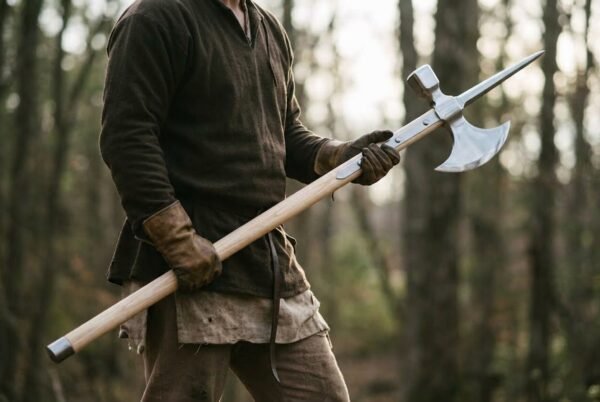
Moonpoll Hand Forged High Carbon Steel Poleaxe | 50 Inch Overall with a 5.5 Inch Cutting Edge | Reenactment Display Gift | RK-1361
Original price was: $599.00.$479.20Current price is: $479.20.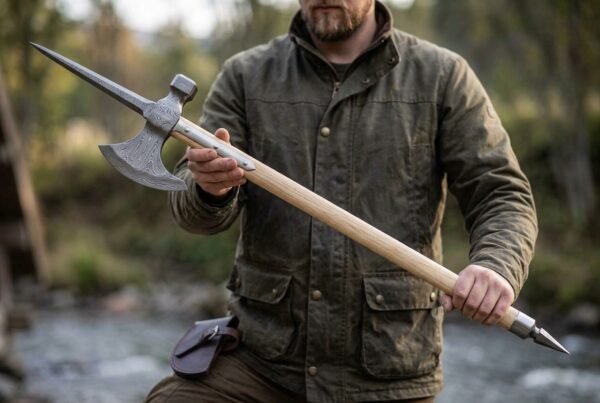
Stormpoll Hand Forged Damascus Steel War Axe | 36 Inch Overall with a 6 Inch Cutting Edge | Reenactment Display Gift | RK-1362
Original price was: $595.00.$476.00Current price is: $476.00.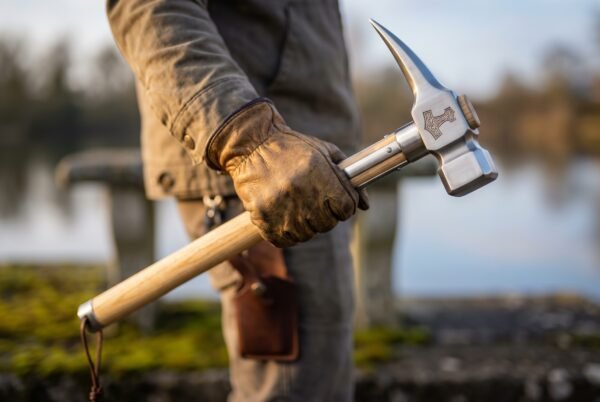
Stormbeak Hand Forged Viking War Hammer | 20 Inch Overall Length | Mjolnir Engraved Head and Steel Langets with Ash Haft | Norse Collector Gift | RK-1680
Original price was: $299.00.$239.20Current price is: $239.20.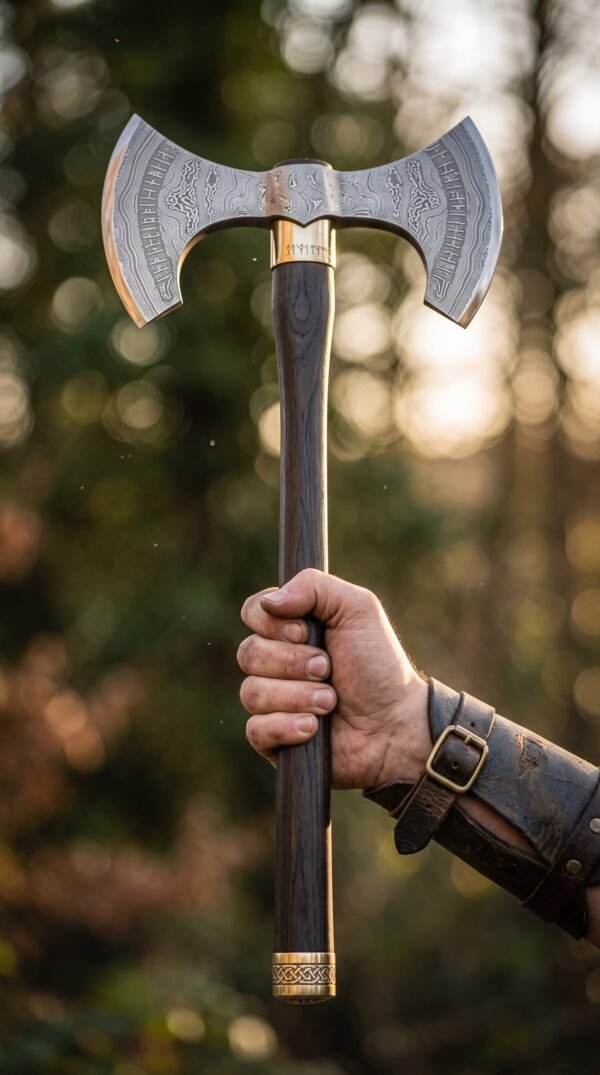
Langhewer Hand Forged Damascus Double Bit Viking War Axe | 28 Inch Overall with 6 Inch Cutting Edge | Norse Battle Collector Gift | RK-1213
Original price was: $285.00.$228.00Current price is: $228.00.What a fighting head is actually shaped for
Put a felling axe and a medieval axe head side by side and the difference is obvious before you pick either one up. The felling axe is fat. It has to be, because splitting wood means driving a wedge into a fibre bundle and forcing the two halves apart, and a thin edge would simply bind and stop. The fighting head is thin through the cheeks, often hollow behind the edge, and the mass has been drawn back toward the eye where it sits close to the axis of the haft.
That change does two things. It cuts the moment of inertia, so the head is quicker to start and much quicker to stop, and it means a swing can be aborted or redirected halfway through. An axe you cannot recover from is an axe that commits you to whatever happens next, which is fine against a log and a poor idea against anything that moves.
The second thing to understand is that a medieval axe head was rarely just an axe. Look at the poleaxes on this page and you will see three working faces on one head. A crescent blade cuts. A square hammer poll on the opposite side delivers a blunt strike that does not need to bite to be effective. A long spike at the top turns the whole thing into a short spear when the distance closes. That is a tool built by people who had thought hard about the fact that a fight does not stay at one range.
The medieval axes in this collection
Four pieces, and they cover a wider spread of length than the category name suggests. Read the overall length before you buy, because the difference between a 20 inch hammer and a 50 inch poleaxe is not a detail.
The long hafted war axe
Twenty eight inches overall on a straight grained ash haft, with a 6 inch cutting edge in a wide sweeping profile and a head weighing about 2 pounds. The head is hand forged high carbon, hand polished, and engraved with a Norse knotwork panel on the cheek. It is listed at 52 to 55 HRC at the edge with a soft eye and poll, which is how a hafted head should be treated. You want the edge hard enough to hold and the eye soft enough to take a shock without cracking around the haft. A leather head cover is stitched to fit and comes with it. At 285 dollars this is the entry point on the page and the easiest of the four to handle indoors.
The poleaxes
Both poleaxes are 50 inches overall on American ash with riveted steel langets running down the haft from the head. The 1095 version carries a 5.5 inch crescent blade, a square hammer poll opposite it, a 9 inch axial spike on top and a steel butt ferrule, and weighs about 4.8 pounds. The Damascus version carries a 6 inch crescent blade, the same square hammer poll, a 10 inch axial spike and polished steel langets, and weighs about 5 pounds. Both ship with a fitted leather head cover.
The war hammer
Twenty inches overall, with a square textured striking face on one side of the head and a long curved beak on the other, hardened to 54 to 58 HRC at both the face and the beak. The haft is pale oiled ash with riveted steel langets down both sides and a drilled butt fitted with a leather lanyard. A Mjolnir is cut into the cheek of the head and a shaped leather head cover is included. At 299 dollars it is the shortest and the most one handed piece on the page.
The textured face is not decoration. A smooth hammer face skids off a curved surface. Texture gives it something to grip with, which is the same reason a machinist's hammer is cross hatched.
Plain steel and Damascus
Three of the four heads are plain high carbon. One poleaxe head is forge welded Damascus of 1095 and 15N20, hand etched so the layers read as light and dark bands across the cheek. On a head with three arms the pattern also shows the order the smith worked in, because the layers run straight where the steel was drawn and swirl where it was upset and folded around the eye. It is the only piece here where the steel is worth looking at as closely as the shape.
Lengths, heads and hafts across the range
Every figure below is taken from the specification panel of a piece on this page. These are forged and fitted by hand, so treat them as what to expect rather than as a guarantee.
| Piece | Steel and hardness | Overall length | Cutting edge | Head | Haft | Weight | Price |
|---|---|---|---|---|---|---|---|
| Long hafted war axe | High carbon, 52 to 55 HRC at the edge | 28 in | 6 in, wide sweeping profile | Knotwork engraved cheek, soft eye and poll | Straight grained ash, 28 in, oil finished | Head about 2 lb | 285 dollars |
| Poleaxe in 1095 | 1095 at 54 to 58 HRC | 50 in | 5.5 in crescent | Square hammer poll, 9 in axial spike | American ash, riveted steel langets, steel butt ferrule | About 4.8 lb | 465 dollars |
| Poleaxe in Damascus | 1095 and 15N20 at 58 to 60 HRC | 50 in | 6 in crescent | Square hammer poll, 10 in axial spike | American ash, riveted polished steel langets | About 5 lb | 595 dollars |
| War hammer | High carbon at 54 to 58 HRC | 20 in | Not applicable | Square textured face, long curved beak, Mjolnir cut into the cheek | Pale oiled ash, riveted steel langets both sides, leather lanyard | Not listed | 299 dollars |
All four include a fitted leather head cover. That is not a nicety. A bare edge on a long haft finds shins, door frames and other people, and the cover is the difference between storing one of these and worrying about it.
Sizing and fit
Length is the first decision and most people get it wrong by going long. A 50 inch poleaxe needs a swing arc most rooms do not have, and it is a genuinely two handed object. A 28 inch war axe works in a normal space and can be swung one handed. A 20 inch hammer is close to a large one handed tool and needs almost no room at all.
Balance matters more than raw weight. The war axe head is about 2 pounds sitting at the end of a 28 inch haft, which puts a lot of the mass a long way from your hand. The poleaxes are heavier in total but their weight is spread along the shaft and split between three head elements, so the balance point sits further back than you expect. If you are buying for display, the poleaxes need a wall run of over four feet and a mount at two points.
Steel and hardness
Two steels run through everything here. Plain heads are 1095 high carbon hardened to 54 to 58 HRC. Damascus heads are 1095 and 15N20 forge welded and taken to 58 to 60 HRC. There is no third grade and no proprietary alloy.
The long hafted war axe is the one exception worth explaining, and it is a deliberate one. It is listed at 52 to 55 HRC at the edge with a softer eye and poll. A head that is hard all the way through is a head that can crack around the eye when it takes a shock, so a good axe is treated so that the edge holds and the body absorbs. That is old practice, not a compromise.
1095 and 15N20 are paired for the Damascus because they weld to each other cleanly and take acid differently. The 1095 darkens in the etch and the nickel bearing 15N20 stays bright, which is what makes the layers visible at all. The nickel also toughens the billet, which is why a pattern welded head can be run harder than a plain one. Neither steel is stainless. Both will rust if you ignore them. The steel and hardness page explains what an HRC figure measures, and Damascus versus high carbon sets the two side by side.
Hafts, langets and fittings
Ash is the traditional haft timber for a reason that has nothing to do with tradition. It has long straight fibres that bend and return rather than splintering, and it damps shock instead of transmitting all of it into your wrists. Hickory is stiffer and heavier. Ash is what a European maker reached for and it is what is fitted here, straight grained and finished with oil.
The steel langets on the poleaxes and the hammer are the strips riveted down the sides of the haft below the head. They exist because the wood immediately under a head is the weakest part of the whole assembly and the first thing to fail when a strike lands on the shaft rather than the head. Langets take that hit instead. They also stop a head working loose over time by spreading the fixing over several inches rather than one hole.
Oil the haft once or twice a year with any timber oil. Dry ash shrinks, and a shrunken haft is how a head starts to move. If a head ever does feel loose, stop using the piece and have it re seated rather than hoping it settles. Replacement hafts and blanks live in axe handles and hafts.
Care and storage
Wipe the head down after handling and keep a light film of oil on the steel. Fingerprints are acidic and they will etch a polished cheek within weeks if you leave them there. Camellia, mineral or any food safe oil all work.
On the Damascus head, never use abrasive polish, wire wool or a rust eraser. The etch lives in the top few thousandths of the surface and scrubbing it takes the pattern off permanently. Light orange spotting comes away with oil and a soft cloth and some patience. Grey patina is stable and does no harm at all.
Store with the leather head cover on, but do not store the piece leaning in a damp garage with the cover fitted for months, because leather holds moisture against steel. For long storage, wipe, oil, and hang it somewhere with steady humidity. Our axe care guide covers the routine and removing rust from an axe deals with the case where it has already gone wrong.
Sharpening a curved axe edge is not knife work. Follow the curve with a file or a coarse stone, keep the existing bevel angle rather than inventing a new one, work both sides evenly and finish with a fine stone or a puck. The method is on how to sharpen an axe.
Engraving
Any of these can be engraved after they arrive in the United States. The cheek of the head is the natural place, and on the war axe and the hammer there is already a cut design there, a knotwork panel on one and a Mjolnir on the other. Where a piece already carries an engraved design, your chosen engraving replaces it rather than sitting beside it.
Text engraving is 19 dollars, a symbol is 39 dollars and a family crest is 49 dollars. Elder Futhark is a phonetic alphabet rather than a cipher, so a name is transliterated by sound and there is no rune for the letter C. Engraving is permanent and an engraved piece cannot be returned, so check the spelling twice before you order.
Where these come from and how they ship
Ransack Viking is a US company based in Chicago, Illinois. The pieces are handmade in the Czech Republic, then imported, inspected and shipped from Chicago. Engraving is done in the US after arrival.
Because heads are forged and hafts are shaped by hand, two pieces of the same model will differ slightly in grind, etch figure and the colour of the ash. Long pieces ship in a long box and a 50 inch poleaxe is a large parcel, so allow room for it to arrive and somewhere to open it.
How to choose
Decide on length first. If the piece is going on a wall in a normal room, the war axe at 28 inches or the hammer at 20 inches will sit comfortably and can be taken down and handled. A 50 inch poleaxe needs a wall of its own and a proper two point mount.
If you want the piece that is most interesting to hold, take a poleaxe. Three working faces on one head is the most sophisticated thing on this page, and it is the piece that most people have read about and never handled. Take the 1095 version at 465 dollars if it is going to be used or carried at events, and the Damascus version at 595 dollars if the steel itself is part of the point.
If it is a gift, the war hammer is the safest choice. It is short, it is the easiest to display, and the Mjolnir on the cheek makes it read as what it is without a caption.
Browse related categories
- Poleaxes, the full range of long hafted heads
- Battle axes across the Norse and medieval period
- Bearded axes with the dropped beard on the edge
- Dane axes, the long two handed Norse blade
- Halberds, the axe and spike on a full length shaft
- Maces and blunt heads that need no edge at all
- Viking axes, the whole Norse axe collection
- Axe handles and replacement hafts
Guides worth reading first
- Viking axe or medieval axe: what actually changed
- Mace, war hammer or flail: how blunt heads differ
- Choosing an axe by length, head weight and use
- How to sharpen an axe without ruining the bevel
- Axe care: head, edge, haft and storage
Frequently asked questions
What is the difference between a medieval axe and a wood axe?
Geometry. A wood axe is thick behind the edge so it can wedge fibres apart. A fighting head is thin through the cheeks with the mass drawn back toward the eye, so it is quicker to start, quicker to stop and easier to redirect in the middle of a swing. The two shapes are bad at each other's jobs.
What are the three parts of a poleaxe head for?
The crescent blade cuts, the square hammer poll on the opposite side delivers a blunt strike that does not need to bite, and the axial spike on top gives you a thrust when the distance closes. One head, three ranges.
Are these sharp when they arrive?
Yes. Every edge is ground and finished by hand and arrives with a working edge. They are not razors, because a very thin edge on an axe chips against anything hard. A file and a puck will take any of them further if you want more.
What are the steel strips down the haft?
Langets. The wood directly under a head is the weakest part of the assembly and the first thing to break when a strike lands on the shaft. The langets take that hit instead, and they spread the head fixing over several inches rather than one hole.
What steel are the heads made from?
Plain heads are 1095 high carbon at 54 to 58 HRC. The Damascus poleaxe head is 1095 and 15N20 forge welded and etched, at 58 to 60 HRC. The long hafted war axe is treated so the edge is at 52 to 55 HRC with a softer eye and poll, which is how a hafted head should be hardened.
Can I hang a 50 inch poleaxe on a normal wall?
Yes, if you use two mounts and find studs. Five pounds hanging on a single drywall anchor is a bad night waiting to happen. Measure first, because a 50 inch shaft plus a spike needs more clear wall than most people picture.
Does a head cover come with it?
Yes. All four ship with a fitted leather head cover. Use it whenever the piece is being moved or stored short term, and take it off for long storage so the leather is not holding damp against the steel.
Where are these made?
Ransack Viking is a US company based in Chicago, Illinois. The pieces are handmade in the Czech Republic, then imported, inspected and shipped from Chicago. Engraving is done in the US after arrival.
Featured pieces
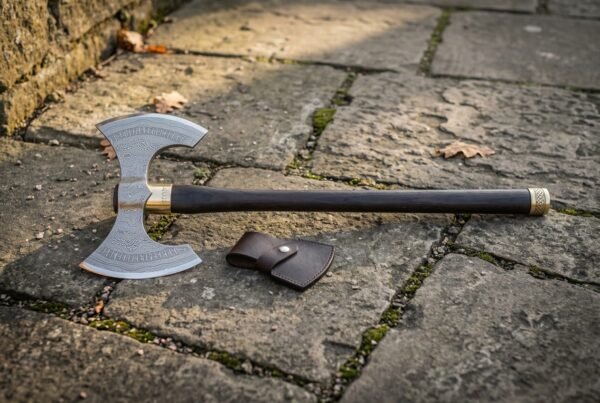 Langhewer Hand Forged Damascus Double Bit Viking War Axe
Original price was: $285.00.$228.00Current price is: $228.00.
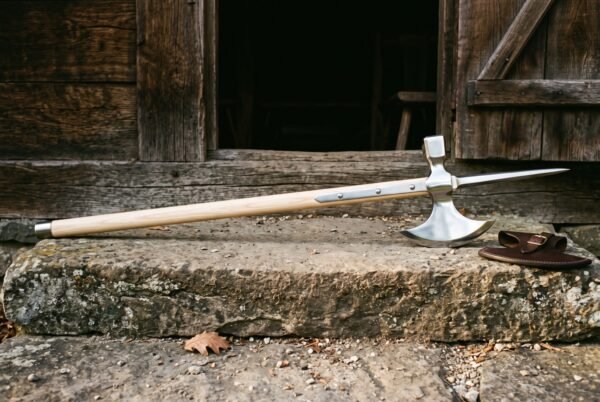 Moonpoll Hand Forged High Carbon Steel Poleaxe
Original price was: $599.00.$479.20Current price is: $479.20.
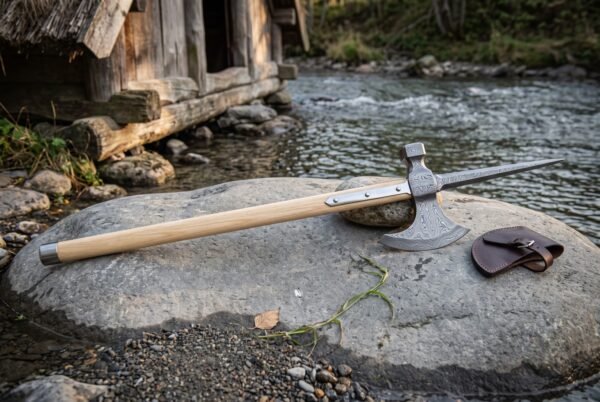 Stormpoll Hand Forged Damascus Steel War Axe
Original price was: $595.00.$476.00Current price is: $476.00.
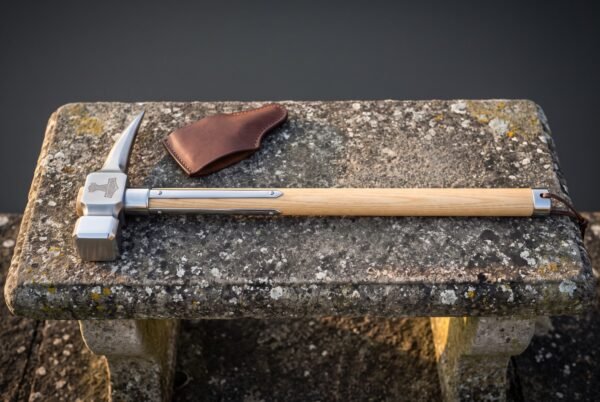 Stormbeak Hand Forged Viking War Hammer
Original price was: $299.00.$239.20Current price is: $239.20.