
An axe haft is the part that breaks. Heads outlive their handles by decades, and a haft that has dried out, split at the eye or been chewed short by a bad overstrike is not worth nursing along. This is where you replace it. The haft also decides how the axe behaves, because length sets your leverage and the curve sets where the edge lands.
The hafts here are American hickory, air dried and picked for straight grain, at 19 inches for one handed work and 24 inches for two hands. Both arrive shouldered and kerfed at the eye, sawn ready for the wedge, and both are sanded rather than varnished so your palm meets wood instead of plastic. One carries a cut Valknut below the eye and ships with a matched wooden wedge and a tin of finishing wax. The other carries a Celtic knotwork band and ships with a wooden wedge plus two steel ring wedges. This page also holds a wet formed leather head mask sized for heads up to a 6 inch edge, and more of those sit with the sheaths.
Measure your eye before you order, and buy the wedges with the haft rather than a week later.
Free US shipping
On most pieces. Heavier and oversized ones carry a flat charge.
Hand Forged
Heated, hammered and ground by hand.
Engraving available
Names, dates or Norse runes on most pieces.
Ships from Chicago
Inspected and dispatched from our Chicago warehouse. No import duty, no customs delay on US orders.
Axe Handles & Hafts
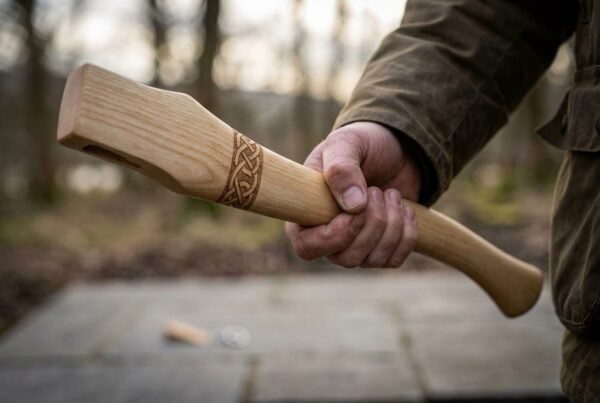
Knotgrain Hand Made Hickory Axe Haft with Celtic Knotwork Engraving | 16 Inch One Hand Length | Wooden Wedge and Two Steel Ring Wedges Included | Norse Rehandle Gift | RK-1742
Original price was: $129.00.$103.20Current price is: $103.20.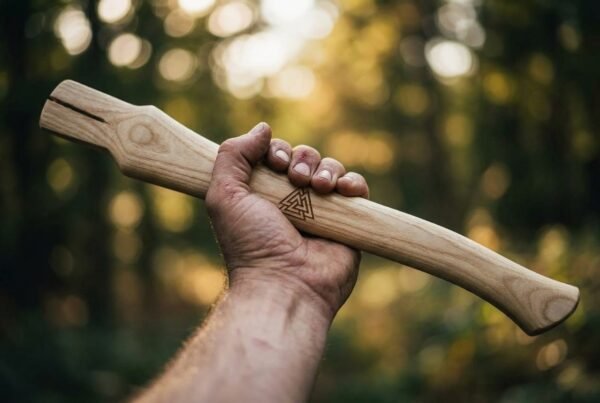
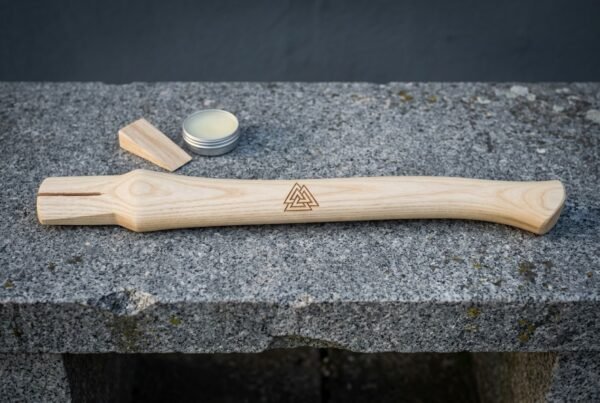
Bindwood Hand Made Hickory Axe Handle with Valknut Engraving | 19 Inch Bearded Axe Haft | Wooden Wedge and Tin of Finishing Wax Included | Norse Rehandle Gift | RK-1737
Original price was: $109.00.$87.20Current price is: $87.20.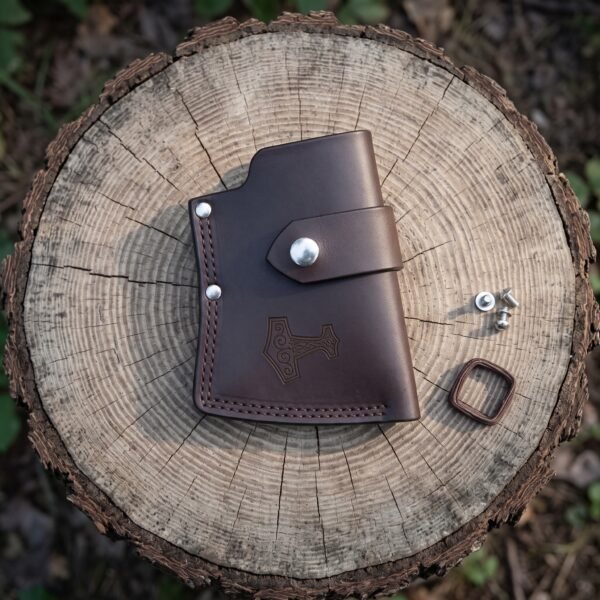
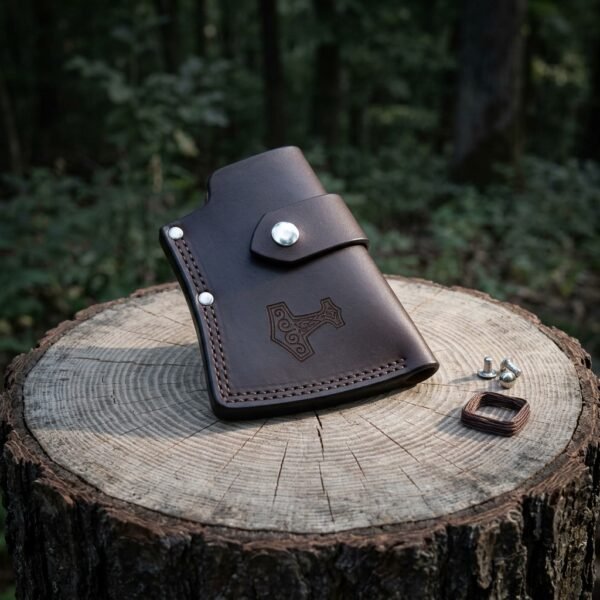
Haftmask Hand Made Leather Axe Sheath with Tooled Mjolnir Panel | Fits Bearded Axe Heads to 6 Inch Edge | Steel Snaps and Hand Stitched Welt | Viking Axe Care Gift | RK-1721
Original price was: $109.00.$87.20Current price is: $87.20.The handle is the part that fails
An axe head is a lump of hardened steel with a hole in it. Left dry and out of the rain it will sit in a shed for a hundred years and still take an edge. The haft will not. Wood dries, shrinks, checks along the grain and eventually lets go of the wedge, and one missed swing that lands behind the head will splinter the top of a handle in a single stroke. Overstrike is how most hafts die, and it has nothing to do with the quality of the wood.
So the sensible thing to do with a good head on a tired handle is rehang it rather than retire it. That is what this page is for. A haft is not a spare part in the way a bootlace is a spare part, because the handle does more than hold the head at a distance from your hand. It sets the arc the edge travels through, it decides how much of the shock of the blow reaches your wrist, and its length is the entire difference between a one handed carving axe and a two handed splitter using the identical head.
Length is leverage. A short haft brings the edge closer to your eye and gives you control, which is what you want for shaping wood, limbing small branches and any job where you are choking up near the head. A long haft gives you speed at the edge because the same shoulder rotation moves the head further, which is what you want when you are splitting rounds or working with both hands. Neither is better. They are different tools that share a head.
Curve is placement. The gentle sweep in a haft is not decoration. It brings the butt of the handle up into the heel of your hand so the grip does not slide, and it tilts the head very slightly so the edge meets the wood square rather than heel first. A dead straight haft is fine on a splitting axe where the blow is vertical and the target is enormous. On a bearded head doing close work, the curve is what stops you glancing off.
The hafts in this collection
Three pieces sit on this page. Two are hickory hafts at different working lengths, and the third is a leather mask for the head you are hanging on them. All three are sold on their own. No axe head is included with any of them, and the axes in the photographs are there for scale.
The 19 inch haft with a cut Valknut
Close grained American hickory, air dried and selected for straight grain, at roughly 19 inches. That is a one handed working length. The profile is gently curved with a raised palm swell at the butt, so the hand has something to close around at the end of a swing rather than a plain taper. A Valknut is cut into the flat below the eye. The finish is sanded and waxed, with no varnish and no lacquer anywhere on it.
It suits bearded and Viking pattern heads with a standard oval eye. The eye end arrives shouldered and kerfed, which means the shoulder is already cut so the head stops in the right place, and the saw cut for the wedge is already made down the centre of the top. In the box you get the haft, a wooden wedge cut to match that kerf, and a small tin of finishing wax.
The 24 inch haft with a Celtic knotwork band
American hickory again, air dried and picked for straight grain and correct ring orientation, at roughly 24 inches. Two hands fit on it comfortably. The profile runs straight through the middle with a swept curve and a swell into the butt, which is the shape you want when the lower hand slides down the shaft during a splitting stroke. A band of Celtic knotwork is cut around the shaft below the eye, and that band sits exactly where a hand grips when you choke up for close work, so it earns its place twice.
This one is sanded and left bare of varnish or lacquer, which matters more than it sounds. Wax and oil soak in and can be renewed. A film finish sits on top, wears through in patches, and traps moisture underneath once it cracks. Bare sanded hickory is also easier to fit, because you can rasp the eye end down without cutting through a coating first. It suits bearded, Dane and medieval pattern heads with a standard oval eye. The box holds the haft, a matched wooden wedge and two steel ring wedges.
The leather head mask
A wet formed sheath for the head itself, cut from dark brown vegetable tanned bridle leather of roughly 9 to 10 ounce weight. It fits bearded and straight heads up to roughly a 6 inch cutting edge. The body is notched at the back so it sits over a bearded head and follows the beard instead of gapping away from it, and it closes with a steel snap strap that passes behind the haft and pulls the mask down tight. A Mjolnir is tooled and cut into the face panel. Construction is hand saddle stitching in waxed thread around a full leather welt, with steel reinforcing studs, and the edges are burnished, sealed and waxed. It ships with spare snap studs and a care card.
A mask protects two things. It protects you and the inside of a bag from an exposed edge, which is obvious. It also protects the axe, because a bare edge rattling around in a pack rolls and nicks, and every nick is steel you have to grind away later.
Lengths, wood and what is in the box
Every figure below comes from the specification panel of a piece on this page. These are shaped by hand from natural stock, so read the lengths as what to expect rather than as a promise to the millimetre.
| Piece | Material | Length or fit | Engraving or tooling | Eye end | Included |
|---|---|---|---|---|---|
| Hickory haft, one handed | American hickory, air dried, straight grained | About 19 in | Cut Valknut on the flat below the eye | Shouldered and kerfed | Haft, matched wooden wedge, tin of finishing wax |
| Hickory haft, two hand | American hickory, air dried, straight grained | About 24 in | Cut Celtic knotwork band around the shaft | Shouldered and kerfed | Haft, matched wooden wedge, two steel ring wedges |
| Leather head mask | Vegetable tanned bridle leather, 9 to 10 oz | Heads to about a 6 in edge | Tooled Mjolnir on the face panel | Not applicable | Mask, spare snap studs, care card |
Note the last column. Wedges are not an accessory you buy afterwards. A haft without the right wedge is a stick, and both hafts here arrive with theirs already cut to match the kerf that was sawn into that particular handle.
Sizing and fit
The number that decides whether a haft will work is not the length. It is the eye. Both hafts here are cut for a standard oval eye of the kind found on bearded, Viking, Dane and medieval pattern heads. Before you order, stand your head on a bench and measure the eye at the top face, across the long axis and the short axis, and write both numbers down. Then measure the depth of the eye from top to bottom. A head with a very small eye, a round eye or a strongly hourglass shaped eye is a different fitting job.
Hafts are deliberately cut a fraction oversized at the eye end. That is the only way a handmade haft can be made to fit a handmade head. Removing wood is easy and putting it back is not, so work slowly.
Hickory, grain and growth rings
Hickory is the standard for striking tool handles in North America for a reason. It is dense, stiff and unusually tough in bending, which means it absorbs the shock of a blow and springs back rather than taking a set or snapping. Ash is the traditional European equivalent and is lighter and slightly more flexible. Both work. Hickory is the harder wearing of the two.
Grain matters far more than species. A handle wants long, straight grain lines running the full length of the shaft, parallel to the axis, with no run out where a line exits through the side of the handle. Every place a grain line runs off the edge is a place the wood can split along. Both hafts here are cut from air dried stock selected for straight grain, and the 24 inch haft is also selected for correct ring orientation, meaning the growth rings run across the width of the handle rather than along it. Rings running the right way put the stiff and the springy layers of the wood where they do the most good under a bending load.
The wedges, and why there are two kinds
A head does not stay on because it is a tight fit. It stays on because the wood inside the eye is being pushed outward against the walls of the eye. The wooden wedge does that. It is driven down into the saw kerf in the top of the haft, spreading the tongue of wood sideways until it locks against the front and back of the eye. Glue is optional and controversial. Correct wedging is neither.
The two steel ring wedges supplied with the 24 inch haft are cross wedges. They go in after the wooden wedge and at an angle across it, so they spread the wood in the other axis, front to back rather than side to side. That closes the small gaps left at the ends of the eye. The order is fixed. Wooden wedge first, driven fully home and the excess sawn flush, then the steel wedges tapped in across it. Reversing the order splits the tongue.
Care and storage
Bare or waxed hickory wants oil, not varnish. Boiled linseed oil, a hard wax finish or the tin of wax supplied with the 19 inch haft all do the same job, which is to slow moisture moving in and out of the wood. Wipe a thin coat on, let it soak, wipe the excess off, and repeat once or twice a year or whenever the handle starts to feel dry and chalky under the thumb.
Store an axe head down or hanging, somewhere with stable humidity. A shed that swings from freezing damp to summer heat is the worst place for a hung head, because the wood in the eye moves with every cycle and the joint slowly works loose. Check the head before every session by holding the haft and giving the head a firm sideways push. Any movement at all means stop, and rewedge before you swing it.
Leather wants the opposite treatment to wood. Keep the mask dry, let it dry slowly and away from heat if it does get wet, and feed it occasionally with a leather conditioner. Never store a head in a damp mask, because leather holds moisture against steel and that is the most common reason a well kept edge still ends up spotted. Our axe care guide covers the rest.
Engraving
Both hafts already carry cut work, a Valknut on one and a Celtic knotwork band on the other, and both can take further engraving after they arrive in the United States. Names, dates and Elder Futhark rune lines go along the flat of the shaft or below the eye. Text engraving is 19 dollars, a symbol is 39 dollars and a family crest is 49 dollars.
Elder Futhark is a phonetic alphabet rather than a code, so a name is transliterated by sound and not letter for letter, and there is no rune for the letter C. Read our guide to the runes before you decide on wording. Engraving is permanent and an engraved piece cannot be returned, so send the exact spelling and check it twice.
Where these come from and how they ship
Ransack Viking is a US company based in Chicago, Illinois. The hafts and the leather mask are sawn, shaped, engraved, stitched and finished by hand in the Czech Republic, then imported, inspected and shipped from Chicago. Engraving is done in the US after arrival.
Because these are worked by hand from natural material, expect small differences in colour, grain figure and the exact depth of a cut line between two hafts of the same name. Hickory ranges from near white sapwood to a warm brown heartwood and both are sound. Two hafts made on two different days will not be identical, and if they were, something would have gone wrong.
How to choose
Start with the head. If it is a bearded or Viking pattern for carving, camp use or display, take the 19 inch haft. If it is a bearded, Dane or medieval head that will be used two handed for splitting or felling, take the 24 inch. Then check your eye measurements against a standard oval before you order either.
If you are buying a haft as a gift for someone who already owns a good head, add the mask. It is the accessory nobody buys for themselves and the one that stops a nice edge getting chewed up in a bag. If you are still choosing the head itself, our bearded axes and Dane axes are the two patterns these hafts suit best.
Browse related categories
- Viking axes, hung and ready to use
- Bearded axes, the pattern the 19 inch haft is cut for
- Splitting and felling axes for two handed work
- Dane axes with long hafts and wide edges
- Throwing axes, where hafts get replaced most often
- Blacksmith tools, tongs, hammers and punches
- Sheaths, scabbards and edge covers
Guides worth reading first
- Axe care: handles, heads and rust
- How to sharpen an axe without ruining the bevel
- How to remove rust from an axe head
- Choosing an axe for the work you actually do
- What is a bearded axe and why the beard is there
Frequently asked questions
Does a haft come with an axe head?
No. Every piece on this page is sold on its own, and the axes shown in the photographs are there for scale. You are buying the handle, the supplied wedges and the finishing wax, or in the case of the mask, the leather sheath and its spare studs.
Which length should I buy?
Nineteen inches is a one handed working length for carving, limbing and camp work where accuracy matters. Twenty four inches is a two hand length for splitting and felling, where you want head speed. The same head will feel like a different tool on each.
Will this haft fit my axe head?
Both hafts are cut for a standard oval eye, of the sort found on bearded, Viking, Dane and medieval pattern heads. Measure the long axis, the short axis and the depth of your eye before ordering. A round eye or a strongly hourglass eye is a different job.
Why is the eye end oversized?
Because it has to be. Both the head and the haft are made by hand, so the fit is finished by you. You rasp the top few inches down a little at a time, offering the head up between passes, until it slides on with firm hand pressure and stops at the shoulder.
What is the difference between the wooden wedge and the steel wedges?
The wooden wedge drives down into the saw kerf and spreads the wood sideways against the walls of the eye. The steel ring wedges go in afterwards, at an angle across it, and spread the wood front to back. Wooden wedge first, always. Reversing the order splits the tongue.
Should I varnish or lacquer the handle?
No. Both hafts are sanded rather than coated on purpose. A film finish cracks, wears through in patches and traps water underneath. Oil or wax soaks in, can be renewed with a rag in two minutes, and leaves the grip feeling like wood.
My head has gone loose. Can I just soak it?
You can, and it will tighten for a few weeks and then be looser than before. Swelling compresses the wood in the eye and it does not recover. The real fix is to drive the wedge deeper, add a cross wedge, or pull the head and rehang it on a new haft.
Where are these made?
Ransack Viking is a US company based in Chicago, Illinois. The hafts and the mask are handmade in the Czech Republic, then imported, inspected and shipped from Chicago. Engraving is done in the US after arrival.
Featured pieces
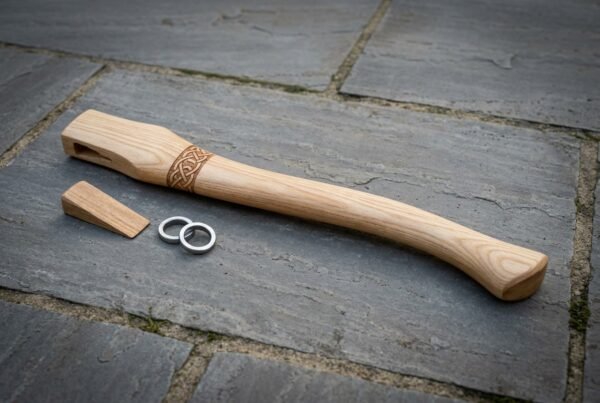 Knotgrain Hand Made Hickory Axe Haft with Celtic Knotwork Engraving
Original price was: $129.00.$103.20Current price is: $103.20.
 Bindwood Hand Made Hickory Axe Handle with Valknut Engraving
Original price was: $109.00.$87.20Current price is: $87.20.
 Haftmask Hand Made Leather Axe Sheath with Tooled Mjolnir Panel
Original price was: $109.00.$87.20Current price is: $87.20.