
Blog
What Is a Bearded Axe? The Viking Axe Shape Explained

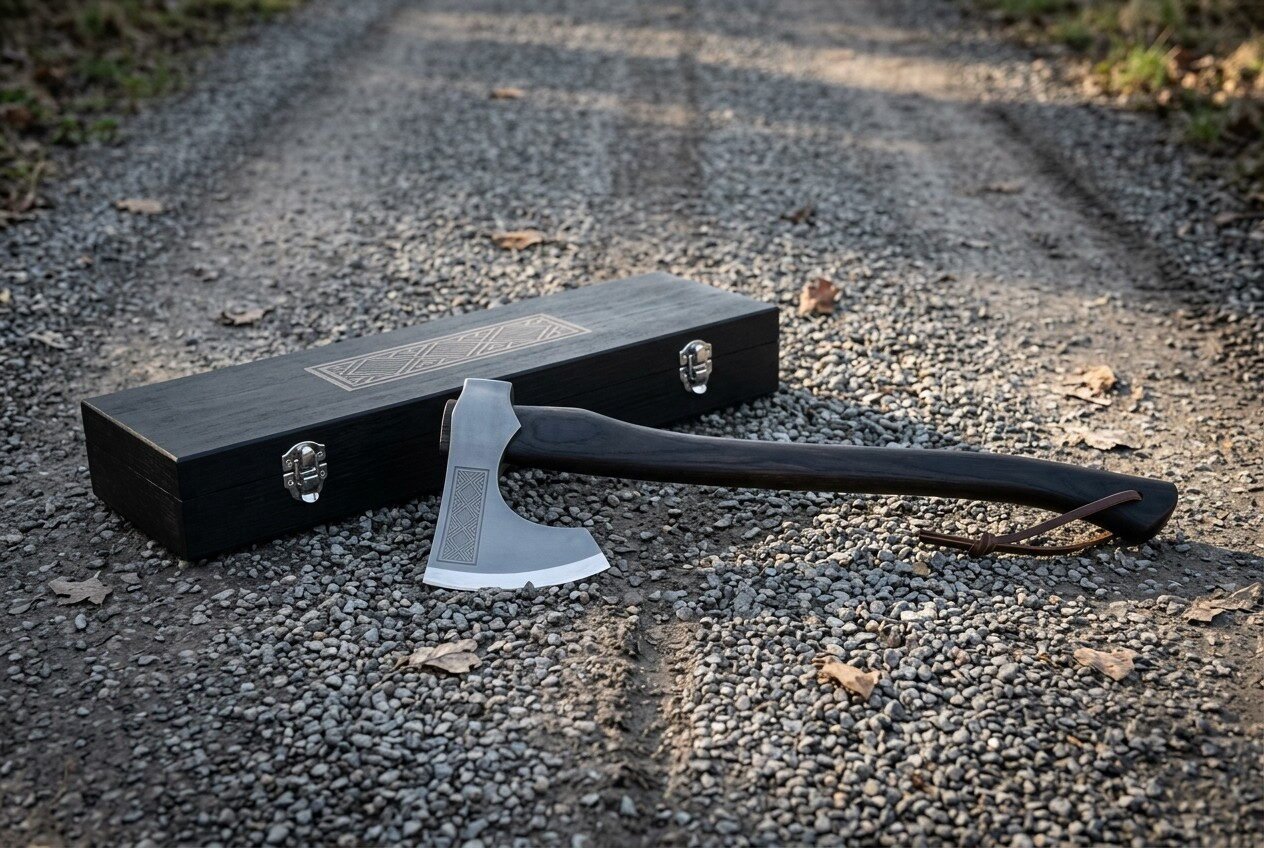
A bearded axe is an axe whose cutting edge hangs well below the eye. That long lower lip is the most recognisable feature of Norse axe design, and it is there for reasons that have nothing to do with looks, which is the reverse of how it is usually sold. This guide explains what the beard is, why smiths shaped it that way, how it compares with the Dane axe and the hand axe, how a modern hand forged bearded axe is made, and what to check before you buy. If you want the wider story of Norse axes from farm tool to war axe, our Viking axe history post covers that ground and this article picks up where it leaves off.
What the beard actually is
Look at a bearded axe head side on. The cutting edge starts up near the top corner, the toe, and sweeps down and back toward the handle, ending at a lower corner called the heel that sits well below the eye. The stretch of blade that drops below the eye is the beard. On a bearded axe the heel hangs down, sometimes an inch, sometimes a hand’s width, leaving a hollow between the beard and the haft where you can fit your fingers.
That hollow is the whole point. A bearded head gives you a long cutting edge without the mass of a full solid blade behind it. The steel sits where it works, along the edge and around the eye, and the middle of the blade is thinned or cut away. The result is an axe that bites like a much bigger head but swings like a lighter one.
Why smiths shaped it that way
There are three practical reasons the beard exists, and all three still matter to anyone who uses one today.
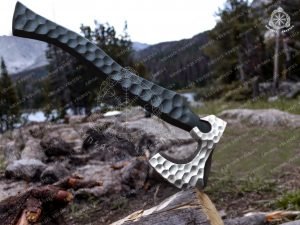 Emberbeard Hand Forged Damascus Viking Bearded Axe | 19 Inch | Rosewood Handle with Leather Blade Cover and Gift Box | Norse Bushcraft Collector Gift | RK-361
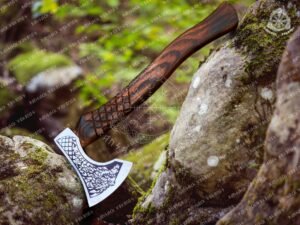 Dragon Hand Forged High Carbon Steel Viking Bearded Axe | 19 Inch | Wood Handle with Leather Blade Cover and Gift Box | Norse Dragon Collector Gift | RK-355
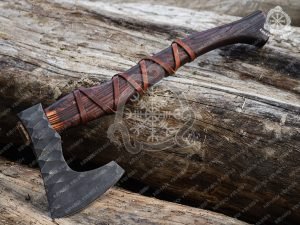 Norsewind Hand Forged High Carbon Steel Viking Bearded Axe | 19 Inch | Rosewood Shaft with Leather Blade Cover and Gift Box | Nordic Camping and Easter Gift | RK-391
The first is reach and hooking. A dropped heel can catch and pull. A farmer could hook a branch or drag brush with it, and a fighter could hook a shield rim and yank it down. Once the shape existed, everyone carrying one found a use for the hook, and later heads kept it deliberately.
The second is choking up. Slide your hand up the haft until your fingers sit in the hollow behind the beard, with the steel guarding your knuckles, and the axe turns into a large knife. You can shave wood or carve a spoon blank with the long edge while the haft rests along your forearm. A plain axe head does not leave room for this grip. This is why bushcraft people keep buying bearded hatchets. One tool genuinely covers both jobs.
The third is weight distribution. Iron and steel were expensive in the Viking Age, and a smith who could get a six inch edge out of the same metal as a three inch edge had a better product. Cutting away the middle of the blade kept the head light and fast while the edge stayed long, and a light head on a long haft is quicker to recover between swings.
Petersen types in plain words
Most of what collectors know about Viking Age axe shapes comes from the work of Jan Petersen, a Norwegian archaeologist who sorted Norse axe heads into lettered types, running from A through M, based on the outline of the blade and the shape of the eye. The sequence runs broadly from smaller, narrower heads that look like everyday tools, through heads with a clearly dropped lower edge, to the wide thin bladed heads that most people call Dane axes.
What matters for a buyer is not the exact letter but what the letters tell you. Bearded heads appear in the middle of the sequence, which means the beard was not a late flourish or a decorative idea; it was a common working pattern. When a modern maker calls a piece a type C, D or E, they usually mean a bearded profile of that general shape rather than a measured copy, so treat the letter as a style cue and judge the actual axe in front of you.
Be wary of anyone who attaches firm dates to a head shape and sells the reproduction on that basis. Shapes overlapped for generations and a good seller leaves the century to the archaeologists.
Bearded axe, Dane axe and hand axe
Three names cover most of what is sold as a Viking axe, and they describe three different tools.
A bearded axe is defined by that dropped heel and usually rides a haft somewhere between a long hatchet and a short felling axe, long enough to swing with one hand and short enough to carry on a belt. The head is compact, the beard gives the edge its length, and the whole thing balances toward the head without being top heavy. This is the pattern most people want when they say Viking axe.
A Dane axe is a two handed piece. The head is broad and thin, the edge is long and often flares in both directions, and the haft is long enough that you hold it like a polearm. It was a battlefield axe first and a wood tool second, and a modern reproduction is for display or reenactment rather than for splitting kindling, whatever the photograph implies. The Dane axes in our range show that proportion, hung on long ash hafts.
A hand axe, or Viking hatchet, has a head of similar weight to a bearded axe but with less drop to the heel and a shorter haft. It is the closest thing to a general purpose camp axe, easier to pack and quicker to chop with, and it often carries a hammer poll on the back so it doubles as a mallet.
You can browse all three patterns in our Viking axes collection, or go straight to the bearded axes if the beard is the feature you are after.
How a modern hand forged bearded axe is made
There are two traditional ways to form the eye, the hole that the haft passes through, and the method shapes the finished piece. Every axe we sell is handmade in the Czech Republic by smiths who work the old way, then imported, inspected and shipped from our warehouse in Chicago, Illinois.
The wrapped and forge welded method starts with a flat bar. The smith heats the middle, folds it around a mandrel so the two ends meet in front, then heats the joint to welding temperature and hammers it shut so the two layers become one. The blade is drawn out from that welded lump, and the beard is formed by spreading the steel down and back. This is the older technique, and a faint seam line at the eye on some pieces is a mark of the method, not a flaw.
The drifted method starts with a thicker billet. The smith punches a slot through the hot steel, then drives a tapered drift through the slot to open it to the shape of the haft. The blade is then drawn out from the solid steel around the eye. There is no weld to fail, the eye walls are usually thicker, and the finished head tends to be heavier for its size. Many modern makers prefer this route for a working axe.
Either way, the head goes through the same finishing sequence. The edge is ground, the head is normalised to relieve stresses from forging, then hardened by quenching and tempered back to a working hardness. Our plain axes are 1095 high carbon steel brought to 54 to 58 HRC, which holds an edge well while staying tough enough to survive a bad strike into a knot, and the steel and hardness page explains what those numbers buy. Damascus heads are forge welded from 1095 and 15N20 and finished at 58 to 60 HRC; the layered pattern shows after etching and the two steels give a slightly harder edge. The haft is shaped from hardwood, typically ash or hickory, fitted to the eye and secured with a wedge, and the head is often etched or engraved before the whole piece is checked and packed.
Engraving is done in the US after the piece arrives, so a name, a date or a rune row on the cheek of the head is added here before the axe ships to you. Text is 19 dollars, a symbol 39.
What to look for when buying
Start with the eye and the hang. Sight down the haft from the poll end and the edge should line up with its centre, with no twist. The head should be seated tight with no gap around the eye and a wedge that sits flush. A head that rocks in the eye is the most common fault in cheap axes.
Check the beard itself. The heel should be a clean corner, not a rounded blob, and the hollow behind it should be wide enough for your fingers if you plan to choke up. The edge should be even in thickness along its length. Feel the transition from the edge into the cheek; a working axe wants a convex or slightly flat grind that supports the edge, while a display piece can carry a thinner edge because it will never hit wood.
Look at the steel and the heat treat. A reputable seller will tell you the grade and the hardness range. Plain 1095 in the mid fifties on the Rockwell scale is what you want for chopping; it is easy to sharpen with a file and a stone and it does not chip when it meets a knot. Damascus is harder and holds an edge longer. It also costs more, and much of that is the pattern rather than the cutting.
Then think about size. For a wall piece or a gift, a full length bearded axe with an engraved head and a wooden case makes the strongest impression, and it will never need to cut anything. For camping, a hand axe or a shorter bearded pattern with a leather mask is the practical choice. For reenactment, match the haft length and head profile to the impression you are building.
Finally, look at the extras. A leather sheath or edge mask that actually fits the head, and the scabbards and sheaths section carries spares, a wrist thong that is stitched rather than knotted, and a presentation box that is more than a cardboard sleeve all say something about how the maker treats the rest of the piece. Our best Viking axes roundup goes through the patterns in the current range if you want a shortlist. If you want to compare the bearded pattern against everything else in the Norse line, the Norse arms category holds the axes, seaxes and swords together in one place.
Once you know what the beard does, the next question is usually which head to buy, which we answer in our axe buying guide. The big two handed alternative is covered in the Dane axe and how it was used.
Bearded axe FAQ
What is the beard on an axe for?
The beard is the part of the blade that hangs below the eye. It gives the axe a long cutting edge without a heavy head, lets you hook and pull with the heel, and leaves a hollow behind the edge so you can grip the haft right under the steel for carving and fine work.
Is a bearded axe the same as a Viking axe?
Not quite, though sellers use them interchangeably. Bearded axes were the most common Norse pattern, so the terms overlap, but Viking axe also covers the two handed Dane axe and the plain hatchet. A bearded axe is the version with the dropped heel.
Can you use a bearded axe for real work?
Yes, as long as it is properly heat treated and hung. A 1095 steel head at 54 to 58 HRC will chop, split kindling and carve. Very thin edged display pieces and long hafted Dane axes are better kept for the wall or the reenactment field.
What do the Petersen type letters mean?
They are a system used by archaeologists to group Viking Age axe heads by the outline of the blade and eye, running from A to M. Modern makers borrow the letters as a style cue. The bearded profiles sit in the middle of the sequence, and the broad Dane axe shapes sit at the end.
Which is better for a bearded axe, plain 1095 or Damascus?
For a user, plain 1095 is tougher, cheaper and easier to sharpen. Damascus, forge welded from 1095 and 15N20 and finished at 58 to 60 HRC, holds an edge slightly longer and shows a layered pattern, which is why collectors and gift buyers choose it, and working users mostly do not.
How is the head fixed to the haft?
The haft is shaped to fit the eye and driven in, then a wedge is set into the top of the haft to spread it and lock the head. Replacement handles and hafts are sold on their own. Check the wedge now and then, especially after the axe has been in a dry room, and tap it down if the head starts to move.
Where are your bearded axes made?
Every piece is handmade in the Czech Republic by smiths working the traditional way, then imported, inspected and shipped from our warehouse in Chicago, Illinois. Any engraving is done in the US before the axe ships.
If nothing on the shelf is quite right, build a custom Viking axe and choose the head profile, the steel, the haft timber and the haft length.
From the shop
Closest to this in the shop, the Wyrmhewn Viking bearded axe and the Northmark bearded axe. Alongside them, the Caskbeard bearded axe and the Braidhewn bearded axe.
Shop the range
Emberbeard Hand Forged Damascus Viking Bearded Axe | 19 Inch | Rosewood Handle with Leather Blade Cover and Gift Box | Norse Bushcraft Collector Gift | RK-361Dragon Hand Forged High Carbon Steel Viking Bearded Axe | 19 Inch | Wood Handle with Leather Blade Cover and Gift Box | Norse Dragon Collector Gift | RK-355Norsewind Hand Forged High Carbon Steel Viking Bearded Axe | 19 Inch | Rosewood Shaft with Leather Blade Cover and Gift Box | Nordic Camping and Easter Gift | RK-391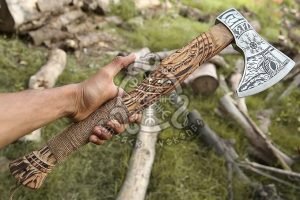 Odin Allfather Hand Forged Damascus Viking Bearded Axe | 18 Inch | Ash Wood Handle with Leather Blade Cover and Gift Box | Norse God Collector Gift | RK-635
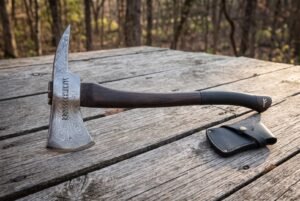 Stormbeard Hand Forged Damascus Viking Bearded Hatchet | 1095 and 15N20 Head | Rune Line Walnut Haft and Leather Mask | Camp and Bushcraft Gift | RK-1538
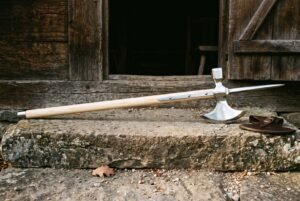 Moonpoll Hand Forged High Carbon Steel Poleaxe | 50 Inch Overall with a 5.5 Inch Cutting Edge | Reenactment Display Gift | RK-1361