A beard ring is a metal band threaded onto a braid. It does two unglamorous jobs. One at the tip stops the plait unravelling, and one at the base keeps loose hair out of your food and out of your work. Everything after that is decoration, and people have been decorating them since the tenth century, when Ibn Fadlan met Rus traders on the Volga and wrote at length about how much metal they wore and how carefully they groomed.
Two pieces sit on this page. One is a seven piece set in a warm bronze tone alloy, three wide flat bands stamped with a Valknut and four slimmer rings twisted from round wire, sized for a braided beard section rather than a finger and threaded on from the tip. The other is the tool that makes braiding possible at all, a comb cut from a single piece of natural horn with a Vegvisir at one end, teeth cut and rounded by hand at medium spacing.
Buy the comb first. The rings and bracelets sit on their own page. A braid you cannot get a ring onto is not a braid. If you have not braided before, beard rings and braids covers what the rings did historically and how they are worn now.
Free US shipping
On most pieces. Heavier and oversized ones carry a flat charge.
Hand Forged
Heated, hammered and ground by hand.
Engraving available
Names, dates or Norse runes on most pieces.
Ships from Chicago
Inspected and dispatched from our Chicago warehouse. No import duty, no customs delay on US orders.
Beard Rings & Beads
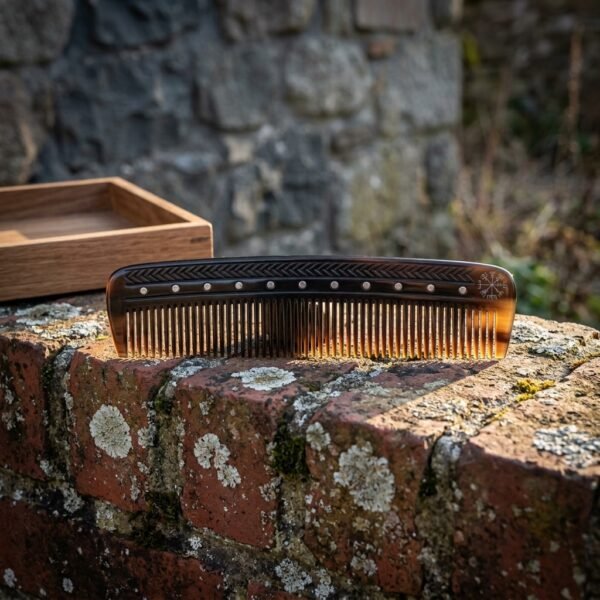
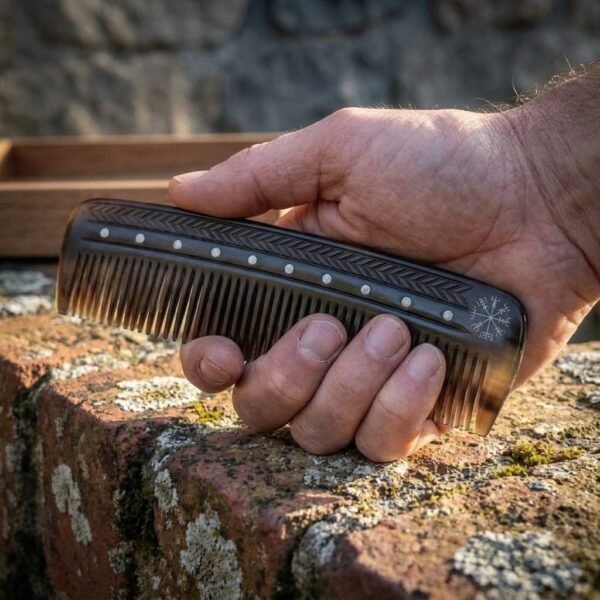
Braidhorn Hand Made Viking Beard Comb with Wooden Box | Natural Horn | Vegvisir Stave and Dotted Spine Border | Groomsmen Gift | RK-1681
Original price was: $109.00.$87.20Current price is: $87.20.Beard rings are older than the television shows
People assume beard rings were invented for a costume department, and they were not. Rings and beads for hair and beard turn up across Scandinavian and Rus finds, and the best written description comes from Ibn Fadlan, the Arab diplomat who met Rus traders on the Volga in the tenth century and wrote at length about how much metal they wore and how carefully they groomed. He was not flattering them. He was recording what he saw.
What is easy to miss is how ordinary this was. Combs are the most common personal object in the Viking Age archaeological record. Not blades, not jewellery, combs. Excavations at Birka, Hedeby and Coppergate in York have produced thousands of them, usually composite pieces riveted together from antler plates, and they turn up in graves of every rank. The English chronicler John of Wallingford, writing in the thirteenth century about the Danes in England, complained that they combed their hair every day, bathed on Saturdays and changed their clothes often, and that this was how they got the local women. He was grumbling three hundred years after the fact, but the archaeology backs the habit.
So the beard ring is not a costume accessory bolted onto a myth. It is the metal that goes with a grooming culture that genuinely existed, and the function is still exactly what it was. A ring at the tip holds the plait. A ring at the base holds the section. The Valknut stamped into the face is the part that is for you.
What a ring actually does to a braid
A three strand plait wants to unwind. Left alone it will slowly loosen from the tip upward until it is a slightly tangled section of beard rather than a braid, usually within a day. A ring slid up to the tip and seated on the taper stops that, because the plait cannot expand past the bore of the ring.
A ring at the base does something different. It gathers the section and holds it away from the rest of the beard, which keeps the braid distinct instead of blurring back into the mass, and it stops loose hair working its way into whatever you are eating or doing. That is why a good set has both wide bands and narrow ones. The wide band sits stable at the base where the section is thickest. The narrow twists dress the length below it.
Twisted wire rings do one more thing worth knowing. Twisting round wire work hardens it, which means the ring holds its shape rather than opening out, and the ridges of the twist grip the braid instead of sliding down it. A smooth ring of the same diameter will creep. A twisted one stays where you put it.
The pieces in this collection
Two pieces, and they are meant to be bought together rather than as alternatives. One is the metal that goes on the beard. The other is the tool that makes a beard braidable in the first place.
The seven piece bronze tone ring set
Seven rings in a metal jewellery alloy with a warm bronze tone finish. Three are wide flat bands with squared edges and a Valknut stamped into the face, deep enough front to back to sit stable at the base of a braid. Four are slimmer rings twisted from round wire into a rope and closed into a continuous ring.
The finish is a polished bronze tone with the Valknut left darker for contrast, which is what keeps the three triangles readable at arm's length instead of vanishing into the shine. The bores are sized for a braided beard section rather than for a finger, and they thread on from the tip. It is a finished alloy set rather than solid precious metal, and the product page says so plainly rather than leaving you to work it out.
All seven arrive together in a soft drawstring pouch. The mix is deliberate. You are meant to anchor a braid at the base with a wide band and dress it down its length with the twists, or spread the set across several braids.
The horn beard comb
A comb cut from a single piece of natural ox horn, hand sanded through the grits and buffed. The teeth are cut and rounded by hand at medium spacing, so each one has a smooth polished tip and no seam running down its sides. A row of punched dots runs down the spine, a chevron border sits above the teeth, and a Vegvisir stave is cut at one end.
The horn runs from honey amber through to near black across the length of the comb, and that colour is the material rather than a stain, so no two combs match. It arrives in a plain wooden box with a lift off lid, and it suits beards, moustaches and long hair.
What is in the set and what it fits
Every figure below is taken from the specification panel of a piece on this page. These are formed, cut and finished by hand, so expect small differences between two of the same name.
| Piece | Material and finish | What you get | Detail | Fit or use | In the box |
|---|---|---|---|---|---|
| Beard ring set | Jewellery alloy, polished bronze tone, not solid precious metal | Seven rings: three wide flat bands and four twisted wire rings | Valknut stamped and relieved on each wide band, hand twisted rope on the narrow rings | Bore sized for a braided beard section, threaded on from the tip | All seven rings in a soft drawstring pouch |
| Beard and hair comb | Single piece natural ox horn, sanded and buffed, honey amber to near black | One comb | Vegvisir stave at one end, punched dot row and chevron border along the spine | Teeth cut and rounded by hand at medium spacing, for beards, moustaches and long hair | Comb and a wooden box with a lift off lid |
The row that catches people out is the fit column. These bores are cut for a plaited section of beard, not for a finger, so do not judge the size against a ring you already own.
Sizing and fitting a ring to a braid
Braid the section first, then size the ring to the braid. Sizing the other way round is how people end up with rings that either fall straight off or will not go on at all. A plait compresses the hair, so a braided section is noticeably narrower than the same hair loose.
Thread from the tip and work upward. Twist the very end of the plait between finger and thumb to taper it, feed it through the bore, and slide the ring up to where you want it. If it will not start, the tip is not tight enough rather than the ring being too small. Take the ring off the same way, upward is a mistake.
Position is a matter of what the beard is doing. A wide band at the base anchors the section and reads as deliberate. A narrow twist near the tip is subtler and keeps the plait closed. Two or three rings spaced down one braid is the usual arrangement, and seven pieces gives you enough to do that on two or three braids at once.
Horn, and why it beats plastic
This is the one piece of grooming advice that is about physics rather than marketing. A moulded plastic comb comes out of a die with a seam down each side of every tooth and a squared off tip. That seam catches the cuticle of the hair and tears it, and the comb builds a static charge as it moves, which lifts the whole beard into frizz.
Horn does neither. It is keratin, the same protein your hair is made of, so it carries almost no charge against hair and the beard sits flat instead of flying. Because the teeth are cut and then rounded by hand, each tip is smooth and there is no seam anywhere along the length of the tooth. The comb slides rather than snags, which matters most at the tangled end of a long beard.
The limit of horn is the same limit horn has always had. It does not like heat. Keep it away from a radiator, a hot car and a hair dryer, because horn is a protein and heat warps it.
Care and storage
The rings want almost nothing. Warm water, a drop of washing up liquid and a soft cloth take off beard oil and skin oil, which is what dulls a bronze tone finish over a few months. Dry them properly and do not scrub the darkened recesses of the Valknut, because that darkening is contrast rather than dirt and an aggressive polish will lift it and leave the symbol flat.
The comb wants a rinse in cool water and a dry cloth. No hot water, no soaking, no dishwasher. Every few months a drop of food safe oil rubbed in with a cloth keeps the horn from drying out and crazing, which is the only way these actually fail. Store it in its wooden box rather than loose in a bag, because a dropped horn comb loses teeth.
Both live in a drawer that stays at room temperature. Neither wants a windowsill.
Engraving
The wide bands and the flat spine of the comb both take engraving, done in the US after the pieces arrive. Names, dates, initials and Elder Futhark rune lines all work at this size. Text engraving is 19 dollars, a symbol is 39 dollars and a family crest is 49 dollars.
Both pieces already carry cut work, a Valknut on the bands and a Vegvisir on the comb, so plan where a personal line sits relative to what is there. Elder Futhark is a phonetic alphabet rather than a cipher, so a name is transliterated by sound and not letter for letter, and there is no rune for the letter C. Our guide to the runes explains it. Engraving is permanent and an engraved piece cannot be returned, so send the exact spelling and read it twice.
The two symbols on these pieces
The Valknut on the wide bands is three interlocked triangles, arranged so that no one of them can be lifted free without the other two. The name is modern, built from Old Norse words for the slain and for a knot. The symbol itself is genuinely old and appears on the Gotland picture stones and on a bed post from the Oseberg ship burial, usually in scenes involving Odin, hanged men and the dead.
The Vegvisir on the comb deserves an honest note. It is not a Viking age symbol. Its earliest appearance is the Huld manuscript, written in Iceland in 1860, with relatives in Icelandic grimoires of the seventeenth and eighteenth centuries, and the text says the one who carries the sign will not lose his way in storms. It is a real piece of Icelandic magical tradition and it is roughly eight hundred years younger than the Valknut sitting on the rings beside it.
Where these come from and how they ship
Ransack Viking is a US company based in Chicago, Illinois. The rings and the comb are formed, cut, stamped and finished by hand in the Czech Republic, then imported, inspected and shipped from Chicago. Engraving is done in the US after arrival.
Horn colour varies from animal to animal, so the comb you receive will not match the photograph exactly and should not. The bronze tone on the rings will also vary slightly in warmth between batches.
How to choose
If the beard is already long enough to braid, buy the ring set. Seven pieces is enough to run two or three braids at once and enough to try different arrangements before you settle on one.
If the beard is at the stage where a braid falls apart before you have finished making it, buy the comb first and the rings later. Most of the time a braid that will not hold is a beard that has not been combed out properly rather than one that is too short. If you are buying for someone else and you cannot judge which, the comb is the safer gift, and it arrives boxed. Our wedding and groomsmen gifts page covers the rest of that problem.
Browse related categories
- Norse jewellery, the full range
- Viking rings and bracelets
- Arm rings and torcs
- Mjolnir pendants
- Norse pendants, Valknut, Vegvisir and Yggdrasil
- Wedding and groomsmen gifts
- Engraved and personalised pieces
Guides worth reading first
- The Valknut, three triangles and what they meant
- The Vegvisir and where it really comes from
- Viking symbols and their meanings
- Elder Futhark runes and how names are written
- Groomsmen gifts that get used
- Viking beard rings and braids, how they are worn
Frequently asked questions
Did Vikings really wear beard rings?
Rings and beads for hair and beard turn up across Scandinavian and Rus finds, and Ibn Fadlan described how much metal Rus traders wore when he met them on the Volga in the tenth century. Combs are the most common personal object in the whole Viking Age record, so the grooming culture is not in doubt.
How do I get a ring onto a braid?
Braid the section first, then twist the very tip between finger and thumb to taper it, feed it through the bore and slide the ring up. Always thread from the tip upward. If it will not start, the tip is not tight enough rather than the ring being too small.
What sizes are these rings?
The bores are cut for a braided beard section rather than for a finger, so do not measure them against a ring you already own. A plait compresses the hair, so a braided section is noticeably narrower than the same hair loose.
Why are some rings wide and some twisted?
Because they do different jobs. A wide flat band is deep enough front to back to sit stable at the base of a braid, where the section is thickest. The twisted rings are slimmer, grip the braid on their ridges instead of sliding, and dress the length below the anchor.
Is the set solid gold or bronze?
Neither. It is a metal jewellery alloy in a warm bronze tone finish, and the product page says so plainly rather than implying solid precious metal. It is sold on the finish, which is what keeps a seven piece set at a sensible price.
Why a horn comb rather than plastic?
A moulded plastic comb has a seam down each tooth that catches and tears the cuticle, and it builds static that lifts a beard into frizz. Horn is keratin, the same protein as hair, so it carries almost no charge, and the teeth are cut and rounded by hand with no seam.
How do I look after the comb?
Rinse in cool water, dry it with a cloth, and rub in a drop of food safe oil every few months to stop the horn drying out and crazing. No hot water, no soaking, no dishwasher, and keep it away from radiators and hot cars. Store it in its box.
Where are these made?
Ransack Viking is a US company based in Chicago, Illinois. The rings and the comb are handmade in the Czech Republic, then imported, inspected and shipped from Chicago, with engraving added in the US after arrival.