
Blog
Viking Symbols and Their Meanings

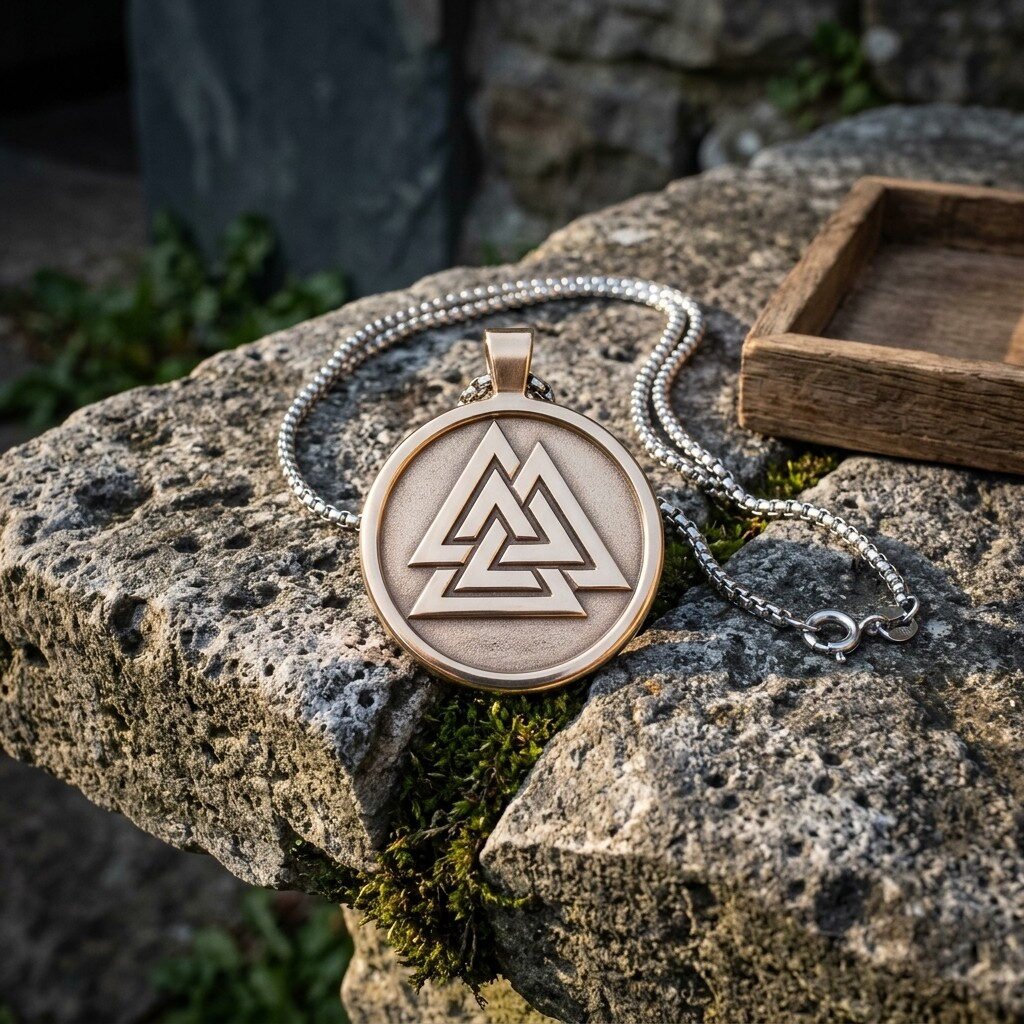
Search for Viking symbols and you will find the same dozen designs on pendants, tattoos and axe heads, each with a confident one line meaning attached. Some really were carved and worn in the Viking Age. Some come from Icelandic books written a thousand years later. A few are genuinely ancient and nobody wrote down what they meant, which has never slowed anyone down. This guide goes through each one and says which is which: where the design actually appears in the record, what people use it for now, and where you will find it on the pieces we sell.
Mjölnir, the hammer of Thor
Mjölnir is Thor’s hammer, the tool he uses against giants. In the Prose Edda it is forged by dwarfs, and in the poem Þrymskviða it is used to hallow a bride, so the hammer had a blessing role as well as a fighting one.
Mjolnir turns up as an object as often as an amulet, which is what our Viking war hammers are.
This is the one Viking symbol with an overwhelming archaeological record, and the one you can wear without a caveat. Hammer pendants in silver, iron, bronze and amber have been found across Scandinavia and the British Isles, most from the ninth to eleventh centuries. A pendant found at Købelev in Denmark in 2014 carries a runic inscription reading, in effect, “this is a hammer,” which settled what the little T shaped pendants were meant to be.
Today it is the most worn Norse symbol by a wide margin. We cover the name, the myths and the finds in depth in our post on the meaning of Mjölnir. On the site it appears as pendants in the jewellery range, applied to rune rings, stamped into the poll of a Damascus axe, and engraved on candle holders and sword stands.
The Valknut
The Valknut is three interlocked triangles. The word is modern, built from Norwegian words for “slain” and “knot,” and does not occur in any Old Norse text. The design itself is genuinely old. It is carved on the Stora Hammars I and Tängelgårda picture stones on Gotland, on a bedpost from the Oseberg ship burial in Norway, and on an Anglo-Saxon gold ring found in the River Nene in England.
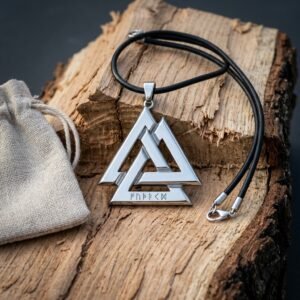 Thricebound Hand Made Polished Steel Valknut Pendant with Elder Futhark Rune Band & Black Leather Cord | Norse Gift | RK-1634
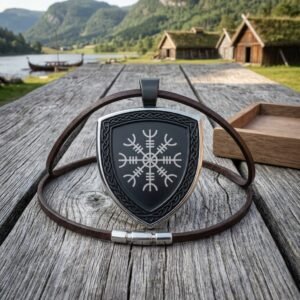 Awestave Hand Made Steel Helm of Awe Pendant with Blackened Shield Face, Knotwork Border & Brown Leather Cord | Norse Gift | RK-1640
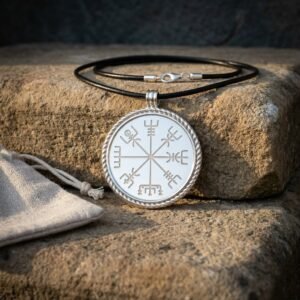 Wayfinder Hand Made Silver Tone Vegvisir Pendant with Twisted Rope Bezel & 20 Inch Black Leather Cord | Norse Runic Gift | RK-1600
It is also the mark you will most often find etched on our Norse swords.
What it meant is not recorded anywhere. On the Gotland stones it sits close to scenes of sacrifice, hanging and a rider on an eight legged horse, so the usual reading is that it belongs to Odin and to death in battle. That is a reasonable inference from context, but it is not a statement any Viking left us. Claims that it “represents the nine worlds” or “binds the soul” have no source behind them.
People wear it now as a memorial mark or as a link to Odin. On our pieces it is one of the most common marks: raised on pendants and beard beads, engraved on a Damascus axe collar, inlaid into sword pommels, etched on karambit and throwing knife blades, and burned into the king piece of a kubb set.
Vegvísir, the so called Viking compass
This eight armed stave is sold everywhere as a “Viking compass.” There is nothing wrong with wearing it. The problem is the dating. The Vegvísir first appears in the Huld manuscript, a collection of magical staves compiled in Iceland in 1860 by Geir Vigfússon, and in a couple of other Icelandic manuscripts of the same period. The accompanying text says that whoever carries the sign will not lose their way in storms or bad weather, even when the way is unknown. That is the whole of the historical evidence. The Huld manuscript is closer in time to the invention of the telephone than to any Viking, which has never stopped the design appearing on a great many tattoos.
No Vegvísir has ever been found on a Viking Age object, runestone, coin or piece of jewellery. Iceland was settled by Norse people, so the connection is cultural rather than nothing at all, but the honest description is nineteenth century Icelandic folk magic, not Viking.
People wear it now for guidance through hard times and for safe travel. On the site it is engraved on silver finish pendants, a belt buckle, a beard comb and a drinking horn hanger, on the chest of a leather cuirass, and burned into the handle of a birch kuksa cup.
Ægishjálmur, the Helm of Awe
The Helm of Awe needs the same honesty. The name is old. In the Poetic Edda and in Völsunga saga, the dragon Fáfnir says he bore the ægishjálmr, the helm of terror, and that every living thing feared him because of it. There it is a possession or a quality, never a drawn shape.
The eight spoked stave with trident like arms that everyone now calls the Helm of Awe comes from Icelandic magical manuscripts of the seventeenth century and later, and one version sits in the same Huld manuscript as the Vegvísir. Instructions in these books say to mark the sign on the forehead to gain the upper hand over an enemy. So the concept is Viking Age and the picture is early modern, a distinction most sellers decline to make.
People choose it today for courage and protection, and often because it is simply a strong graphic. We have it engraved on steel pendants with a blackened shield face and on the brass strapped lid of a wooden storage chest in the home decor range.
Yggdrasil, the world tree
Yggdrasil is the great ash at the centre of the Norse cosmos. Völuspá, Grímnismál and the Prose Edda describe it in detail: three roots reaching into different realms, the well of Urðr beneath it where the Norns decide fates, an eagle in the crown and the serpent Níðhöggr gnawing at a root. In Hávamál, Odin hangs nine nights on a windy tree, wounded by a spear, to win the runes, and that tree is generally taken to be Yggdrasil.
Unlike the hammer, there is no standard Viking Age image of the tree. A few later textiles and stones show trees that might be it, if you are feeling generous, but the neat “tree inside a circle with roots mirroring branches” on modern pendants is modern graphic design.
It is worn now for family, growth and the link between the living and the dead. On the site it appears as a tree of life pommel on a blackened sword and painted across a display shield, and it works well as uploaded line art on the engraving page.
Huginn and Muninn, the ravens of Odin
Odin’s two ravens are named in Grímnismál. Their names mean roughly “thought” and “memory.” Each day they fly across the world and return to tell him what they saw. Odin admits in the same stanza that he fears Huginn may not come back, and fears for Muninn even more.
Ravens are all over the Viking Age record, though rarely labelled as these two. Skaldic poets used ravens as a stock image of battle, since they fed on the dead. The Anglo-Saxon Chronicle records a raven banner captured from a Viking army in 878, and a coin struck for the Norse king of York around 940 shows a raven.
Today the pair stand for wisdom and watchfulness, and for keeping the memory of the dead. Raven marks are common on our pieces: etched on seax blades and arming swords, tooled on a knife sheath and a drinking horn strap, and cut into the walnut plaque behind one of the wall mounted bearded axes.
The Triple Horn
The Triple Horn, sometimes sold as the Horns of Odin, is three drinking horns interlaced into a triskele. The design is genuinely old: the Snoldelev runestone from Zealand in Denmark, dated to the ninth century, carries three interlocked horns above its inscription.
The meaning usually attached to it comes from the story of the mead of poetry in the Prose Edda, in which Odin drinks from three vessels named Óðrerir, Boðn and Són. The link between that story and the horns on the stone is a modern interpretation, not something the stone or any text explains.
People wear it for inspiration in poetry and craft, and for the sworn toast. It is not a stock mark on any of our pieces, so if you want it, the emblem upload on the engraving page is the route, and the three horn design reproduces cleanly as line art.
The Elder Futhark runes
Runes are an alphabet rather than a symbol, and the Elder Futhark is its oldest form: twenty four staves in three rows of eight, called ættir. The full row is carved on the Kylver stone from Gotland, dated to around the year 400.
By the time the Viking Age began, Scandinavians had cut the row down to the sixteen stave Younger Futhark, which is what you will see on nearly every Viking Age runestone. The Elder Futhark is nonetheless what most modern jewellery and engraving uses, because each stave has a recorded name and a single clear sound, which makes English names easier to spell. Convenience won that argument some time ago.
We use the Elder Futhark on rune rings, arm rings, the rune bands of Valknut pendants, slate plaques, and the twenty four stone casting sets in our runestones and rune sets category. The engraving page has the full rune table, the rules for letters the Futhark lacks, and a tool that shows your name in runes before you order.
Jörmungandr, the Midgard serpent
Jörmungandr is the child of Loki and the giantess Angrboða, thrown into the ocean by Odin, where it grew until it circled the world and could bite its own tail. It is Thor’s great enemy. The story of Thor fishing for it with an ox head for bait is told in Hymiskviða and the Prose Edda, and it is one of the few myths we can point to on stone: the Altuna runestone in Sweden, the Hørdum stone in Denmark and the Gosforth cross in England all show a figure fishing with a foot through the bottom of the boat, as the poem describes. At Ragnarök, Thor kills the serpent and walks nine steps before its venom kills him.
Modern wearers use the circled serpent for endurance and for the idea that the world is held together by something enormous and hostile. On our pieces the serpent shows up as etched coils along the fuller of an arming sword and as the serpentine core of a pattern welded Viking sword, and several blades carry “wyrm” in their names for the same reason.
Sleipnir, the eight legged horse
Sleipnir is Odin’s horse, the best of all horses, with eight legs. The Prose Edda tells how Loki, in the shape of a mare, lured away a giant’s stallion and later gave birth to the foal. Sleipnir carries Odin between the worlds, and Hermóðr rides him to Hel to try to bring back Baldr.
An eight legged horse is carved on the Tjängvide and Ardre VIII picture stones from Gotland, both Viking Age, each carrying a rider usually identified as Odin or a dead man arriving in the next world. It appears in the same context as the Valknut.
Sleipnir is chosen today for travel and for the passage between life and death. It is not a stock mark on our current pieces, so like the Triple Horn it is something to bring to the engraving page as line art.
How to choose one you will not regret
Pick the symbol whose story you actually like, and know its date. Those are two separate questions, and most buyers only ask the first. If it matters that the mark was carved by Viking hands, choose Mjölnir, the Valknut, the ravens, the Triple Horn, Sleipnir or a line of runes. If you love the look of the Vegvísir or the Helm of Awe, wear them, and if someone tells you they are Viking Age, you now know better. All of our pieces are handmade the old way in the Czech Republic, then inspected and shipped from Chicago, Illinois, and engraving is cut in the United States after inspection.
If you want ornament without a claimed meaning, Celtic knotwork is the safer choice, and it runs across our steel, leather and carved pieces.
Two of these have longer explanations of their own, the wayfinder stave and Odin’s two ravens.
Questions people ask
Is the Vegvísir a real Viking symbol?
No. It is first recorded in the Huld manuscript, compiled in Iceland in 1860. No Viking Age object carries it. It is an Icelandic magical stave from the nineteenth century, and calling it a Viking compass does not make it any older.
What does the Valknut mean?
Nobody recorded its meaning. It appears on Viking Age stones and objects, often near scenes connected with Odin and death, so scholars link it to Odin and the slain. Anything more specific is a modern interpretation, however confidently it is printed on the card that comes with the pendant.
Was the Helm of Awe worn by Vikings?
The name comes from the Poetic Edda and Völsunga saga, where it is a “helm of terror” carried by the dragon Fáfnir. The eight armed drawn stave comes from Icelandic magical books of the seventeenth century and later.
Did Vikings use the Elder Futhark?
Mostly not. Viking Age runestones use the sixteen stave Younger Futhark. The twenty four stave Elder Futhark is earlier, and it is used today because each stave maps cleanly to a sound, not because it is the more authentic choice.
Can I get a symbol engraved on a knife or axe?
Yes. The engraving page offers lettering, Elder Futhark runes and an emblem upload for line art. Engraving is cut in the United States after the piece has been inspected.
Where are the pieces on this site made?
Every piece is handmade in the Czech Republic, then imported, inspected and shipped from Chicago, Illinois. Engraving is done in the US after inspection.
The shop side of this
Carried in the shop, the Thricebound Valknut pendant and the Wayfinder Vegvisir pendant. The Awestave Helm of Awe pendant and the Thunderknot Mjolnir pendant sit with them.
Shop the range
Thricebound Hand Made Polished Steel Valknut Pendant with Elder Futhark Rune Band & Black Leather Cord | Norse Gift | RK-1634Awestave Hand Made Steel Helm of Awe Pendant with Blackened Shield Face, Knotwork Border & Brown Leather Cord | Norse Gift | RK-1640Wayfinder Hand Made Silver Tone Vegvisir Pendant with Twisted Rope Bezel & 20 Inch Black Leather Cord | Norse Runic Gift | RK-1600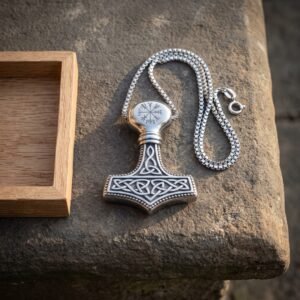 Thunderknot Hand Made Silver Finish Mjolnir Pendant with Celtic Knotwork & Vegvisir Crown | 24 Inch Box Chain | Norse Gift | RK-1754
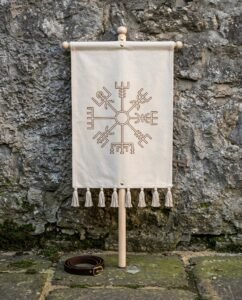 Waymark Hand Made Vegvisir Canvas Banner on an Ash Staff | 16 by 22 Inches | Heavy Cotton Canvas with a Turned Ash Cross Bar and Tassel Fringe | Norse Home Decor Gift | RK-1659
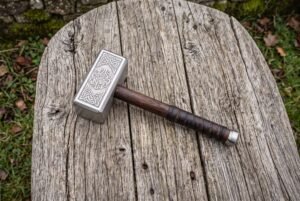 Mjolnir Hand Forged Stainless Steel Viking Hammer | 17.71 Inch Overall and 11.24 lb Weight | Thor Norse Mythology Collector and Display Gift | RK-625
40 thoughts on “Viking Symbols and Their Meanings”
Comments are closed.