
Blog
Thor in Norse Myth, Beyond the Hammer

Thor is the god everybody thinks they already know, which is exactly why the sources are worth reading. The hammer is real and it is central. It is also, in the surviving stories, less a thing for fighting with than a thing for making safe. Thor hallows with it, blesses with it, and quite often loses it.
He is also the god the archaeology actually supports. If you go by place names, by personal names, by amulets pulled out of the ground, Thor was the one ordinary people in the Viking Age lived alongside. Odin belongs to kings and poets. Thor belongs to farms.
Who He Was, in Family Terms
Son of Odin and of Jord, whose name simply means earth. Married to Sif, whose golden hair Loki cuts off in one of the better dwarf stories, and which is replaced with hair spun from actual gold. Father of Thrud by Sif, and of Magni and Modi, whose names mean strength and courage and who are among the small handful of gods left standing after the end of the world. Magni’s mother is the giantess Jarnsaxa, which is a reminder that the line between gods and giants in this mythology is a good deal blurrier than the stories pretend.
Where the whole family tree sits is in the guide to the Norse gods.
What Thor Was Actually For
Protection, and specifically protection of the ordered world against the things outside it. The giants are not simply enemies in these poems; they are the disorder that presses on the fields and the fences. Thor goes out and hits it. That is a farmer’s theology, and it is why his cult looks the way it does.
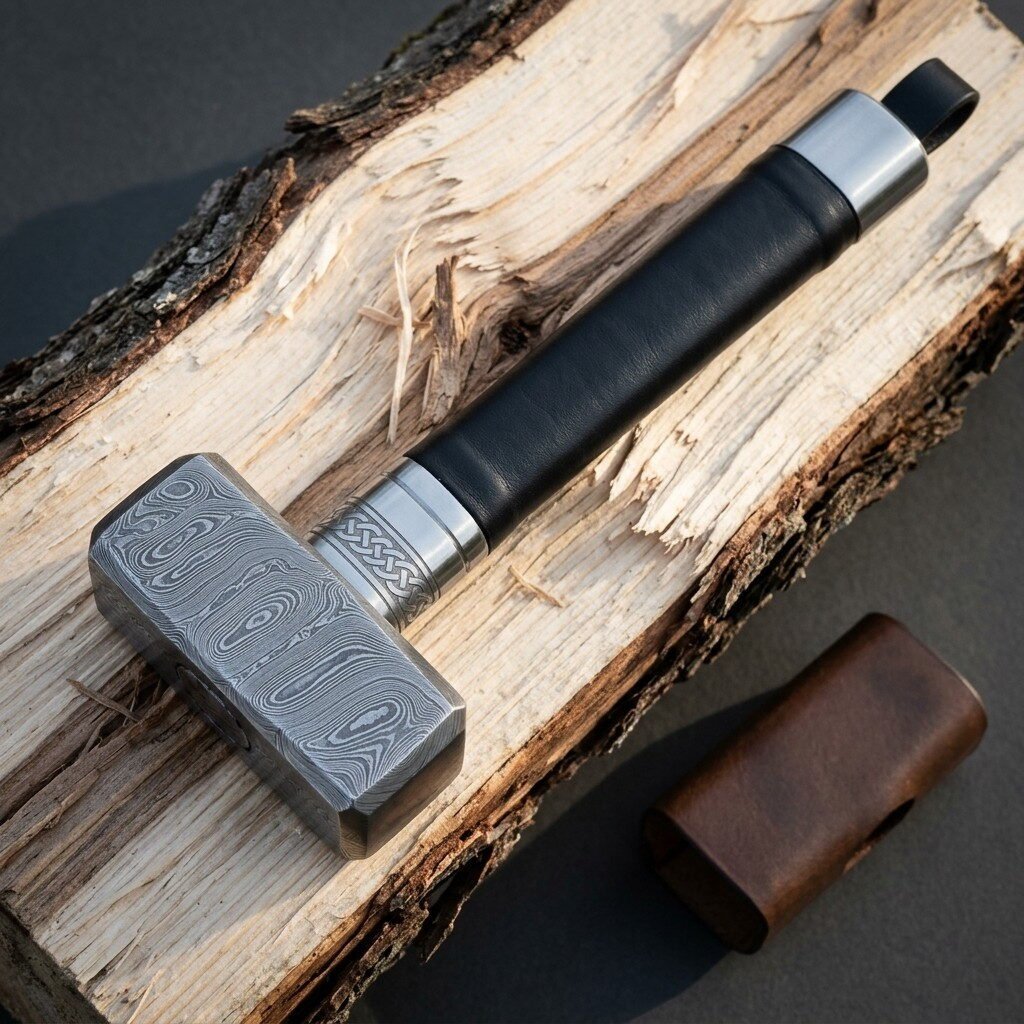
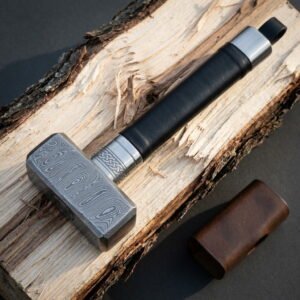 Ladderpeen Hand Forged Damascus Mjolnir Hammer | 10 Inch Overall | Ladder Pattern Head with Black Leather Haft and Knotwork Collar | Thor Gift | RK-1843
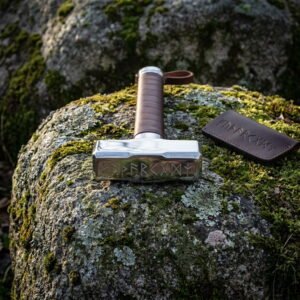 Thunderhide Hand Forged 1095 Steel Mjolnir War Hammer | 10 Inch Overall | Rune Cut Head with Brown Leather Haft and Wrist Loop | Norse Thor Gift | RK-1838
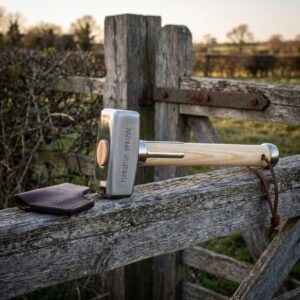 Runestrike Hand Forged Steel Norse War Hammer | Rune Cut Head with Ash Haft and Steel Collar | Leather Head Cover and Wrist Lanyard | Norse Gift | RK-1635
He is also associated with weather and with crops. Adam of Bremen, describing the temple at Uppsala in the eleventh century, puts Thor in the middle of the three figures and says he governs thunder, lightning, wind, rain and fair weather, and that people call on him in famine and plague. That is a working god, not a distant one.
And the hammer sanctifies. Runestones in Denmark and Sweden carry the formula asking Thor to hallow these runes, which is a request made of a hammer rather than of a fist. In Thrymskvida the hammer is brought out and laid in the bride’s lap to hallow the wedding. The full case for the hammer as a blessing object rather than only a fighting one is set out in the meaning of Mjolnir.
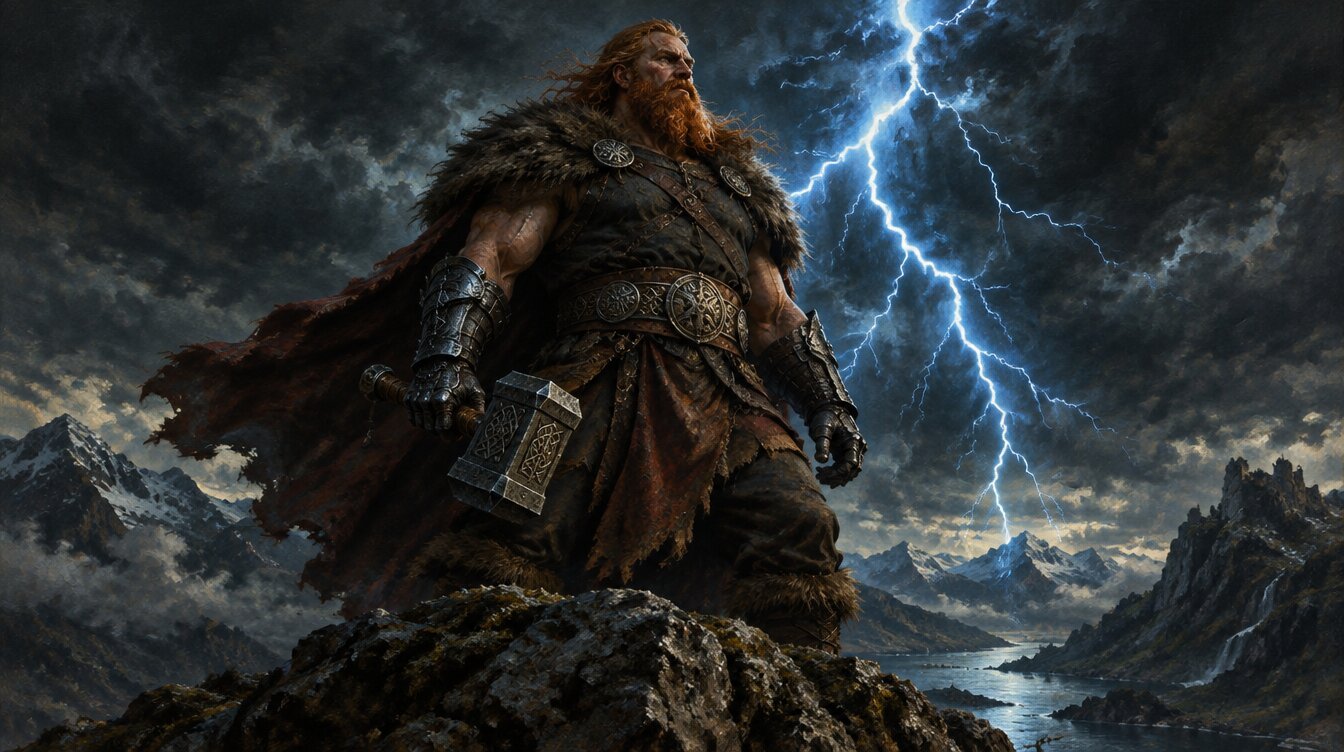
The Kit Beyond the Hammer
Megingjord
The belt of might, which doubles his strength when he puts it on. Snorri lists it as the second of his three great possessions. It is the detail that most retellings drop, presumably because a magic belt is harder to sell than a hammer.
Jarngreipr
Iron gloves, needed to handle the hammer at all. A short handled hammer that cannot be gripped bare hands is an odd design, and the Prose Edda has an explanation: Loki, in the form of a fly, bit the dwarf working the bellows, the fire dropped, and the handle came out short.
The goats and the cart
Tanngrisnir and Tanngnjostr, whose names refer to their teeth, pull Thor’s cart and can be slaughtered, eaten, and brought back to life the next morning from their hides and bones. In one telling a bone is broken by a farmer’s son and one goat is left lame, which is how Thor acquires the servants Thjalfi and Roskva as compensation. It is a story about the cost of ignoring instructions, and it is unusually domestic.
The Stories Worth Knowing
The stolen hammer
Thrymskvida is the funniest poem in the Poetic Edda. The giant Thrym steals Mjolnir and will return it only in exchange for Freyja as a bride. Freyja refuses in a rage strong enough to shatter her necklace. The gods dress Thor in the bridal linen instead, with Loki as the maidservant, and the poem gets a great deal of mileage out of the bride eating an ox and eight salmon at her own wedding feast. The hammer is produced to hallow the marriage, Thor takes it, and the wedding party does not survive the reception.
The fishing trip
Thor rows out with the giant Hymir, baits a line with an ox head, and hooks Jormungandr, the serpent that circles the world. He hauls until his feet go through the bottom of the boat. Hymir, sensibly, cuts the line. This one is not only literary. The Altuna runestone in Uppland shows a figure in a boat with his foot through the hull and a line running down to a serpent, which is about as direct a link between poem and carved rock as this material offers. The serpent’s own story is in the children of Loki.
Hrungnir
A formal duel with a stone giant, fought after Odin loses a horse race bet and the giant is invited into Asgard to drink. Thor wins, but a fragment of the giant’s whetstone lodges in his head and stays there. His son Magni, aged three, lifts the dead giant’s leg off him when the gods cannot. Snorri tells it in Skaldskaparmal as background to a piece of poetry, which is how a lot of this material survives at all.
Utgarda-Loki
The most interesting failure in the mythology. Thor and his companions are set contests they cannot win, and only afterwards are they told what was really happening. The drinking horn Thor could not empty ran to the sea, and he lowered the tide. The cat he could not lift was Jormungandr. The old woman who wrestled him to one knee was old age. The point of the story is that Thor lost and still frightened his host badly enough that the host packed up and left.
The Evidence He Was Worshipped
This is where Thor separates from every other figure. Personal names built on his are everywhere in the Viking Age and after: Thorstein, Thorbjorn, Thorgerd, Thorfinn, Thorkell, and dozens more, in Iceland, Norway, Denmark, Sweden and the Norse settlements abroad. Nothing comparable exists for Odin.
Place names follow the same pattern across Scandinavia. Hammer amulets survive in the hundreds, in silver, bronze, iron and amber, from Scandinavia to England to the Rus territories. A soapstone mould found at Trendgarden in Jutland cuts both a hammer and a cross, side by side, which is either commercial pragmatism or a fair picture of what people’s beliefs looked like during the conversion.
Then there are the runestones. Several in Denmark and Sweden carry a line asking Thor to hallow the runes or the monument. Those are not literary flourishes. They are requests, cut in stone by people paying for the work, and they are the closest thing we have to hearing a Viking Age person address a god directly.
Thor Against Christ
The hammer pendant becomes commoner, not rarer, in the tenth century, which is exactly when Christianity is arriving in force. That is usually read as a badge worn in answer to the cross, a visible statement of which side you were on, and the shape of some late pendants moves closer to a cross while the meaning stays put. Conversion narratives in the sagas are full of contests staged between Thor and the new god, written down by Christians two centuries later and shaped accordingly. What they preserve is the memory that Thor was the one worth arguing with.
What the Pendants Actually Look Like
Small, mostly. The majority of excavated hammer pendants are between two and five centimetres, with a short haft, a broad head and a loop at the top of the handle. Decoration ranges from plain to intricate punched and granulated work. The Skane pendant in silver and the elaborate examples from Bredsatra and elsewhere are the ones photographed most; the typical find is plainer and smaller than the ones sold today. If you want yours to look like the archaeology rather than like a film prop, choose small and understated.
Thursday
Old English Thunresdaeg, the day of Thunor, the same god under the Anglo-Saxon form of the name. The Romans gave that day to Jupiter, the thunderer, and northern Europe matched its own thunder god to it. French kept the Latin as jeudi, English kept the Germanic. Norwegian, Danish and Swedish still say Thor’s day out loud every week.
Carrying It
A hammer pendant is the most honest piece of Norse jewellery you can wear, in the sense that it is the one form we can show real people actually wore. What people do with the shape now runs from the accurate to the enormous. The Viking hammers range covers the forged pieces meant to be held, and Thor’s hammers covers hammers and pendants together. The Mjolnir pendants are the wearable end of it.
Steel is 1095 at 54 to 58 HRC, or Damascus of 1095 and 15N20 at 58 to 60 HRC, and what those numbers mean is in the steel glossary. Ransack Viking is a US company in Chicago, Illinois; the pieces are handmade in the Czech Republic and imported, inspected and shipped from Chicago, where engraving is cut after arrival. US shipping is free and tracked with no duty, and the lifetime warranty against defects has no end date. The rest of the writing sits in the guides, including how blunt arms beat armour and mace against war hammer against flail.
Questions people ask
What was Thor the god of?
Thunder and storm, and beyond that the protection of the ordered world against the giants who threaten it. Adam of Bremen adds weather and crops, and says people appealed to Thor in famine and plague. He functions as a farmer’s god rather than a king’s god.
Was Thor more popular than Odin?
By every measure that survives, yes. Personal names built on Thor are extremely common, place names naming him are widespread, and hammer amulets survive in the hundreds. Odin has place names and poetry associated with rulers, and almost nothing in the way of everyday objects.
What else did Thor own besides the hammer?
A belt called Megingjord that doubled his strength, iron gloves called Jarngreipr needed to grip the hammer, and a cart drawn by two goats that could be eaten at night and revived in the morning. Snorri treats the belt and gloves as being nearly as important as the hammer itself.
Why is Mjolnir’s handle so short?
The Prose Edda gives a reason. Loki, in the shape of a fly, bit the dwarf working the bellows while the hammer was being made, the fire dropped at the wrong moment, and the handle came out shorter than intended. It is a story invented to explain a shape people already knew from the amulets.
Did Thor kill the world serpent?
Not in the fishing trip. He hooks Jormungandr, hauls it to the surface, and the giant Hymir cuts the line before the blow lands. They meet again at Ragnarok, where Thor kills the serpent and then walks nine paces before dying of its venom.
Who were Thor’s children?
Thrud, a daughter by Sif, and two sons, Magni and Modi, whose names mean strength and courage. Magni’s mother is the giantess Jarnsaxa. Both sons survive Ragnarok and inherit the hammer, which is one of the few hopeful notes in the whole sequence.
Is Thursday named after Thor?
It is. Old English Thunresdaeg is the day of Thunor, the Anglo-Saxon form of the name, matched to the Roman day of Jupiter the thunderer. Norwegian, Danish and Swedish still name Thor in the word for the day.
Are Thor’s hammer pendants authentic to the Viking Age?
Yes, and they are the best attested piece of Norse personal ornament we have. Hundreds survive across Scandinavia, England and the east, mostly small, with a short haft and a broad head. A mould from Jutland cuts hammers and crosses side by side, which says a lot about the period it comes from.
From the shop
If you want a piece that carries this, the shop has the Thor Viking bearded axe and the Ladderpeen Mjolnir hammer. The Thundergrain Mjolnir hammer and the Aleholm Viking tankard are in the same corner.
Shop the range
Ladderpeen Hand Forged Damascus Mjolnir Hammer | 10 Inch Overall | Ladder Pattern Head with Black Leather Haft and Knotwork Collar | Thor Gift | RK-1843Thunderhide Hand Forged 1095 Steel Mjolnir War Hammer | 10 Inch Overall | Rune Cut Head with Brown Leather Haft and Wrist Loop | Norse Thor Gift | RK-1838Runestrike Hand Forged Steel Norse War Hammer | Rune Cut Head with Ash Haft and Steel Collar | Leather Head Cover and Wrist Lanyard | Norse Gift | RK-1635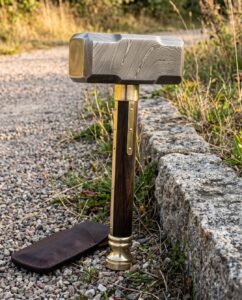 Thunderclad Hand Forged Damascus Viking War Hammer | Flat Faced Damascus Head | Rosewood Haft with Brass Bolsters and Turned Brass Pommel | Norse Gift | RK-1633
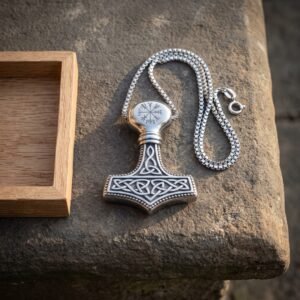 Thunderknot Hand Made Silver Finish Mjolnir Pendant with Celtic Knotwork & Vegvisir Crown | 24 Inch Box Chain | Norse Gift | RK-1754
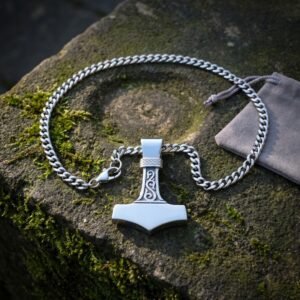 Thunderclasp Hand Made Stainless Steel Mjolnir Pendant with Knotwork Bail & Heavy Curb Chain | Norse Gift | RK-1734