A throwing axe is a light head on a long haft, and everything about it follows from that. A heavy head nose dives in flight and lands unpredictably. A light head rotates at a steady rate, so once you know how far one turn carries, you know where to stand. That is the whole skill, and it is why these heads sit near 1.1 lb rather than near 2.5 lb, and why the edge is deliberately taken to the softer end of the range rather than being made as hard as possible.
The axes here run 14 to 20 inches overall with cutting edges of 3.5 to 5.5 inches. Most are plain high carbon steel hardened to 54 to 58 HRC, in mirror polish, hammer finish or blackened oxide, and one is Damascus of 1095 and 15N20 at 58 to 60 HRC. Hafts are light ash, hickory and rosewood, and one piece is a single skeletonised billet with a leather wrapped grip and no eye at all. Every one ships with a leather cover or sheath, as the tomahawks do.
If you are buying to throw, buy the matched set of three. Throwers are short and light, which puts them nearer a hatchet than a felling axe, and the axe against hatchet comparison explains why that changes the swing.
Free US shipping
On most pieces. Heavier and oversized ones carry a flat charge.
Hand Forged
Heated, hammered and ground by hand.
Engraving available
Names, dates or Norse runes on most pieces.
Ships from Chicago
Inspected and dispatched from our Chicago warehouse. No import duty, no customs delay on US orders.
Throwing Axes
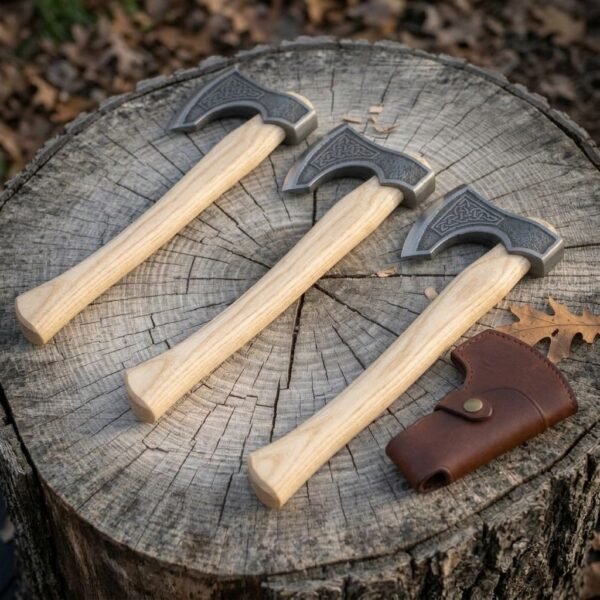
Thrimhawk Hand Forged High Carbon Steel Viking Throwing Axe Set of 3 | 15 Inch Overall with 3.5 Inch Cutting Edge Each | Axe Throwing Gift | RK-1214
Original price was: $395.00.$316.00Current price is: $316.00.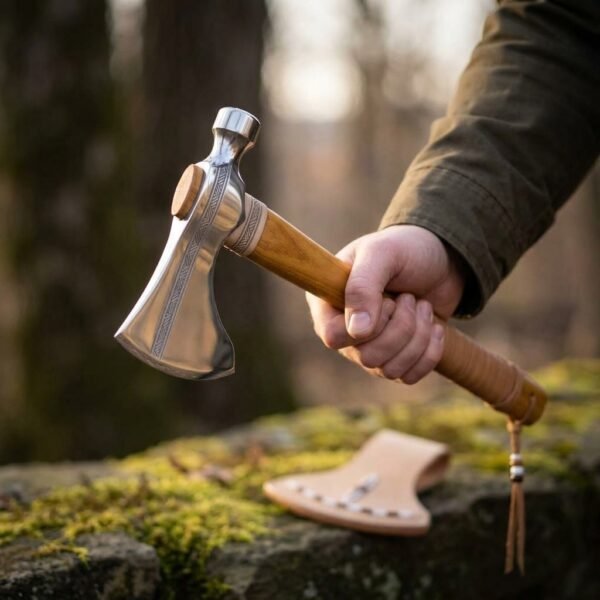
Hickoryhawk Hand Forged High Carbon Steel Native American Style Tomahawk | Collector Reenactment and Display Gift | RK-1201
Original price was: $225.00.$180.00Current price is: $180.00.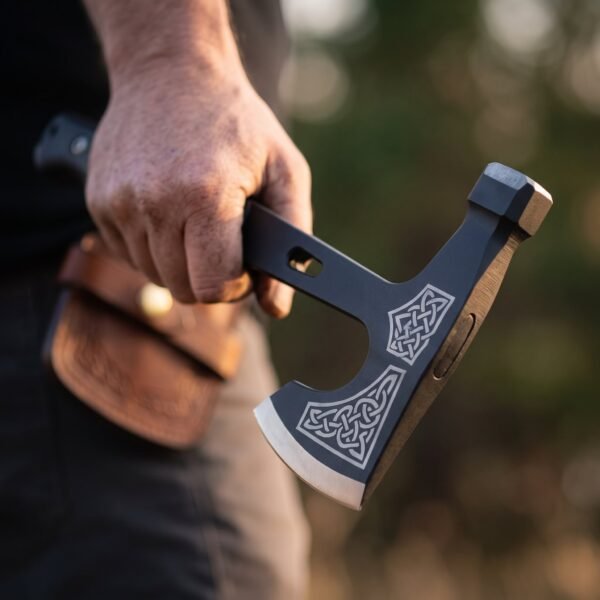
Grimhawk Hand Forged High Carbon Steel Tactical Tomahawk | 14 Inch Overall with 3.5 Inch Cutting Edge | Bushcraft Camping Gift | RK-1202
Original price was: $215.00.$172.00Current price is: $172.00.What separates a throwing axe from a working axe
Three things, and none of them is decoration. The first is head weight, kept low so the axe rotates at a predictable rate instead of nosing over in flight. The second is edge hardness, taken to the softer end of the range on purpose, because a thrown axe will eventually meet a nail, a knot or the steel frame of a target and a very hard edge chips where a slightly softer one rolls. The third is the haft, which is straight, plain and cheap to replace, because you will replace it.
The physics of the first point is worth a paragraph. Kinetic energy rises with the square of velocity, so a light head at the end of a long haft moving quickly carries a surprising amount of force while staying easy to control. That is the tomahawk argument in one line. A hatchet puts a heavy head on a short handle and relies on mass. A tomahawk puts a light head on a long handle and relies on speed, which is why one is carried all day and the other is carried to the woodpile.
The third point is the one people resent and then accept. A haft that survives every miss is a haft that transmits every impact into the eye. A haft that breaks cleanly at the throat has done its job, cost a fraction of the head, and can be swapped in an evening.
Rotation, distance and the part everyone skips
An axe leaves your hand spinning and it does not stop. That means there are only certain distances at which the edge arrives first, and everything between those distances is a handle strike. For a 15 inch axe thrown with a standard overhand release, one full rotation lands somewhere around twelve to fifteen feet depending on your height, your grip and how much wrist you put into it. Two rotations lands roughly double that.
So the method is not to aim harder. It is to stand where the rotation finishes. Mark a line, throw five, and if the axe hits handle first you are too close, and if it hits with the head still coming over you are too far. Move six inches at a time, not two feet. Once you find the line, put a mark on the ground and stop moving it.
Grip the haft near the end, keep your wrist locked rather than flicking it, and let the axe leave your hand at about eye level with both arms following through towards the target. Wrist flick is the single most common reason a throw that felt perfect lands sideways, because it adds rotation that your distance is not accounting for.
The axes in this collection
Four listings, and they are not all for the same job.
The matched set
One listing here is three axes rather than one. They are matched hand forged throwing axes, 15 inches overall each, with a 3.5 inch cutting edge measured from horn to beard and a head weight of about 1.1 lb each, matched across the set so all three rotate the same way. The cheeks are left hammer finished rather than polished. The steel is deliberately taken toward the softer end of the range so the edge takes repeated impact into a wooden target without chipping. The hafts are light ash, straight grained, hand shaped, oil finished and wedged. One stitched and riveted leather head sheath comes with the set.
Three matched axes is the right number because throwing one axe and walking to fetch it teaches you very little. Throwing three, seeing which one landed differently and why, teaches you a great deal.
Tomahawk patterns on wooden hafts
Two of these. The trade pattern is 19 inches overall with a 3.5 inch fan shaped bit, mirror polished high carbon steel with a rounded poll, on a hickory haft with a leather laced grip and a beaded leather tassel. A geometric linear band is engraved on the head cheek and the collar, and a natural leather head cover is included. The flared bit is the defining feature of the trade tomahawk. Widening the edge away from a narrow eye puts a long cutting edge on a very light head, which is exactly why these were carried all day and thrown accurately.
The Damascus piece is 20 inches overall with a 6 inch head and a 5.5 inch cutting edge on a rosewood handle, in layered 1095 and 15N20 at 58 to 60 HRC, supplied with a leather blade cover and a gift box. It is the longest and the sharpest here, and with a 5.5 inch edge it is more of a camp and display piece than a target axe.
The one piece build
The fourth is different in construction rather than in shape. It is 1095 high carbon in a blackened oxide finish, 14 inches overall with a 3.5 inch cutting edge, forged as one piece full tang with a skeletonised handle and a vegetable tanned leather wrap for grip. The poll is a flat hammer face. A hand stitched leather belt sheath comes with it.
Most tomahawks under two hundred dollars are a head wedged onto a hickory haft, which is fine until you baton it, pry with it or hit something harder than you meant to, and then the head works loose. A one piece build has nothing to come apart, since there is no eye, no wedge and no glue line. You trade a little shock absorption for something that will not fail at the joint, which is the trade most people actually want in a pack.
Sizes, steel and fittings across the range
Every figure below comes from the specification panel of a piece on this page. These are forged and ground by hand, so read the numbers as what to expect rather than as a guarantee to the millimetre.
| Piece | Steel and finish | Overall length | Cutting edge | Haft or grip | Supplied with |
|---|---|---|---|---|---|
| Thrimhawk, set of three | High carbon, hammer finished cheeks | 15 in each | 3.5 in each, horn to beard | Light ash, oil finished, wedged | One stitched and riveted leather head sheath |
| Hickoryhawk | High carbon at 54 to 58 HRC, mirror polished | 19 in | 3.5 in, fan shaped, rounded poll | Hickory with leather laced grip and beaded tassel | Natural leather head cover |
| Grimhawk | 1095 at 54 to 58 HRC, blackened oxide | 14 in | 3.5 in, flat hammer poll | One piece full tang, vegetable tanned leather wrap | Hand stitched leather belt sheath |
| Emberhawk | Damascus at 58 to 60 HRC, acid etched | 20 in | 5.5 in, head 6 in long | Rosewood | Leather blade cover and gift box |
The head weight figure is the one to compare, and only the matched set states it, at about 1.1 lb each. That is the number that decides how an axe rotates, and it is why a set built for throwing lists it and a display piece does not.
Steel and hardness
Two steels run through the range. Plain 1095 high carbon is hardened to 54 to 58 HRC and comes back on a stone quickly, which matters more here than anywhere else because a throwing edge gets dressed often. Damascus of 1095 and 15N20 is forge welded, drawn and acid etched at 58 to 60 HRC, and holds an edge longer at the cost of being slower to bring back.
For throwing specifically, the softer end of the 1095 range is what you want, and the matched set is heat treated with that in mind. An edge at the top of the range is harder, holds longer and chips when it lands on a knot at speed. An edge lower down rolls instead, and a rolled edge is fixed in two minutes with a file. Neither steel is stainless and both will rust, so a wipe of oil after use is not optional.
The finishes behave differently too. A mirror polish shows every fingerprint and looks superb on a wall. A hammer finish hides marks and is the sensible choice for a target axe. A blackened oxide coating gives some corrosion resistance and will wear through at the edge and on any surface that rubs, which is normal and not a defect.
Hafts, eyes and the one piece
Ash and hickory are the two traditional throwing hafts and both are here. Ash is lighter and more flexible, hickory is heavier and tougher. Both are cut so the growth rings run down the length of the haft rather than out through the side, and both are shaped by hand to a straight oval section, so your hand can feel where the edge is pointing without looking. A straight haft is not a style choice on a throwing axe. A curved haft rotates around a different axis and makes distance harder to learn.
The wedged eye is the part that eventually needs attention. Timber shrinks in dry heat, and a head that has any movement in it at all should not be thrown. Test it by holding the haft and tapping the poll on a block. A tight head gives a dull thud, a loose one gives a rattle. Replacement hafts are in the axe handles and hafts category, and rehanging a head is an evening's work with a saw, a wedge and some patience.
The one piece has none of that and needs none of it. Its wear point is the leather wrap, which is replaceable, and its weakness is shock, since there is no timber between the steel and your hand to soak up an impact.
Throwing safely, and what to throw at
Use end grain. A target built from rounds of soft wood standing on end takes a blade cleanly and closes up behind it. Plywood, pallet boards and cross grain planks split, throw splinters and bounce axes back. Set the target so the impact face is roughly vertical or leaning very slightly toward you, because a face leaning away deflects axes upward.
Keep everyone behind the thrower, never beside them, and never let two people throw at the same target at once. Walk to collect, do not jog. An axe that bounces back travels a lot further than people expect, so give yourself twenty feet of clear ground behind the throwing line. Check the head and the haft between rounds. If you have been throwing for an hour and one axe starts landing differently, stop and look at it rather than adjusting your throw.
Wear closed shoes. This should not need saying and yet.
Care, sharpening and rust
Wipe the head dry after use and leave a light film of oil on it. Do not store an axe in a leather sheath for months, because leather holds moisture against steel and that is the most reliable way to spot an otherwise well kept head. Grey patina is stable and harmless. Orange spotting lifts with fine abrasive and oil, and the guide on removing rust from an axe covers the method.
A throwing edge does not want to be razor sharp. Take it to a working edge with a file or a coarse puck worked in small circles along the convex bevel, then refine lightly on a fine stone. A file is genuinely the right tool here and there is no shame in it. Match the existing angle, which on these is more open than a knife bevel, and stop when a burr runs the length of the edge. The guide on sharpening an axe goes through it properly.
Give the haft a wipe of oil once or twice a year and keep it out of hot cars and off radiators. A dry haft shrinks, a shrunk haft loosens, and a loose head is the one genuine hazard in the whole activity.
Engraving
The cheek of a head and the flat of a poll both take a cut, and a name, a date or a rune line is the usual request. Elder Futhark is a phonetic alphabet rather than a cipher, so a name is transliterated by sound and there is no rune for the letter C. Where a piece already carries an engraved band or panel, your engraving replaces it rather than sitting alongside it. Text engraving is 19 dollars, a symbol is 39 dollars and a family crest is 49 dollars. It is permanent, an engraved piece cannot be returned, and the spelling you send is the spelling that gets cut. Engraving a set of three usually means one line across all three, so say if you want them numbered instead.
Where these come from and how they ship
Ransack Viking is a US company based in Chicago, Illinois. The pieces are handmade in the Czech Republic, then imported, inspected and shipped from Chicago. Engraving is done in the US after arrival. Because every head is forged and ground by eye, bit profile, hammer texture and etch figure vary slightly between two axes of the same name, and timber colour shifts from haft to haft. On the matched set the three heads are weighed against each other rather than against a catalogue figure, which is what matching actually means.
How to choose
Buy the matched set if you intend to throw. Three axes, matched weight, softer edge, replaceable ash hafts, and the sheath. Buy the trade pattern if you want the classic fan shaped bit on hickory and a piece that looks right on a wall between throws. Buy the one piece if it lives in a pack or a truck and will be used for camp work as much as anything. Buy the Damascus if the layered pattern is the reason you are here, and treat it as a camp and collector piece rather than a target axe.
Browse related categories
- Tomahawks in the full range of patterns
- Bearded axes with the dropped beard and long cutting arc
- Battle axes on longer hafts
- Viking axes across every pattern
- Throwing knives for the same target board
- Splitting and felling axes built to be used
Guides worth reading first
- Axe throwing for beginners, distance and release
- Viking axe vs tomahawk, how the two differ
- How to choose a Viking axe
- Axe care, oiling the head and the haft
- Axe against hatchet, where the line actually falls
Frequently asked questions
How far should I stand from the target?
Far enough that one full rotation finishes at the board. For a 15 inch axe that is usually somewhere around twelve to fifteen feet, but it depends on your height, your grip and your release. Throw five, adjust six inches at a time, then mark the ground and stop moving.
Why are throwing axes not razor sharp?
Because a very thin, very hard edge chips when it lands on a knot at speed. A working edge at the softer end of the hardness range rolls instead, and a rolled edge comes back in two minutes with a file. Sharp enough to bite the target is the target.
Why buy a set of three?
Throwing one axe and then walking twenty feet to fetch it teaches you almost nothing. Three matched axes let you throw a group, see which one behaved differently and work out why. The three heads are weighed against each other so they rotate the same way.
What should I throw at?
End grain. Rounds of soft wood standing on end take a blade cleanly and close behind it. Plywood, pallet boards and cross grain planks split, throw splinters and bounce axes straight back at you.
What is the difference between a tomahawk and a hatchet?
Head weight and haft length. A hatchet puts a heavy head on a short handle and works by mass. A tomahawk puts a light head on a long handle and works by speed, which makes it easier to carry, easier to control and far better in the air.
Is a one piece tomahawk better than a wedged head?
It is better at not coming apart, since there is no eye, no wedge and no glue line to fail. It is worse at absorbing shock, because nothing sits between the steel and your hand. For a pack or a truck the one piece usually wins. For repeated throwing, a replaceable wooden haft has its own logic.
What happens when I break a haft?
You replace it, and you will. A haft that breaks at the throat has done its job by taking the damage instead of the eye. Replacement hafts are sold separately and rehanging a head is an evening's work.
Where are these made?
They are handmade in the Czech Republic, then imported, inspected and shipped by Ransack Viking from Chicago, Illinois. Engraving is added in the US after arrival.
Featured pieces
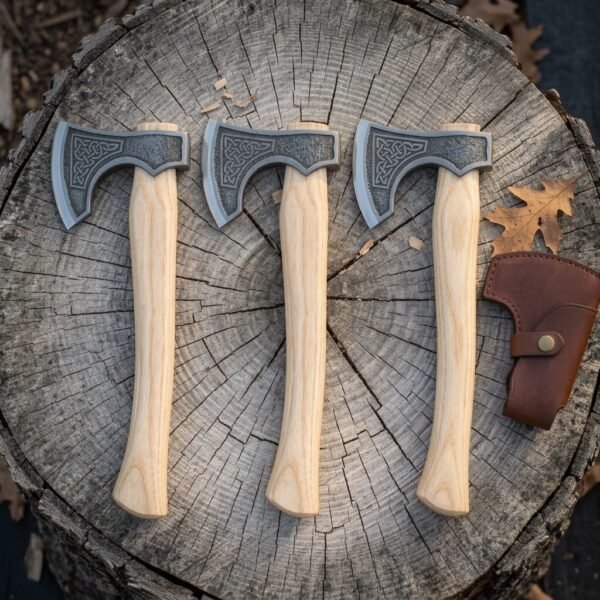 Thrimhawk Hand Forged High Carbon Steel Viking Throwing Axe Set of 3
Original price was: $395.00.$316.00Current price is: $316.00.
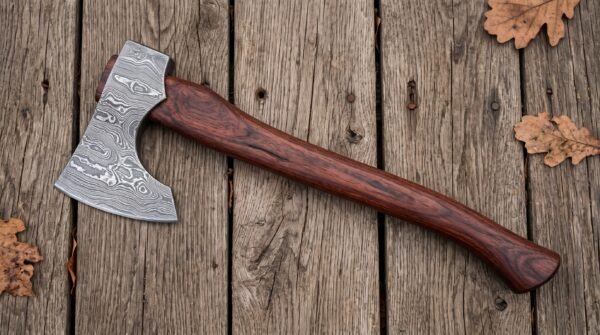 Emberhawk Hand Forged Damascus Bearded Axe
Original price was: $159.00.$127.20Current price is: $127.20.
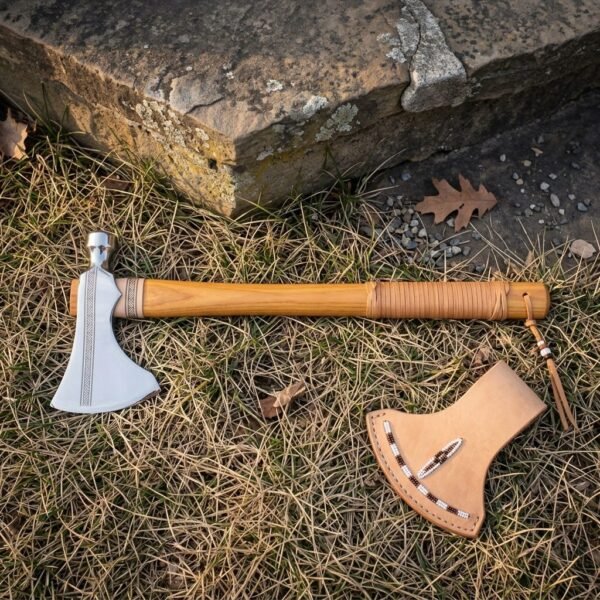 Hickoryhawk Hand Forged High Carbon Steel Native American Style Tomahawk
Original price was: $225.00.$180.00Current price is: $180.00.
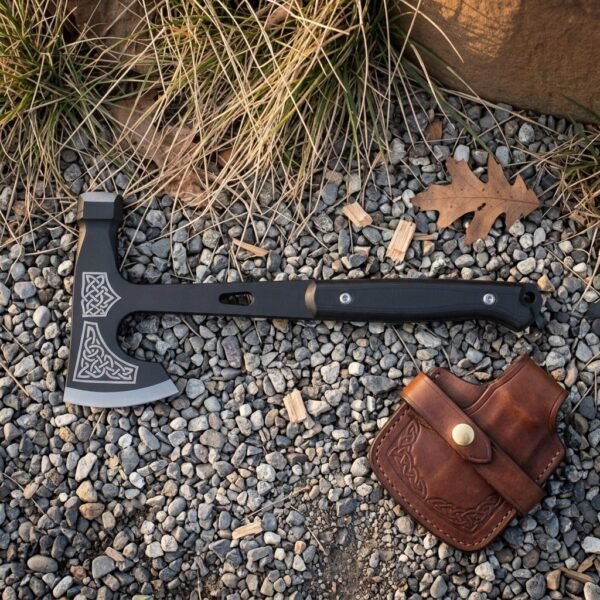 Grimhawk Hand Forged High Carbon Steel Tactical Tomahawk
Original price was: $215.00.$172.00Current price is: $172.00.