
A shield boss is the steel dome at the centre of a round shield. It exists because of how a Viking age shield is held. The board is cut through in the middle, a wooden bar runs across the back of that hole, and your fist closes around the bar inside the empty space. The boss covers the hole and gives your knuckles somewhere to live. Without it you are gripping a plank with your hand exposed.
The bosses here are raised by hand from mild steel in 16 gauge, about 1.6 mm, and one in 14 gauge at about 2 mm. Domes are hemispherical or conical on a wide flat flange, with six or eight rivet holes drilled around the rim. The 14 gauge piece measures about 12 inches across the flange with a dome roughly 6 inches wide and 2.5 inches deep, and weighs about 1 lb 14 oz. Several are cut with a Vegvisir, a Valknut, a Mjolnir or a line of Elder Futhark runes.
Buy the gauge that matches the job. Thin for display, thick if anything is going to hit it.
Free US shipping
On most pieces. Heavier and oversized ones carry a flat charge.
Hand Forged
Heated, hammered and ground by hand.
Engraving available
Names, dates or Norse runes on most pieces.
Ships from Chicago
Inspected and dispatched from our Chicago warehouse. No import duty, no customs delay on US orders.
Shield Bosses
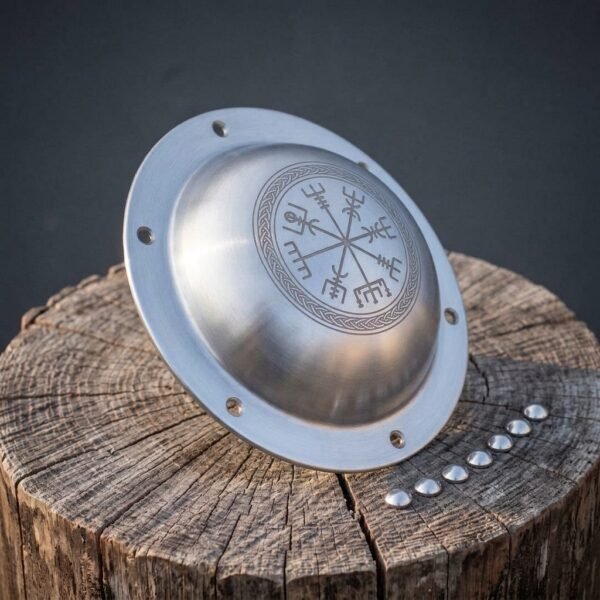
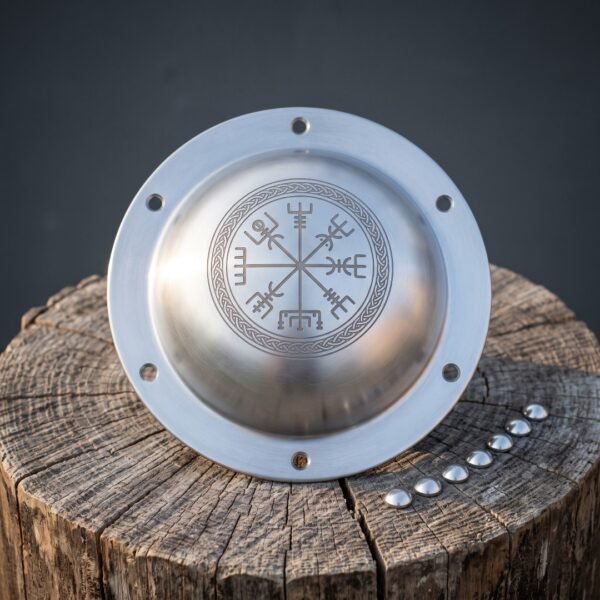
Pathmark Hand Forged Steel Shield Boss with Vegvisir Engraved Dome & Eight Hole Rivet Flange | Shield Building Gift | RK-1441
Original price was: $119.00.$95.20Current price is: $95.20.
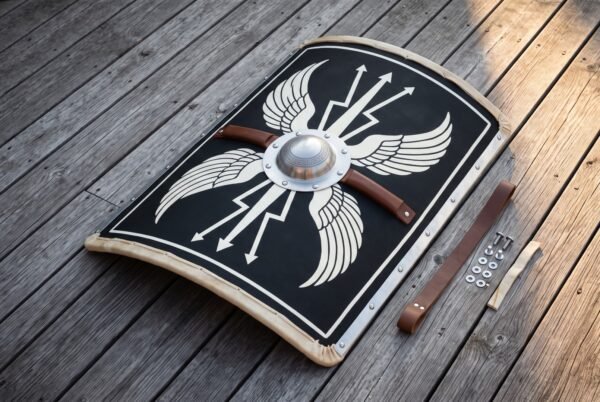
Legionwall Hand Made Curved Roman Scutum Shield | 37 Inch Tall | Steel Boss, Painted Wings and Rawhide Edge with Fitting Kit | Legionary Reenactment Gift | RK-1456
Original price was: $449.00.$359.20Current price is: $359.20.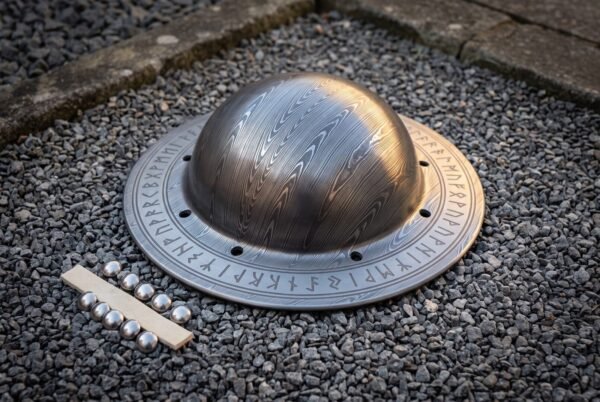
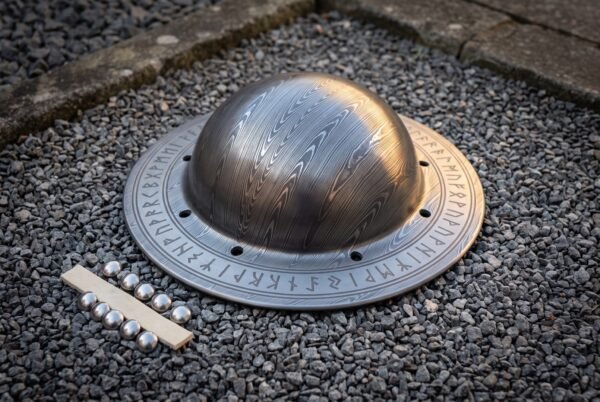
Stormeye Hand Forged Steel Viking Shield Boss with Pattern Etched Dome & Rune Cut Flange | Shield Building Gift | RK-1437
Original price was: $139.00.$111.20Current price is: $111.20.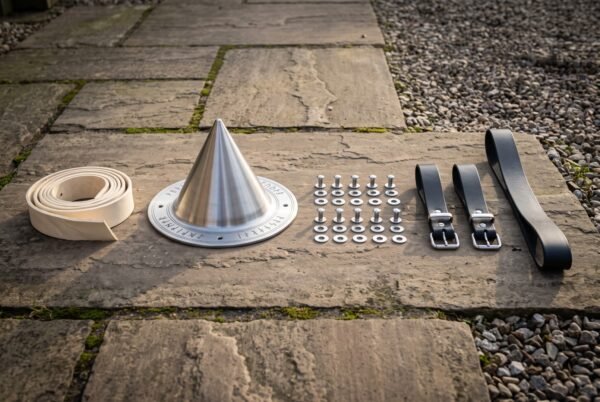
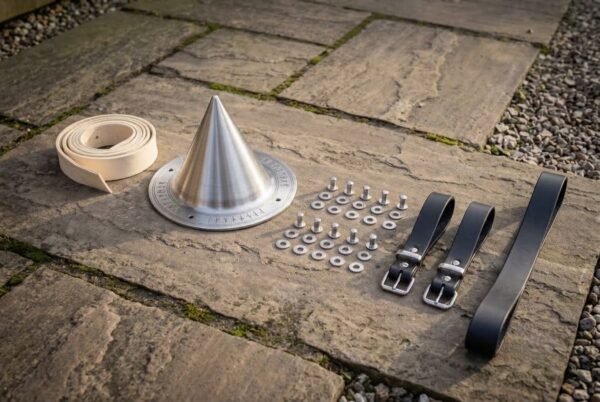
Spikerim Hand Forged Steel Conical Viking Shield Boss and Fitting Kit with Rune Ring Engraving & Black Leather Straps | Shield Building Gift | RK-1544
Original price was: $179.00.$143.20Current price is: $143.20.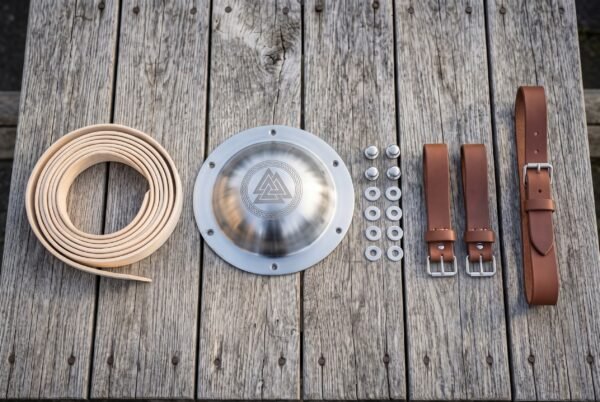
Rimbind Hand Forged Steel Viking Shield Boss and Fitting Kit with Valknut Engraving & Full Leather Strap Set | Shield Building Gift | RK-1532
Original price was: $169.00.$135.20Current price is: $135.20.What the boss actually does
Take a Viking age round shield apart and there is less to it than people expect. A board of butted planks, a leather or rawhide edge to stop the planks splitting, a wooden bar across the back for the hand, and a steel dome over the middle. The dome is the boss, and it is the only part of the shield that has to be metal.
The reason is the grip. A Norse round shield is held in the centre, not strapped to the forearm like a later medieval shield. A hole is cut through the middle of the board, the crossbar spans the back of that hole, and the hand closes around the bar with the fingers sitting inside the empty space. That arrangement is fast and it lets the shield rotate around the fist, which is the whole point of a centre grip. It also leaves a hole in the shield with your knuckles behind it. The boss covers that hole.
Everything about the shape follows from that. The dome has to be deep enough to clear a closed fist. The flange has to be wide enough to spread the load into the board rather than concentrating it around the hole. The steel has to be heavy enough to turn an edge and light enough that the shield still balances near the hand. Get those three right and you have a boss. Get them wrong and you have an ornament.
The bosses in this collection
Six pieces sit on this page. Five are bosses, sold either on their own with rivets or as a complete fitting kit with rim binding and straps. One is a finished shield with the boss already riveted in place.
Bosses in 16 gauge
Mild steel at approximately 1.6 mm, raised and finished by hand. This is the gauge most reproduction round shields use. It is stiff enough to hold its shape under normal handling and light enough that it does not drag the balance of the board toward the centre. The forms here run from a deep round dome on a wide flat flange, drilled with eight evenly spaced rivet holes, to a tall cone on a flange with six holes. Finishes are brushed steel with the etch left dark against the ground, bright polished steel, and bright satin.
The boss in 14 gauge
One piece steps up to 14 gauge, about 2 mm, hand dished and planished rather than pressed. It measures roughly 12 inches across the flange with a dome about 6 inches across and 2.5 inches deep, sized specifically to clear a closed fist sitting on a crossbar, and it weighs about 1 lb 14 oz. Six pre punched rivet holes run around the flange and six steel rivets and washers come with it. This is the one to buy if the shield will be carried at an event and might actually take a knock. It is supplied as boss and rivets only, with no board, no grip bar and no strap.
Complete fitting kits
Two pieces here ship as a full set rather than as a bare boss. Each includes the raised steel boss, a coiled strip of natural veg tan leather for binding the rim, rivets with washers, and a set of buckled leather straps. One supplies six rivets and six washers with two short buckled arm straps and one long buckled carry strap in brown leather. The other supplies ten rivets and ten washers with two buckled arm straps and one wide grip strap in black leather, all on steel buckles. If you are building a board from scratch, this is the shortest route to a finished shield, because sourcing rim binding and matched rivets separately is the part that stalls most builds.
The finished shield
One item on this page is not a boss for sale on its own. It is a curved Roman scutum built to 37 inches tall on a laminated timber core, bent on the vertical axis and sealed before painting, with hand painted wings, thunderbolts and arrows in white on a black field. A domed steel umbo is riveted through the centre of the board and a horizontal leather grip sits behind it, which is the same centre grip principle as a Norse shield in a very different outline. The edge is bound in bone coloured rawhide style binding with a spare strip supplied, and a fitting kit of steel rivets, burrs and washers comes loose in the box along with a spare grip strap.
Gauges, domes and fittings across the range
Every figure below is taken from the specification panel of a piece on this page. These are raised and dished by hand, so read the numbers as what to expect rather than as a guarantee to the millimetre.
| Form | Steel gauge | Rivet holes | Cut work | Finish | Supplied with |
|---|---|---|---|---|---|
| Deep dome on a wide flat flange | 16 gauge, about 1.6 mm | Eight | Etched pattern across the dome, cut runes around the flange | Brushed steel, etch left dark | Dome head shield rivets |
| Deep round dome on a wide flat flange | 16 gauge, about 1.6 mm | Eight | Vegvisir stave inside a knotwork ring | Bright polished steel | Dome head shield rivets |
| Deep hemispherical dome on a flat flange | 16 gauge, hand raised | Six | Valknut inside a knotwork ring | Bright satin steel | Six rivets and washers, veg tan rim strip, two arm straps and a carry strap in brown |
| Tall cone on a wide flat flange | 16 gauge, hand raised | Six | Elder Futhark rune line around the flange | Bright satin steel | Ten rivets and washers, veg tan rim strip, two arm straps and a wide grip strap in black |
| Dished dome about 6 in across and 2.5 in deep, flange about 12 in | 14 gauge, about 2 mm | Six, pre punched | Mjolnir and a knotwork band on the crown | Polished satin steel | Six steel rivets and washers, boss only |
| Domed umbo riveted into a curved 37 in scutum | Not listed | Riveted through the board | Painted wings, thunderbolts and arrows | Steel on a painted board | Rawhide style edge binding, spare strip, spare grip strap, rivets, burrs and washers |
The listed weight of 1 lb 14 oz applies to the 14 gauge piece. The 16 gauge bosses are lighter, and the difference is noticeable the moment you pick both up.
Sizing a boss to a board
Two measurements matter and neither is the one people check first. The dome has to clear your closed fist on the crossbar, which for most adult hands means an internal depth of about 2.5 inches and an internal width of about 5 to 6 inches. If the dome is shallow, your knuckles touch the inside of the steel and the shield stops being comfortable within minutes.
The second is the hole in the board. Cut it slightly smaller than the inside diameter of the dome, not the same size, so the flange sits on solid timber all the way round rather than overhanging the cut. On a 12 inch flange with a 6 inch dome, a hand hole of about 5 inches leaves you a clean seat for the flange with material to spare.
Board diameter is a separate question. Viking age round shields from grave finds run roughly 30 to 36 inches across and about 6 to 10 mm thick, and a boss of this size suits any of that range. A smaller board with the same boss looks front heavy, which is a matter of taste rather than function.
Steel, gauge and how the metal was worked
These are mild steel, not hardened tool steel, and that is correct for the job. A boss is meant to deform rather than crack. Mild steel takes a dent, spreads the energy across the dome and stays in one piece. Hardened steel of the same thickness would be more likely to split at the shoulder where the dome meets the flange.
Gauge is measured on the sheet before it is worked, and raising thins the metal slightly at the crown. So a 16 gauge boss finishes a little under 1.6 mm at the top of the dome and a little over at the flange. That is normal and it is also why hand raised bosses feel stiffer than the gauge alone suggests, because the working of the metal stiffens it.
Planishing is the finishing stage, a series of light overlapping hammer blows that even out the surface after the dome has been raised. On a polished piece you can still read the planishing under the finish if you catch it in raking light. That is the mark of hand work, not a flaw.
Riveting a boss to a board
Rivets go through the flange, through the board, and are set against a washer on the back so the head does not pull through the timber. Dome head rivets sit proud on the front, which is the historically correct look and also the reason a shield face is never quite flat.
Work opposite pairs, the same way you tighten wheel nuts. Set one rivet, then the one across from it, then the pair at ninety degrees, and carry on until all six or eight are down. Setting them in a circle pulls the flange around and you end up with a boss sitting slightly off centre.
Leave the rim binding until the boss is on. A bound edge stiffens the board and makes it harder to flex the timber into contact with the flange, so the sequence is boss first, then edge, then straps.
Rust, finishing and storage
Mild steel rusts. There is no getting around it and none of these are stainless. A brushed or polished boss wants a light film of oil or a paste wax after handling, particularly if you have been holding it, because a fingerprint left on bare steel prints itself into the surface within days.
Grey patina is stable and harmless. Orange spotting lifts with fine abrasive and oil, and on an etched piece work carefully around the etch, because the dark ground is a surface effect and heavy abrasive will take it off.
Store a shield upright or flat on its back, not leaning face down on the boss, and keep it off a concrete floor. Concrete wicks moisture straight into a timber board and into any steel resting on it. Leather straps and rim binding want a wipe of leather conditioner once a year, particularly if the shield has been out in the rain.
Engraving and cut work
Four of the pieces here already carry cut work. A Vegvisir inside a knotwork ring, a Valknut inside a knotwork ring, a Mjolnir with a knotwork band on the crown, and an Elder Futhark rune line running around the flange. A fifth carries an etched flowing pattern across the dome with the etch left dark against a brushed ground.
Further engraving is added in the United States after the pieces arrive, so a name, a date or a short line can go onto the flange or the crown. Text engraving is 19 dollars, a symbol is 39 dollars and a family crest is 49 dollars. Elder Futhark is a phonetic alphabet rather than a code, so names are transliterated by sound and there is no rune for the letter C. Read the rune guide before you send a spelling.
Engraving is permanent and an engraved piece cannot be returned. Check the spelling twice.
Where these come from and how they ship
Ransack Viking is a US company based in Chicago, Illinois. The pieces are handmade in the Czech Republic, then imported, inspected and shipped from Chicago. Engraving is done in the US after arrival.
Because each dome is raised over a stake by hand, two bosses of the same name will differ slightly in the exact curve of the shoulder and in the depth of the planishing. The rivet holes are drilled or punched to the same pattern, so fitting is consistent even when the surface is not.
How to choose
If the shield is for a wall, a photograph or a display stand, 16 gauge is plenty and you can pick on the cut work alone. If it is going to a reenactment field or a training session, take the 14 gauge, because 2 mm of mild steel is what stands between a rattan blow and your fingers.
If you are building a board from bare timber and have not done it before, buy one of the complete fitting kits. Matching rivet length to board thickness and finding veg tan strip in the right width are the two jobs that turn a weekend build into a month of waiting for parts.
If you want a shield you can hang up on the day it arrives, buy the finished scutum and skip the build entirely.
Browse related collections
- Round shields, finished boards ready to hang or carry
- Kite shields and bucklers for the later grip styles
- Roman and Greek shields including the curved scutum
- Viking armor, helmets, mail and body protection
- Medieval helmets to match a shield build
- Blacksmith tools for the rest of the workshop
- Engraved and personalised pieces across the range
Guides worth reading first
- Viking shields explained, construction, size and grip
- Round shield vs kite shield, what changed and why
- Choosing a shield for display without wasting money
- The Valknut, what the three knot symbol means
- The Vegvisir, what the stave actually is
- How to display swords, axes and shields on a wall
Frequently asked questions
What is a shield boss for?
It covers the hand hole in the centre of a round shield and protects the fist gripping the crossbar behind it. On a centre grip shield the board is cut through in the middle, so without a boss your knuckles sit in an open hole. The wide flange also spreads impact into the timber instead of concentrating it around the cut.
What gauge steel should I choose?
16 gauge, about 1.6 mm, suits display shields and light reenactment and keeps the weight down. 14 gauge, about 2 mm, is the one to take if the shield will be carried at an event and struck. The heavier boss on this page weighs about 1 lb 14 oz, and you feel that difference immediately.
How big should the hand hole in my board be?
Slightly smaller than the inside diameter of the dome, so the flange seats on solid timber all the way round rather than overhanging the cut. With a 6 inch dome on a 12 inch flange, a hole of about 5 inches leaves a clean seat with material to spare.
Do these come with rivets?
Yes. Every boss on this page ships with rivets sized for the flange. Two of them are complete fitting kits that also include veg tan leather rim binding, washers and a set of buckled arm and carry straps. One is supplied as boss and rivets only, with no board, grip bar or strap.
Will a shield boss rust?
Yes. These are mild steel and none of them are stainless. Wipe a light film of oil or paste wax over the surface after handling, because fingerprints etch into bare steel within days. Grey patina is stable. Orange spotting lifts with fine abrasive and oil, worked carefully around any etched area.
Can I rivet a boss to a shield I already own?
Usually yes, as long as the existing hand hole is smaller than the inside of the dome and the board is sound around it. Set the rivets in opposite pairs rather than round the circle, so the flange pulls down evenly and the boss stays centred.
Is the conical boss more period correct than the round one?
Both forms are found. Deep hemispherical domes on a wide flange are the common Viking age pattern in Scandinavian graves, and taller conical shapes appear across a wider range of periods and regions. Pick on what the shield is for rather than on the shape alone.
Where are these made?
They are handmade in the Czech Republic, then imported, inspected and shipped by Ransack Viking from Chicago, Illinois. Engraving is added in the US after arrival.
Featured pieces
 Stormeye Hand Forged Steel Viking Shield Boss with Pattern Etched Dome & Rune Cut Flange
Original price was: $139.00.$111.20Current price is: $111.20.
 Pathmark Hand Forged Steel Shield Boss with Vegvisir Engraved Dome & Eight Hole Rivet Flange
Original price was: $119.00.$95.20Current price is: $95.20.
 Legionwall Hand Made Curved Roman Scutum Shield
Original price was: $449.00.$359.20Current price is: $359.20.
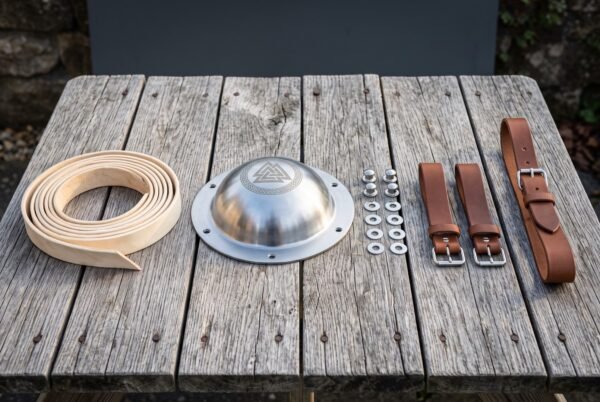 Rimbind Hand Forged Steel Viking Shield Boss and Fitting Kit with Valknut Engraving & Full Leather Strap Set
Original price was: $169.00.$135.20Current price is: $135.20.