
Blog
Choosing a Shield for Display: Size, Mounting and Materials

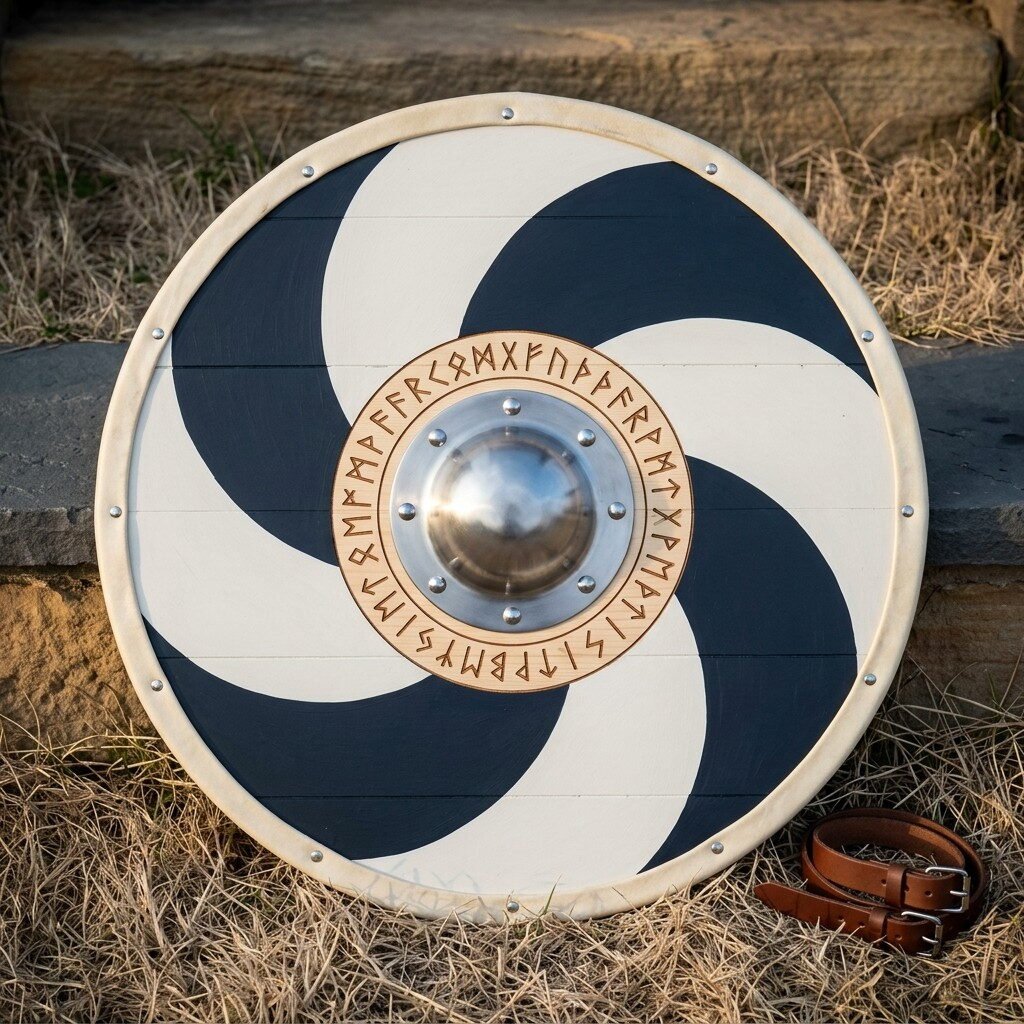
For a shield that is going on a wall, buy a round shield of 24 to 30 inches, planked or plywood faced, with a steel or brass boss, a painted design and a rawhide or leather rim. Hang it on a French cleat or a plate hanger fixed into a stud. That covers almost every room, and it is the cheapest large object that can carry a whole wall on its own. Most people buy one a size too small.
Shields are the best value display piece in this hobby by a distance. A sword is a line on a wall; a shield is a surface. They are also the piece people most often buy at the wrong size and then fail to mount safely, so the details below are worth the ten minutes.
What the shield is for
Wall display
The dominant use, and the one driving every recommendation here. A shield above a fireplace, over a bed or on a landing gives colour and pattern at a scale nothing else matches. The face design matters more than anything structural, and so does diameter, since a shield too small for its wall looks like an apology.
Reenactment and living history
A shield in a fighting line takes real punishment, and groups have specific rules: minimum thickness, rim material, boss fixing, and often a ban on plywood. Ask your group before you buy. A beautiful non-compliant shield is a wall piece with extra steps.
Costume, film and photography
Here weight is the thing. You will carry it, and a heavy planked shield with a steel boss tires quickly. A lighter build at 24 inches or under is far more pleasant over a long day, and it fits through doorways and into a car, which the 32 inch version does not.
Gifting and rooms for children
Shields give well because there is no sizing and no sharpened edge. For a child’s room, choose one with no exposed rim rivets and a domed rather than spiked boss, and mount it where it cannot be pulled down.
Round or kite
This is the first real decision, and it is mostly about period and wall shape. A round shield is Norse, Anglo-Saxon and early medieval, and it is what most people picture for a Viking display. It fills a square of wall, works above a fireplace, and reads instantly.
A kite shield is later, from the eleventh century onwards, tall and tapering to a point, built to cover a rider’s leg. On a wall it is a vertical object, suiting a narrow strip beside a door or a stairwell far better than a circle does. A heater shield is the shorter, flat topped descendant and works in the same spaces. A buckler is a small round fist shield of 12 to 15 inches, a companion piece rather than a wall anchor.
If you cannot choose, our round shield against kite shield comparison goes through it in detail, and Viking shields explained covers how the round shield was actually built and used.
Size, and how to pick it
Historical round shields varied widely, and the ones recovered from Gokstad sit around 32 inches. Modern reproductions run from roughly 20 to 36 inches. For a wall, the shield should occupy around half to two thirds of the width of the space it sits in. Over a standard fireplace, 24 to 28 inches usually looks right; on a large open wall, 30 inches and up.
Measure before you order and mark the circle out with masking tape on the actual wall. It takes two minutes and prevents the most common regret here, which is a shield correct to spec and wrong for the room. For carrying rather than hanging, go smaller than you think. Twenty four inches is comfortable for hours; thirty is not.
Materials, and what each one changes
The board
Historical shields were planked: boards glued edge to edge, thin at the rim and thicker at the centre, which keeps them light and lets them split rather than shatter. Modern planked shields do the same and are what serious reenactors want. They are heavier, dearer, and look right close up because you can see the joins, which is the entire point.
Plywood shields are lighter, cheaper, flatter and good for display, and being uniform they take a painted design cleanly. Many groups do not allow plywood in the line, so check first if you are fighting. Thickness drives weight and durability: thin boards under about half an inch are display items, and reenactment builds are heavier.
The boss
The boss is the steel or brass dome at the centre. On a real shield it covers the hand, which passes through a hole in the board and grips a bar behind. On a display shield it may be decorative, fixed to a solid board with no hand hole. Either is fine for a wall, but they are different objects, and a listing that shows a boss without saying what is behind it is worth a question.
A steel boss is heavier and darker, a brass one warmer under lamplight. Rivets around the flange should be real and visible from the back. On a piece that will be handled, check the boss is riveted rather than glued or screwed from the front.
The rim
A rawhide rim, wet fitted and stitched, is the historical answer and what stops a board splitting outward. It also gives the edge a soft, irregular line that looks correct. Leather rims do a similar job on modern builds. Steel rims look striking, add weight, and are banned by many groups because a metal edge into someone else’s hand is a bad afternoon. An unrimmed shield is a display piece.
The face
Paint, leather facing, linen facing, or bare oiled wood. Painted designs are the norm, from pinwheel quarters to full knotwork and rune rings. Linen or leather over the board is the historical construction and gives a textured surface. What matters for a wall is contrast: a design that reads across the room, rather than detail that disappears from the sofa.
The back
Look at the back before you buy, since that is where the honesty is. You want a proper handgrip bar across the boss cutout, or arm straps on a strapped build, with the fixings visible. The back also tells you how to hang it, which is the part most listings skip.
Mounting, properly
A 30 inch planked shield with a steel boss is a serious weight, hanging above where people sit. Do not trust a picture hook.
The best fixing is a French cleat: an interlocking pair of angled battens, one screwed across the back of the shield, the other into the wall. It spreads the load, sits the shield flat, and cannot be knocked off sideways. Second best is a pair of heavy D rings with the wall screws driven into a stud.
On plasterboard with no stud available, use toggle or metal expansion anchors rated well above the actual weight, and use more than one. Plastic plugs pull out over time as the shield rocks with door slams and temperature change.
Do not hang a shield by its arm straps or grip. Those are stitched for the load of a forearm, not for years of dead weight on two points, and leather stretches and rots. Avoid screwing through the painted face. And be honest about what sits under the shield: over a bed, use a cleat and check it yearly.
Traps and how to spot them
The first trap is the photo without scale. Round shields all look alike in a product image. Read the stated diameter and mark it on your wall.
The second is the printed face. Some cheap shields carry a design printed on a vinyl skin bonded to the board. It looks fine online, reveals itself close up, and peels at the edges over time. Painted finishes show brush texture and slight irregularity, which is what you want.
The third is the ornamental boss on a fighting shield. If you are buying to fight and the boss is screwed on from the front into thin ply, it will come off.
The fourth is unstated weight. A listing with no weight is hiding either a very light board or a very heavy one, and both change how you mount it.
The fifth is period mixing. A round shield carrying a later heraldic device is a fantasy piece, which is fine if that is what you want. Just do not present it as Norse.
What to spend
These are ranges, not quotes, and prices change. The lowest band is thin plywood with a printed or simply painted face and a light decorative boss, fine over a desk and not much more. The main display band covers painted plywood or planked faces with a riveted steel or brass boss, a rawhide or leather rim and a real grip behind. Most buyers belong here.
Above that you pay for planked construction, linen facing, hand painted detail, engraved boss and rim bands, and heavier builds that survive a fighting line. At the top sit large planked shields built to a specific find, which cost what they cost because they take days.
Budget separately for the mount. A French cleat kit, or rated D rings and the right anchors, is a small cost that protects a large object.
What I would buy
A 26 to 28 inch round shield, plywood or planked, with a riveted steel boss, a rawhide or leather rim, a painted design with strong contrast, and a real grip bar behind the boss. Mounted on a French cleat into a stud. That size sits well above a fireplace or on a landing, it is light enough that mounting is not a project, and the painted face does the work.
If the wall is tall and narrow, buy a kite or heater shield instead of trying to make a circle fit a column. If you are buying to fight, buy planked, buy rimmed, and get the specification approved before you order.
Our range covers both shapes. The Viking shields and round shields hold the Norse patterns, kite shields and bucklers covers the later shapes, and shield bosses are stocked alone for anyone building a board from scratch. Ransack Viking is a US company in Memphis, Tennessee. Every piece is handmade in the Czech Republic the old way, then imported, inspected and shipped from Memphis, and engraving is done in the US after arrival. If you want to pair a shield with the right axe on the same wall, our axe picks is a short read.
Which shape to hang is worth settling first, and we compare them in the round and kite boards. A matching helmet is covered in our helmet buying guide.
Questions people ask
What size round shield suits a wall above a fireplace?
Usually 24 to 28 inches. The shield should take up around half to two thirds of the visual width of the chimney breast, so it anchors the space without crowding it. Mark the circle on the wall with masking tape before ordering, because diameters that sound similar look very different in place. On a wide open wall you can go to 30 inches or more.
How should I hang a heavy shield safely?
Use a French cleat: one angled batten screwed across the back of the shield, a matching one fixed into a wall stud. It spreads the weight, holds the shield flat and cannot be knocked sideways off the wall. Heavy D rings into a stud are an acceptable alternative. Never hang a shield by its arm straps or grip, and never rely on plastic plugs in plasterboard.
Is plywood acceptable, or do I need planked?
For display, plywood is fine and often better, whatever the purists tell you: lighter, flatter, cheaper and a cleaner surface for a painted design. For reenactment, ask your group, because many require planked boards on authenticity grounds and some ban plywood outright. Planked construction is also what splits rather than shatters under a blow, which is the behaviour a fighting shield is supposed to have.
Does the boss need a hand hole behind it?
Only if you will hold the shield. A working round shield has a hole cut through the board under the boss with a grip bar across it, so the hand sits inside the dome. A display shield often has a solid board with the boss fixed on top, which is lighter and cheaper and perfectly fine on a wall. Check the listing or the back photo if you plan to carry it.
What is a rawhide rim for?
It holds the board together, which is less glamorous than it sounds. A shield made of boards glued edge to edge wants to split outward at the rim under impact, and a wet fitted rawhide edge shrinks as it dries and clamps the whole perimeter. It also protects the edge from knocks and gives the outline the slightly soft, irregular line that looks correct. Leather rims do a similar job on modern builds.
Can I hang a shield outdoors or in a garage?
Not without accepting damage. Wood moves with humidity, painted faces fade in sunlight, rawhide softens in damp, and a steel boss will rust. A covered porch is survivable if you oil the metal and check the piece seasonally. An unheated garage with big temperature swings will open the plank joints within a couple of years. Display shields belong indoors.
Shop the range
 Yggdrasil Handcrafted Viking Shield | 24 Inch Diameter | Plywood Body | Wall Display for Home Bar and Man Cave | RK-636
 Silverward Hand Forged Steel Round Shield | 20 Inch Dished Face | Etched Knotwork Border with Riveted Centre Boss | Norse Display Gift | RK-1522
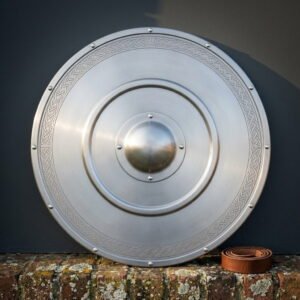 Ringward Hand Made Steel Viking Round Shield | Domed Centre Boss and Riveted Rim | Engraved Norse Knotwork Band with Leather Arm Strap | Norse Display Gift | RK-1797
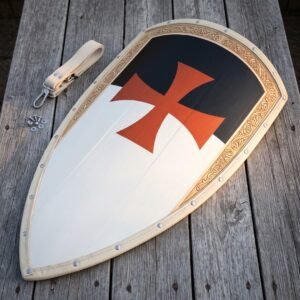 Crossmarch Hand Made Wooden Templar Kite Shield | Black and White Field | Red Cross Pattee and Engraved Gilt Border | Crusader Reenactment Gift | RK-1439
 Quarterfell Hand Made Wooden Heater Shield | Quartered Navy and White | Rawhide Edge and Knotwork Border | Medieval Reenactment Gift | RK-1442
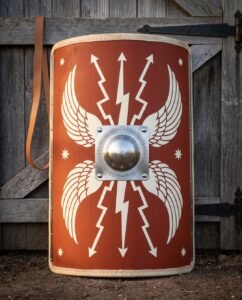 Stormwing Hand Made Roman Legionary Scutum Shield | 40 Inch Curved Laminated Body | Rawhide Edging and Steel Dome Boss | Legion Reenactment Gift | RK-1491