Blog
Two Swords on the Back: The Witcher Setup and Why It Is Fiction

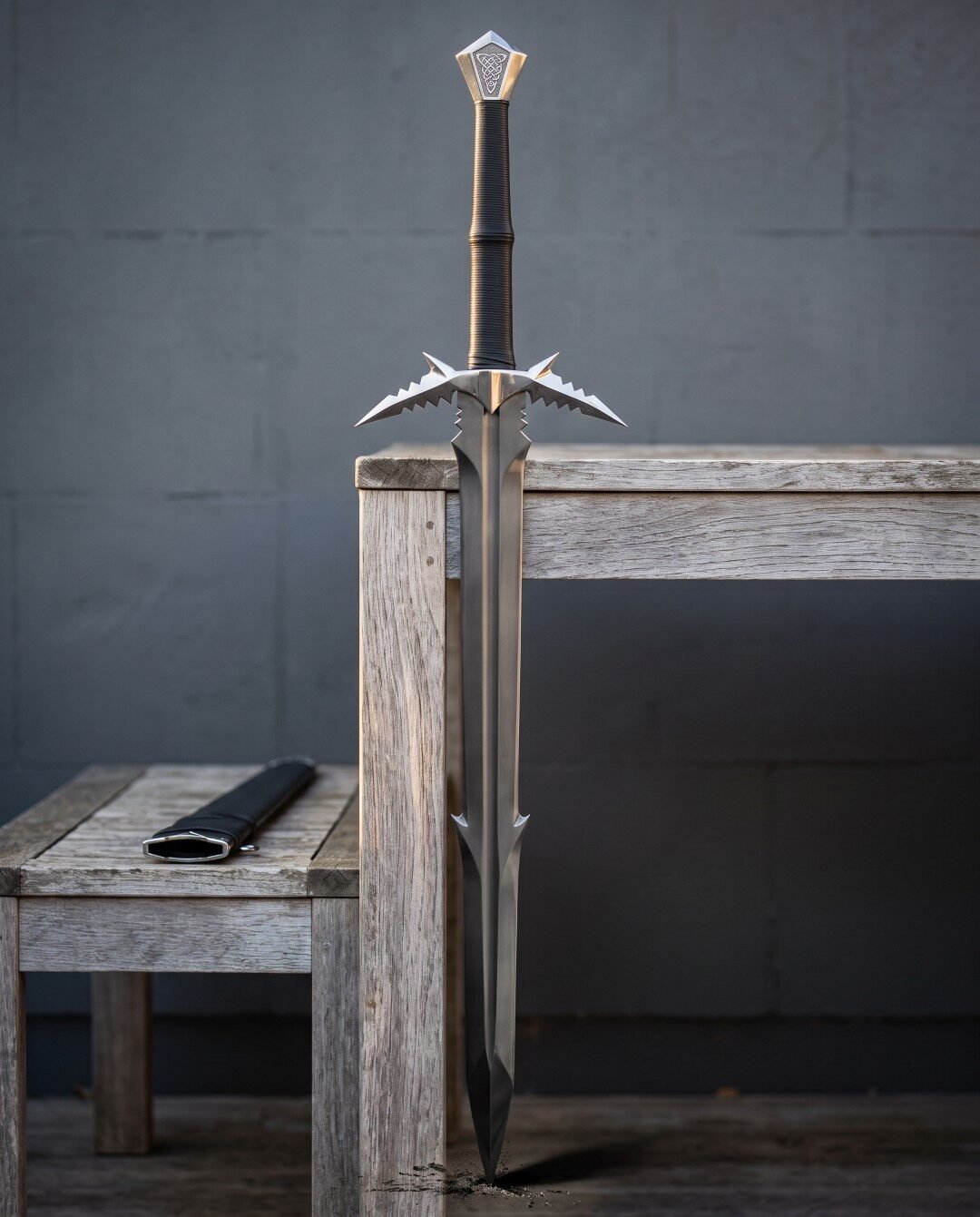
Two swords strapped across the back is a modern invention, and the geometry gives it away before the history does. A blade longer than your arm cannot clear a scabbard mounted between your shoulders, because your hand runs out of travel before the point comes free. Real swords hung at the hip. The silver and steel pairing is a story device from Andrzej Sapkowski’s novels, not a fighting system.
None of which is a complaint. The back carry reads instantly on a screen, it keeps the silhouette clean, and it tells you something about the character before he speaks. It just belongs to illustration and film rather than to any period of European arms, and the two are easy to mix up once a thing has been drawn enough times.
Where the setup comes from
The Witcher began as Polish short stories by Andrzej Sapkowski in the 1980s, grew into a novel sequence, and reached most of its current audience through the CD Projekt Red games from 2007 onward and the Netflix adaptation from 2019. The two swords, one steel and one silver, are Sapkowski’s, and they exist to solve a narrative problem rather than a tactical one. A monster hunter needs a way to distinguish the human threats from the supernatural ones, and giving him two blades makes that distinction visible.
Readers of the novels often point out that the twin back carry is more of a game and screen signature than a book one, and that the second blade is not always on the character’s person in the prose. The image that most people hold in their heads comes from illustration and from a games studio’s need for a recognisable silhouette.
Why a back scabbard does not work
Try it with a broom handle. Hold the handle against your spine with the top end above your shoulder, then take hold of it and try to lift it clear. Your hand travels perhaps two feet before your elbow locks and your shoulder stops rotating. Anything longer than that stays in the scabbard, however confidently it came out on screen.
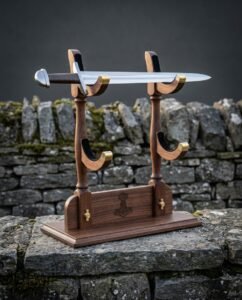 Stavecradle Hand Made Walnut Two Tier Sword Display Stand | Holds Two Swords | Brass Tipped Cradles and Thumb Screws with Mjolnir Engraving | Norse Home Gift | RK-1731
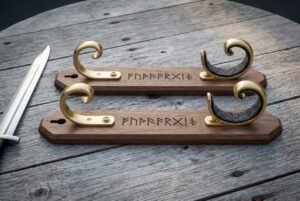 Runeledge Hand Made Walnut Sword Wall Mount Pair with Solid Brass Scroll Hooks | Felt Lined Cradles | Elder Futhark Rune Engraving and Keyhole Slots | Display Gift | RK-1759
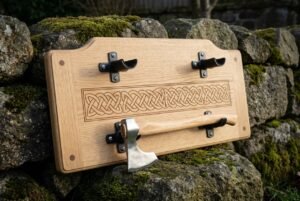 Oakhewn Hand Forged Viking Axe Wall Plaque | Bearded Axe on Carved Oak Board | Celtic Knotwork Band and Leather Lined Steel Cradles | Norse Wall Gift | RK-1683
A typical medieval European arming sword has a blade around thirty inches. Longswords run longer. There is no draw stroke that clears either from a fixed scabbard sitting flat on your back, which is why film and television routinely cheat it. Watch closely and you will usually see one of three cheats: the scabbard is far too short for the blade shown, the camera cuts during the draw, or the scabbard is hinged or open along one side so the blade swings out rather than sliding.
What people did do was carry a sheathed sword slung across the back while travelling or marching, then take the whole rig off to draw it. That is a carrying method, not a fighting one, and it is the grain of truth the fiction grew from.
How swords were actually worn
At the hip, from a belt or a baldric, with the hilt forward of the hip bone so the hand falls naturally onto it. That arrangement is shown in art across the whole of the European Middle Ages and confirmed by surviving scabbard fittings and belt hardware. It puts the grip where the hand already is, it lets you draw while walking, and it keeps the blade out of the way of your shield arm.
Longer blades that genuinely could not be drawn from the hip were carried differently. The two handed greatswords of the sixteenth century were shouldered like a pole, and their users were paid as specialists precisely because the thing was a nuisance to carry and a nuisance to use. Somebody had to be persuaded.
The silver question
Silver as a metal that wards off the supernatural does appear in European folklore, and the idea has real depth to it. What does not have depth is the specific modern rule that silver kills a werewolf. That version is a product of nineteenth and twentieth century writing and then of cinema, which fixed it into something everybody now assumes was always there. Older folklore is much less tidy about what harms what.
There is also a metallurgical problem that fiction never has to solve. Silver is soft. A blade made of it would bend under its own use, would not take or hold an edge, and would be ruinously heavy for its performance. Any real object described as a silver sword is going to be a steel blade with silver ornament, silver inlay or a silvered surface, and that is exactly how historical silver on arms works: as decoration on the fittings and as wire inlaid into the steel, never as the cutting material.
The famous inlaid Norse axe heads work this way, and so do the silver mounted hilts of high status early medieval swords. If you want to see what silver on a blade honestly looks like, look at inlay rather than at a solid casting.
Did anyone fight with two swords at once?
Yes, though not like this.
In Renaissance Europe the standard pairing was a sword in the right hand and something shorter in the left: a dagger, a buckler, or a cloak. Case of rapiers, meaning two matched rapiers used together, was a real if unusual practice taught by some masters. It never became common because the second blade costs you the defensive tools that work better.
In Japan, Miyamoto Musashi argued for using the long and short sword together, and set out his reasoning in the Book of Five Rings, completed in 1645. His approach is genuinely two swords, and it is genuinely marginal. Most schools did not adopt it. Our page on what a katana is and how it was worn covers the paired daisho carry and why the two blades had different jobs.
The point in both traditions is that a second sword is a specialist’s choice made for particular reasons, and that carrying two of anything means carrying twice the weight for one pair of hands.
What is real and what is invented
Real: carrying a sheathed sword slung over the back while travelling. Real: silver as a decorative and symbolic metal on high status arms. Real: matched pairs of blades of different length worn together, in Japan as a formal pairing and in Europe as a fencing option. Real: the idea that certain metals and materials were held to have power against the supernatural, which appears widely in European folk belief.
Invented: drawing a full length sword from a back scabbard. Invented: a solid silver blade as a working object. Invented: the specific folkloric rule that silver is the answer to a particular kind of monster, which is a modern narrative convention rather than an old belief. Invented: the whole two sword carry as a practical fighting arrangement.
The honest summary is that the fiction assembled several real things into an arrangement nobody used, and did it well enough that the arrangement now feels older than it is.
Why collectors still buy the pair
Because a matched pair displays beautifully, and display is what almost all of these swords are honestly for. Two blades on one wall mount reads as a set in a way a single sword does not, and the visual contrast between a bright polished blade and a darker or patterned one is genuinely striking on a wall.
If that is what you are after, buy for the mount as much as for the blade. A pair hung without a proper bracket sags, marks the wall and eventually comes down, usually at night and usually onto something breakable, and the felt lined cradles on a decent wall mount exist for a reason. Our oak and walnut sword stands and wall mounts include two tier table stands and matched pairs of wall hooks made for exactly this arrangement.
From our own range
We do not name anything after a game, a novel or a show, and we make no claim of any connection to one. What we do offer is the two families that suit this interest. Our fantasy and display swords cover the longer heroic proportions, barbed and spiked guards, rune etched panels and blackened finishes, all built as display pieces. The hand forged Norse swords sit at the historical end, with lobed pommels, leather wrapped grips and fitted scabbards, and a pattern welded Damascus blade beside a plain polished one gives you the light and dark contrast without pretending either is silver.
Blades are plain 1095 carbon steel at 54 to 58 HRC, or Damascus of 1095 and 15N20 forge welded and taken to 58 to 60 HRC. Every piece is handmade in the Czech Republic the old way, then imported, inspected and shipped from Chicago, Illinois. Engraving is done in the US after arrival, so a pair can be marked to match.
Before buying, read our notes on what to check when buying a sword as a collector, particularly the section on tang construction, and the steel glossary if a spec sheet has left you guessing what a hardness figure means.
The other two screen sets people ask about most are covered in the swords of The Lord of the Rings and the Excalibur legend. For the arms in the games, see Assassin’s Creed Valhalla.
Questions people ask
Can you actually draw a sword from your back?
Not a full length one. Your arm runs out of extension long before a thirty inch blade clears the scabbard mouth. Short blades under roughly twenty inches can be drawn from a back rig. Everything longer is a screen cheat achieved with a shortened prop scabbard, an open sided scabbard or a cut in the edit. Once you have spotted it you will not be able to stop spotting it.
Did anyone carry swords on their back historically?
For travelling, yes. A sheathed sword slung across the back on a strap is a sensible way to move on foot for a long distance, and it appears in period imagery. To use it you took the whole assembly off first. Nobody fought from a back scabbard, because nobody could.
Would a silver sword work?
No, and it would be a costly way to find that out. Silver is far too soft to hold an edge or resist bending under impact, and it is dense enough to make a poorly performing blade heavy as well. Historical silver on arms is decoration: inlaid wire, mounted fittings and plated surfaces on a steel core that does all the actual work.
Is silver against monsters an old belief?
Partly. European folklore does treat certain metals as protective, and silver appears in that role. The specific and tidy rule that silver is what kills a particular kind of creature is much more recent, shaped by nineteenth and twentieth century fiction and then hardened by film into something audiences assume is ancient.
Are two matched swords worth buying as a display set?
They display very well, particularly when one blade is pattern welded and the other polished bright, since the contrast carries across a room. Buy the wall mount at the same time. A pair hung on improvised hooks will slip, and felt or leather lined cradles keep the scabbards from scuffing.
Do you sell Witcher swords?
We do not use that name or any other franchise name on our products, and nothing we sell is connected to or endorsed by any book, game or series. What we sell is fantasy styled display swords in our own designs and historically grounded Norse swords, and either family can be bought as a matched pair, which is as close to the idea as anyone can honestly get.
The shop side of this
In the shop right now, the Silverthorn elven fantasy sword and the Elmshade fantasy longsword. The Ringwolf half sword and the Nightwhorl bastard sword sit next to them.
The real paired option
Case of rapiers, the genuine paired practice mentioned above, is still a rare sight on a club floor, and most people start with one blade. Rapier versus sidesword covers that single sword choice. The Corvalde rapier has a blunt blade, and HEMA rapiers has the rest.
Shop the range
Stavecradle Hand Made Walnut Two Tier Sword Display Stand | Holds Two Swords | Brass Tipped Cradles and Thumb Screws with Mjolnir Engraving | Norse Home Gift | RK-1731Runeledge Hand Made Walnut Sword Wall Mount Pair with Solid Brass Scroll Hooks | Felt Lined Cradles | Elder Futhark Rune Engraving and Keyhole Slots | Display Gift | RK-1759Oakhewn Hand Forged Viking Axe Wall Plaque | Bearded Axe on Carved Oak Board | Celtic Knotwork Band and Leather Lined Steel Cradles | Norse Wall Gift | RK-1683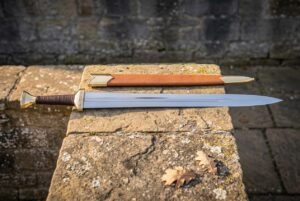 Fernstride Hand Forged 1095 High Carbon Steel Ranger Longsword | 42 Inch Overall with 33 Inch Blade | Cosplay and Display Gift | RK-1253
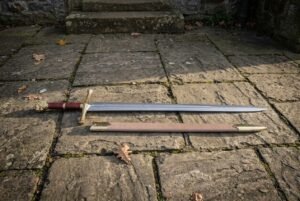 Grailwarden Hand Forged 1095 High Carbon Steel Excalibur Sword Replica | 45 Inch Overall with 36 Inch Blade | Cosplay and Display Gift | RK-1255
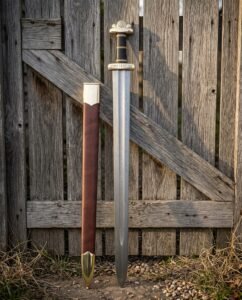 Thornwatch Hand Forged Damascus Viking Sword Replica | Reenactment Collector and Display Gift | RK-1257