
Blog
Excalibur: The Legend, the Sources and What Collectors Actually Buy

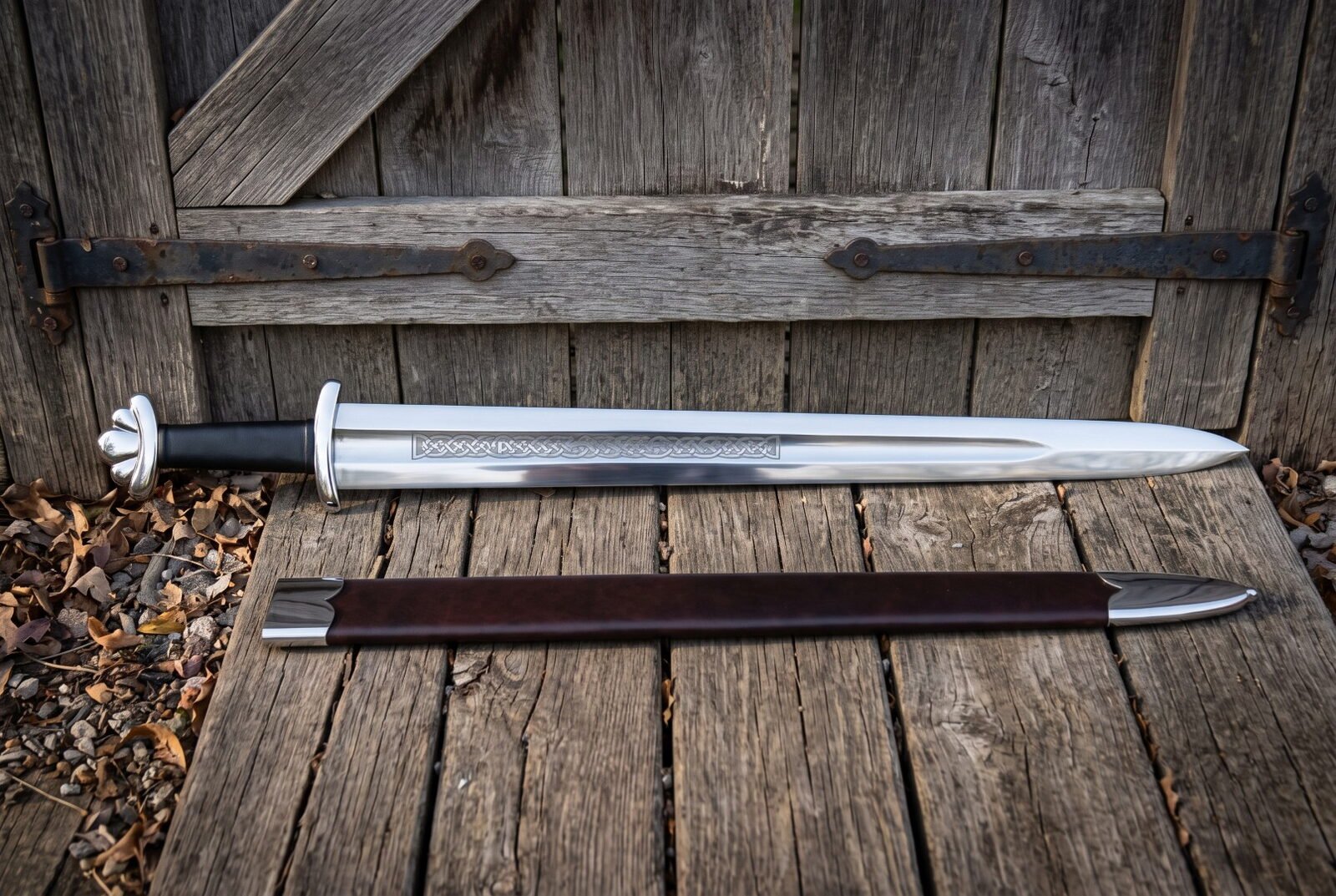
Excalibur is a literary object, not an archaeological one. No sword of that name has ever been excavated, and no chronicle written close to the period Arthur is supposed to have lived in mentions one. It arrives in writing around 1136, in Geoffrey of Monmouth, under the name Caliburnus. Everything collectors recognise today grew out of that line of books, which is a perfectly respectable place for a sword to come from.
That does not make it a small subject. The Arthurian sword has a documented textual history stretching across three languages and roughly four centuries, and the details most people think they know tend to come from the latest layer rather than the earliest. Here is the sequence, what each stage added, and what a sword from Arthur’s supposed era would really have looked like.
The sources, in the order they were written
The Welsh material
The oldest recognisable ancestor of the name appears in Welsh as Caledfwlch, in the tale of Culhwch and Olwen, which survives in the manuscript collection usually published as the Mabinogion. The name is generally connected by scholars to the Irish Caladbolg, a sword in Irish legend. At this stage the sword is simply one of Arthur’s possessions, listed alongside his ship, his shield and his spear. It has no origin story, no stone and no lake. It is inventory.
Geoffrey of Monmouth
Geoffrey’s Historia Regum Britanniae, written in Latin around 1136, is where the sword becomes famous. Geoffrey Latinises the name as Caliburnus and says it was made in the Isle of Avalon. That is the whole of it. Geoffrey was writing a national history with a very loose relationship to evidence, and modern historians read him as a maker of legend rather than a recorder of it, but he is the point at which the sword enters European literature properly.
French romance and then Malory
French writers took Geoffrey’s material and expanded it enormously through the twelfth and thirteenth centuries. The name softens into forms like Escalibor. The stone, the Lady of the Lake, the doomed return of the sword to the water and most of the imagery that fills modern retellings belong to this romance tradition rather than to any chronicle. Thomas Malory’s Le Morte d’Arthur, printed by Caxton in 1485, gathered the French material into English and became the version nearly every later film and novel works from, whether or not the makers have read it.
Two swords, not one
This is the detail that trips up most retellings. In the fuller medieval tradition, the sword drawn from the stone and the sword given by the Lady of the Lake are separate objects. The stone sword proves Arthur’s right to rule and then breaks. The lake sword replaces it, and that second sword is the one that carries the name in much of the tradition. Malory himself is not entirely consistent about which is which, and film adaptations almost universally collapse the two into a single blade because one sword is easier to film than two.
 Wolfmark Hand Forged Damascus Steel Ulfberht Style Viking Sword | 28 Inch Overall with 21 Inch Blade | Norse Collector Gift | RK-1230
 Stonewake Hand Forged High Carbon Steel 11th Century Viking Sword | 37 Inch Overall with 31 Inch Blade | Norse Collector Gift | RK-1232
 Rhinewarden Hand Forged High Carbon Steel Carolingian Viking Sword | 36 Inch Overall with 30 Inch Blade | Norse Collector Gift | RK-1234
So when someone tells you the sword in the stone is Excalibur, they are quoting a film rather than a medieval text.
The scabbard nobody remembers
In Malory, Merlin asks Arthur which he values more, the sword or the scabbard. Arthur says the sword. Merlin tells him he is wrong, because the scabbard keeps its bearer from bleeding to death. Morgan le Fay later takes the scabbard, and its loss is part of what dooms Arthur. It is a genuinely striking piece of storytelling, and it has almost completely vanished from popular memory, because a scabbard does not sell posters.
What is real and what is invented
Invented: the sword, the name, the stone and the lake as a specific event. There is no candidate object, no find, no inscription, and no amount of solemn narration will produce one. Arthur himself sits somewhere between a real fifth or sixth century figure whose existence cannot be demonstrated and a wholly literary king, and the sword is more securely fictional than he is.
Real, and this is the part worth knowing: putting swords into water was an actual practice, not a romantic invention. Across Bronze Age and Iron Age Britain and northern Europe, fine metalwork was deliberately deposited in rivers, lakes and bogs, in quantities and in condition that rule out accidental loss. Archaeologists debate the meaning, but the pattern itself is beyond dispute. So the image of a sword going into the water at the end of a life is not a medieval fantasy. It is a memory, several thousand years old by Malory’s time, of something people genuinely did.
Also real: the idea that a named sword could be an heirloom of enormous value. Early medieval Europe treated good blades as gifts between kings. That is a documented practice in wills, in law codes and in poetry.
What a sword of Arthur’s era would look like
If you place Arthur in the fifth or sixth century, as most of the pseudo historical dating does, then the sword should be a pattern welded blade with a short simple crossguard, a fairly heavy pommel and a straight double edge suited to cutting. Nothing like the tall cruciform hilt of the film versions. The Sutton Hoo sword, an early seventh century English find, is the sort of object that gives the honest picture: pattern welded, richly fitted, and quite unlike anything a modern audience pictures.
Nearly every screen version instead shows a high medieval sword, the kind carried five to eight hundred years after Arthur’s supposed lifetime. That is an aesthetic choice about what reads as kingly, and it is worth naming rather than correcting, because the audience for an Arthurian film is not there for the archaeology.
Pattern welding is the closest real thing to the legend
Pattern welded blades were made by forge welding bundles of iron and steel rods together, twisting them, and drawing them out so the finished blade carries a visible pattern in its surface. The technique produced good blades from inconsistent early metal, and it produced something that looked, to anyone who saw it, like the material itself had been made rather than merely shaped. The famous inscribed Ulfberht swords of the Viking Age sit at the top end of that tradition and show what a genuinely prestigious early medieval blade meant to its owner.
What collectors actually buy
In practice, Arthurian sword buying divides into three groups of people who want different things and are often sold the same item.
The first group wants the film silhouette. Long straight blade, wide cruciform guard, ornate pommel, and a finish that photographs well. These are display pieces and should be bought as display pieces, whatever the listing prefers to call them. Ask about the tang before you buy anything in this group, because a decorative sword with a narrow rat tail tang mounted to look like a full one is the commonest disappointment in the category.
The second group wants the historically defensible sword: an early medieval type with a lobed or brazil nut pommel and an honest carbon steel blade. This group is usually happier, because the objects are cheaper to make well and there is a real body of evidence to argue about.
The third group wants something to hang above a fireplace and does not much care about either, which is an entirely honest position and the one most buyers are actually in. For them the mount matters as much as the blade, and a good wall bracket or table stand changes the whole effect.
Our guide to choosing a sword as a collector works through tang construction, balance and finish in more detail, and the steel glossary covers what the numbers on a spec sheet mean.
From our own range
We do not sell anything from a film and we do not attach film or novel names to our pieces. What we make sits in two families that both serve this interest. The hand forged Norse and early medieval swords follow documented hilt forms, with lobed and brazil nut pommels, leather wrapped grips and fitted scabbards, which is the closest honest answer to a sword of Arthur’s supposed century. For the taller heroic silhouette that most people picture, our fantasy and display swords cover greatswords and long cruciform hilts made for the wall rather than the field. The oak and walnut sword stands and wall mounts are worth buying at the same time, since a good blade lying flat in a cupboard is a waste of both.
Blades are plain 1095 carbon steel at 54 to 58 HRC, or Damascus of 1095 and 15N20 forge welded and taken to 58 to 60 HRC, which is the modern descendant of the pattern welding described above. Every piece is handmade in the Czech Republic the old way, then imported, inspected and shipped from Chicago, Illinois. Engraving is done in the US after arrival, so a name or a motto can be cut into a blade or a stand.
Screen swords raise the same questions about what is real and what was invented, which we take up in the swords of The Witcher and the blades of Middle earth.
Questions people ask
Was Excalibur a real sword?
No. There is no archaeological candidate, no contemporary record, and nothing to go and dig for. The sword is a literary creation that first appears in recognisable form in Geoffrey of Monmouth around 1136, with a Welsh name ancestor in Caledfwlch. Every later detail, including the stone and the lake, comes from medieval romance written centuries after Arthur’s supposed lifetime.
Is the sword in the stone the same sword?
In the fuller medieval tradition, no. The sword pulled from the stone proves Arthur’s kingship and later breaks, and a second sword from the Lady of the Lake replaces it. Films almost always merge the two into one blade. Malory is not perfectly consistent either, which is part of why the confusion has lasted.
Did people really throw swords into lakes?
Yes, though long before Arthur. Deliberate deposition of fine metalwork in rivers, lakes and bogs is well attested across Bronze Age and Iron Age Britain and northern Europe. The quantity and condition of the finds rule out simple accident. The medieval story preserves a genuine ancient practice even though the story itself is fiction.
What would a sixth century British sword look like?
Straight, double edged, built for cutting, with a short crossguard and a substantial pommel, and very likely pattern welded. It would look nothing like the tall cross hilted swords of Arthurian film, which are based on high medieval forms from many centuries later and were settled on by costume departments rather than historians.
Do you sell an Excalibur replica?
We do not use that name on any product and we make no claim of any connection to any film or book. What we sell are historically grounded early medieval swords and separately a range of display swords with heroic proportions. Which one suits you depends on whether you want the archaeology or the silhouette. Both are worth owning. Only one of them is history.
What should I check before buying a display sword?
Ask how the tang is built, since a narrow tang pinned into a decorative hilt will loosen over time. Check the steel and its hardness rather than accepting a vague description. Confirm whether the edge is sharpened. And plan the mount before the blade arrives, because a stand bought later rarely fits properly.
What the shop carries
If you are shopping rather than reading, the Grailwarden Excalibur sword replica and the Kingsbarrow king sword replica are the nearest match. Also worth opening, the Thornwatch knight sword replica and the Palethorn knightly longsword.
What people actually swing
Nobody gets to hold Excalibur, but plenty of people hold a longsword every week at a HEMA club, usually a feder. The feder guide explains the training shape, the Vindlaur feder has a rounded schilt, and HEMA feders has the rest. No lake is involved.
Shop the range
Wolfmark Hand Forged Damascus Steel Ulfberht Style Viking Sword | 28 Inch Overall with 21 Inch Blade | Norse Collector Gift | RK-1230Stonewake Hand Forged High Carbon Steel 11th Century Viking Sword | 37 Inch Overall with 31 Inch Blade | Norse Collector Gift | RK-1232Rhinewarden Hand Forged High Carbon Steel Carolingian Viking Sword | 36 Inch Overall with 30 Inch Blade | Norse Collector Gift | RK-1234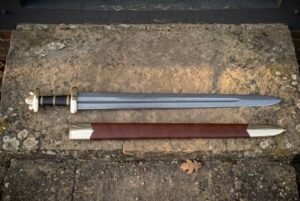 Thornhelm Hand Forged Damascus Viking Sword with Scabbard and Belt | 36 Inch Overall and 30 Inch Blade | Norse Collector Gift | RK-1236
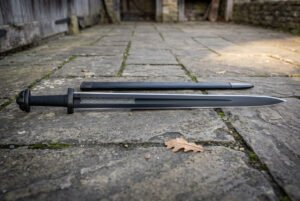 Ravenmark Hand Forged Blackened High Carbon Steel Viking Warrior Sword | 36 Inch Overall with 30 Inch Blade | Norse Collector Gift | RK-1238
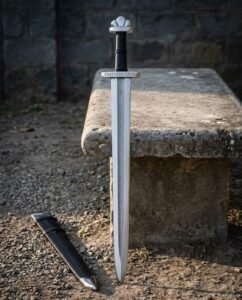 Runemarch Hand Forged Pattern Welded Viking Sword | 36 Inch Overall | Elder Futhark Cut Guard with Lobed Pommel and Black Leather Scabbard | Norse Collector Gift | RK-1652