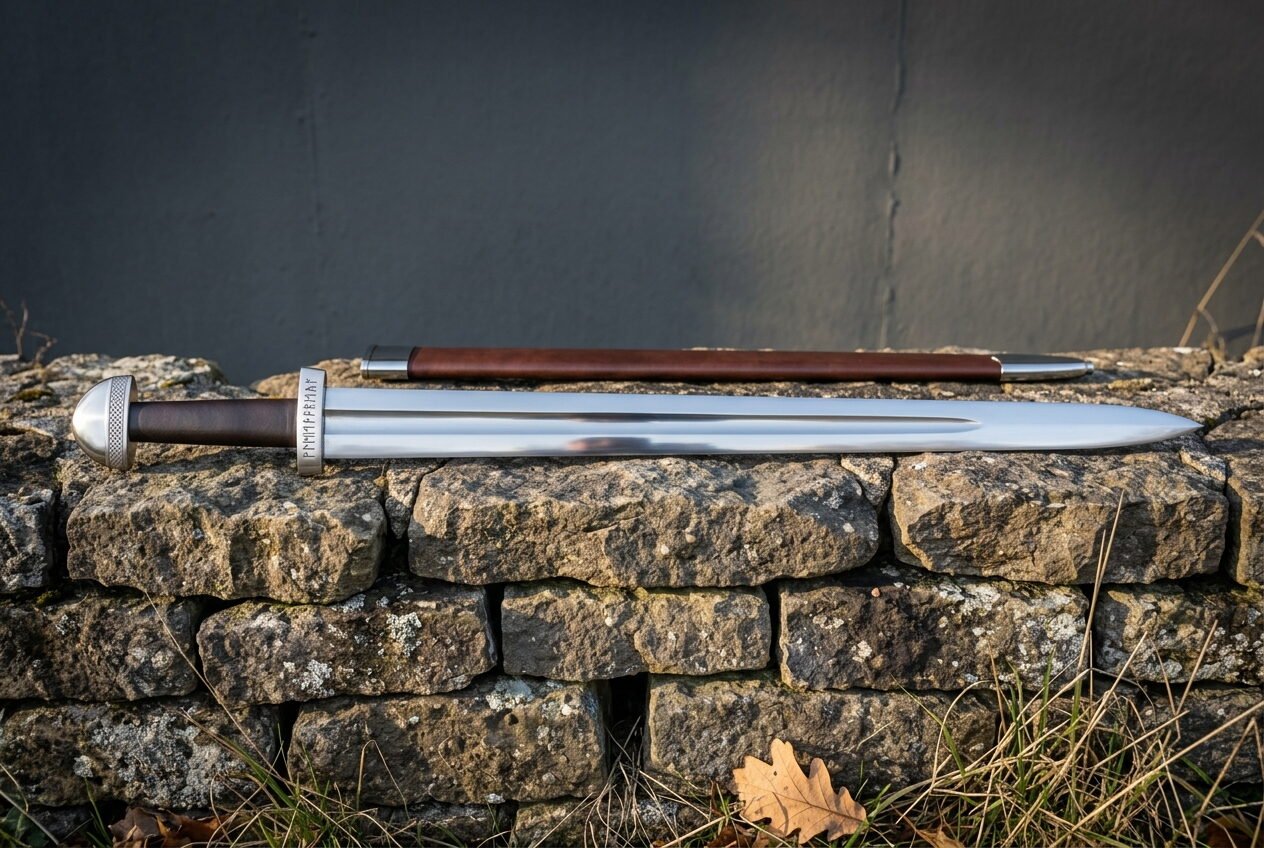
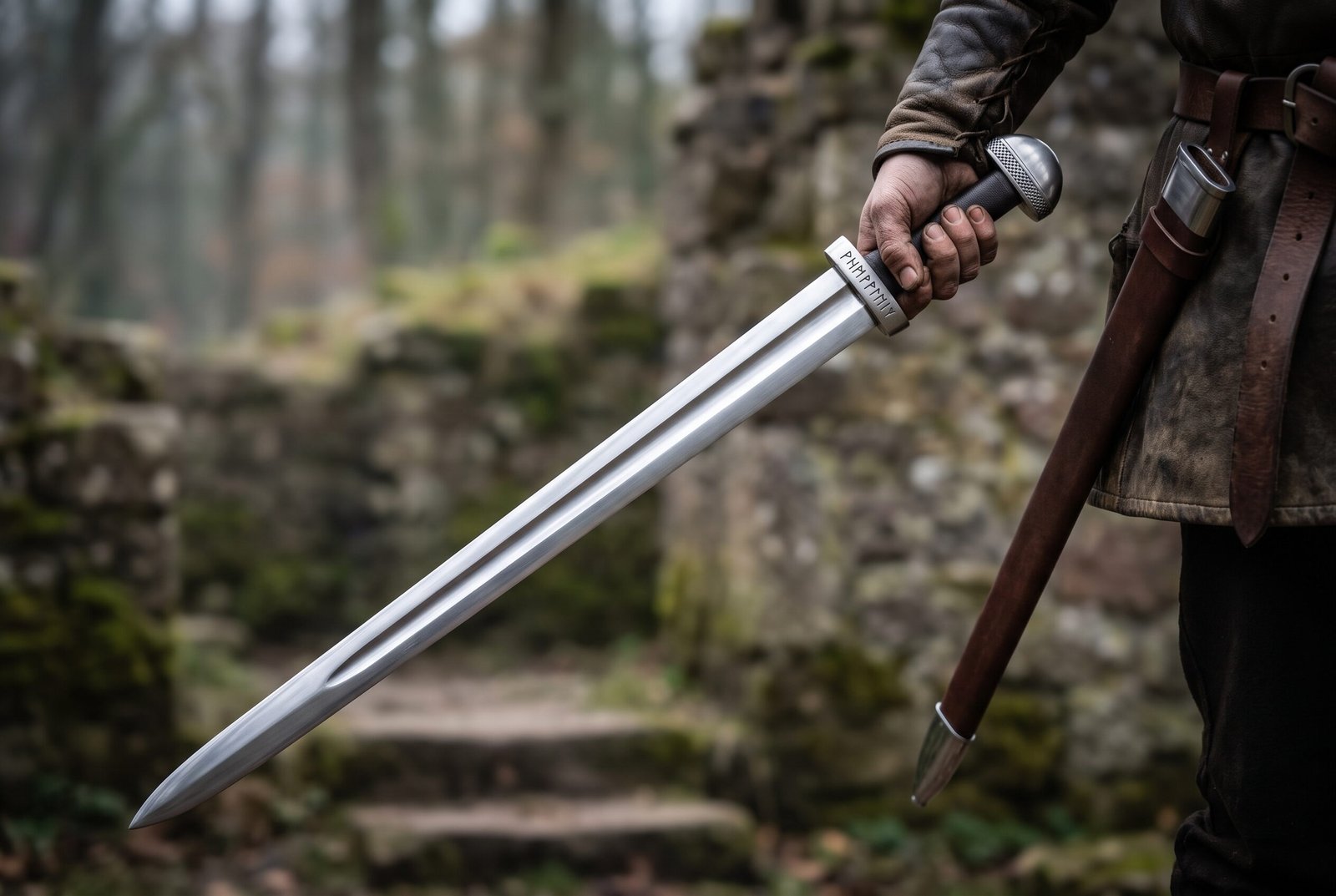
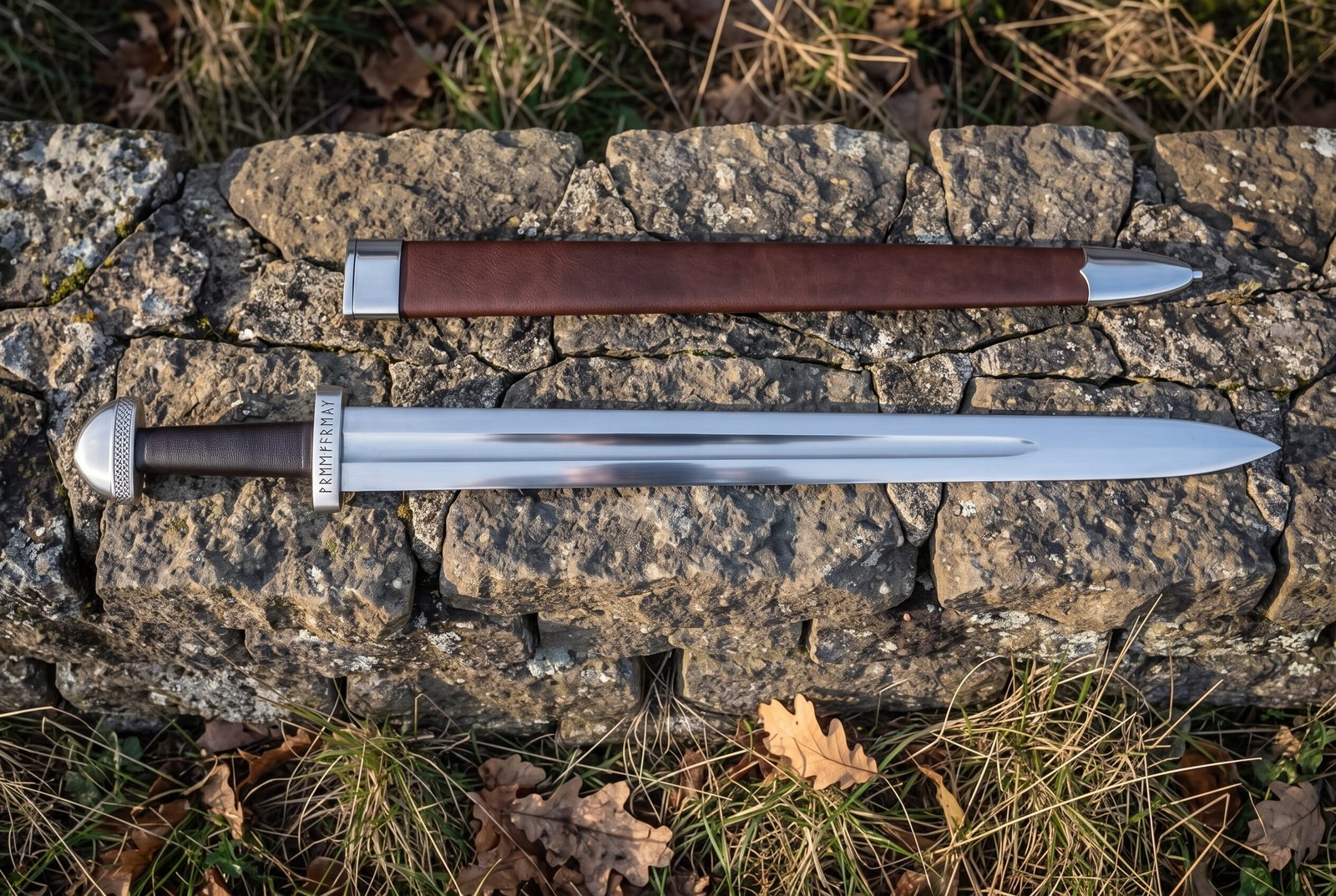
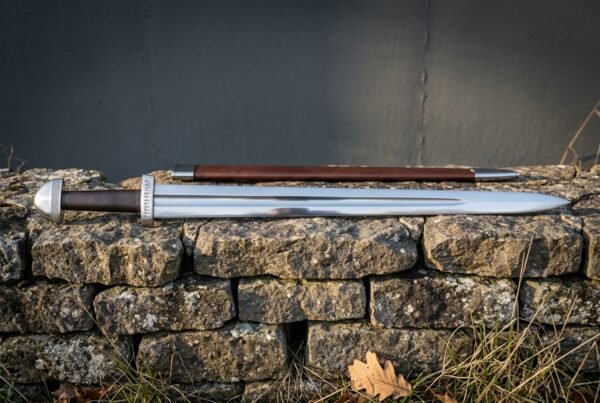
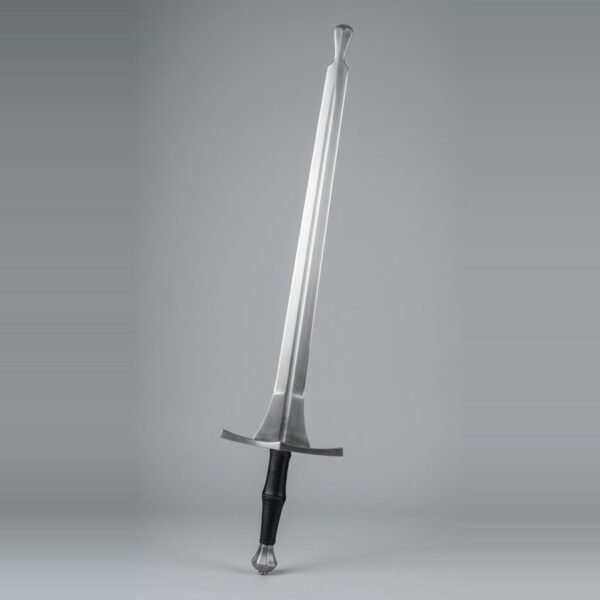
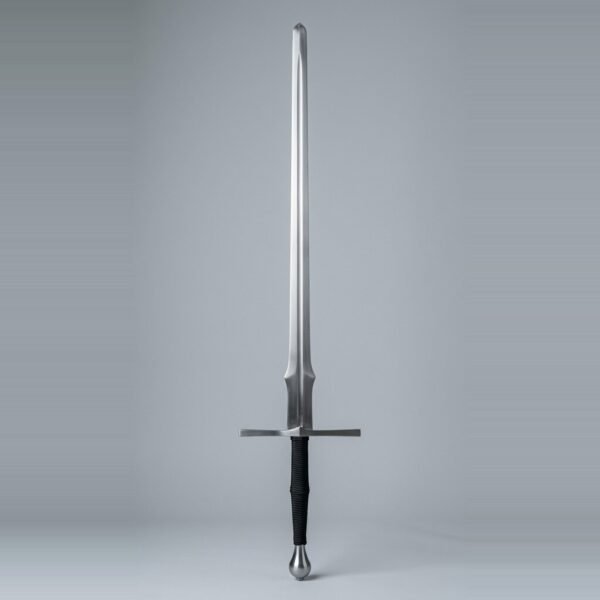
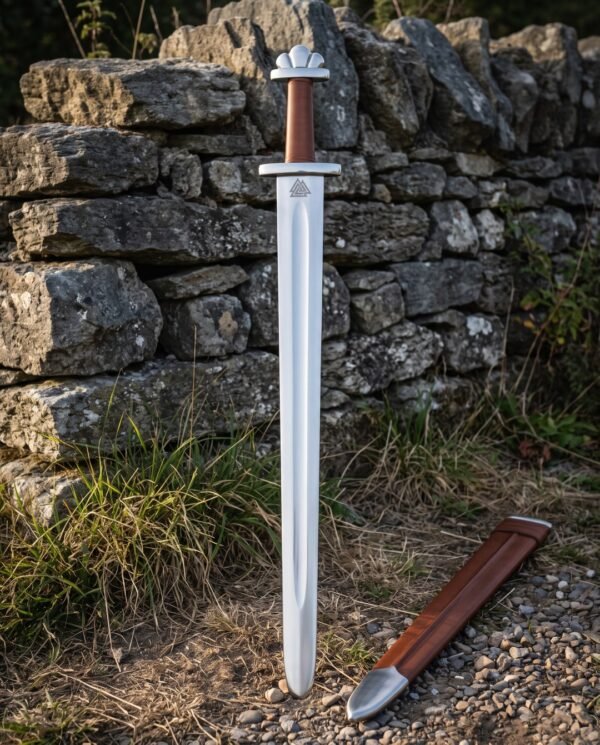
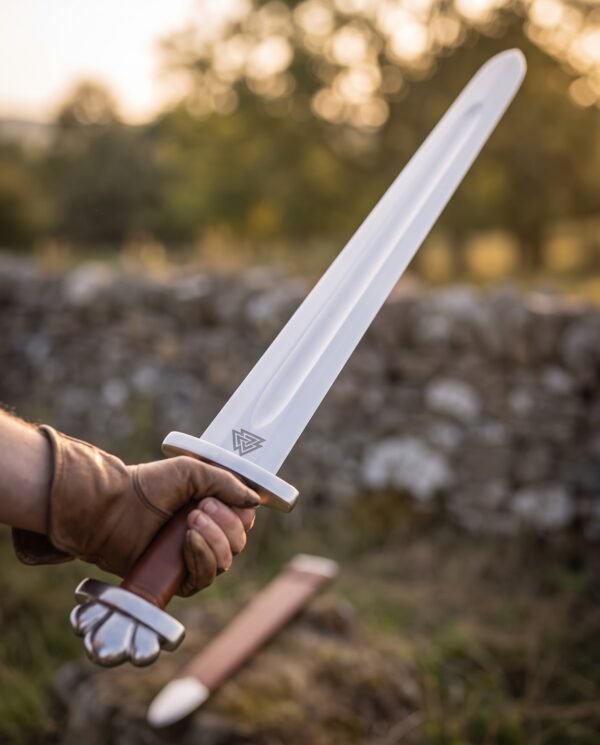
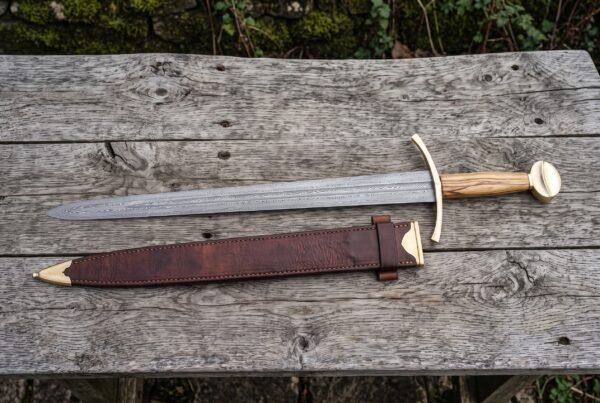
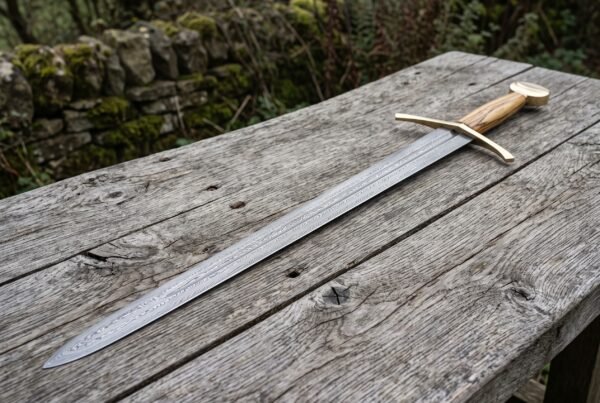
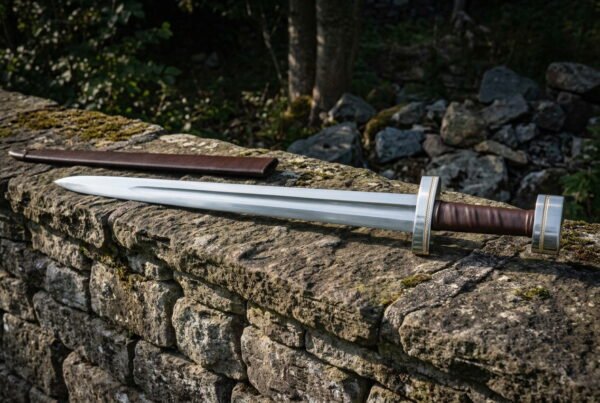
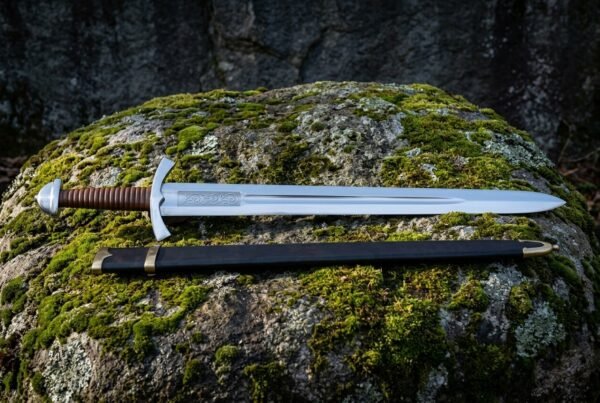
The Stonewake is a late Viking sword built to the 11th century pattern, the shape the Norse sword had reached by the generation of Harald Hardrada and Hastings. It has a longer, slimmer blade than the broad ninth century types, a short straight steel guard cut with a rune line, and a rounded steel dome pommel. Overall it runs 37 inches with a 31 inch blade. That change in proportion was not fashion. Through the tenth and eleventh centuries mail armour spread down the ranks, and a wide cutting blade that had been devastating against a padded coat began to spend itself against riveted rings. Smiths answered by lengthening the blade for reach, narrowing it and increasing the distal taper for a stiffer point that could be driven into a gap, and stretching the guard so a hand could be protected in a bind. The Norse who served in the Varangian Guard at Constantinople carried swords of this shape, and the Bayeux Tapestry is full of them, which makes the 11th century sword the last and most developed form of the true Viking sword before it becomes, without any clear line, the knightly arming sword. If you are building a collection, choosing a Viking sword covers what to look for.
This one is forged and finished by hand in the Czech Republic. The blade is hammered out, the fuller ground in by hand and stopped short of the point where the taper begins, and the sword is hardened and tempered in house before the furniture goes on and the tang is peened. It ships with a fitted brown leather scabbard over a wooden core with steel throat and chape, a belt hanger, blade oil and a care card. Shipping inside the United States is free, and the engraving option above the add to cart button is open on every piece.
Specifications
| Steel | 1095 high carbon steel, hand forged, oil quenched and tempered |
|---|
| Hardness | 54 to 58 HRC |
|---|
| Overall length | 37 inches |
|---|
| Blade length | 31 inches |
|---|
| Blade width at guard | 1.9 inches, with strong distal taper to a reinforced point |
|---|
| Fuller | Central fuller, hand ground, running most of the blade and stopped before the point |
|---|
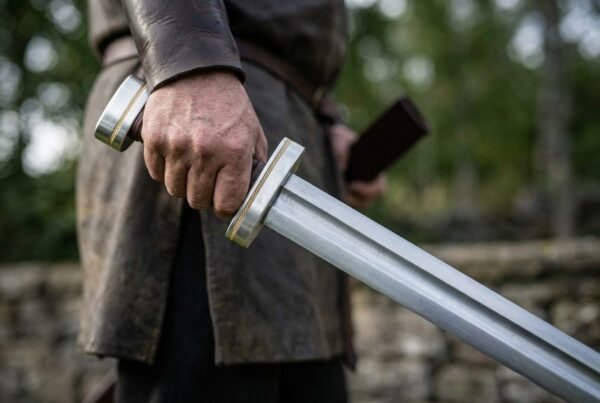
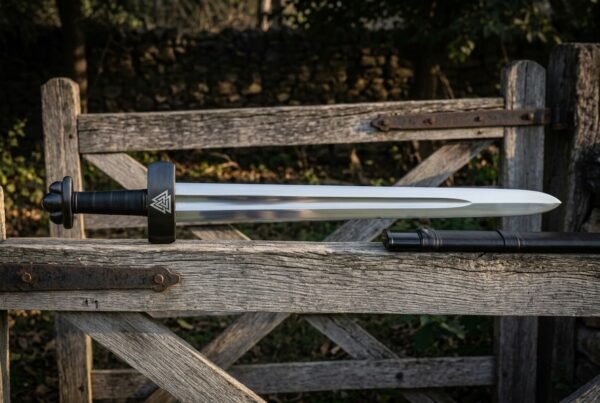
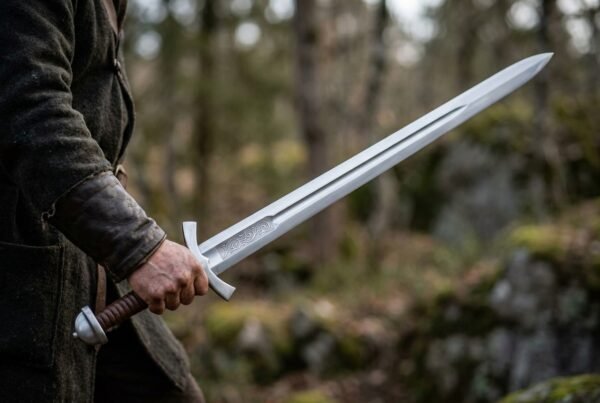
| Guard | Short straight polished steel guard engraved with a rune line |
|---|
| Handle | Hardwood core wrapped in dark brown leather |
|---|
| Pommel | Rounded polished steel dome pommel with a cross hatched collar, peened tang |
|---|
| Scabbard | Brown leather over a wooden core with steel throat and chape, belt hanger |
|---|
| Weight | Approximately 2 lb 10 oz |
|---|
| SKU | RK-1232 |
|---|
Why the 11th century sword looks the way it does
Most of what separates this sword from a ninth century Viking sword is in the blade, and it is a direct answer to armour.
The hilt stays simple. The guard is a short straight steel bar only a little wider than the blade, with a line of runes cut into its face. The pommel is a rounded steel dome over a cross hatched collar, a compact block of counterweight that keeps the long blade from feeling nose heavy.
The blade narrows and tapers harder. Width does the work against soft targets, but a point does the work against mail, and a blade that tapers in both plan and thickness carries its mass rearward, stiffens toward the tip and gives a stab somewhere to concentrate. The fuller narrows with it and stops well short of the point, leaving a solid diamond section in the last several inches so the tip does not fold when it meets resistance. On this sword the balance point sits about four inches ahead of the guard, which is where a one handed sword wants to be if it is going to change direction in the middle of a cut.
Taken together those changes produce a sword that is still unmistakably Norse in its furniture and unmistakably medieval in its blade. It is the bridge piece, and for a collector it is often the most interesting sword in the Viking range for exactly that reason.
Why high carbon steel and not stainless
1095 is a plain, clean, high carbon steel with no alloying complications. It hardens deeply, takes a keen edge, and at 54 to 58 HRC it will bend under load and come back rather than shatter. Stainless steel gets its corrosion resistance from a high chromium content, and in a section as long as a sword blade that chromium encourages coarse carbides and brittle behaviour. Long stainless blades are display objects, and inexpensive ones can break at the tang with no warning. The trade with high carbon steel is upkeep: it will patina, and it will spot if you leave it wet or fingerprinted. That is a small price for a blade that behaves like a sword. Our Damascus versus stainless page compares the two properly if you want the numbers.
The grip, the guard and the dome pommel
The grip core is shaped hardwood, slightly waisted so your hand finds the edge alignment by feel. The wrap is brown leather, wet fitted and stitched down the back edge where the seam sits away from the palm. The guard and pommel are polished steel, filed to shape and fitted tight, with the tang peened over the pommel so the assembly is locked mechanically and not with adhesive. A dome pommel is heavier than it looks, which is the point, and it also gives the heel of the hand a curved surface to press against at the end of a cut rather than a corner.
There is wood under the wrap, so treat the grip as wood: no soaking, no hot cars, no drying it out with heat. Wipe it with a barely damp cloth and dry it straight away. Our notes on wooden handle care apply to this core exactly, and a light conditioner on the leather once or twice a year keeps it from drying out and cracking at the stitch line.
Engraving, runes and your own design
Use the rune converter on this page to turn a name, a date or a short phrase into Elder Futhark and we will cut it into the steel or the handle. If you would rather have a Viking pattern than a rune line, choose your own design in the engraving option above the add to cart button and tell us whether it goes on the blade or the handle. Where a piece already carries an engraved design, your chosen engraving replaces it rather than sitting alongside it. On this pattern the fuller takes a short rune line neatly. The guard already carries a rune line, so a design ordered for the guard replaces it. The engraving page shows worked examples and the character counts that fit each placement.
Care and sharpening
Keep it dry, keep it oiled, and do not store it in the scabbard for months. A wipe with mineral oil or a purpose made blade oil after every handling session is the whole routine, and it matters because skin oils are mildly acidic and will etch a polished blade in a humid room faster than most people expect. Leather holds damp and tanning salts, so the sword should live on a rack or a wall mount with the scabbard beside it, not inside it. Our steel care guide covers patina, storage and how to lift a rust spot before it becomes a pit.
Sharpening is ordinary high carbon work with more length to cover. Support the blade, work in overlapping sections along a coarse stone and then a fine one at a steady angle, and finish with a few passes on a strop. Be a little more careful on the last six inches, where the reinforced point means the bevel changes angle. The method in our guide to sharpening with a whetstone transfers directly to a sword.
Made in the Czech Republic
This piece is made by hand in the Czech Republic, in a workshop that still works the old way. The steel is forged, ground, heat treated and finished by smiths who learned the trade from the people before them, and the wood, horn and leather are cut and fitted by hand rather than pressed out on a line. That is also why no two pieces come out exactly the same.
Ransack Viking is a United States company. We import these pieces ourselves, check every one when it lands and ship from our warehouse in Chicago, Illinois. Engraving is done here in the United States after the piece arrives, so your runes or your own design go on before it leaves for you.
A note on handmade variation
This sword is hand forged. It is not machine made and it is not bulk produced, so what arrives will not be a pixel for pixel copy of the photograph on this page. Wood grain under the grip leather, the tone the hide takes, the exact satin of the polish along the fuller, the file marks on the guard and the precise curve of the pommel are all worked by hand from natural materials and vary from piece to piece. The specification does not vary. Steel, heat treatment, dimensions, construction and finish standard are the same on every one. The character is what changes, and that is what separates a forged sword from a stamped one.
Frequently asked questions
Is it sharp out of the box?
Yes. It comes with a hand cut and honed working edge, ground for durability rather than shaving sharpness. If you want it blunt for display, stage use or reenactment, ask in the order notes and we will finish it with a rounded edge at no extra charge.
Can I spar or reenact with it?
Not with a live edge, and not against other steel. This is a sharp functional sword suited to target cutting and display. Reenactment groups require blunt rebated blades with rolled edges for contact work, and while we can supply this pattern blunted on request, you should check your group standards first and order it that way rather than modifying a sharp blade later.
Can I have runes engraved on it?
Yes. Use the rune converter on this page for Elder Futhark, then pick the engraving option above the add to cart button and tell us whether the line goes on the blade or the handle. The fuller suits a short line.
Will mine look like the photograph?
Very close in shape and specification, not identical in character. Leather tone, wood grain, polish and hand file work change between pieces because each sword is made individually. Dimensions, steel and build are fixed.
What is the difference between this and an earlier Viking sword?
Reach and point. An earlier ninth century Norse sword is shorter, broader, has a short guard and a lobed pommel, and is built to cut. This 11th century pattern has a longer narrower blade with strong distal taper and a rounded dome pommel, and it can thrust as well as cut. It is the last stage of the Viking sword before the knightly arming sword.
How long does shipping take?
Shipping inside the United States is free. In stock swords go out within two business days with a tracking number. Forged to order, allow two to three weeks of bench time, plus a few days more if you have added a custom engraving.
What is in the box
- One Stonewake 11th century Viking sword, 37 inches overall with a 31 inch 1095 blade
- Fitted brown leather scabbard over a wooden core with steel throat and chape
- Leather belt hanger with buckle
- Blade oil and a lint free cloth for first storage
- Care and sharpening card
- Forged and finished in the Czech Republic
Explore the range
See the full Viking swords range, the arming swords this pattern turns into, the wider swords collection and the rest of the Norse arms we carry. Steel and edge geometry are explained in the guides.
Close to this one
Closest to this in the range is the Redoath Viking sword, 36 inches overall. If this one is not quite right, there is the Stonewake Viking sword, forged from 1095. Also in this group is the Skaldbone Viking sword, 36 inches overall.
If you are putting a set together, the Stormcrane Japanese sword sits alongside it. Nothing here exactly right, build one to your own spec on the custom Viking sword page.


This one was a letdown compared to the listing. Handle was loose right out of the box. Build quality felt cheaper than the pictures suggested. Considering asking for a return.
So happy I finally pulled the trigger on this one. If you’re on the fence just get it. You won’t regret it. Ransack Viking’s attention to detail is honestly unmatched.
Absolutely blown away by this sword.
This thing is a beast in the best way. Ordered from Ransack Viking before and the quality stays consistent every time. The wood handle feels amazing and the balance is perfect. Leather sheath is thick and well stitched. Not the cheap stuff you usually get. Shipping was fast and everything arrived well packaged.
This thing is a beast in the best way. Even the small engravings are crisp and clean. Great buy overall.
This is exactly what I wanted and then some. The wood handle feels amazing and the balance is perfect. Fit and finish is museum quality. You can tell real craftsmen made this by hand. Can’t recommend this enough.
This is exactly what I wanted and then some. Leather sheath is thick and well stitched. Not the cheap stuff you usually get. Already planning my next purchase from this shop.
Bought this on a whim and it turned out to be one of my favorite purchases this year. High Carbon Steel blade holds a razor edge right out of the box. Leather sheath is thick and well stitched. Not the cheap stuff you usually get. Even the small engravings are crisp and clean. 10/10 would buy again.
Got this as a gift and now I want one for myself too. The wood handle feels amazing and the balance is perfect. So worth it. Ordered from Ransack Viking before and the quality stays consistent every time.
Been eyeing this sword for months and it did not disappoint. Weight and balance make it feel like a real functional piece not some cheap replica. If you’re on the fence just get it. You won’t regret it.