
A poleaxe is a short polearm built for one job, getting through plate armour. It puts three heads on the end of one haft. A crescent axe blade or a hammer face on one side, a spike or a beak on the other, and a long spike on the top. You choose which end you use depending on what is in front of you, and none of the three is decorative.
The pieces here run 33 to 58 inches overall and weigh about 3.2 to 5.2 lb. Heads measure 8.5 to 10 inches across, with crescent blades of 5.5 to 6 inches and top spikes of 8 to 10 inches. Four are plain 1095 high carbon hardened to 54 to 58 HRC. One is forge welded Damascus of 1095 and 15N20, hand etched and hardened to 58 to 60 HRC. Hafts are American ash or walnut with riveted steel or brass langets and a turned butt ferrule.
Buy the length that matches the space you have, or a halberd for more reach. A 58 inch haft indoors is longer than it sounds.
Free US shipping
On most pieces. Heavier and oversized ones carry a flat charge.
Hand Forged
Heated, hammered and ground by hand.
Engraving available
Names, dates or Norse runes on most pieces.
Ships from Chicago
Inspected and dispatched from our Chicago warehouse. No import duty, no customs delay on US orders.
Poleaxes
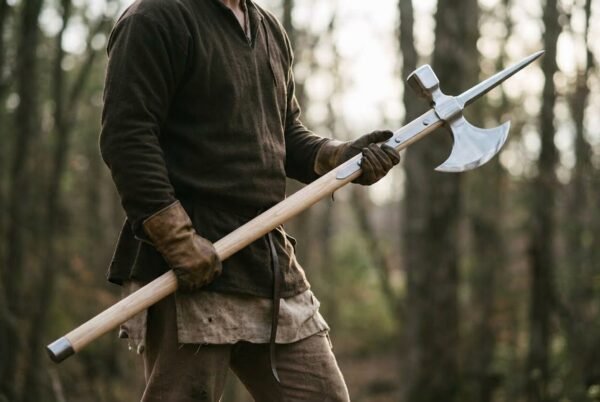
Moonpoll Hand Forged High Carbon Steel Poleaxe | 50 Inch Overall with a 5.5 Inch Cutting Edge | Reenactment Display Gift | RK-1361
Original price was: $599.00.$479.20Current price is: $479.20.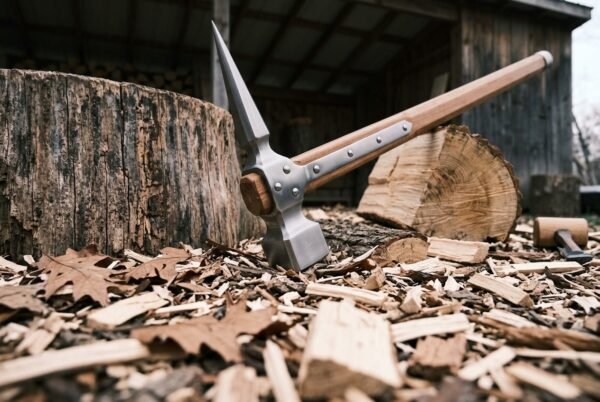
Rookbeak Hand Forged High Carbon Steel Medieval War Hammer | 33 Inch Overall with a 10 Inch Head | Reenactment Display Gift | RK-1360
Original price was: $315.00.$252.00Current price is: $252.00.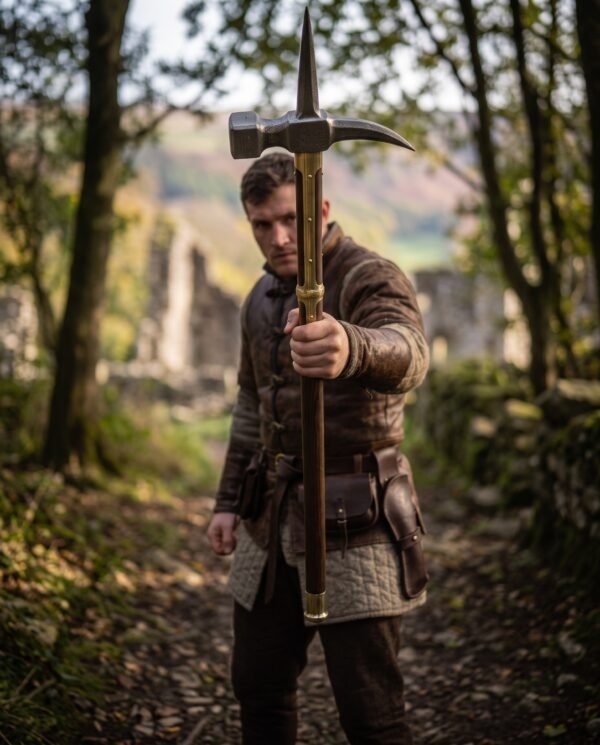
Brassmaul Hand Forged High Carbon Steel Medieval Polehammer | 58 Inch Overall with an 8.5 Inch Head | Reenactment Display Gift | RK-1359
Original price was: $599.00.$479.20Current price is: $479.20.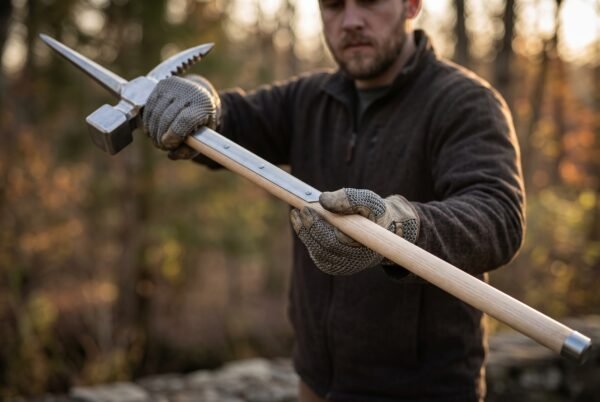
Ashmaul Hand Forged High Carbon Steel Polehammer | 52 Inch Overall with a 9 Inch Head | Reenactment Display Gift | RK-1358
Original price was: $599.00.$479.20Current price is: $479.20.Why the poleaxe has three heads
By the fifteenth century a knight on foot was covered in shaped plate. A sword edge slid off it. An arrow needed a lucky angle. What worked was mass on the end of a stick, and once you accept that, the poleaxe designs itself.
The first face is either an axe blade or a hammer. The axe blade is a crescent, ground thin enough to cut through a gambeson or a mail voider and heavy enough to dent plate underneath. The hammer face is squared and sometimes crowned, and it does not try to cut at all. It transmits shock straight through armour into the person wearing it. Plate spreads a cutting blow beautifully and handles a concentrated hammer blow very badly.
The second face is the beak or back spike, opposite the first. That is the armour opener. All the force of a swing arrives on a point a few millimetres across, which is enough to punch a hole in a breastplate or, more usefully, to hook a limb, a helmet rim or the top of a shield and pull.
The third is the axial spike on the top. That turns the whole thing into a short spear, so you can hold ground, thrust into a gap at the armpit or the visor, and keep somebody at a distance instead of closing with them.
Add a haft of 4 to 5 feet, and you have a piece that covers cutting, crushing, punching through and thrusting without changing hands. That is why it stayed in use for foot combat and judicial duels long after the battlefield moved on.
The polearms in this collection
Five pieces sit on this page, and they split by head type and by haft length.
Polehammers
Two long pieces with a hammer face rather than an axe blade. One runs 52 inches overall with a 9 inch head from hammer face to beak, an 8 inch top spike and a 1.25 inch square hammer face that is lightly crowned, on an American ash haft with riveted steel langets and a steel butt ferrule, at about 4.6 lb. The other is the longest piece here at 58 inches overall, with an 8.5 inch head, a 9 inch top spike, brass langets on brass rivets and a turned brass butt ferrule on an oil finished American walnut haft, at about 5.2 lb.
Poleaxes with a crescent blade
Two pieces at 50 inches overall, each with a curved cutting edge on one side and a square hammer poll opposite. One carries a 5.5 inch crescent blade and a 9 inch axial spike in polished 1095. The other carries a 6 inch crescent blade and a 10 inch axial spike in forge welded Damascus. Both are hafted in American ash with riveted steel langets, and they weigh about 4.8 lb and about 5 lb.
The short war hammer
One piece is a hand length rather than a polearm at 33 inches overall, with a 10 inch head from hammer face to spike tip, a flat 1.25 inch square face and a close grained hardwood haft with riveted steel langets. At about 3.2 lb it is the lightest and the easiest to handle indoors, and it is the only piece here supplied without a leather head cover.
Lengths, heads and weights across the range
Every figure below is taken from the specification panel of a piece on this page. Heads are forged and ground by hand, so read the numbers as what to expect rather than as a guarantee to the millimetre.
| Head type | Overall length | Head size | Top spike | Steel and hardness | Haft and fittings |
|---|---|---|---|---|---|
| Hammer face and beak | 52 in | 9 in face to beak, 1.25 in crowned face | 8 in | 1095 at 54 to 58 HRC | American ash, steel langets, steel butt ferrule |
| Hammer face and beak | 58 in | 8.5 in face to beak | 9 in | 1095 at 54 to 58 HRC | American walnut, brass langets, turned brass ferrule |
| Hammer face and spike | 33 in | 10 in face to spike tip, 1.25 in flat face | None | 1095 at 54 to 58 HRC | Close grained hardwood, steel langets |
| Crescent blade and hammer poll | 50 in | 5.5 in cutting edge | 9 in | 1095 at 54 to 58 HRC | American ash, steel langets, steel butt ferrule |
| Crescent blade and hammer poll | 50 in | 6 in cutting edge | 10 in | Damascus at 58 to 60 HRC | American ash, polished steel langets |
Listed weights run from about 3.2 lb on the short hammer to about 5.2 lb on the 58 inch walnut hafted piece. That is a wide spread for five items, and it is the single most useful number on the page if you intend to handle one rather than hang it.
Langets, ferrules and why they are there
The steel or brass straps running down the haft from the head are langets, and they are not decoration. A polearm takes blows on the shaft as well as on the head, and a bare wooden haft cut by an edge is a haft that breaks in the middle of the next swing. Langets armour the top eighteen inches or so, which is the part most likely to be struck, and they also stop the head twisting loose on the wood.
They are riveted through rather than glued or pinned into a blind hole, which is the correct way to do it. Rivets can be re set if one ever works loose. Glue cannot.
The butt ferrule at the bottom does two jobs. It stops the end of the haft splitting when it is grounded on stone, and it adds a little weight behind your rear hand, which balances the mass of the head and makes the piece feel considerably lighter than it is.
Steel and hardness
Four of these heads are plain 1095 high carbon hardened to 54 to 58 HRC. That is deliberately not as hard as a knife blade. A head at 60 HRC on the end of a 50 inch lever is a head that chips or cracks when it meets something solid. At 54 to 58 the steel deforms and takes a dent instead of failing, which is exactly what you want in a piece that is meant to hit armour.
The fifth head is forge welded Damascus of 1095 and 15N20, hand etched, hardened to 58 to 60 HRC. The 15N20 carries nickel and resists the etch so it stays bright while the 1095 goes dark, and the contrast runs all the way through the steel rather than sitting on the surface. It is the display piece of the five.
Finishes here are polished and satin polished. Neither is a coating. Both are bare steel, which brings us to the part people underestimate.
Rust, oil and the leather head cover
Every head on this page is carbon steel and every one of them will rust. There is no lacquer, no plating and no stainless anywhere in the range.
Wipe the head down after handling and leave a light film of oil or a paste wax on it. Fingerprints are the usual culprit, because the salt in a print etches itself into polished steel within days and then you are polishing rather than wiping. Camellia oil, mineral oil or a hard wax all work.
Four of the five ship with a fitted leather head cover. Use it for transport and for dust, but do not store the piece with the cover on for months at a time, because leather holds moisture against steel and a damp cover will spot a head that would have been fine bare. If a piece is going into long term storage, oil the head and leave the cover off.
Grey patina is stable and harmless. Orange spotting lifts with fine abrasive and oil before it has a chance to pit. On the etched Damascus head, work gently and avoid heavy abrasive, because the dark and light contrast is a surface etch and a wire wheel will take it straight off.
Hafts, wood movement and re seating
Ash is the traditional haft timber for a reason. It is springy, it bends before it breaks and it takes shock without transmitting all of it into your hands. Walnut is denser and stiffer, it finishes beautifully and it is the better looking of the two. The short hammer uses a close grained hardwood.
Wood moves with humidity. A haft that has spent a winter in a dry heated room will shrink slightly and a head can loosen. Check it by holding the haft and giving the head a firm twist. If there is any movement, stop using the piece and have the rivets re set rather than hoping. A loose head on a 5 lb polearm is not a small problem.
Oil the haft once or twice a year with linseed or a furniture oil, particularly on the walnut, which is oil finished from the start. Do not varnish a haft. Varnish is slippery when your hands are damp and it hides the cracks you want to be able to see.
Display and storage
These are long. Fifty inches on a wall needs a run of clear space that most rooms do not have above the picture rail, so measure before you buy rather than after.
Mount horizontally on two brackets that support the haft rather than clamping the head, and fix into a stud or a proper wall plug. A 5 lb piece pulling out of plasterboard takes a lot of the wall with it. Vertically in a corner works too, but stand the piece on a rubber pad rather than on bare floor so the ferrule does not skid.
Keep them away from radiators and out of damp basements. Steel wants dry and wood wants stable, and a garage in a humid summer gives you neither. If a piece is displayed point up in a room where people walk past, put the leather cover on the head.
Engraving and gifting
Engraving is added in the United States after the pieces arrive. A name, a date, a unit or a short line of runes goes onto the flat of a hammer cheek, onto the langets or onto the flat of an axe blade. Text engraving is 19 dollars, a symbol is 39 dollars and a family crest is 49 dollars.
Elder Futhark is a phonetic alphabet rather than a cipher, so a name is transliterated by sound and there is no rune for the letter C. Read the rune guide before you send a spelling.
Engraving is permanent and an engraved piece cannot be returned. Read the spelling twice before you order.
Where these come from and how they ship
Ransack Viking is a US company based in Chicago, Illinois. The pieces are handmade in the Czech Republic, then imported, inspected and shipped from Chicago. Engraving is done in the US after arrival.
Because each head is forged and each haft is fitted by hand, two pieces of the same name will differ slightly in the exact curve of a beak, in the grain of the haft and in the tone of the finish. The listed dimensions and hardness stay the same. Long items ship in a longer box than most carriers enjoy, so allow a little extra time on delivery.
How to choose
If it is going on a wall, measure the wall first and then pick on the head. The Damascus poleaxe is the one that photographs best and the one people ask about, and the brass fitted walnut hammer is the most formal looking of the five.
If you want something you can actually pick up and handle without clearing furniture, take the 33 inch hammer. At about 3.2 lb it is the only piece here that works in an ordinary room.
If you are kitting out for reenactment or living history, take a 50 to 52 inch ash hafted piece with steel langets. Ash takes knocks better than walnut and steel langets take knocks better than brass, and both of those things matter more in a field than they do on a wall.
Browse related collections
- Halberds, the longer polearm with an axe and a hook
- Glaives and other polearms
- Maces and flanged heads for the same job
- Battle axes in one and two handed sizes
- Plate armor, the reason these exist
- Medieval helmets to match a kit
- Stands and displays for long pieces
Guides worth reading first
- Mace vs war hammer vs flail, what each one does
- War hammers and maces explained
- Display piece vs battle ready, what the difference means
- How to display swords, axes and polearms on a wall
- How to remove rust from a forged head
- Safety and storage tips for edged and pointed pieces
Frequently asked questions
What is the difference between a poleaxe and a polehammer?
The face opposite the beak. A poleaxe carries a crescent cutting blade, a polehammer carries a squared hammer face. Both usually have a spike or a beak on the reverse and a spike on the top. On this page the poleaxes carry 5.5 and 6 inch crescent blades, and the polehammers carry 1.25 inch square faces.
How heavy are these?
Listed weights run from about 3.2 lb for the 33 inch hammer to about 5.2 lb for the 58 inch walnut hafted piece. The 50 to 52 inch pieces sit around 4.6 to 5 lb. A butt ferrule behind your rear hand makes any of them feel lighter than the number suggests.
Are these sharp?
The crescent blades arrive with a working edge rather than a razor edge, and the spikes and beaks are pointed. Treat every piece here as capable of doing real damage, because a 5 lb head on a 50 inch haft does not need a fine edge to be dangerous.
Why is the head not hardened as far as a knife?
Because it is meant to survive impact. At 54 to 58 HRC a plain 1095 head deforms and dents when it meets something solid. Take the same head to 60 HRC and it becomes brittle enough to chip or crack on the end of a long lever, which is the one failure you cannot fix.
Will the head rust?
Yes. These are bare high carbon steel with no plating or lacquer. Wipe fingerprints off after handling and leave a light film of oil or paste wax on the head. Grey patina is stable and harmless. Orange spotting lifts with fine abrasive and oil.
What are the metal straps down the haft for?
Those are langets. They armour the top of the haft against blows that would otherwise cut into bare wood, and they stop the head twisting loose. They are riveted through rather than glued, so a rivet can be re set if it ever works free.
Can I hang one of these on a plasterboard wall?
Only into a stud or with a proper cavity fixing. These weigh 3 to 5 lb and the leverage of a long haft multiplies the pull on the top bracket. Use two brackets supporting the haft rather than one clamping the head, and check them once a year.
Where are these made?
They are handmade in the Czech Republic, then imported, inspected and shipped by Ransack Viking from Chicago, Illinois. Engraving is added in the US after arrival.
Featured pieces
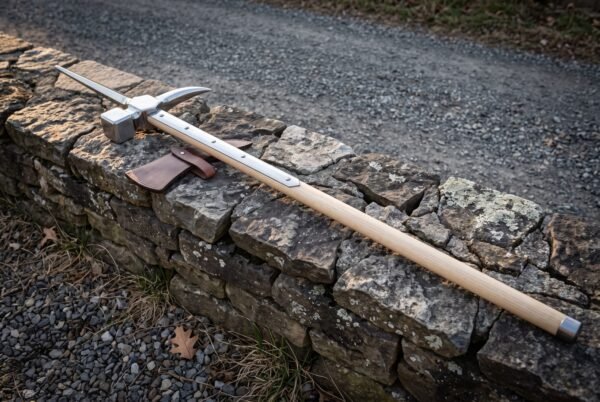 Ashmaul Hand Forged High Carbon Steel Polehammer
Original price was: $599.00.$479.20Current price is: $479.20.
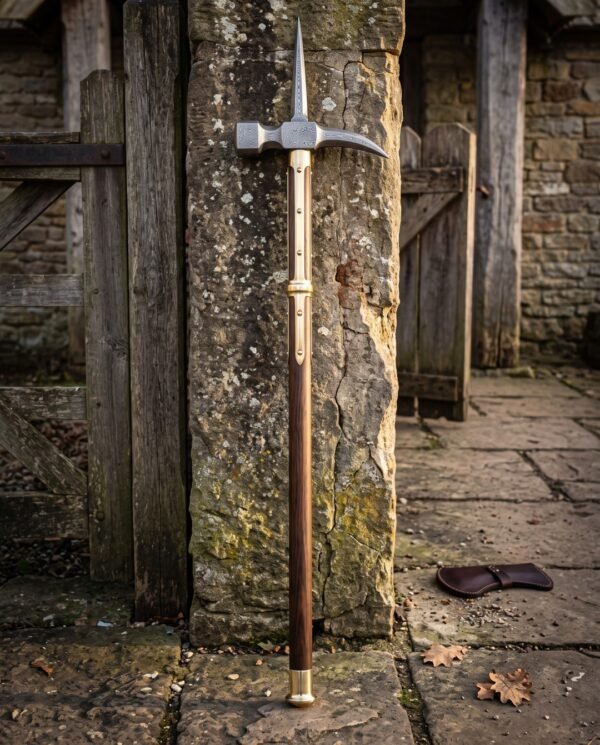 Brassmaul Hand Forged High Carbon Steel Medieval Polehammer
Original price was: $599.00.$479.20Current price is: $479.20.
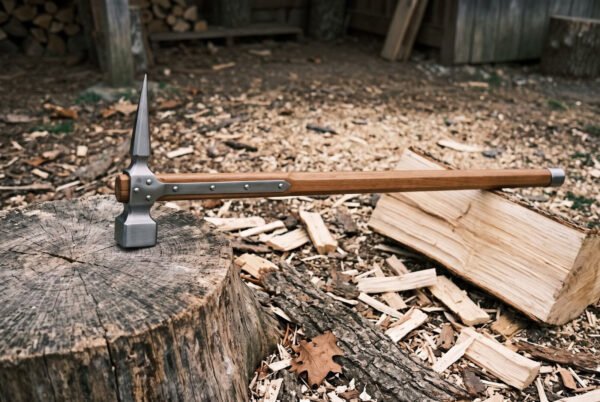 Rookbeak Hand Forged High Carbon Steel Medieval War Hammer
Original price was: $315.00.$252.00Current price is: $252.00.
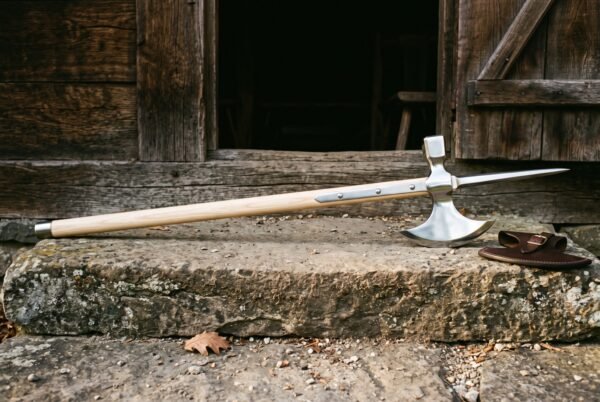 Moonpoll Hand Forged High Carbon Steel Poleaxe
Original price was: $599.00.$479.20Current price is: $479.20.