
A scabbard is not a bag for a sword. It is a fitted shell that holds the blade off its own leather, stops the edge cutting its way out through the seam, and lets you draw without looking down. Get it wrong and the sword rattles, the point wears a hole at the tip, and damp leather sweats rust onto good steel.
Three jobs are covered here. Sword scabbards are built on a two part wooden core, wrapped in oak tanned or vegetable tanned cowhide of 8 to 9 ounce weight, lined with wool fleece and finished with a steel throat collar and chape. They take straight double edged sword blades up to 30 or 31 inches long and 2 inches wide. Knife sheaths carry fixed blades of 6 to 10 inches, built with a full leather welt and hand saddle stitching so the edge never touches thread. Axe sheaths are wet formed masks for bearded and straight heads up to a 6 inch cutting edge, closed with a steel or brass snap.
Measure your blade before you order. Length and width both matter.
Free US shipping
On most pieces. Heavier and oversized ones carry a flat charge.
Hand Forged
Heated, hammered and ground by hand.
Engraving available
Names, dates or Norse runes on most pieces.
Ships from Chicago
Inspected and dispatched from our Chicago warehouse. No import duty, no customs delay on US orders.
Scabbards & Sheaths
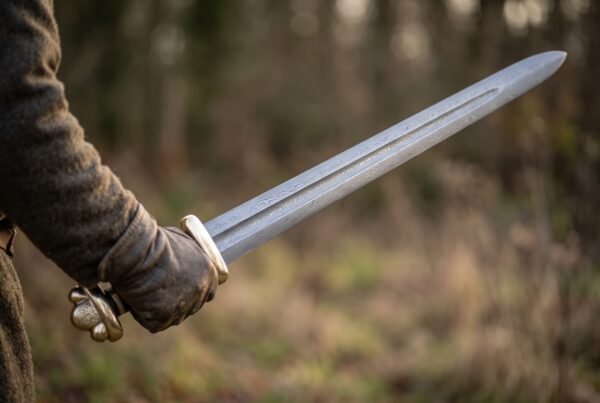
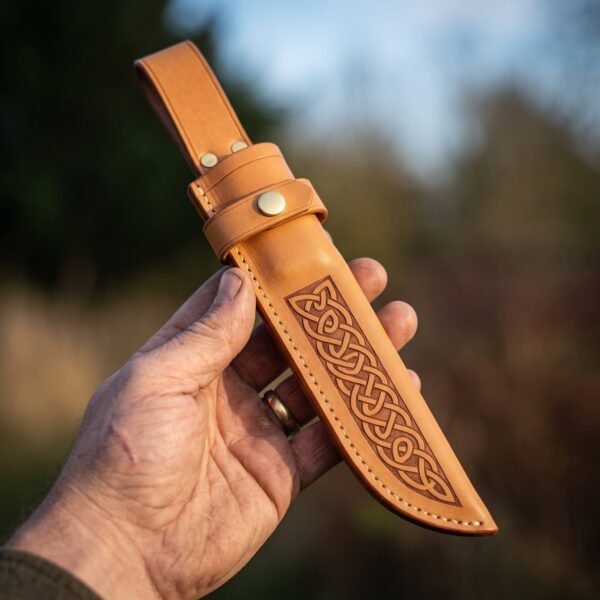
What a scabbard is actually doing
Most people think of a scabbard as storage. It is closer to a piece of fitted machinery. A sword scabbard has to grip the blade tightly enough that the sword does not fall out when the point drops, loosely enough that you can draw it in one motion, and it has to do both while holding a sharpened edge away from the leather that would otherwise be sliced apart in a week.
That is why the good ones are not made of leather alone. A wooden core is shaped in two halves, hollowed to the profile of the blade, lined with fleece, then glued and wrapped. The wood carries the shape. The leather is a skin over it. The fleece holds a light film of lanolin against the steel and takes up the last fraction of clearance so the blade sits still instead of rattling. Pull a sword from a scabbard built this way and the sound is a quiet hiss rather than a scrape.
Knife sheaths and axe masks work on a different principle. There is no core. Instead the leather is wet formed over the blade itself, so the shape is moulded rather than cut, and a welt is stitched into the seam. The welt is a strip of leather sandwiched between the two faces along the edge side. It sets the thread back from the edge so the knife rides against leather and never against stitching. A sheath without a welt is a sheath with a countdown on it.
The last job is retention. On a sword, friction from the fleece and the fit of the throat do the work. On a knife or an axe mask you need a strap, because a fixed blade carried vertically with no strap eventually parts company with you.
The scabbards and sheaths in this collection
Nine pieces on this page, split by what they carry. Three of them arrive with a blade already in them. Six are sold empty, for a piece you already own.
Sword scabbards with wooden cores
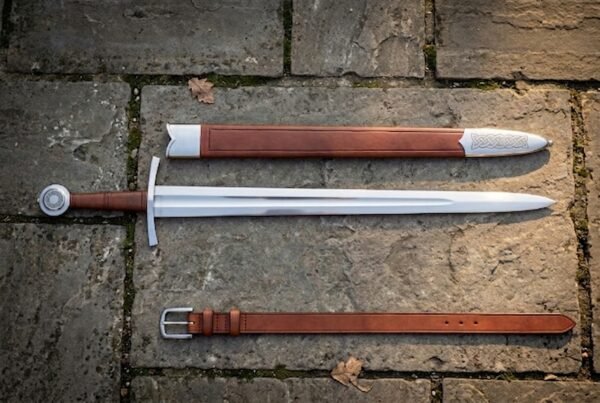
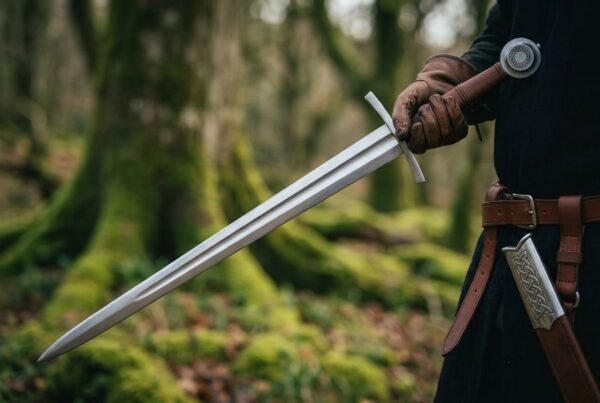
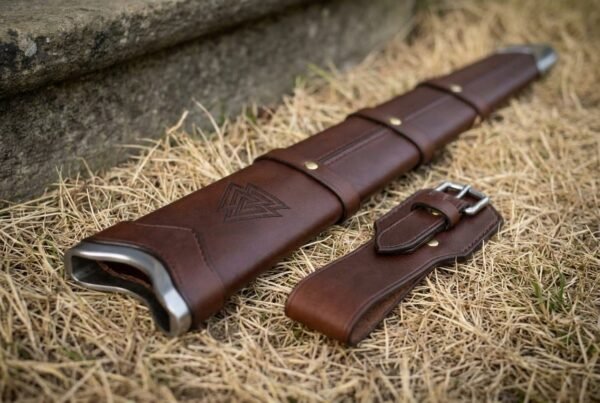
Two standalone sword scabbards. Grimhold is oak tanned cowhide of 8 to 9 ounce weight, hand dyed chestnut brown, over a two part wooden liner with a lanolin rich wool fleece lining, and it takes straight double edged blades up to 30 inches long and 2 inches wide. It carries a polished steel throat collar and chape held with three solid brass rivets, and it ships with a matching leather belt frog and a brass roller buckle sized for belts up to 2 inches. The face is stamped with a Valknut.
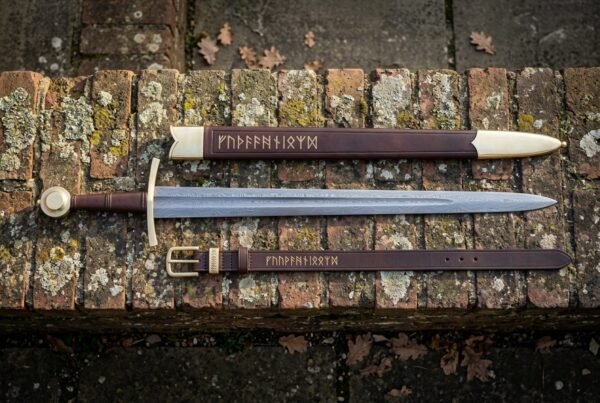
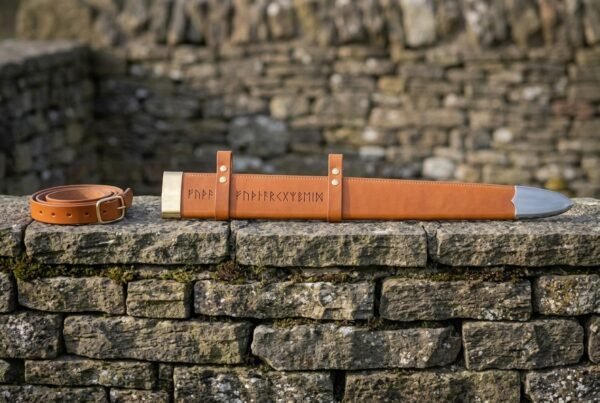
Staveguard is vegetable tanned cowhide over a shaped wooden core with a wool lining, cut for blades to about 31 inches long and 2 inches wide, with an Elder Futhark rune line worked along the face. It has a fitted steel chape at the tip and solid brass rivets at the throat, a hand saddle stitched back seam and burnished edges, and it comes with a tan leather belt on a steel roller buckle that fits waists to about 44 inches.
Knife sheaths
Knotwelt is vegetable tanned cowhide running roughly 3 to 4 mm through the body, cut for straight blades to about 10 inches long and 1.75 inches wide. An interlaced Celtic knotwork panel is tooled the full length of the face. It is built with a full welt and hand saddle stitching, solid brass rivets, a brass stud retention strap and a riveted belt loop for belts to 2 inches. A tin of leather balm and a care card come with it.
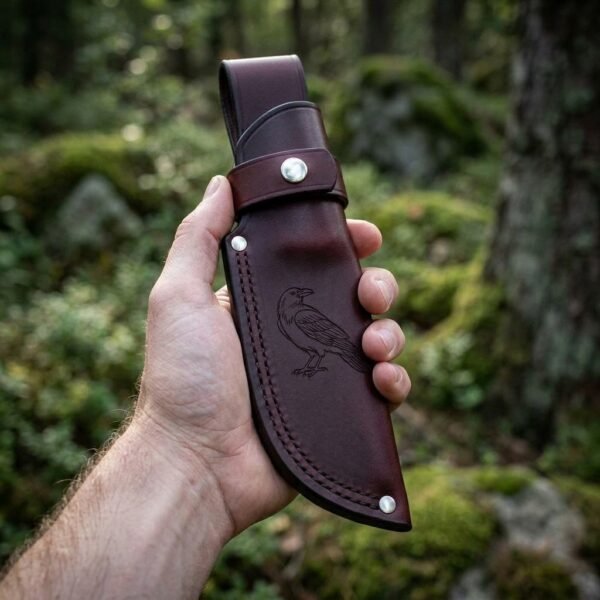
Quillhide is the smaller of the two, in oxblood vegetable tanned bridle leather of roughly 8 to 9 ounce weight, for fixed blades up to about 6 inches long and 1.5 inches wide. It has a full leather welt, waxed thread hand stitching, steel reinforcing studs, a steel snap retention strap that closes over the handle, and a vertical belt carry for belts to 1.75 inches. A standing raven is tooled into the face panel. Spare snap studs and a tin of clear balm are in the box.
Axe sheaths and head masks
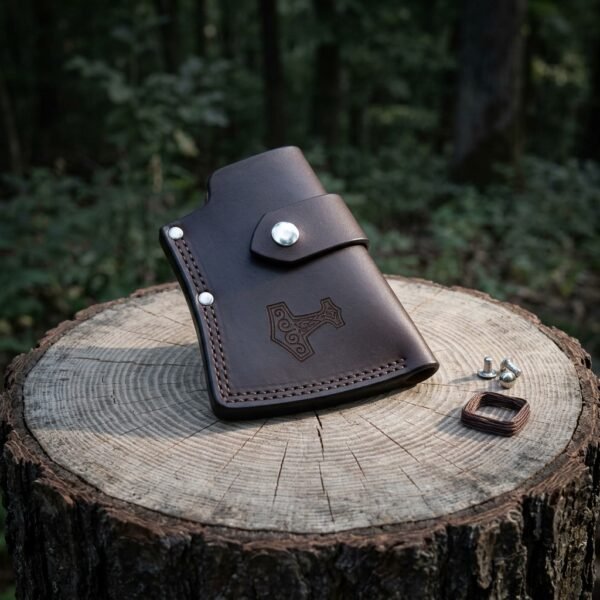
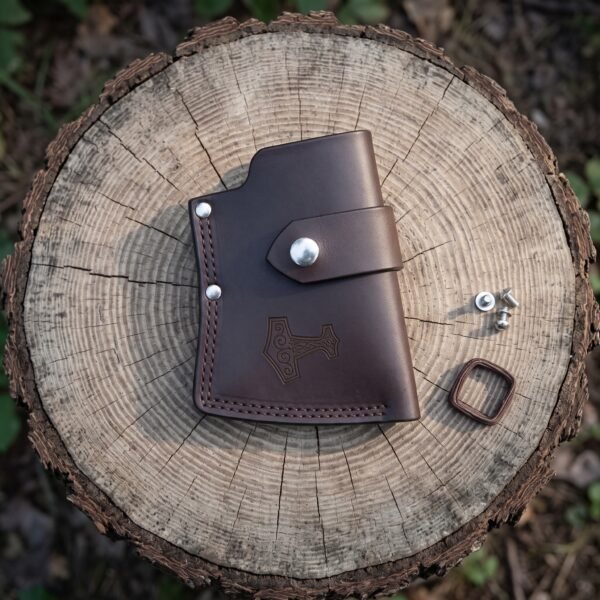
Haftmask is dark brown vegetable tanned bridle leather of roughly 9 to 10 ounce weight, wet formed to shape with a full welt and waxed thread saddle stitching. It fits bearded and straight axe heads up to roughly a 6 inch cutting edge, and it closes with a steel snap strap that passes behind the haft and pulls the mask down tight against the head. A Mjolnir is tooled into the face panel. Spare snap studs and a care card are included.
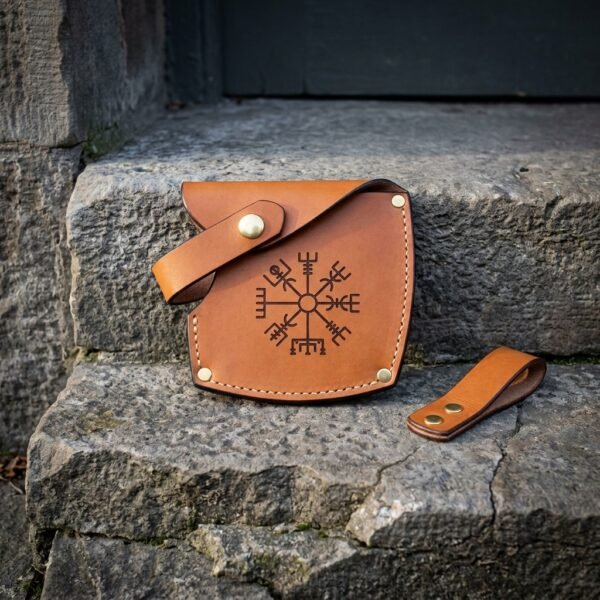
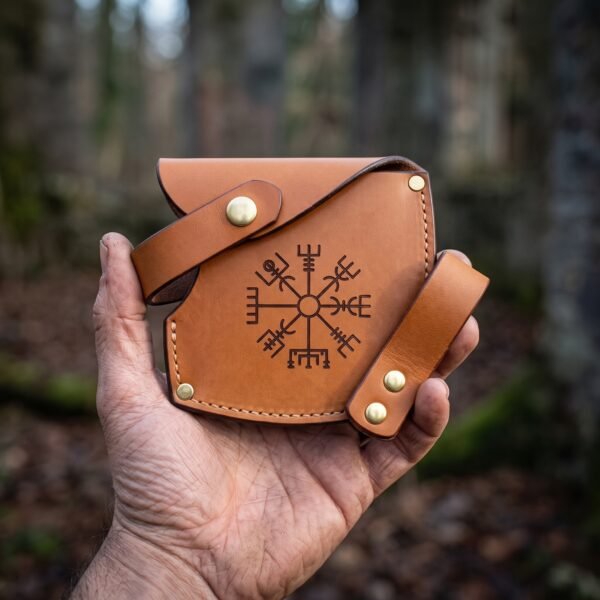
Edgekeep is heavy vegetable tanned leather, wet formed, hand saddle stitched in waxed thread with brass corner rivets and a solid brass snap fastener on the strap. A Vegvisir stave is struck into the face. The belt loop is detachable on twin brass snaps and suits belts up to 1.75 inches or 45 mm, which means you can carry the axe on a belt or drop the loop and store the mask flat.
Rigs that arrive with the blade
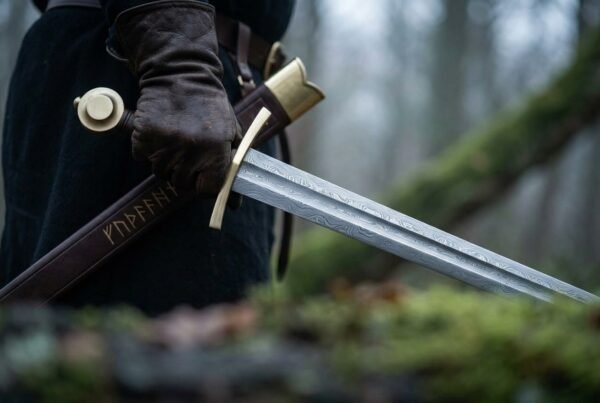
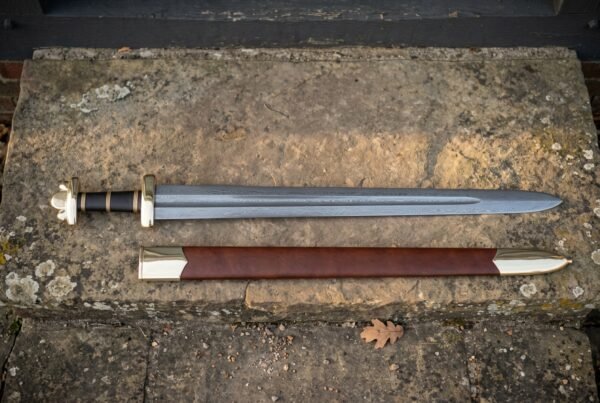
Three pieces here are complete carry rigs sold with the sword. Thornhelm is a 1095 high carbon Viking sword at 36 inches overall with a 30 inch fullered blade, oil quenched to 56 to 58 HRC, supplied with a fitted leather scabbard over a wooden core and a full grain leather belt on a cast buckle. Oathgird is a mirror polished 1095 arming sword at 54 to 58 HRC on the Oakeshott type XII outline, also 36 inches overall with a 30 inch blade, with a tan leather scabbard and a matching sword belt on steel fittings. Runegird is the Damascus version of the same outline, forge welded 1095 and 15N20 at 58 to 60 HRC, with a rune tooled scabbard and matching belt on bone and brass fittings.
Leather, fittings and fit across the range
Every figure below comes from the specification panel of a piece on this page. These are hand cut and hand stitched, so treat the numbers as the fit to expect rather than a machined tolerance.
| Piece and tooling | Leather | Fits | Fittings | Carry |
|---|---|---|---|---|
| Sword scabbard, Valknut stamp | Oak tanned cowhide, 8 to 9 oz, wood core, wool lined | Double edged blades to 30 in, 2 in wide | Polished steel throat and chape, three brass rivets | Leather belt frog, brass roller buckle, belts to 2 in |
| Sword scabbard, Elder Futhark rune line | Vegetable tanned cowhide, wood core, wool lined | Double edged blades to 31 in, 2 in wide | Fitted steel chape, brass rivets at the throat | Matching tan belt, steel roller buckle, waists to about 44 in |
| Knife sheath, Celtic knotwork panel | Vegetable tanned cowhide, 3 to 4 mm | Straight blades to 10 in, 1.75 in wide | Solid brass rivets, brass stud retention strap | Riveted belt loop, belts to 2 in |
| Knife sheath, tooled raven panel | Oxblood bridle leather, 8 to 9 oz | Fixed blades to 6 in, 1.5 in wide | Steel snap strap, steel reinforcing studs | Vertical belt carry, belts to 1.75 in |
| Axe head mask, tooled Mjolnir panel | Dark brown bridle leather, 9 to 10 oz, wet formed | Axe heads to a 6 in cutting edge | Steel snap strap behind the haft | Strap on the haft, no belt loop |
| Axe sheath, Vegvisir stamp | Heavy vegetable tanned hide, wet formed | Bearded and hand axe heads | Brass corner rivets, solid brass snap | Detachable loop on twin brass snaps, belts to 1.75 in |
| Viking sword rig, supplied with the sword | Leather over a wooden core | 30 in fullered blade, 1095 at 56 to 58 HRC | Cast buckle | Full grain leather belt |
| Arming sword rig, supplied with the sword | Tan leather | 30 in type XII blade, 1095 at 54 to 58 HRC | Steel fittings | Matching sword belt |
| Arming sword rig, rune tooled, supplied with the sword | Rune tooled leather | 30 in blade, Damascus at 58 to 60 HRC | Bone and brass fittings | Matching sword belt |
One number does more work than the rest. Blade width at the shoulder, not blade length, is what stops a sword going home. A 30 inch blade that measures 2.2 inches across the ricasso will not enter a scabbard cut for 2 inches, however much you lean on it.
Measuring a blade you already own
Measure the blade only, from the point to where the steel disappears into the guard or the handle. Do not include the grip or the pommel. Then measure the widest part of the blade, which on a straight double edged sword is almost always right at the shoulder, and on a knife is usually just ahead of the choil.
Compare both against the listed maximums. A blade shorter than the maximum is fine and sits with the point above the tip, held by the throat and the fleece. A blade wider than the maximum is not. Leather stretches a little over months, but a wooden core does not, and forcing a wide blade into a fitted core splits the glue seam along the back.
Steel and brass on the fittings
The throat collar is the band at the mouth of a scabbard. The chape is the cap at the tip. Both exist because those two points take all the wear. The throat is where the blade rubs on every draw and return, and the tip is what hits the ground when you sit down carelessly. Leather alone gives way at both. Steel and brass do not.
Steel fittings here are polished and will hold that finish indoors. Brass rivets and buckles darken over months into a dull gold, which most people prefer to the bright new colour. If you do not, a metal polish on a cloth brings them straight back, and there is no lacquer to strip first.
Care and storage
The single most common way a good blade gets ruined is being left in its sheath for a year. Leather is hygroscopic. It pulls moisture out of the air, holds it, and presses it against the steel. Tanning residues are mildly acidic on top of that. A blade that is stored in leather for months will come out spotted even if it went in dry and oiled.
So use the scabbard for carrying and displaying, not for long term storage. If a sword will sit for a season, wipe it, oil it and leave it out of the leather. If it lives on a belt or on a wall in its scabbard, pull it once a month and wipe the blade.
Treat the leather itself two or three times a year with a balm or a light conditioner. Work a small amount in with a cloth, let it sit, buff off what has not soaked in. Do not soak leather in oil, because oversaturated leather goes soft and loses the shape that holds your blade. Never dry wet leather next to a heater or in direct sun. It will shrink, harden and crack. Let it dry slowly at room temperature and condition it once it is dry to the touch.
If stitching wears through anywhere, stop using the piece until it is restitched. A failed welt seam on a knife sheath means the edge is now working directly on thread and the rest will unzip fast. Our safety and storage notes cover the rest of it.
Engraving and tooling
Several pieces already carry symbols worked into the face during construction. A Valknut on one sword scabbard, an Elder Futhark rune line on the other, a Celtic knotwork panel, a standing raven, a Mjolnir and a Vegvisir stave. Those are part of the piece rather than an option.
Separately, most items can be personalised after they reach the United States. Text engraving is 19 dollars, symbol engraving is 39 dollars, and a family crest is 49 dollars. Elder Futhark is a phonetic alphabet rather than a code, so a name is transliterated by sound and there is no rune for the letter C. Read our guide to Elder Futhark before sending a name, and the notes on what the Norse symbols actually mean if you are choosing a stamp.
Personalisation is permanent, and a personalised piece cannot be returned. Send the exact spelling and check it twice.
Where these come from and how they ship
Ransack Viking is a US company based in Chicago, Illinois. The pieces are handmade in the Czech Republic, then imported, inspected and shipped from Chicago. Engraving is done in the US after arrival.
Because every one of these is cut, moulded and stitched by hand, two examples of the same sheath will differ slightly in dye depth, in the depth of the tooling and in the exact set of the moulded shape. That is the nature of wet formed leather and not a fault. Colour also shifts over the first few months of handling, and oxblood in particular darkens noticeably.
How to choose
If you own a straight double edged sword and want to carry or hang it properly, measure it first and then pick between the two sword scabbards on blade length and on which face you prefer, the Valknut or the rune line. Both come with a belt, so there is nothing else to buy.
If you own a fixed blade knife, the choice is simply size. Under 6 inches of blade takes the oxblood sheath with the snap strap. Up to 10 inches takes the knotwork sheath with the stud strap and the wider belt loop.
If you own an axe, decide whether you want to carry it on a belt or just protect the edge in storage and transport. The Vegvisir mask has a detachable belt loop and does both. The Mjolnir mask straps to the haft and is the tighter fit on a bearded head.
Browse related categories
- Viking swords, the straight double edged Norse blades
- Arming swords on the Oakeshott outlines
- Viking knives, single edged working blades
- Viking seax knives for belt carry
- Bearded axes that these masks are cut for
- Viking belts and flags
- Sword stands and display mounts
- The full Norse arms collection
Guides worth reading first
- The complete knife care guide: blade, handle and sheath
- Axe care: heads, hafts and edges
- How to display swords and axes safely
- Looking after a Damascus blade
- Safety and storage tips
Frequently asked questions
Will one of these scabbards fit my sword?
Measure the blade from the point to the guard, then measure the widest part of the blade at the shoulder. The two sword scabbards here take straight double edged blades up to 30 and 31 inches long and up to 2 inches wide. A shorter blade is fine. A wider blade is not, because the wooden core does not stretch.
What is the chape and the throat collar for?
The throat is the metal band at the mouth and the chape is the cap at the tip. They protect the two points that take all the wear, the mouth where the blade rubs on every draw and the tip that hits the floor.
Why does a knife sheath need a welt?
The welt is a strip of leather stitched into the seam between the two faces on the edge side. It sets the thread back so the blade rides on leather rather than on stitching. Without one, the edge cuts the thread and the sheath comes apart along the seam.
Can I store my sword in the scabbard?
For display or carry, yes. For months at a time, no. Leather pulls moisture from the air and holds it against the steel, and tanning residues are mildly acidic. Wipe the blade, oil it and store it out of the leather if it is going to sit unused for a season.
Do the sheaths come with a knife or axe?
Six are sold empty, for a blade you already own. Three are complete rigs supplied with the sword, and the listing title says so.
How do I look after the leather?
Condition it two or three times a year with a balm, worked in and buffed off. Do not soak it, because oversaturated leather goes soft and loses the shape that holds the blade. Never dry it near a heater.
Can these be engraved or personalised?
Yes, after they arrive in the United States. Text engraving is 19 dollars, symbol engraving is 39 dollars and a family crest is 49 dollars. Personalised pieces are not returnable, so check the spelling before you order.
Where are these made?
Ransack Viking is a US company based in Chicago, Illinois. The pieces are handmade in the Czech Republic, then imported, inspected and shipped from Chicago. Engraving is done in the US after arrival.
Featured pieces
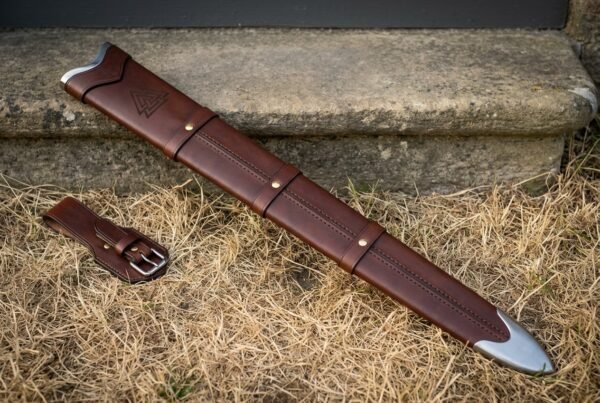 Grimhold Hand Made Leather Sword Scabbard
$159.00
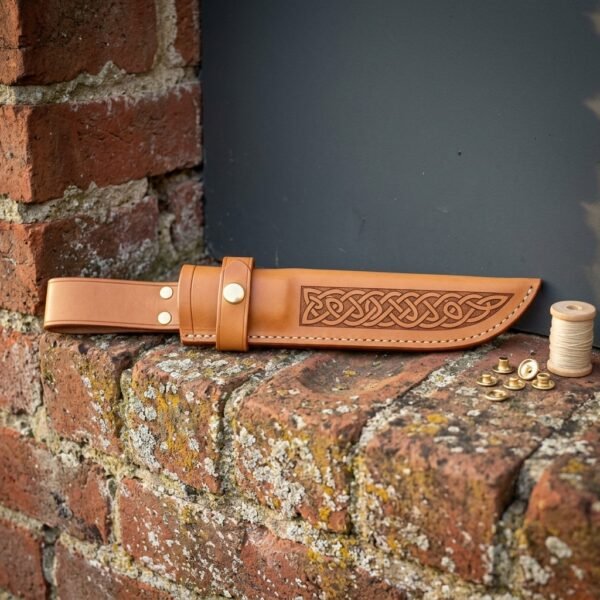 Knotwelt Hand Made Tooled Leather Viking Knife Sheath with Celtic Knotwork Panel
$129.00
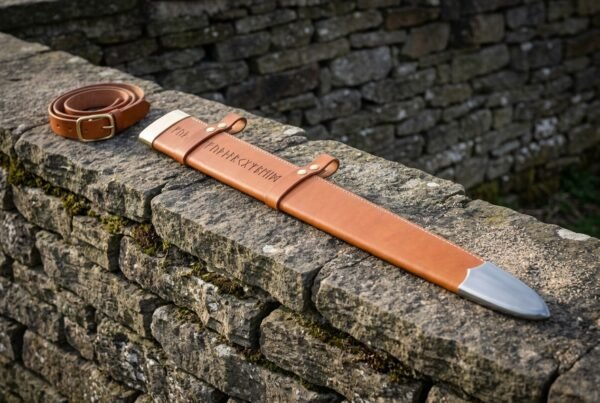 Staveguard Hand Made Rune Tooled Leather Sword Scabbard with Steel Chape & Matching Belt
$169.00
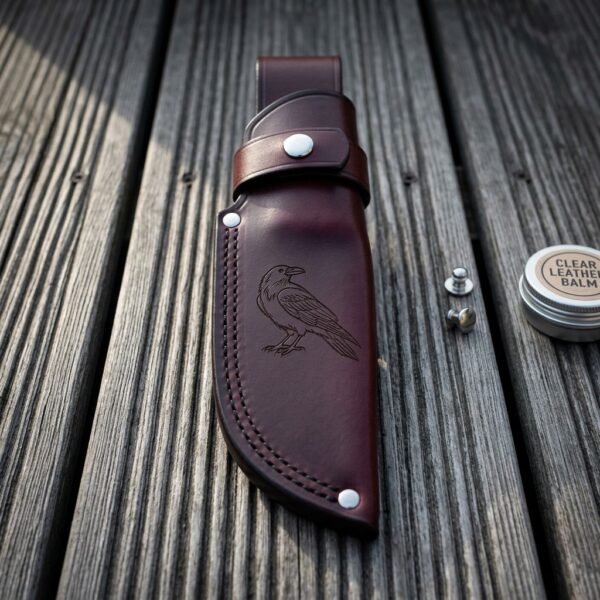 Quillhide Hand Made Oxblood Leather Knife Sheath with Tooled Raven Panel
$129.00