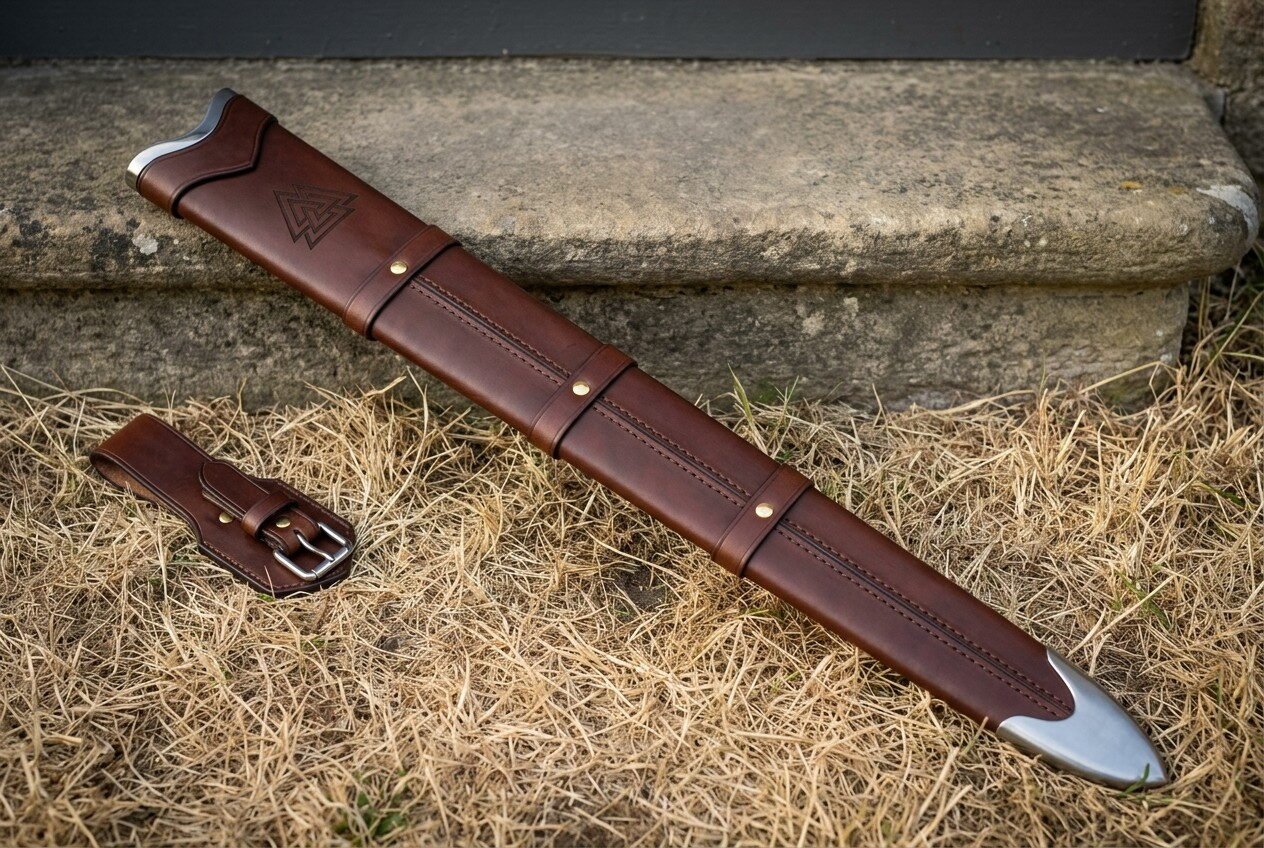
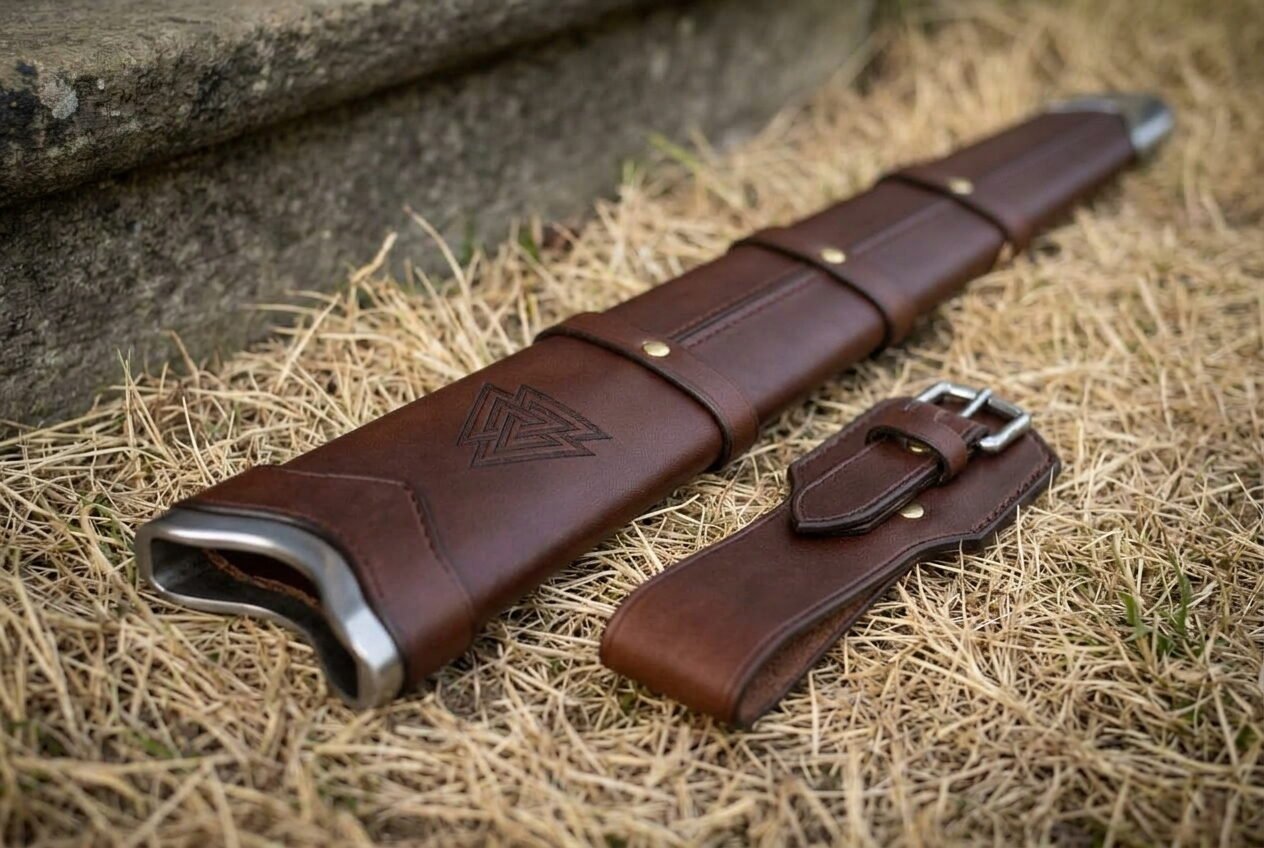
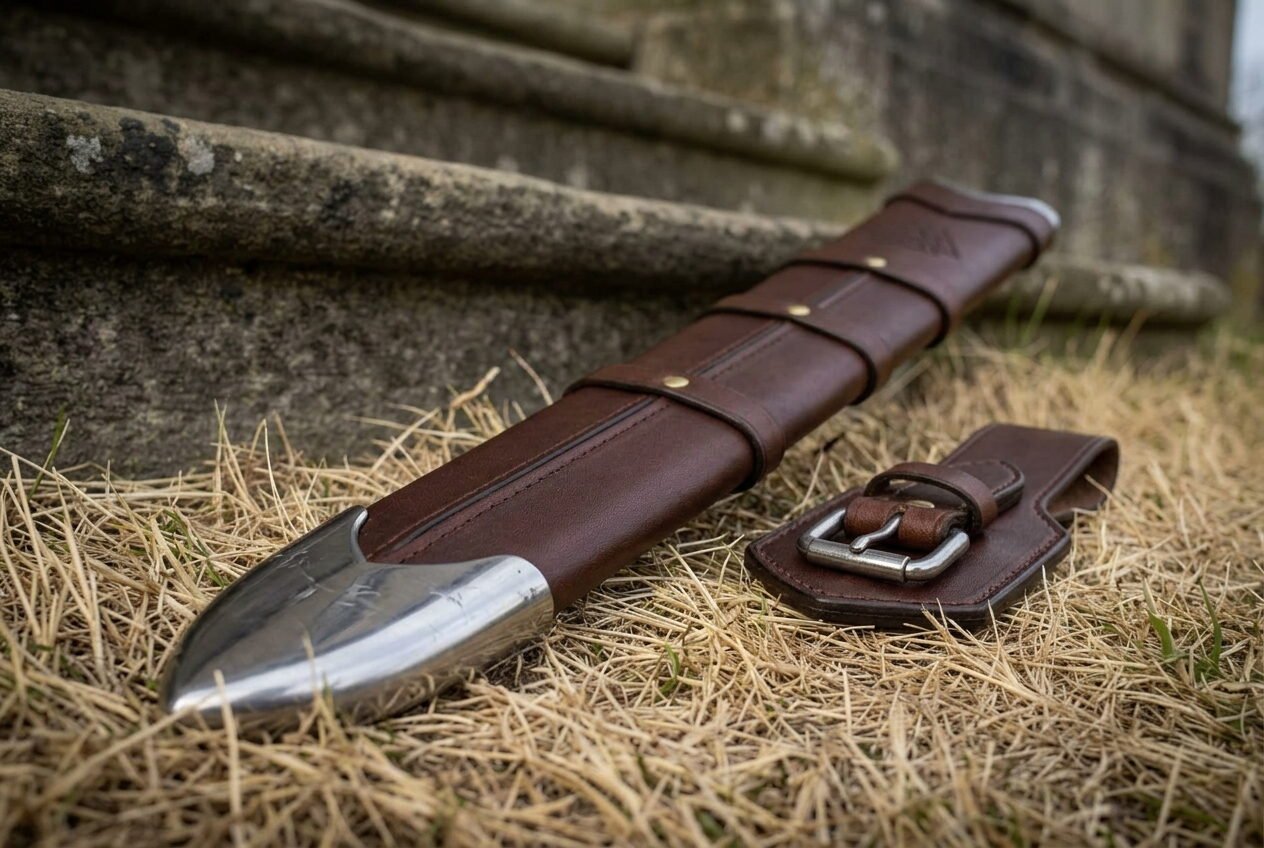
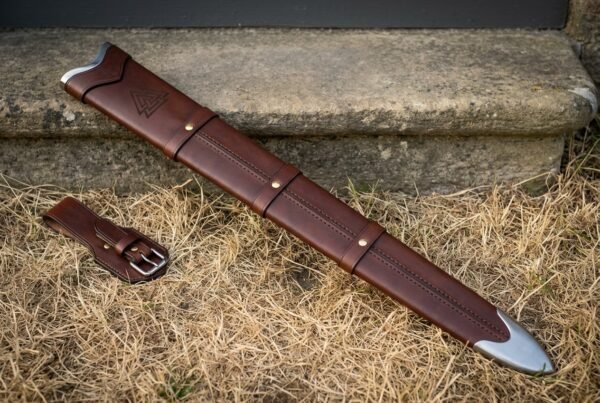
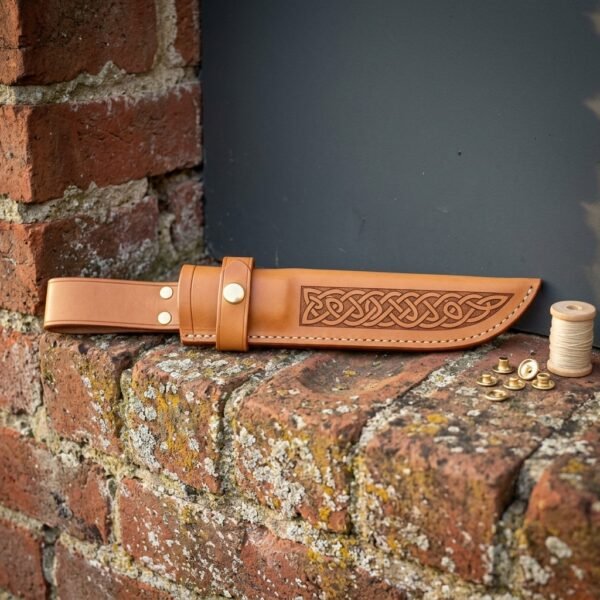
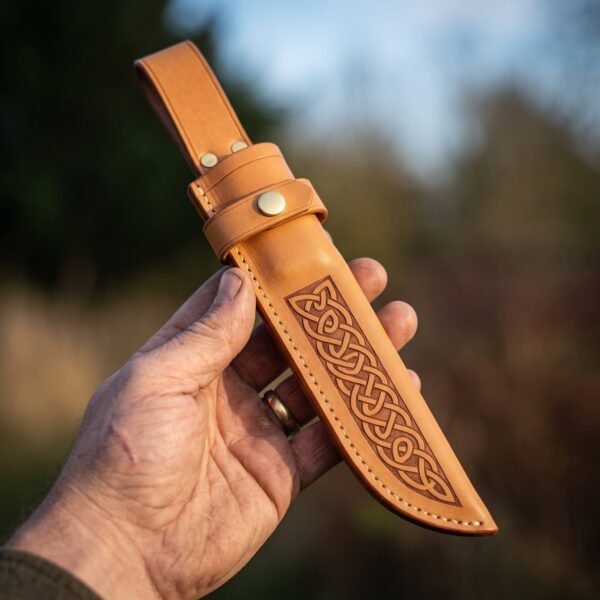
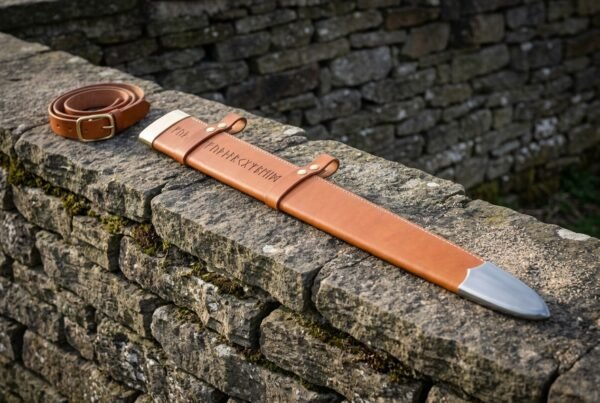
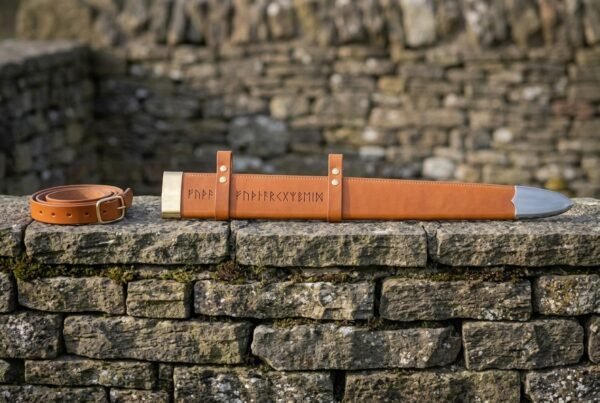
This is a hand made leather sword scabbard sold on its own, without a blade. The body is oak tanned cowhide in a deep chestnut brown, stitched down the centre of the face and bound with three leather bands, each set with a solid brass rivet. The throat carries a Valknut stamped deep into the damp hide, three interlocked triangles in clean outline. A polished steel throat collar and a matching steel chape protect the two ends. A separate belt frog with a steel buckle is included so the scabbard can hang from a belt at whatever angle you like.
Something worth knowing about scabbards. The leather is the part you see, but on a good scabbard it is not the part that does the work. Underneath there is a thin wooden liner, split in two halves and glued around the blade shape, and inside that a fleece or wool lining. Wool still carries lanolin after tanning, and that lanolin quietly oils the blade every time it goes in or out. That is why medieval scabbards protected steel so well in a wet climate. This one is made and finished in the Czech Republic, and it ships with the frog and a tin of leather cream. Look for it with the scabbards and sheaths, and take in the Viking knives on the way past.
Specifications
| Material | Oak tanned cowhide, approximately 8 to 9 ounce weight, chestnut brown |
|---|
| Overall length | Approximately 33 inches including the chape |
|---|
| Fits | Straight double edged blades up to about 30 inches long and 2 inches wide |
|---|
| Liner | Two part wooden liner with a wool fleece lining |
|---|
| Construction | Stitched seam running down the centre of the face |
|---|
| Bands | Three leather bands around the body, each set with a solid brass rivet |
|---|
| Fittings | Polished steel throat collar and pointed steel chape |
|---|
| Stamping | Valknut stamped at the throat |
|---|
| Belt frog | Matching leather frog with a steel buckle, fits belts up to 2 inches |
|---|
| Weight | Approximately 1 lb 4 oz with the frog |
|---|
| Included | Scabbard, belt frog, leather cream, care card |
|---|
| SKU | RK-1653 |
|---|
What the chape and the throat are really for
The steel chape at the tip is not a decorative cap. A scabbard spends its life being set down point first, leaned in corners and dragged across floors and saddles, and untreated leather at that end wears through in a season. The chape takes that abuse and can be replaced when it wears out, which is cheaper and quicker than rebuilding a scabbard. Archaeological chapes turn up far more often than the leather they protected, for the obvious reason that the metal survived and the hide did not.
The collar at the throat does the opposite job. It keeps the mouth from spreading. Every draw pushes the edges of the mouth outwards, and once a leather mouth has stretched, the blade rattles, the friction fit is gone and the sword can drop out when the scabbard tips. A steel collar holds that opening at a fixed diameter for the life of the piece. Between the collar and the fleece lining the blade sits on friction alone, which is how a properly made scabbard holds a sword upside down without a strap.
The leather
The hide is oak tanned rather than chrome tanned. Oak tanning uses vegetable tannins and leaves a firm, dense leather that can be soaked, moulded around a form and left to dry hard in that shape. Chrome tanned leather stays soft and will never hold a moulded profile, which is why it belongs in jackets and not in scabbards. Firm oak tanned hide is also what allows the Valknut to be stamped deeply and stay crisp instead of relaxing back flat within a year.
The colour comes from a hand rubbed dye followed by a wax finish. It is not a printed film, so it darkens with handling and with sunlight, and the high points along the seam and the bands will polish to a lighter tone with use. That is normal behaviour for oak tanned hide and most people come to prefer it after a few months.
Engraving, runes and your own design
Use the rune converter on this page to turn a name, a date or a short phrase into Elder Futhark and we will cut it into the steel, the leather or the wood. If you would rather have a Viking pattern than a rune line, choose your own design in the engraving option above the add to cart button and tell us where it goes. Where a piece already carries an engraved design, your chosen engraving replaces it rather than sitting alongside it. On this scabbard that means your chosen stamp or rune line goes where the Valknut currently sits at the throat. There is also clear space along the body below the middle rivet for a longer line. See the engraving page.
Fit and sizing
Measure your blade before ordering, not your sword. What matters is the length from the guard to the tip, the width at the guard and the thickness at the guard. This scabbard is cut for a straight double edged blade up to about 30 inches long, up to 2 inches wide at the shoulder and up to a quarter inch thick. A blade shorter than that will still sit safely because the fleece grips it, but the tip will not reach the chape and it will feel loose in the hand when carried.
The frog buckles onto a belt up to 2 inches wide. Set it high and near the hip for walking, or lower and further back if you are sitting down in it, which is the usual reason people rebuckle a frog after their first event. If you want a scabbard cut to a specific blade, send us the three measurements above with your order and we will build to them.
Care
Feed the leather twice a year with a neutral cream or a light dubbin, working it in with your fingers and buffing off what has not soaked in after twenty minutes. Do not use saddle soap as a conditioner, since it strips more than it feeds. Keep the scabbard out of direct sun and away from radiators, because heat dries the fibres and makes them crack along the seam. If it gets soaked, let it dry slowly at room temperature and never in front of a heater, then feed it once it is merely damp. Wipe the steel throat and chape occasionally and put a trace of oil on them. Store the sword out of the scabbard for long periods so the blade is not sitting against damp leather.
Made in the Czech Republic
This piece is made by hand in the Czech Republic, in a workshop that still works the old way. The steel is forged, ground, heat treated and finished by smiths who learned the trade from the people before them, and the wood, horn and leather are cut and fitted by hand rather than pressed out on a line. That is also why no two pieces come out exactly the same.
Ransack Viking is a United States company. We import these pieces ourselves, check every one when it lands and ship from our warehouse in Chicago, Illinois. Engraving is done here in the United States after the piece arrives, so your runes or your own design go on before it leaves for you.
A note on handmade variation
This scabbard is hand made, not machine made or bulk produced, so what arrives will not be a pixel for pixel copy of the photograph. Hide is a natural material and no two sides take dye the same way, so the brown will land lighter or darker and may carry the faint growth marks of the animal it came from. The stamp is struck by hand, so the Valknut sits a few millimetres higher or lower on one piece than another. The dimensions, the leather weight, the fittings and the build are the same every time. The character is not. You can carry on with the knife care guide, or look at keeping Damascus from staining while you are there.
Frequently asked questions
Is a sword included
No. This listing is the scabbard, the belt frog and the care kit only. It is sold for owners who already have a blade or who want a spare carry option.
Will it fit my sword
If your blade is up to 30 inches long, up to 2 inches wide at the shoulder and up to a quarter inch thick, yes. Measure the blade and not the whole sword.
Will the blade rust inside it
Not in normal use, because the wool lining carries lanolin. For storage longer than a few weeks, keep the blade out of the scabbard and oiled.
Can the Valknut be replaced with something else
Yes. Your chosen runes or Viking pattern go in that same spot instead of the Valknut rather than next to it.
Does the frog fit a wide belt
It buckles onto anything up to 2 inches wide, which covers almost every reenactment and everyday leather belt.
How long does shipping take
One to two weeks of processing while the leather is moulded and dried, then free shipping inside the United States.
What is in the box
- Grimhold oak tanned leather sword scabbard with stamped Valknut throat
- Wooden liner and wool fleece lining, fitted
- Polished steel throat collar and steel chape
- Matching leather belt frog with steel buckle
- Tin of neutral leather cream and a care card
- Lifetime warranty against defects, no receipt needed
- Made and finished in the Czech Republic
Explore the range
See the other scabbards and sheaths, the blades they are built for under viking swords, the rest of the accessories, and the guides for measuring a blade properly.
Other pieces in this group
Closest to this in the range is the Staveguard sheath. If this one is not quite right, there is the Quillhide sheath. Also in this group is the Edgekeep sheath.
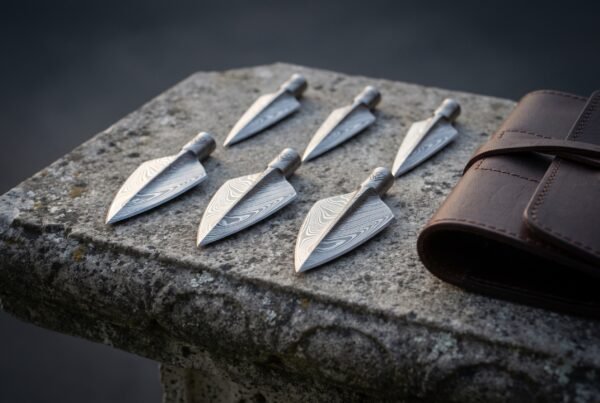
If you are putting a set together, the Arrowward Damascus jewelry piece sits alongside it. Nothing here exactly right, build one to your own spec on the design your own page.

Knew this sword was special the second I opened the box. Made overseas in the Czech Republic yet shipped from a US location so no long customs wait. Weight and balance make it feel like a real functional piece not some cheap replica. This is going straight into my display case.
My whole family was impressed when I unboxed it. The wood handle feels amazing and the balance is perfect. Couldn’t be happier with this.
Photos don’t do this sword justice at all. I keep coming back to Ransack Viking because it’s always this good.