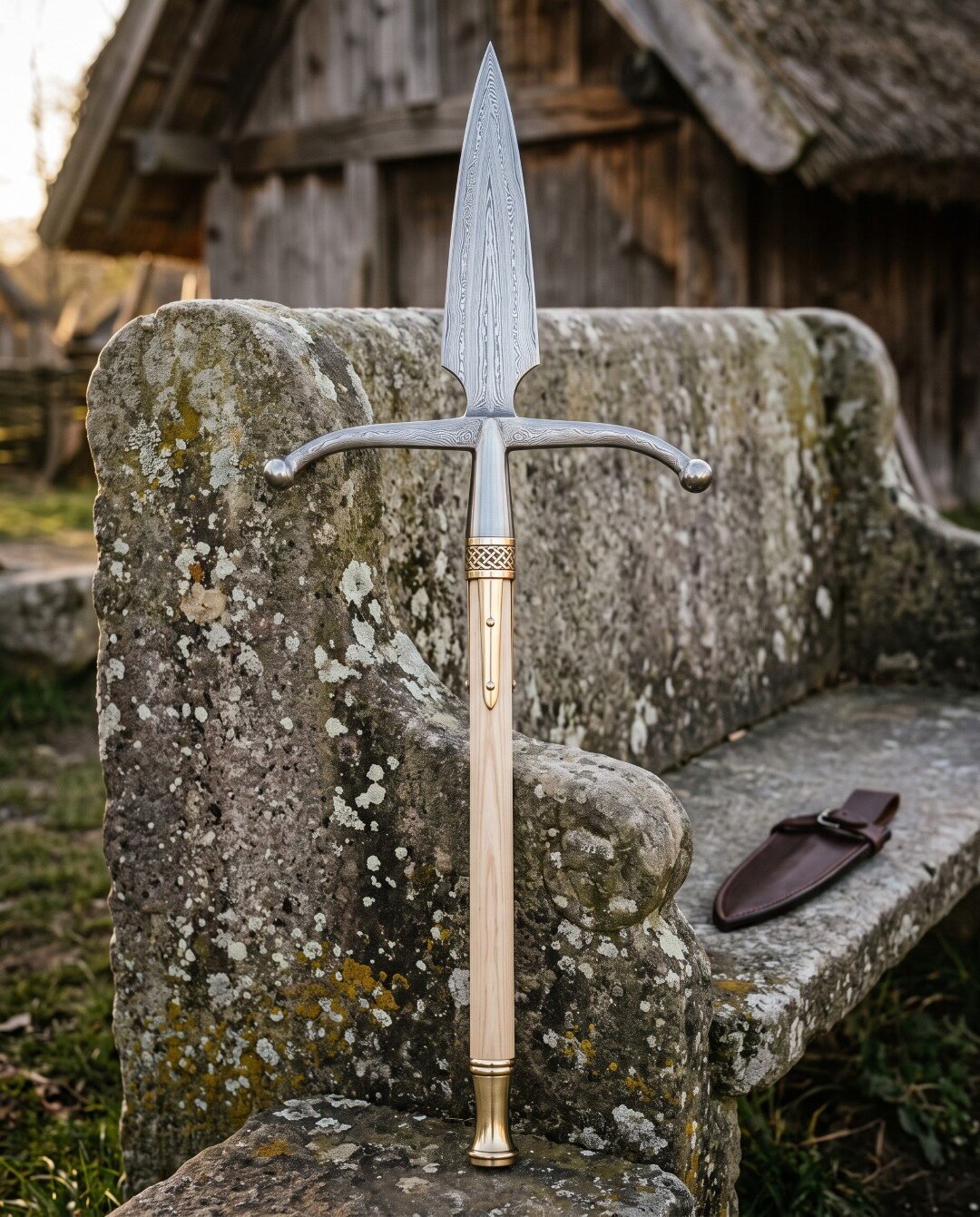
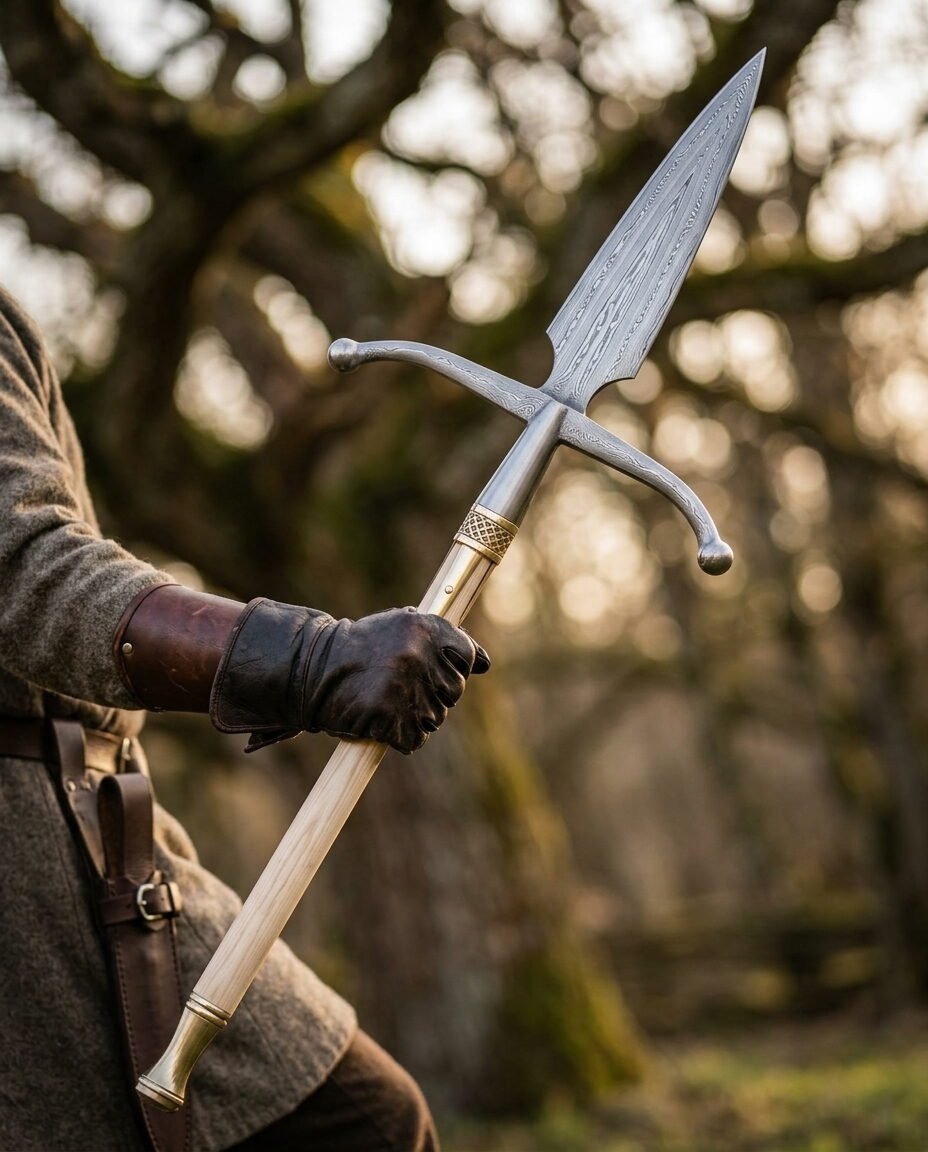
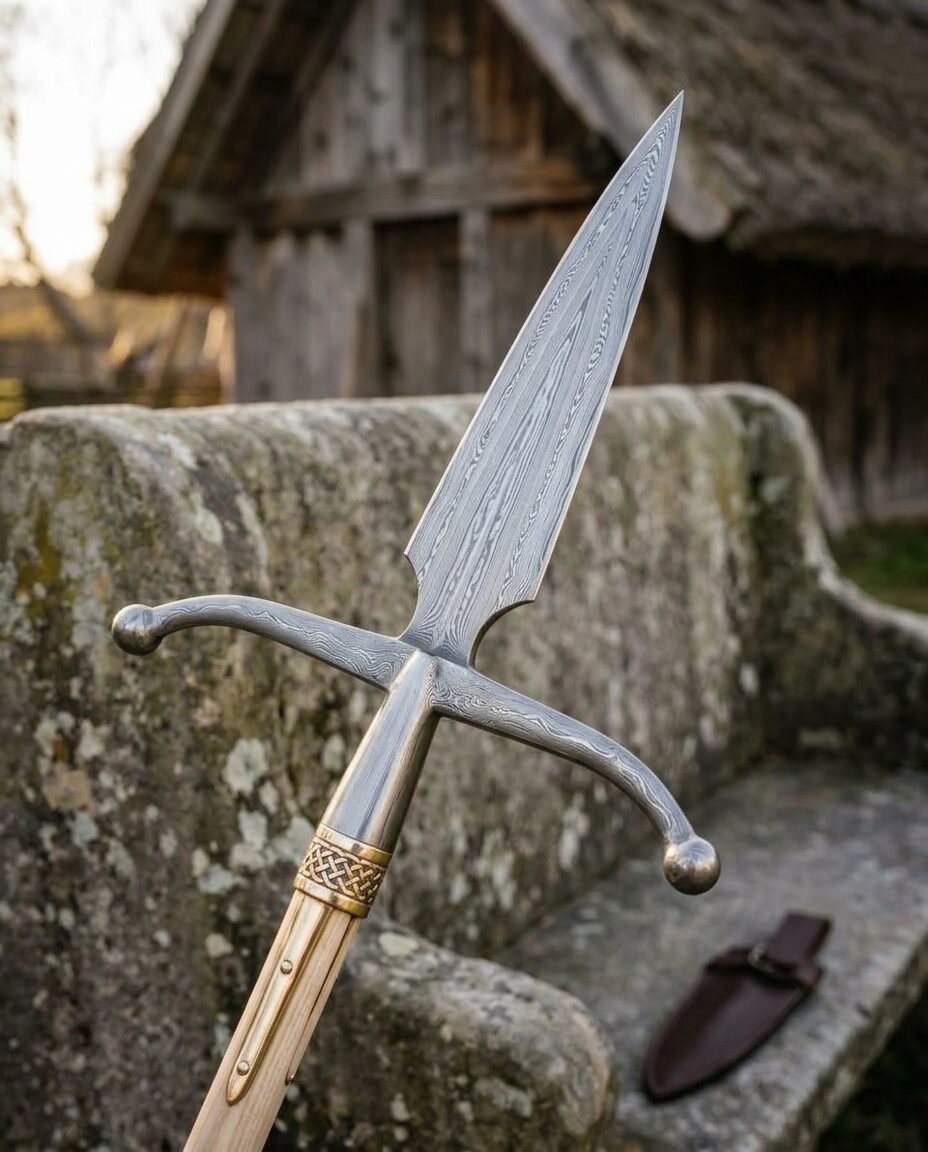
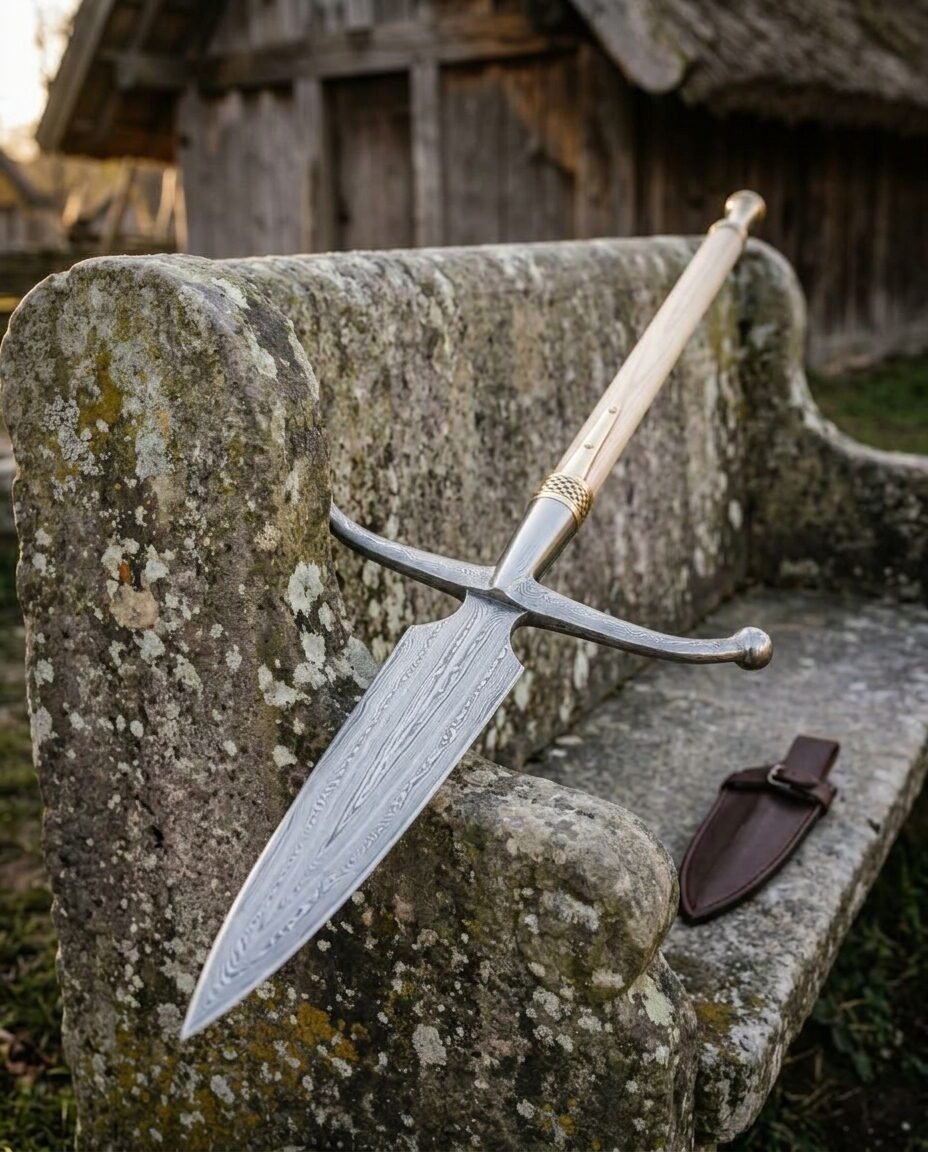
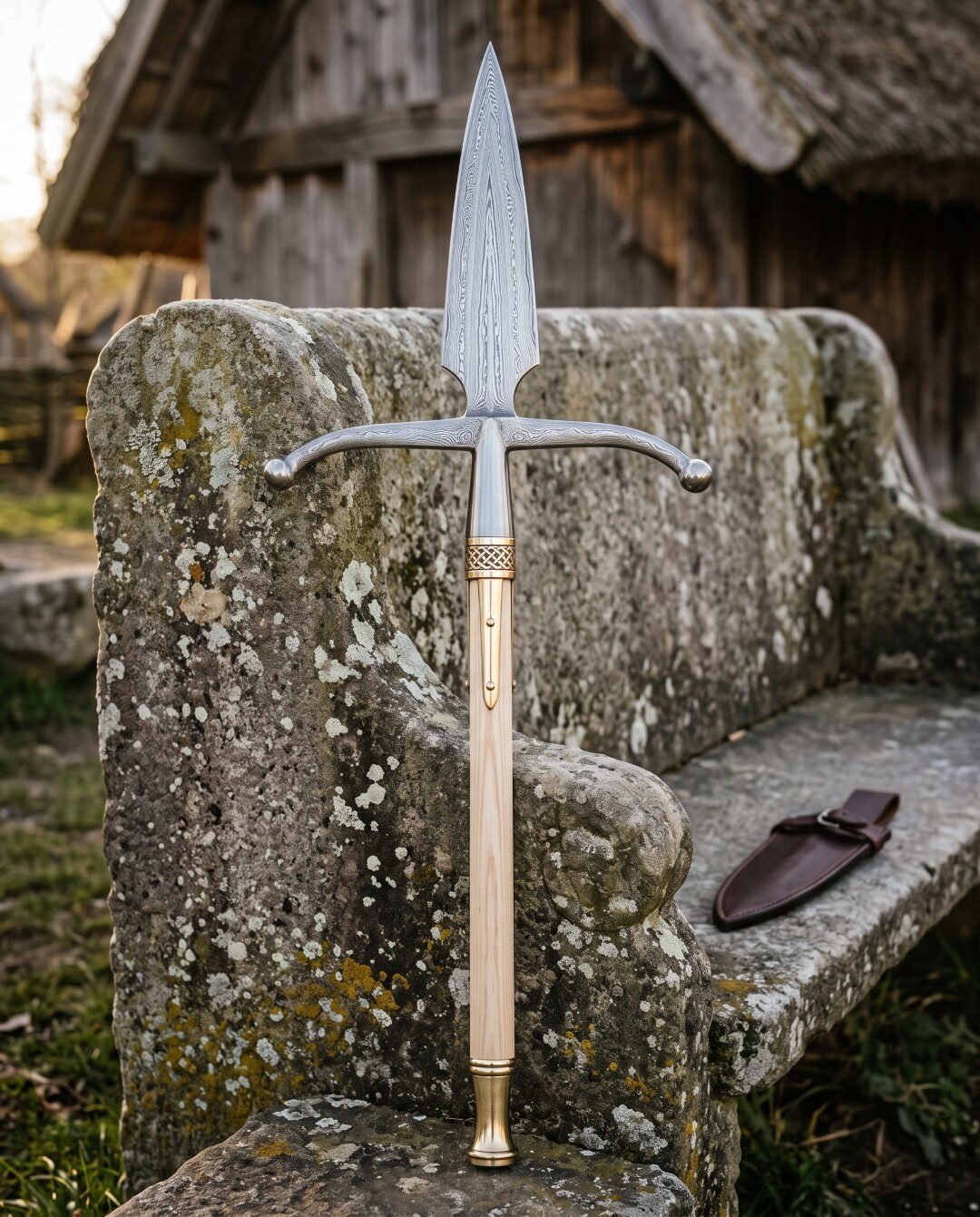
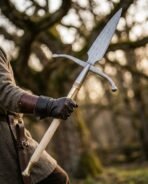
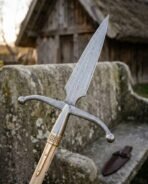
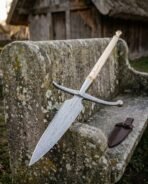
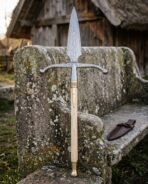
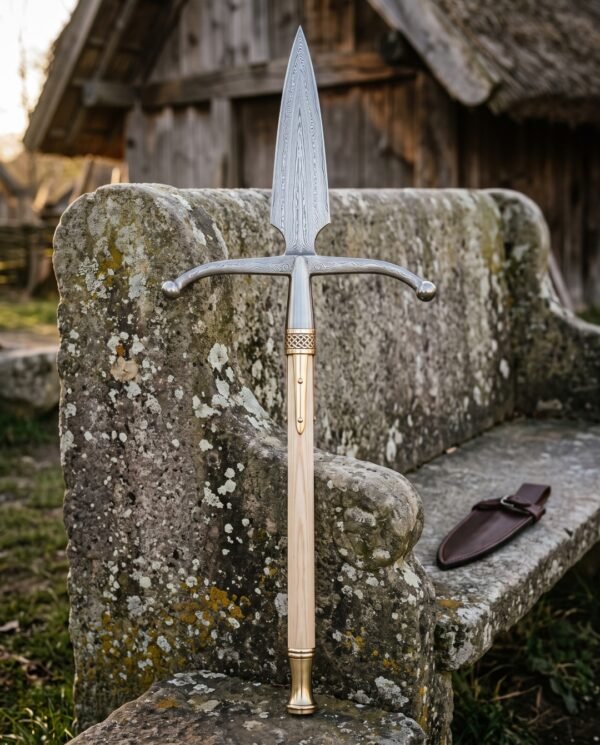
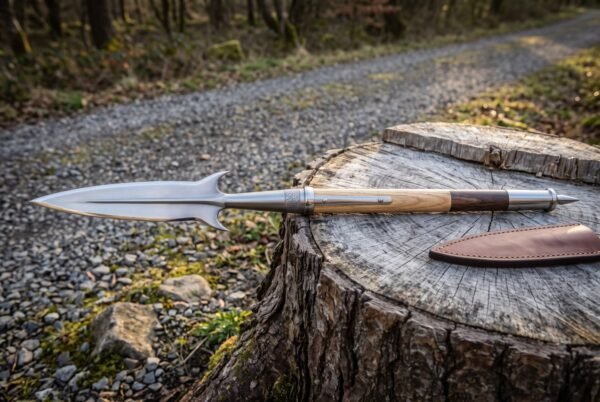
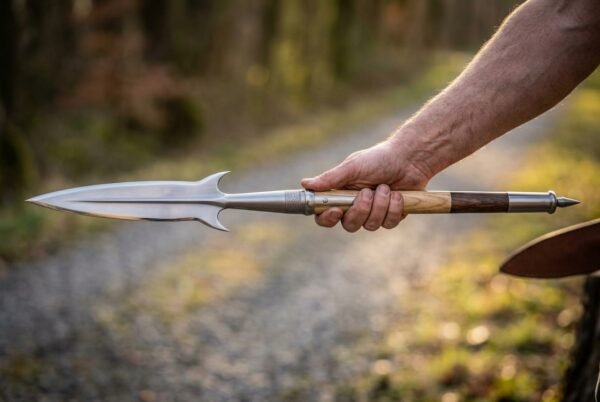
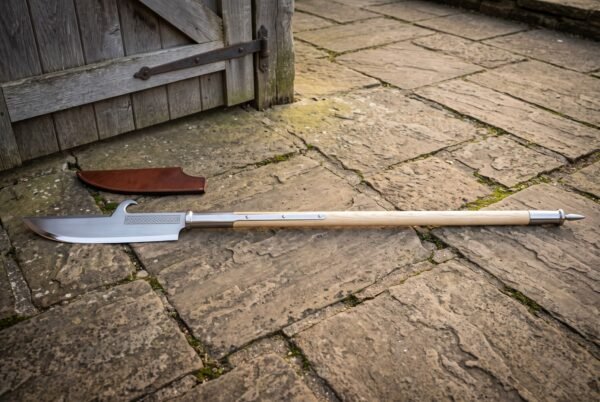
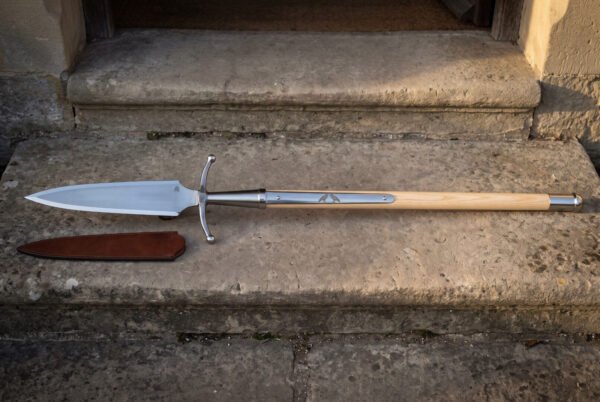
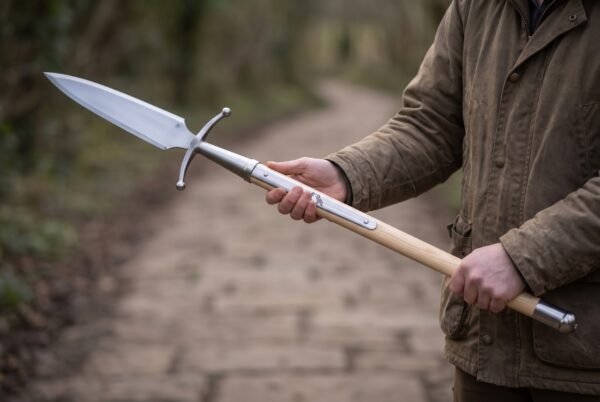
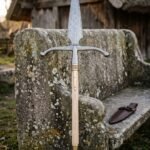
The Boarcleft is a winged spear. The head is a broad damascus leaf blade drawn to a stiff point, and below it the socket carries a swept steel crossbar with rounded ball finials that stands out to either side. That crossbar is not decoration. It is the feature that separates a hunting and close quarters spear from a plain thrusting spear, and it is the reason this pattern of head has stayed in use from the Viking age through the medieval boar hunt and into the modern reenactment field.
The lugs on a winged spear exist to stop the thrust. A boar or a man on the end of a plain spear can run up the shaft, because a narrow blade goes in and keeps going, and the animal or the fighter arrives at your hands still very much in the fight. Wings set below the blade catch on the body and hold the target at the length of the shaft. Norse and Frankish smiths made this exact head in quantity, and the winged spear turns up across northern Europe in graves and in river finds often enough that it was clearly a standard pattern rather than a curiosity. Ours is forged, ground, etched and hafted in the Czech Republic, and it ships with a fitted leather cover for the blade. It sits in the glaives and polearms. The Viking spears cover the same ground from a different angle.
Specifications
| Blade steel | 1095 and 15N20 damascus, hardened to 58 to 60 HRC, hand etched to raise the pattern |
|---|
| Head | Broad leaf profile with a raised central spine, drawn to a stiff thrusting point |
|---|
| Wings | Steel crossbar set below the blade, arms curving back toward the haft, rounded ball finials at each tip |
|---|
| Socket | Plain polished steel socket |
|---|
| Haft | Straight grained ash, sanded and sealed, pinned into the socket |
|---|
| Fittings | Brass ferrule with a cut knotwork band at the socket, brass strap down the haft, long ringed brass butt cap |
|---|
| Finish | Etched damascus head, satin brass, natural sealed ash |
|---|
| Edge | Ground and sharpened by hand, arrives keen |
|---|
| Included | Spear, dark brown leather blade cover with strap and buckle |
|---|
| SKU | RK-1612 |
|---|
What the wings on a boar spear actually do
Set a plain spear against something heavy and the physics work against you. The blade penetrates, the shoulders of the blade pass through, and nothing stops the shaft from sliding deeper. A boar weighing two hundred pounds will drive itself up a spear to reach the person holding it, and there are enough medieval accounts of exactly that happening for the crossbar to have been invented and kept.
The crossbar sits a hand span below the blade and its arms curve back toward the haft. When the head has buried itself to the wings, the bar hits bone and muscle across a wide face and stops. The animal is now pinned at arm plus shaft length and cannot close. In a fighting context the same lugs stop the head burying in a shield or a body so deep that you cannot recover the spear, and they give you something to hook and lever with when you are working against a shield rim.
The ball finials on the ends of the bar are the traditional finish. They keep the bar from being a pair of hooks that snag on everything you walk past, and they spread the load at the point of the sweep where the steel is thinnest.
The steel and the haft
The head is forged from 1095 and 15N20 layered together and folded. The two steels differ in nickel content, so when the finished head is etched the 15N20 stays bright and the 1095 goes dark, and the pattern you see is the actual folded structure of the billet rather than a print or a coating. It is hardened and tempered to 58 to 60 HRC, which is hard enough to hold a thrusting point and take a real edge while keeping enough toughness that the tip is not brittle.
The haft is ash, chosen the same way tool handle makers choose it, for long straight grain and the ability to flex slightly under shock instead of splitting. It is sanded through the grits, sealed, and pinned into the socket rather than only glued. The brass ferrule at the socket carries a cut knotwork band, and there is a long ringed brass butt cap at the other end so the base of the haft does not brush out when the spear is grounded.
Engraving, runes and your own design
Use the rune converter on this page to turn a name, a date or a short phrase into Elder Futhark and we will cut it into the steel, the leather or the wood. If you would rather have a Viking pattern than a rune line, choose your own design in the engraving option above the add to cart button and tell us where it goes. Where a piece already carries an engraved design, your chosen engraving replaces it rather than sitting alongside it. On this spear the usual placements are the brass ferrule, the flat of the blade below the wings, or the leather blade cover. Details are on the engraving page.
Handling and balance
A spear is the easiest polearm to handle well and the hardest to handle badly, because the balance point sits close to the middle of the shaft rather than out at the head. Hold it in a relaxed two hand grip with your back hand near the butt cap and your front hand about a third of the way up, and the point sits still. Thrusts come from the back hand driving and the front hand steering, not from swinging the arms.
The wings change what you can do with the spear at close range. You can catch and turn an incoming shaft on the crossbar, and you can hook a shield edge and pull it off line. When you ground the spear, plant the butt cap against your instep and angle the head forward so the crossbar takes the load rather than your wrists. Keep the leather cover on the head whenever the spear is being moved, carried in a car or stood in a corner at home.
Care
Damascus is high carbon steel and it rusts if you let it. Wipe the head down after handling, because skin oil and salt are what start the spotting, and keep a light film of mineral oil or a proper blade oil on the etched surface. If a spot of surface rust does appear, take it off with a soft cloth and oil rather than abrasive paper, which will cut through the etch and leave a bright patch across the pattern. Full detail is in steel care.
The ash haft wants an occasional wipe of boiled linseed or a hard wax oil, particularly if the spear lives somewhere dry. Brass will dull to a soft gold on its own and can be brought back with a brass polish and a cloth, or left to age. Feed the leather cover once or twice a year so it does not go hard and crack at the fold.
Made in the Czech Republic
Every piece we sell is made by hand in the Czech Republic. The smiths there work the way the trade has been worked for a long time, heating and hammering the steel, taking the bevels down by eye, and fitting the handle and the leather one at a time. There is no automated line anywhere in it, so small differences from one piece to the next are normal and expected.
Ransack Viking is a United States company based in Chicago, Illinois. We bring the pieces in ourselves, inspect them on arrival and ship them from our own warehouse. If you add engraving, that is carried out here in the United States before your order goes out.
A note on handmade variation
This is hand made, not machine made and not bulk produced, so what arrives will not be a pixel for pixel copy of the photograph. The damascus pattern is the single most variable part. Each billet folds and draws slightly differently, so the swirl and ladder across your head will be its own. Grain in the ash, tone in the brass, hammer texture and exact profile all vary because each piece is worked by hand from natural materials. The dimensions, the material and the build are the same every time. The character is not. We go further into it in the Viking spear, and pick it up again in how steel and hardness actually work.
Frequently asked questions
Is it sharp out of the box
Yes. The head is ground and sharpened by hand and arrives keen, and the point is stiff enough to thrust with. Keep the leather cover on it when it is not in your hands.
Can I actually hunt with this
It is built as a functional spear rather than a wall piece, but hunting law is a local matter. Check what your state allows for spear hunting before you take it anywhere near an animal, and be honest with yourself about the range at which you can place a thrust.
Is the crossbar welded or forged in
The bar is set into the socket at the forge and finished as part of the head assembly, not pinned on afterwards as a decoration. It is meant to take load across the sweep.
Can the haft be shortened
Yes, from the butt end, and you can refit the brass butt cap afterwards. Cutting from the socket end is not possible without pulling the pin, so measure before you cut.
Will my damascus pattern match the photo
No two etched heads run the same pattern. Yours will show the same character of layered swirl but its own arrangement, because the pattern is the folded structure of your billet.
How long does shipping take
Processing is one to two weeks in the shop, plus transit time. Shipping within the United States is free.
What is in the box
- One Boarcleft winged boar spear with a damascus head, swept crossbar and ash haft
- One fitted brown leather blade cover
- Care card covering oiling the head and feeding the leather
- Forged and finished in the Czech Republic
Explore the range
See more in Viking spears, glaives and polearms, Norse arms and damascus swords, or read the guides.
Near neighbours in the shop
Worth putting side by side with this is the Thornwake polearm, pattern welded Damascus. In the same category sits the Boarhelm polearm, forged from 1095. A near match for this one is the Reedfork polearm, forged from 1095.
For a different piece from the same family, look at the Ashfang Viking spear. You can have this made your way instead on the custom Norse arms page.

Reviews
There are no reviews yet