A shield is a board you hold between yourself and a problem, and the shape of the board tells you how its owner fought. The Greek hoplon is a shallow bowl about a metre across, carried on a forearm band at the centre and a grip at the rim, so its weight rests on your arm rather than your hand and its left edge covers the man beside you. The Roman scutum is curved the other way, wrapping around the body on a vertical axis, held one handed behind a domed boss so it can be punched forward as well as hidden behind.
This page holds a curved scutum built to 37 inches tall, matched by the Roman and Greek helmets, two hoplon shields at 30 and 32 inches with bronze and steel facings over dished hardwood, and a pair of carved hardwood round shields at 24 inches with steel rims and eagle devices. Listed weights on the two hoplons run about 13 to 16 pounds, which is a real shield rather than a prop.
Decide first whether you want to carry it or hang it. That answers most of the rest.
Free US shipping
On most pieces. Heavier and oversized ones carry a flat charge.
Hand Forged
Heated, hammered and ground by hand.
Engraving available
Names, dates or Norse runes on most pieces.
Ships from Chicago
Inspected and dispatched from our Chicago warehouse. No import duty, no customs delay on US orders.
Roman & Greek Shields
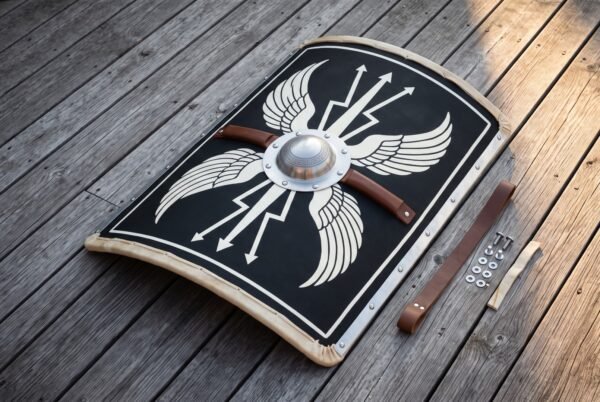

Legionwall Hand Made Curved Roman Scutum Shield | 37 Inch Tall | Steel Boss, Painted Wings and Rawhide Edge with Fitting Kit | Legionary Reenactment Gift | RK-1456
Original price was: $449.00.$359.20Current price is: $359.20.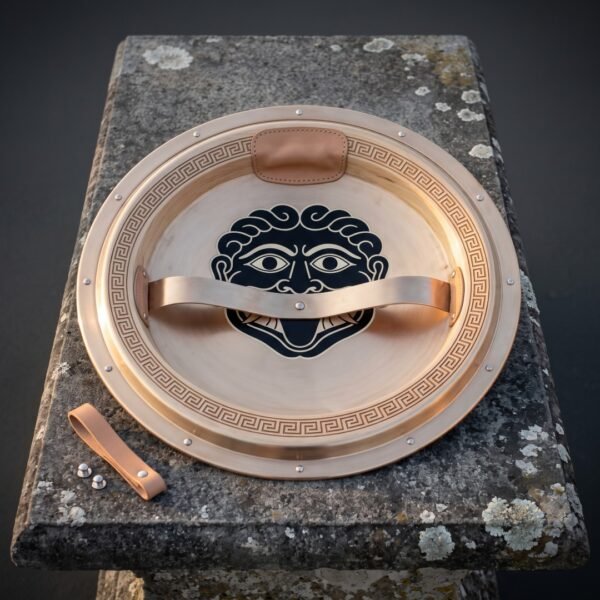
Gorgonward Hand Made Bronze Faced Greek Hoplon Shield | 32 Inch Aspis with Meander Border | Porpax Arm Band and Antilabe Grip | Spartan Display Gift | RK-1497
Original price was: $479.00.$383.20Current price is: $383.20.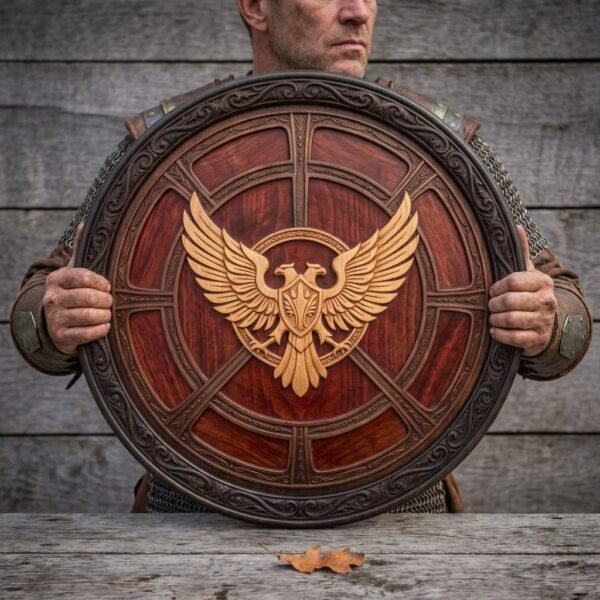
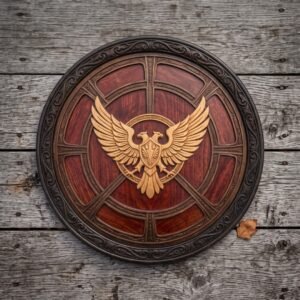
Twinhawk Hand Made Carved Hardwood Round Shield with Double Headed Eagle | 24 Inch Diameter | Carved Dark Wood Rim with Scroll Band | Heraldry Display Gift | RK-1986
Original price was: $389.00.$311.20Current price is: $311.20.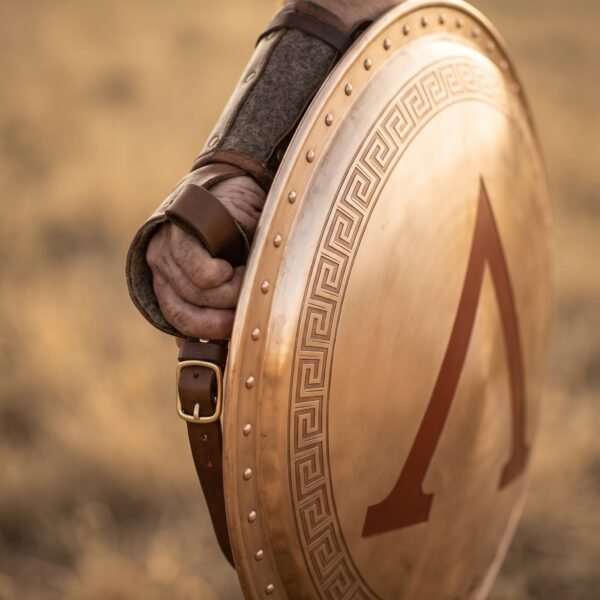
Crimsonward Hand Made Steel Faced Greek Hoplon Shield | 30 Inch Spartan Aspis | Bronze Meander Rim and Painted Crimson Lambda | Hoplite Display Gift | RK-1503
Original price was: $449.00.$359.20Current price is: $359.20.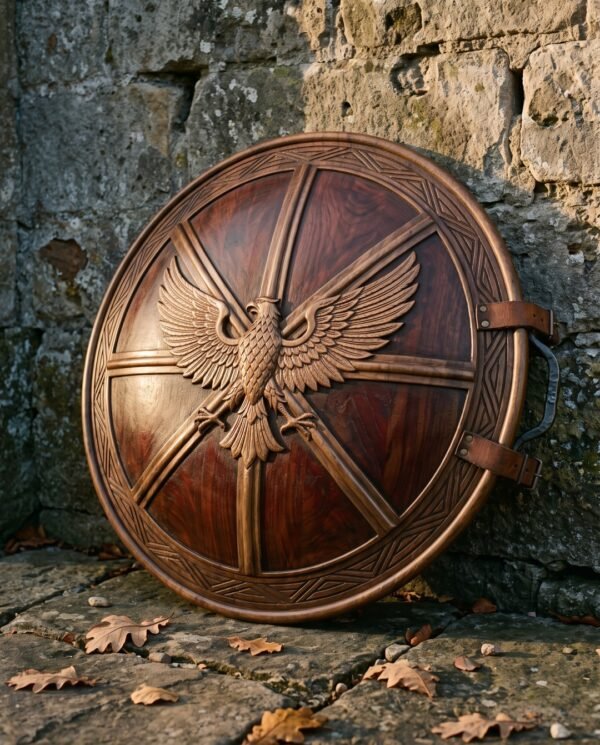
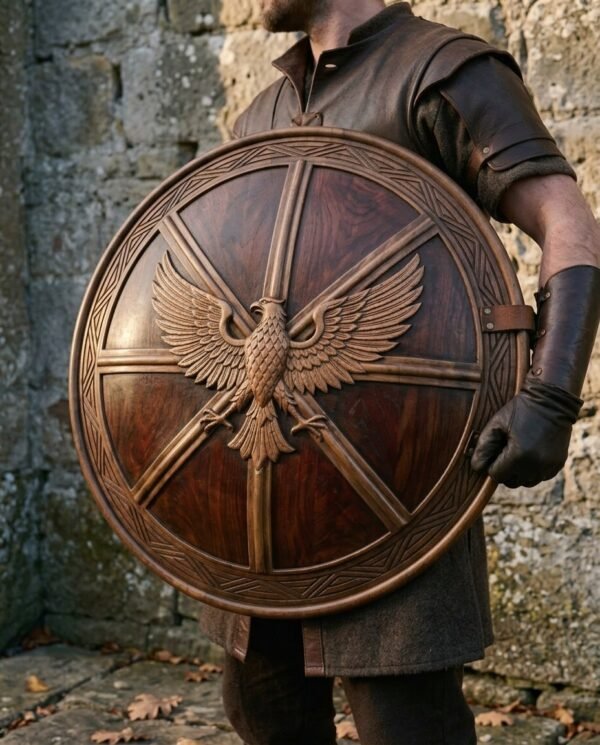
Aquilorn Hand Made Carved Hardwood Round Shield with Bronze Toned Roman Eagle | 24 Inch Diameter | Leather Arm Straps and Forged Grip Bar | Legionary Display Gift | RK-1987
Original price was: $349.00.$279.20Current price is: $279.20.Two shields, two ways of fighting
Look at a hoplon and a scutum side by side and you are looking at two armies arguing. Both boards are made of laminated wood, both are faced and rimmed, and both stop the same things. Everything else about them is different, and the differences all come from how the men behind them stood.
The hoplon, or aspis, is round and dished into a shallow bowl. It is carried on two fittings. A band at the centre, the porpax, takes your forearm, and a grip near the rim, the antilabe, takes your hand. That arrangement moves the load off your wrist and onto the whole arm, which is the only reason a board this heavy can be held up at all. It also means the shield cannot move far from your body, and it sticks out well past your left shoulder. In a phalanx that overhang covers the man on your left, and his covers you. The formation is the point. On your own a hoplon is an awkward thing to carry.
The scutum solves the problem differently. It is a tall rectangle curved on the vertical axis so it wraps around the torso, and it is held one handed with a horizontal grip behind a domed metal boss at the centre. That single grip makes it mobile. You can push it forward, shove with the boss, drop it to cover your legs or raise it over your head. The curve means an edge sliding down the face is deflected around your body rather than into it. A legionary with a scutum could fight in formation or alone, which the hoplite could not.
The shields in this collection
Five shields across three traditions, from a full sized curved scutum to a pair of carved round boards built to be looked at.
The Roman scutum
Built to 37 inches tall and shaped in proportion, curved on the vertical axis, with rounded top and bottom edges. The core is laminated timber, bent to the curve and sealed before painting. The face is hand painted in white on a black field with wings, thunderbolts and arrows, which is the standard legionary device pattern and reads well from a distance. A domed steel umbo is riveted through the centre of the board, with a horizontal leather grip behind it.
Two details make this one practical rather than purely decorative. The edge binding is a bone coloured rawhide style strip, and a spare strip comes with the shield, because edging is the first thing to take damage on any shield that gets used. A fitting kit of steel rivets, burrs and washers is supplied loose along with a spare grip strap, so a repair does not mean sending the shield anywhere.
Greek hoplon shields
Two aspides, both on a laminated hardwood core dished to a shallow bowl, and both listed as display, film and light reenactment pieces rather than full contact combat rated.
The larger is about 32 inches across with a bronze finished sheet spun and polished over the full face, an engraved meander border around the rim, and a painted black lambda on the front. Behind it is a hand painted Gorgoneion and a leather shoulder pad at the upper rim, with a bronze porpax forearm band at the centre and a leather antilabe grip at the rim. The rim itself is rolled and riveted through the body at regular intervals. Listed at about 14 to 16 pounds.
The smaller is about 30 inches across, faced in steel sheet spun and polished bright, with a bronze finished flange at the rim carrying an engraved meander and a ring of domed rivets. The device is a hand painted crimson lambda for Lakedaimon. It uses the same forearm band and rim grip arrangement, riveted through the body, and is listed at about 13 to 15 pounds.
Carved round shields
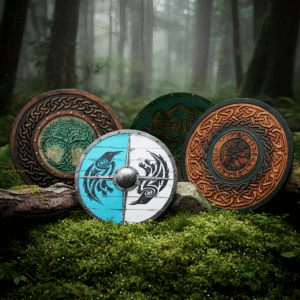
Two boards at 24 inches across, carved from hardwood rather than planked and faced, in a deep red brown stain with a six spoke frame worked in relief. Both are hand stained, sealed and waxed.
One carries a carved double headed eagle with an escutcheon on the chest, under a blackened steel rim cut with a running knotwork band. It ships with the rim fitted and is built as a display and wall piece.
The other carries a single eagle with wings displayed in a bronze tone, under a bronze toned steel rim cut with a chevron band, and it comes with two leather arm straps and a forged iron grip bar already fitted. That is the one to take if you want to hold it as well as hang it.
Sizes, facings and fittings across the range
Every figure below is taken from the specification panel of a piece on this page. These are built by hand from timber and sheet, so read the numbers as what to expect rather than as a promise to the millimetre. Where a listing gives no weight, the table says so instead of guessing.
| Shield | Core | Facing and rim | Size | Fittings | Listed weight |
|---|---|---|---|---|---|
| Roman scutum, curved | Laminated timber, bent to the curve and sealed | Hand painted face, rawhide style edge binding | 37 in tall | Domed steel umbo, horizontal leather grip, fitting kit | Not listed |
| Greek hoplon, bronze faced | Laminated hardwood, dished to a shallow bowl | Bronze finished sheet, rolled and riveted rim with meander | About 32 in across | Bronze porpax band, leather antilabe grip, shoulder pad | About 14 to 16 lb |
| Greek hoplon, steel faced | Laminated hardwood, dished to a shallow bowl | Steel sheet, bronze finished flange with meander and rivets | About 30 in across | Forearm band at the centre, leather grip at the rim | About 13 to 15 lb |
| Round shield, double headed eagle | Carved hardwood, six spoke frame in relief | Stained and waxed face, blackened steel rim with knotwork | 24 in across | Rim fitted, built as a wall piece | Not listed |
| Round shield, Roman eagle | Carved hardwood, six spoke frame in relief | Stained and waxed face, bronze toned steel rim with chevrons | 24 in across | Two leather arm straps and a forged iron grip bar | Not listed |
Weight, and how you carry it
A hoplon is carried on the arm, not the hand. Your forearm goes through the porpax at the centre and your fingers close on the antilabe at the rim, so the load spreads along the whole forearm and the shoulder takes most of it. Get that right and 15 pounds is manageable. Get it wrong, hold it out on the grip alone, and your shoulder will tell you within two minutes.
The leather shoulder pad at the upper rim of the larger hoplon is not decoration either. Tip the shield back so the rim rests on your shoulder and the arm comes off duty entirely. That is how a hoplite stood around waiting, and it is how you will get through a long day at an event.
The scutum is different. One hand, one horizontal grip, all the weight through your wrist, which is why the boss sits where it does and why the board is curved. The curve pulls the mass in around your forearm instead of hanging it out in front. Hold a scutum with a straight arm and it is exhausting. Tuck it against your shoulder and it is a wall you can walk behind.
The 24 inch round shields are the light option by a distance. A quarter of the diameter of a hoplon means roughly a quarter of the board, and the one with arm straps and a grip bar can be worn for an afternoon without complaint.
Cores, facings and rims
Every shield here is built on wood. The scutum and both hoplons use a laminated core, which is thin layers glued with the grain running in different directions, and that is what makes a curved or dished board hold its shape instead of splitting along a grain line. Solid boards split. Laminated ones do not, which is why the technique is as old as it is.
Facings do two jobs. A bronze or steel sheet over the whole face turns an edge before it reaches the timber and it holds the board together after the wood underneath has taken damage. Paint over sealed timber, as on the scutum, is lighter and easier to repair, and it lets you carry a device that reads across a field.
Rims take the punishment. The hoplons use a rolled rim riveted through the body, and the round shields use a steel rim over the edge of the carved board. The scutum uses rawhide style binding, which is the traditional answer and the one most likely to want attention, hence the spare strip in the box. Check the rivets around a rim once a season and reseat anything that has started to work loose before the rim opens up.
Grips, bosses and arm straps
The domed steel boss on the scutum is riveted straight through the board, and the grip sits behind it in the hollow. That hollow is the whole design: your knuckles live inside the dome, so a strike landing on the boss loads the metal and the rivets rather than your hand. Keep an eye on those rivets, because they are what stands between a boss and your fingers.
The hoplon fittings are a band and a grip rather than a boss, and they are riveted through the body at the centre and the rim. There is no metal cup over the hand at all, which is fine, because a hoplite was never punching with the face of the shield.
The round shield with straps carries two leather arm straps and a forged iron grip bar on the back, which is the arrangement that lets a lighter board be moved quickly. The other round shield comes with the rim fitted and nothing on the back, which is honest about what it is for.
Care and storage
Wood moves. Keep any shield here out of direct heat and away from a radiator, and do not leave one leaning in a garage that swings from freezing to warm, because a laminated board that gets damp and then dries fast will lift at a seam. Stable humidity matters more than temperature.
Steel facings and rims will rust if you let them. Wipe them down, keep a light film of oil or a wax polish on bare steel, and dry the shield properly if it has been out in rain. Bronze finished sheet does not rust but it will dull, and a metal polish on a cloth brings it back if you prefer it bright.
Paint and stain want the least of all. Keep the painted face out of long direct sun, because red and crimson fade faster than anything else in a device, and wax the stained round shields once a year to keep the finish even. Rawhide edge binding dries and stiffens over years, so oil it lightly with the same dressing you use on a scabbard.
Devices, painting and engraving
Most of what you see on these faces is already hand work. Wings and thunderbolts on the scutum, a lambda on each hoplon, a Gorgoneion painted on the inside of the larger one, and carved eagles under a stained finish on the round boards. Meander borders are engraved into the rims of both hoplons.
Metal fittings can be engraved after they arrive in the United States, which in practice means a boss, a rim flange or a grip bar rather than the painted face. Text engraving is 19 dollars, a symbol is 39 dollars and a family crest is 49 dollars. Engraving is permanent and an engraved piece cannot be returned, so send the exact spelling and read it back before you order.
Where these shields come from and how they ship
Ransack Viking is a US company based in Chicago, Illinois. The pieces are handmade in the Czech Republic, then imported, inspected and shipped from Chicago. Engraving is done in the US after arrival.
Every board is built and finished by hand, so the exact line of a painted device, the depth of a carving and the tone of a stain vary between two shields of the same name. These are large parcels. A 37 inch scutum and a 32 inch hoplon both ship in oversized boxes, so clear some floor before the delivery arrives and check the rim and rivets before you hang anything.
How to choose
For a legionary impression, the scutum is the only real answer here, and the fitting kit and spare edge strip mean it can be maintained rather than retired after one season.
For a hoplite impression, choose by facing. Bronze over 32 inches is the more historically expected look and the heavier board. Steel over 30 inches is brighter, slightly lighter and reads sharper under lights.
For a wall, the carved round shields do more with less space. Twenty four inches fits above a door or over a mantel where a 32 inch hoplon simply will not.
Browse related categories
- Round shields across the wider range
- Kite shields and bucklers
- Shield bosses and fittings
- Viking shields, planked and painted
- Roman and Greek helmets to match
- Scale and lamellar armour
- Gladius short swords of the legions
- Short swords across the wider range
Guides worth reading first
- Shields explained, from construction to carry
- Choosing a shield for display
- Round shield vs kite shield
- How to display arms and armour at home
- Armour explained, from mail to plate
- Gifts for reenactors
Frequently asked questions
What is the difference between a hoplon and a scutum?
The hoplon is a round dished Greek shield carried on a forearm band and a rim grip, built for standing in a phalanx. The scutum is a tall Roman board curved around the body and held one handed behind a central boss, which makes it far more mobile and lets it be pushed forward.
How heavy are these shields?
The two hoplons are listed at about 14 to 16 pounds for the 32 inch bronze faced board and about 13 to 15 pounds for the 30 inch steel faced one. The scutum and the two round shields have no listed weight, so no figure is quoted for them here.
Can these be used for full contact reenactment?
No. Both hoplons are listed for display, film and light reenactment and are not rated for full contact combat, and the scutum is listed the same way. Fighting groups set their own construction standards and these are built to be carried and looked at rather than hit.
What are the porpax and the antilabe?
They are the two fittings on the back of a hoplon. The porpax is the band at the centre that your forearm passes through, and the antilabe is the grip near the rim that your hand closes on. Together they put the weight on your arm instead of your wrist.
Why is there a face painted inside one of the shields?
The Gorgoneion on the inside of the bronze faced hoplon faced the man behind you in the formation rather than the enemy. Decorating the inner face was normal, and if you hang that shield with the back showing you get the more interesting side of it.
Can I hang these on a wall?
Yes, and hanging is better for them than standing on the floor, which slowly flattens one point of the rim. Fix into something solid and remember that a metal faced board at 15 pounds needs a proper fixing rather than a picture hook.
What maintenance does a shield need?
Keep the wood out of direct heat and away from damp, wipe and oil any bare steel, and check the rim rivets once a season and reseat anything loose. Keep painted faces out of long sun because red fades first, and treat rawhide edging with a leather dressing so it does not dry hard.
Where are these shields made?
They are handmade in the Czech Republic, then imported, inspected and shipped by Ransack Viking from Chicago, Illinois. Any engraving is added in the United States after arrival.
Featured pieces
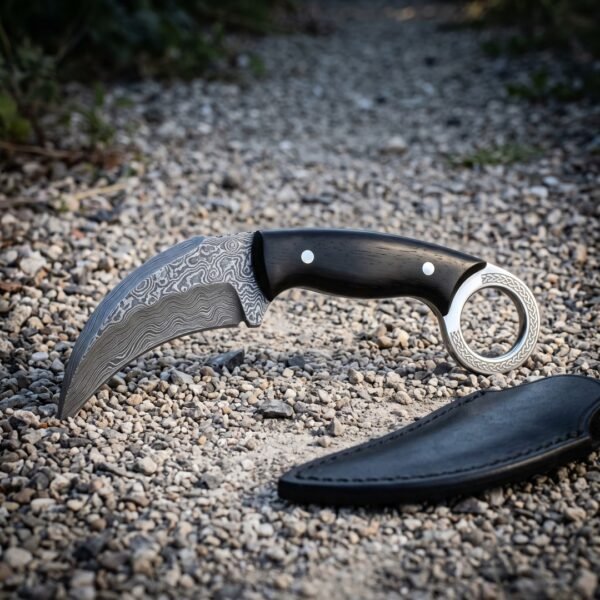 Clawshade Hand Forged 1095 and 15N20 Damascus Karambit Knife with Ebony Handle & Knotwork Engraved Finger Ring
Original price was: $199.00.$159.20Current price is: $159.20.
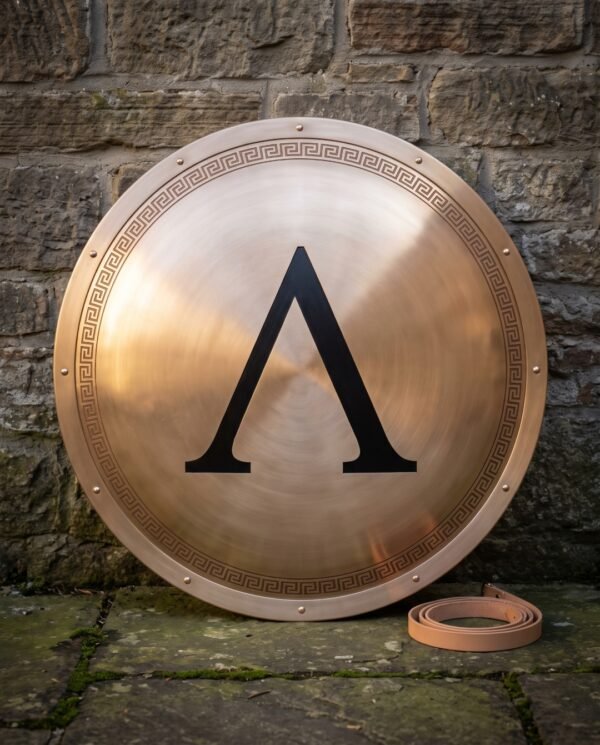 Gorgonward Hand Made Bronze Faced Greek Hoplon Shield
Original price was: $479.00.$383.20Current price is: $383.20.
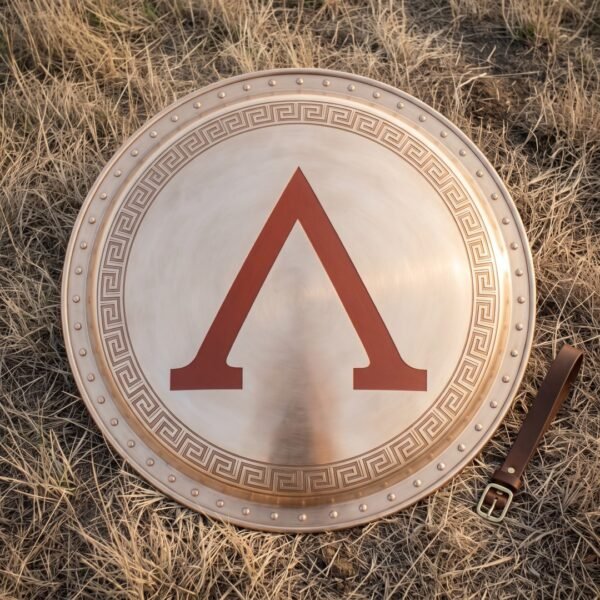 Crimsonward Hand Made Steel Faced Greek Hoplon Shield
Original price was: $449.00.$359.20Current price is: $359.20.
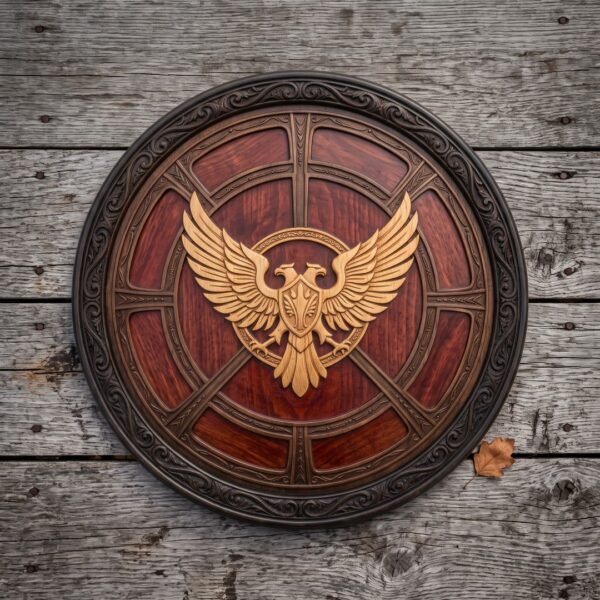 Twinhawk Hand Made Carved Hardwood Round Shield with Double Headed Eagle
Original price was: $389.00.$311.20Current price is: $311.20.