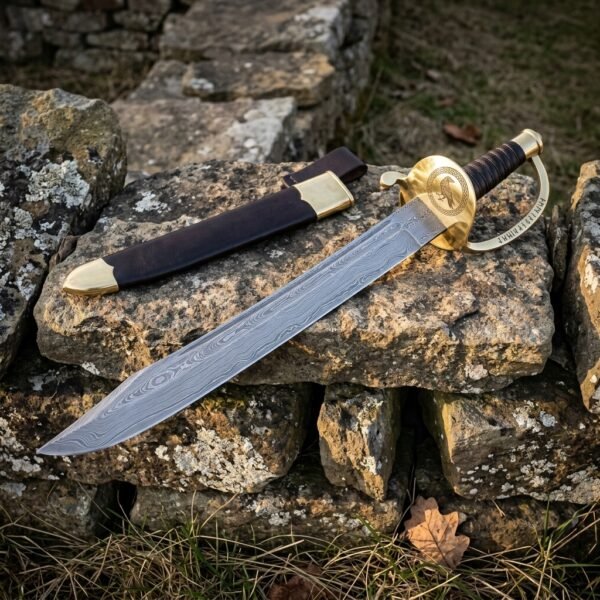
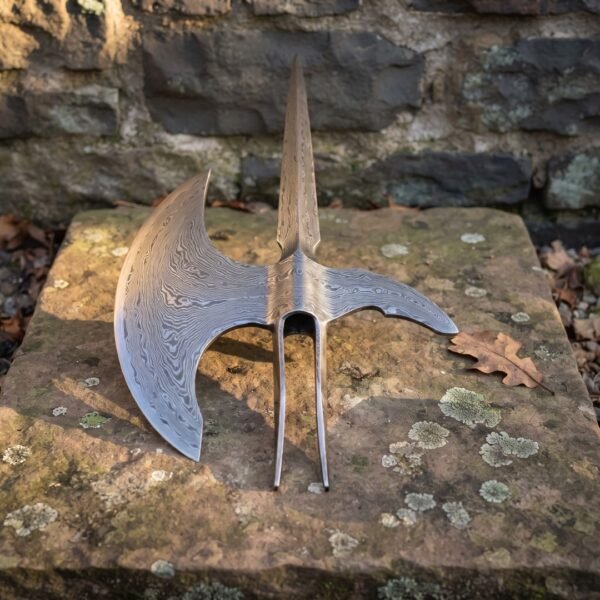
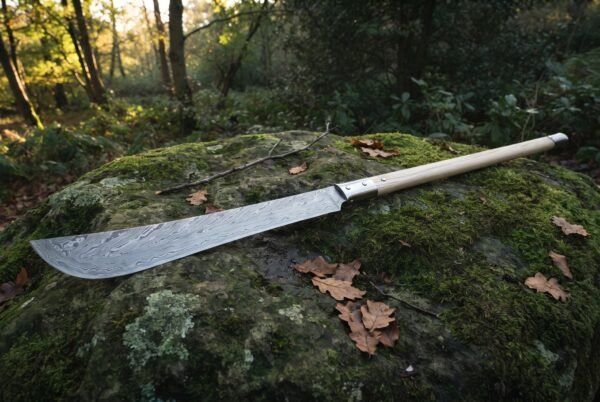
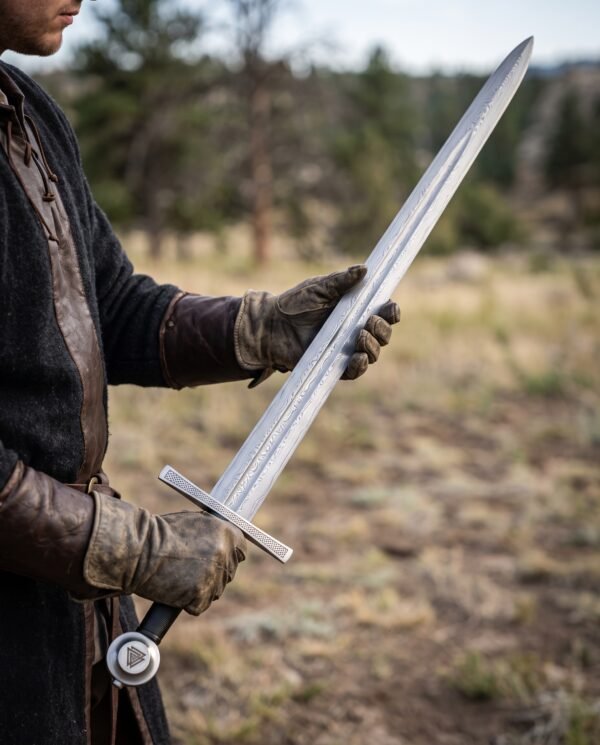
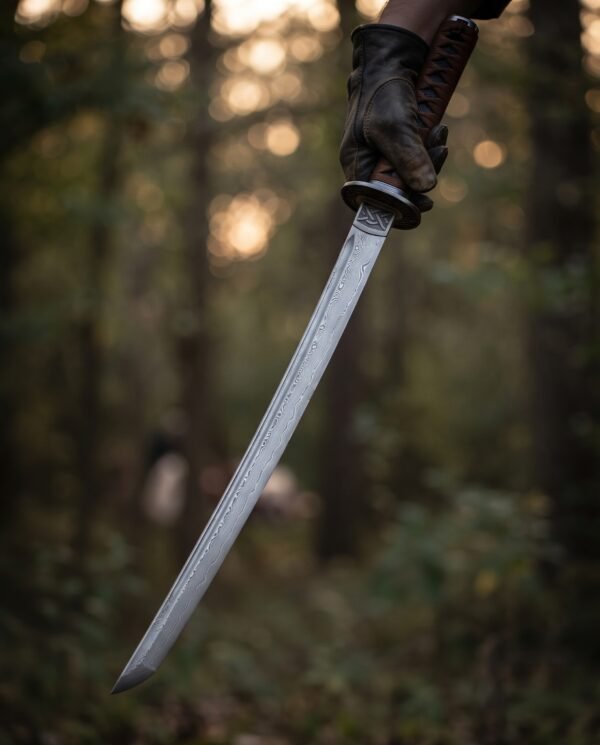
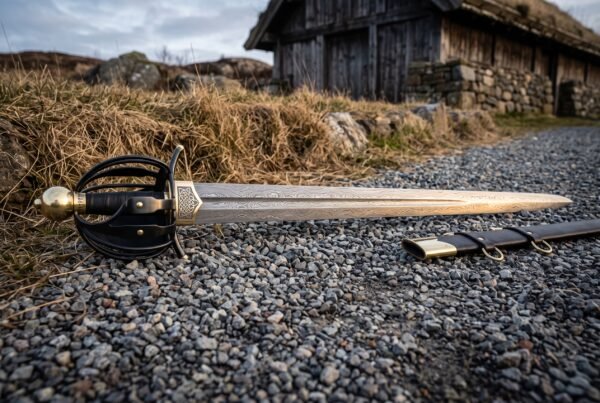
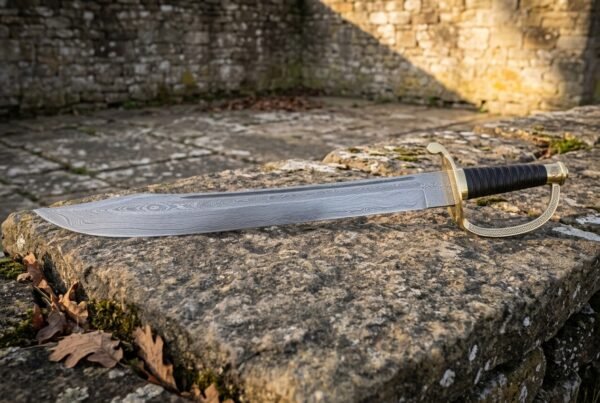
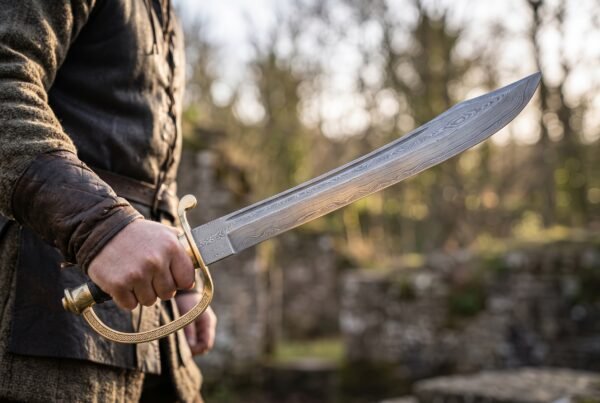
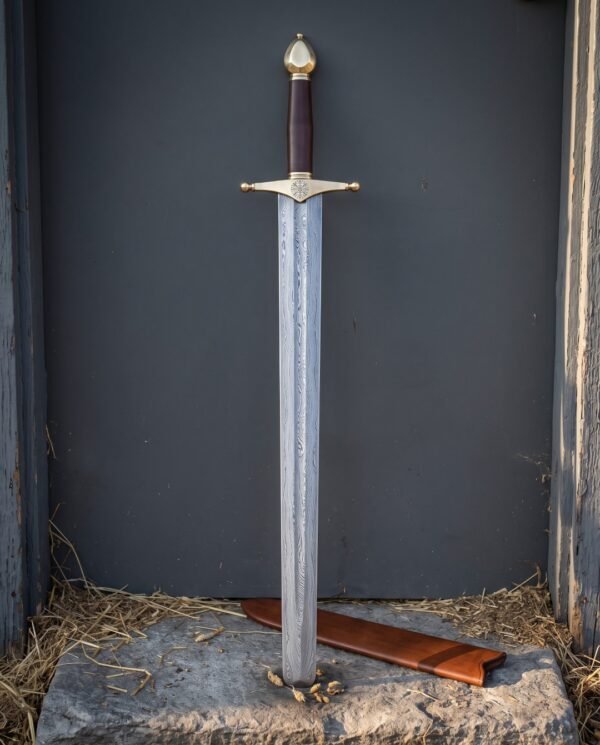
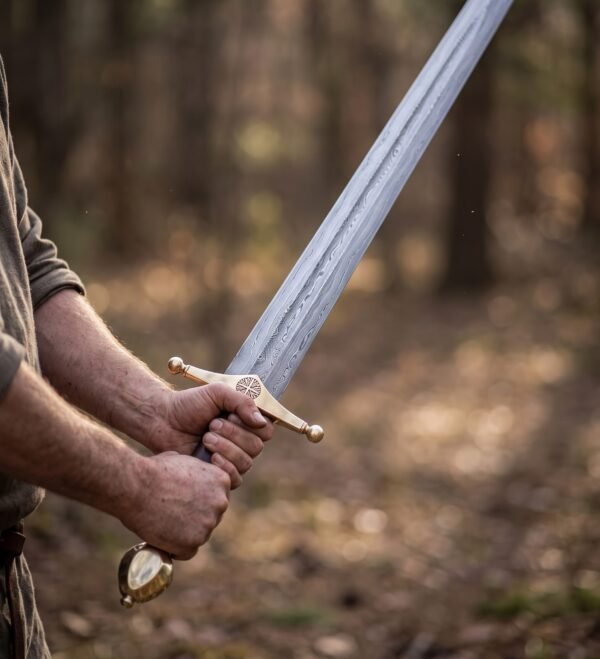
Damascus swords are the pattern welded half of the sword range here. Every blade is 1095 and 15N20 forge welded in alternating layers, drawn out, folded and etched so the two alloys read as light and dark bands down the steel. Hardness across the group runs 58 to 60 HRC, a little above the plain 1095 blades elsewhere in the catalogue.
The shapes follow the rest of the sword range rather than sitting apart from it. Viking swords with lobed and wheel pommels, single handed arming swords, hand and a half longswords, katana and wakizashi, gladius, falchions, messers, cutlasses, sabres, rapiers and a run of flame bladed flamberges all appear in Damascus. Overall lengths start around 25 inches on the short swords and reach about 46 inches on the longswords, with most single handed pieces sitting between 33 and 38 inches.
Buy on shape first and let the pattern follow, since every blade here carries one. Then read the edge line in the product’s own specification table, because some pieces are finished sharp and some are ground as display edges.
A custom engraving can go on the blade, guard or pommel of most pieces here, selected on the product page.
A Damascus sword can also be commissioned. Build one to your own spec and choose the pattern, the blade length, the guard, the pommel and the scabbard.
Free US shipping
On most pieces. Heavier and oversized ones carry a flat charge.
Hand Forged
Heated, hammered and ground by hand.
Engraving available
Names, dates or Norse runes on most pieces.
Ships from Chicago
Inspected and dispatched from our Chicago warehouse. No import duty, no customs delay on US orders.
Damascus Swords
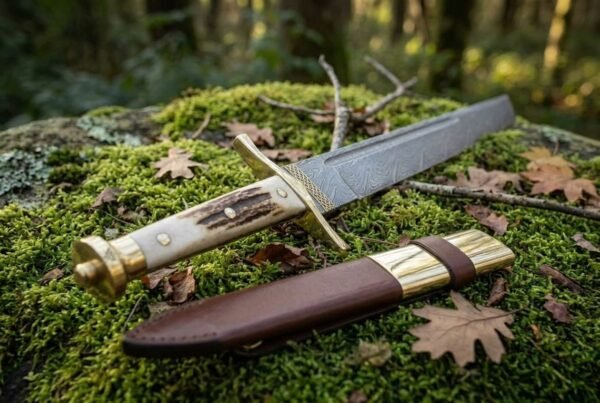
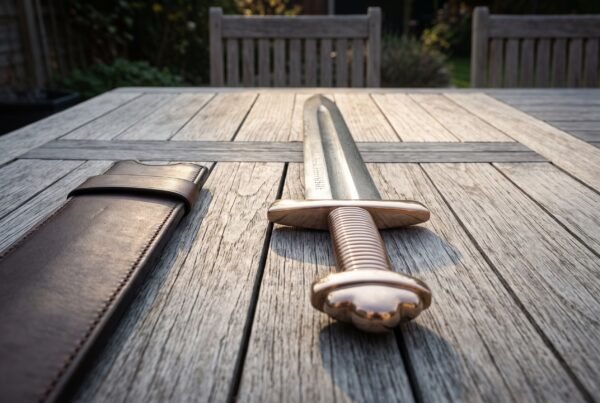
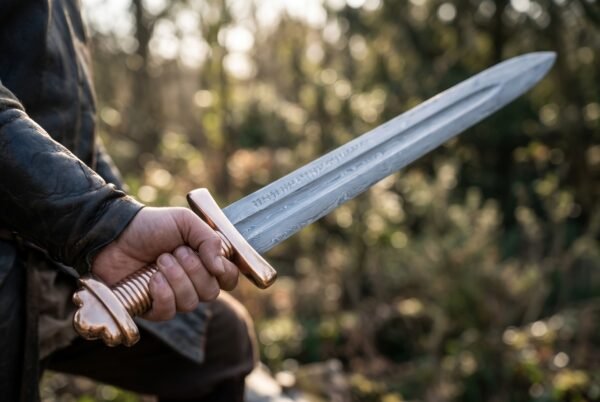
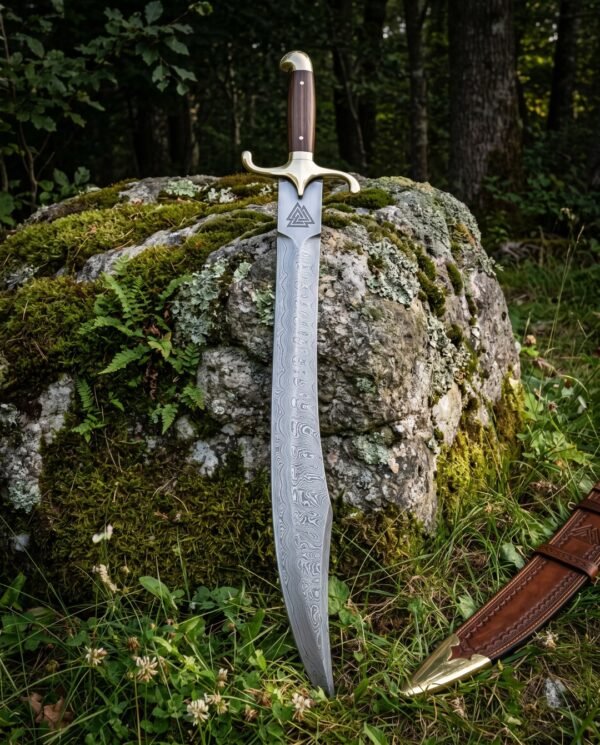
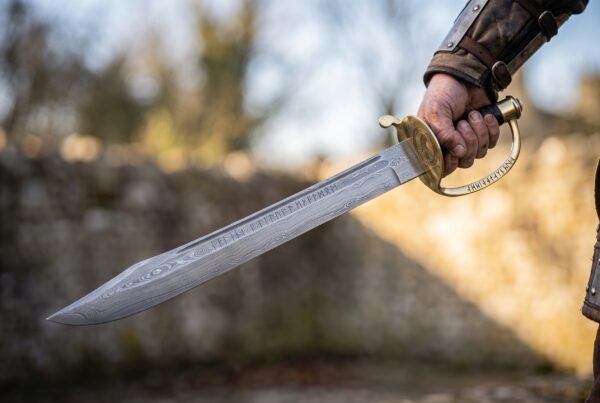
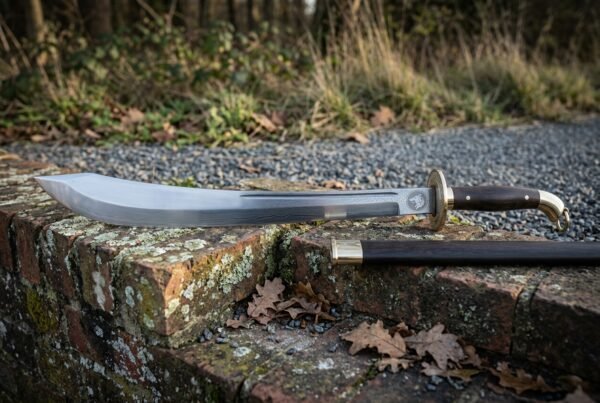
What Damascus means on this page
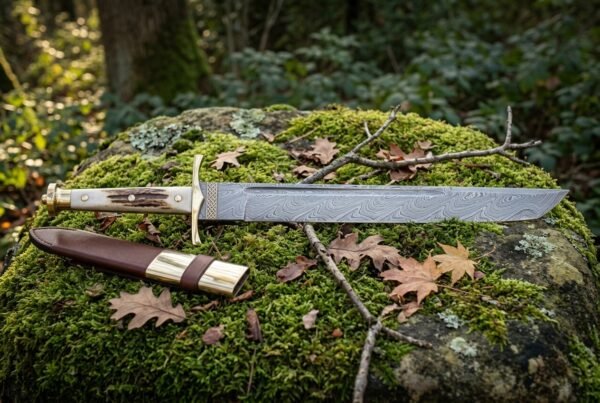
Damascus here is pattern welded steel, used in the modern sense of the word rather than the historical one. Two alloys are stacked into a billet, brought to welding heat and forge welded into a single bar. That bar is drawn out, folded back on itself and welded again, and the sequence repeats until the layer count is where the smith wants it. Only then is the bar forged down into the shape of a sword and ground.
The two alloys are 1095 and 15N20. Both are high carbon steels and both move in much the same way under the hammer, which is exactly why they weld cleanly to one another. What separates them is nickel. 15N20 carries roughly two percent of it, 1095 carries none worth mentioning. Nickel resists the acid used at the end of the process, so when the finished blade is etched the 15N20 layers stay bright and the 1095 layers go dark. The pattern is simply the edge of every fold, cut open by the grinder and brought up by the acid.
Blades on this page are hardened to 58 to 60 HRC. That sits a step above the plain 1095 blades elsewhere on the site, which run 54 to 58 HRC. The extra hardness buys edge retention and costs a little toughness, which is why the plain carbon blades remain the better choice for anything that will be used hard and sharpened often.
The older meaning of the word describes a different material. Wootz was a crucible steel from South Asia whose figure came from carbide banding inside one alloy rather than from welded layers, and it has not been produced at scale for well over a century. Every modern blade sold as Damascus is pattern welded.
How the pattern gets its shape
Layer count sets the fineness of the pattern and very little else. A billet folded a few times gives broad, lazy bands. Fold it further and the bands tighten into a close grain that reads almost as a texture at arm's length. Past a certain point the layers become too thin to see without leaning in, which is why an extremely high layer count is not automatically a better blade.
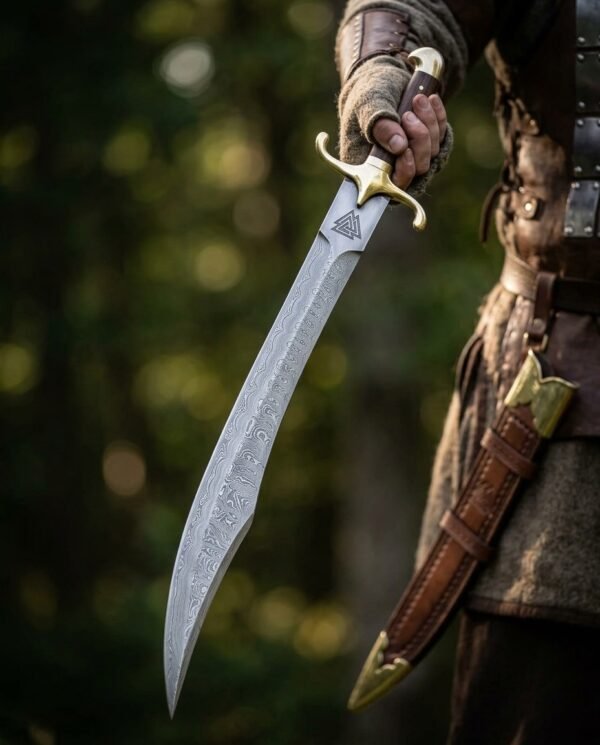
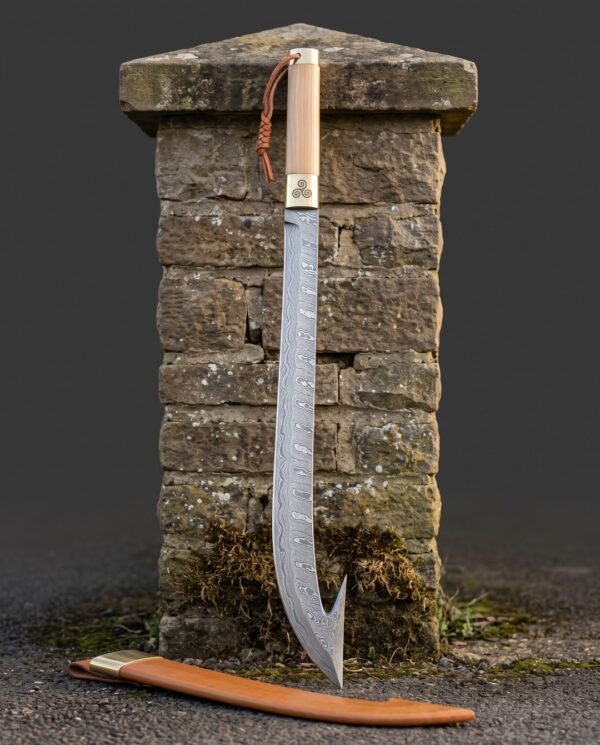
What actually decides the look is what happens to the bar between the last weld and the grinder. Left alone, the layers run straight and the blade shows a plain flowing figure. Cut grooves across the bar and forge them flat again and the lines pull into rungs, the ladder pattern. Punch or drill dimples and flatten them and the layers rise into concentric rings, which is where raindrop comes from. Twist the bar along its length before drawing it out and the figure spirals. Every one of these is done to the steel before the sword exists, which is why the pattern follows the geometry of the blade rather than sitting on top of it.
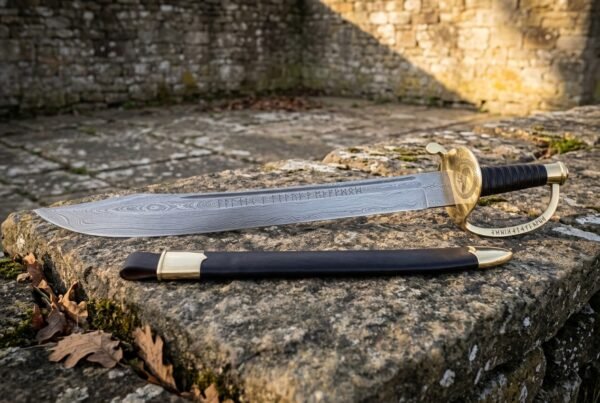
Grinding matters as much as forging. The pattern you see is a cross section, so a deep fuller or a steep bevel cuts through the layers at a different angle and changes the figure along that stretch of blade. That is one of the honest signs of a forged bar rather than a printed surface. Each product page states the finish for that specific sword.
The sword shapes offered in Damascus
This is not a separate family of swords. It is the same range of shapes as the rest of the catalogue, forged from a pattern welded bar instead of a plain one, so pick the shape you want first.
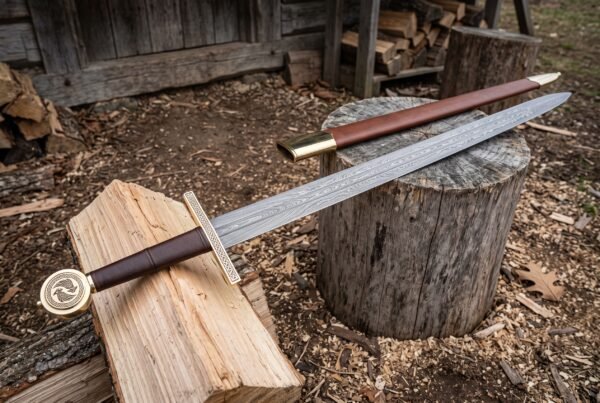
Viking swords
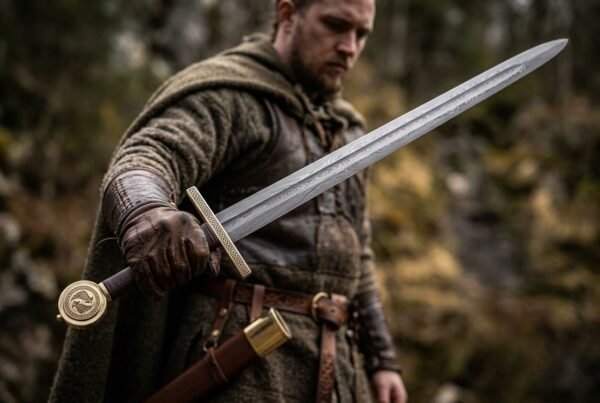
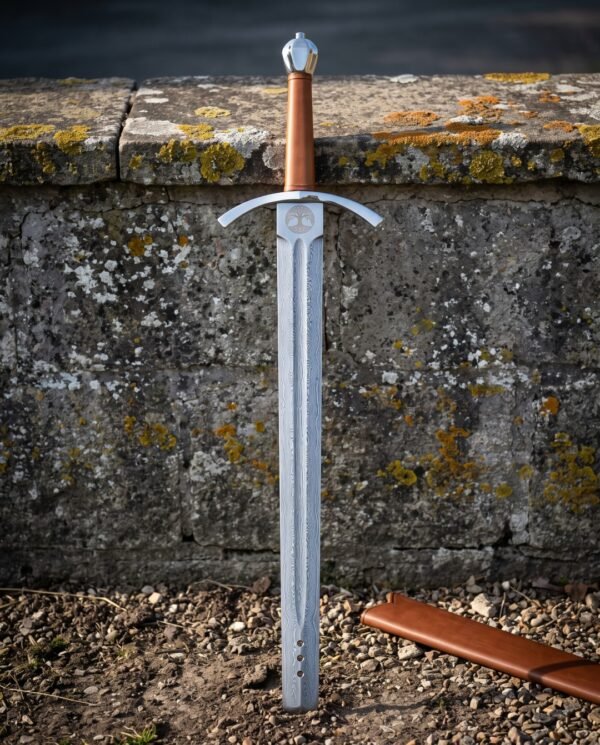
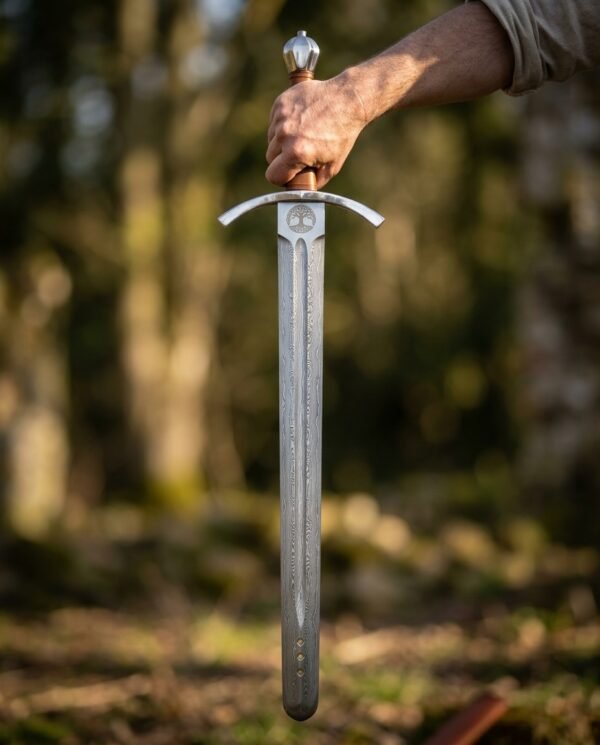
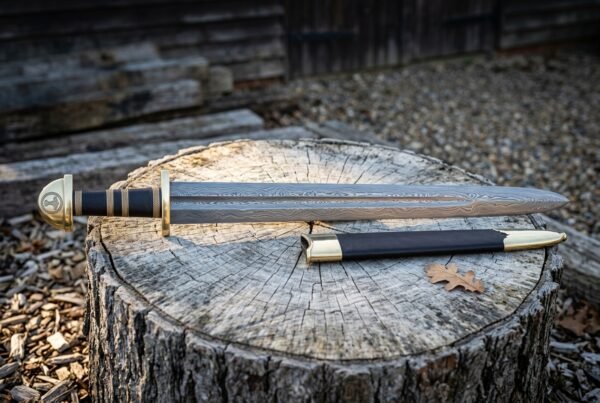
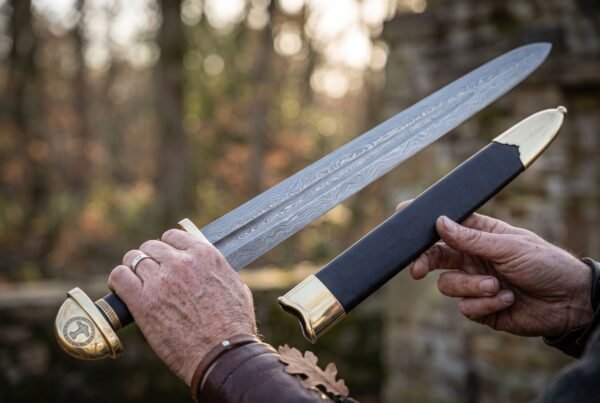
The largest group here. Broad double edged blades with a long central fuller, short single handed grips and the pommel forms that define the type, lobed, tea cosy, brazil nut and disc. Overall lengths run 33 to 38 inches with 27 to 31 inches of blade, and bare weights sit around 2 lb 10 oz to 2 lb 14 oz. Guards are short and straight, often blackened, and most ship with a leather scabbard. A Damascus Viking sword is the single most requested piece on this page and the one that photographs best on a wall.
Arming swords
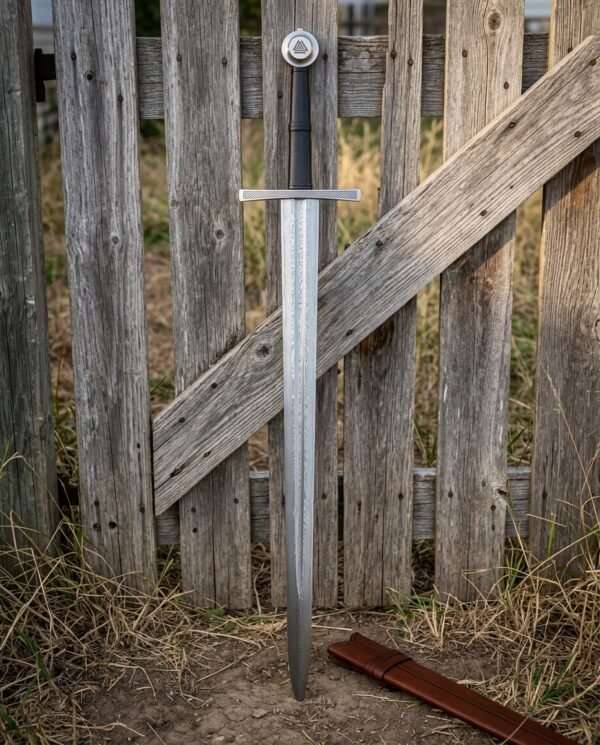
The knightly single hander that followed the Viking sword. Straighter, more tapered, with a longer cross and a wheel or scent stopper pommel. In Damascus they run 35 to 38 inches overall with 29 to 32 inches of blade at around 2 lb 9 oz. If you want one medieval sword and you want it to look like the thing on a church effigy, this is the shape.
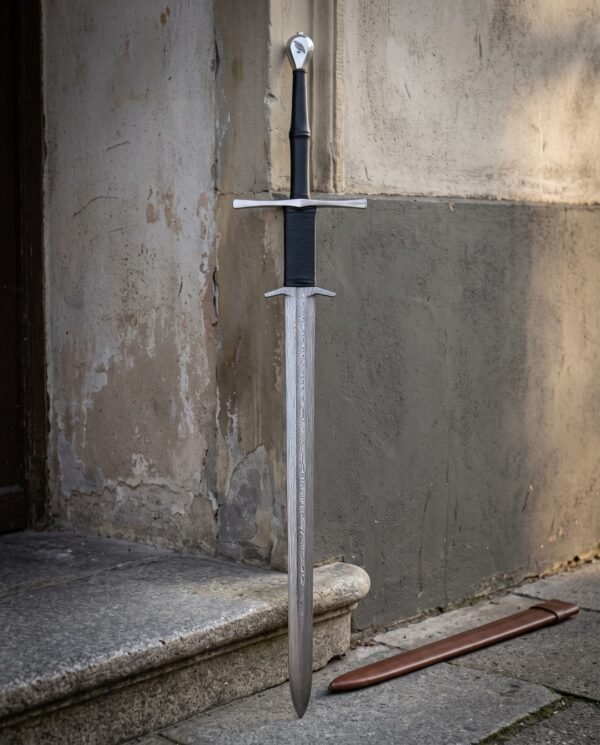
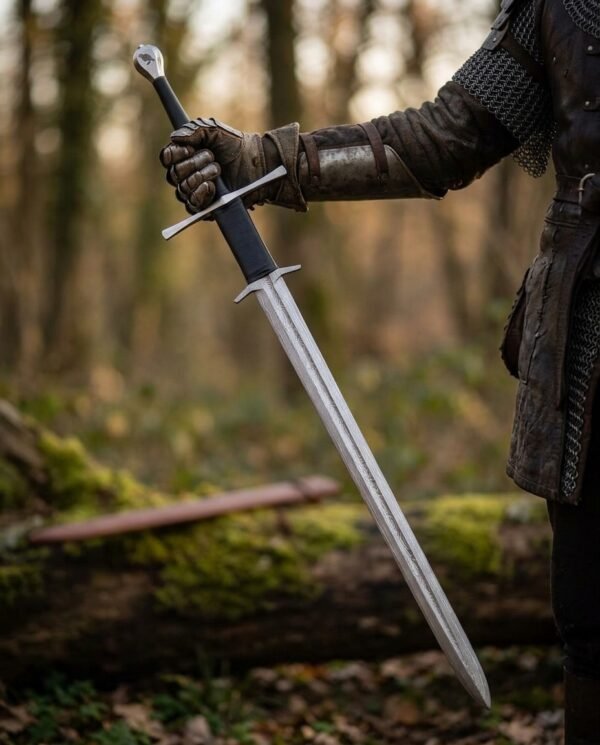
Longswords
Hand and a half hilts with room for the second hand on the grip and the pommel. The Damascus longswords here measure 44 to 46 inches overall with 33 to 35 inches of blade and weigh about 3 lb 6 oz. The extra length reads very differently in a room than a single hander does, so measure your wall before you buy one.
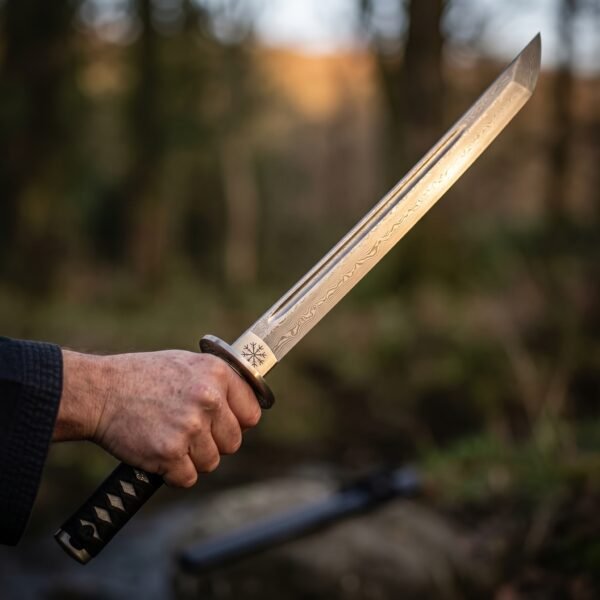
Katana and wakizashi
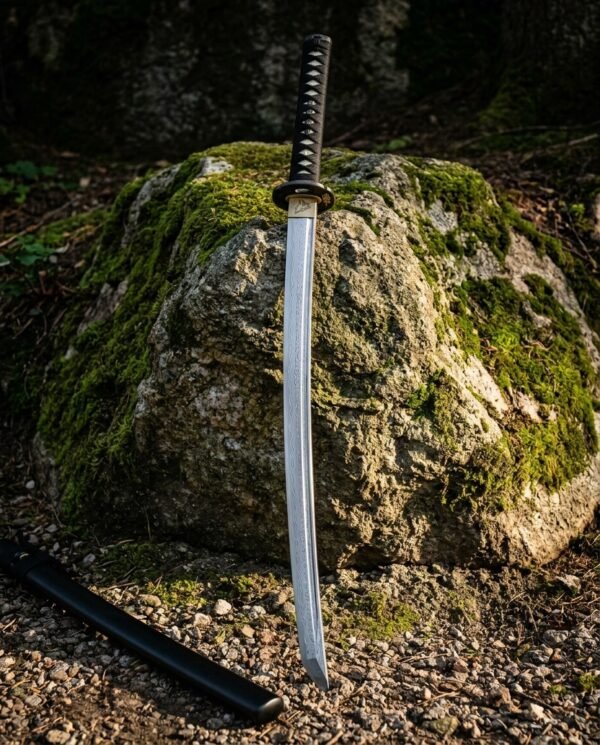
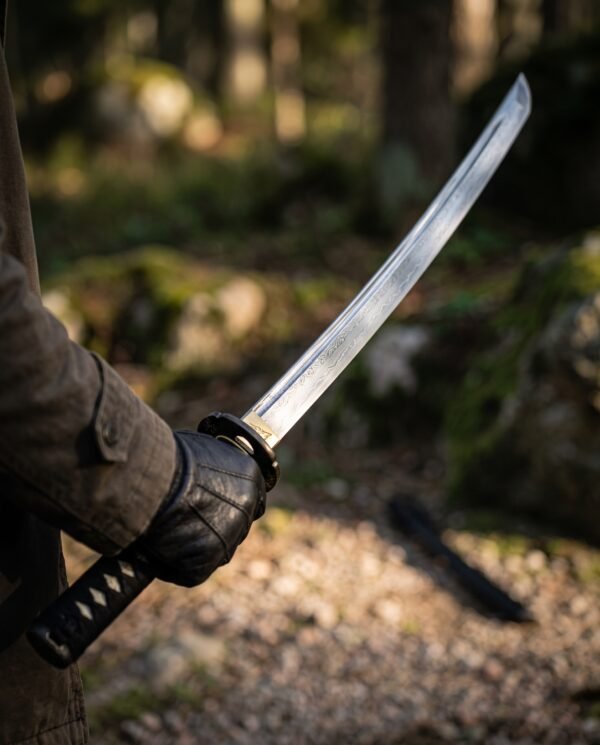
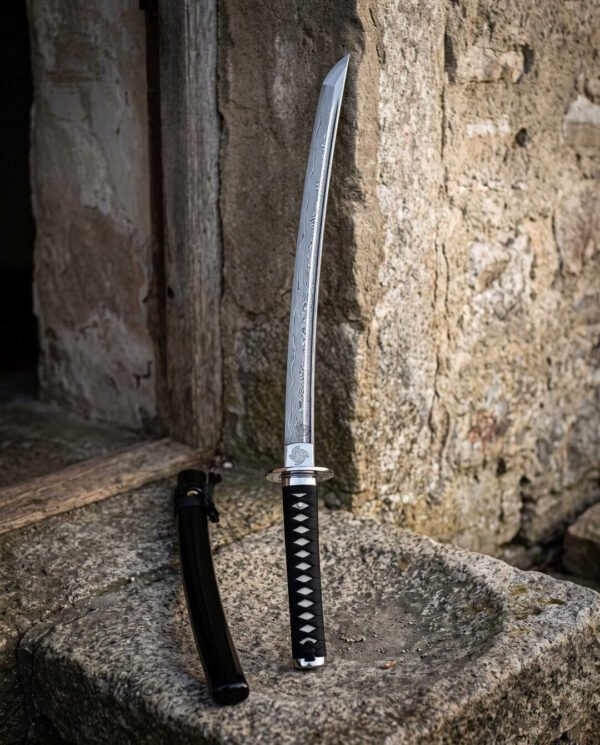
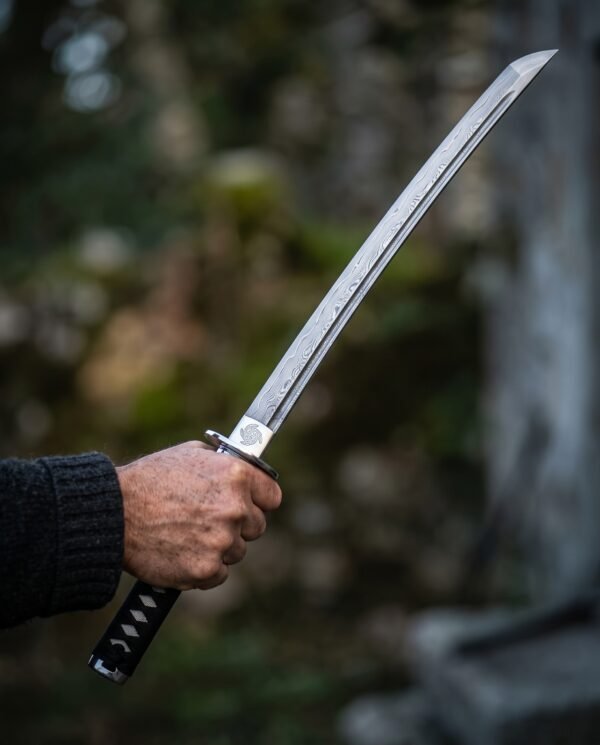
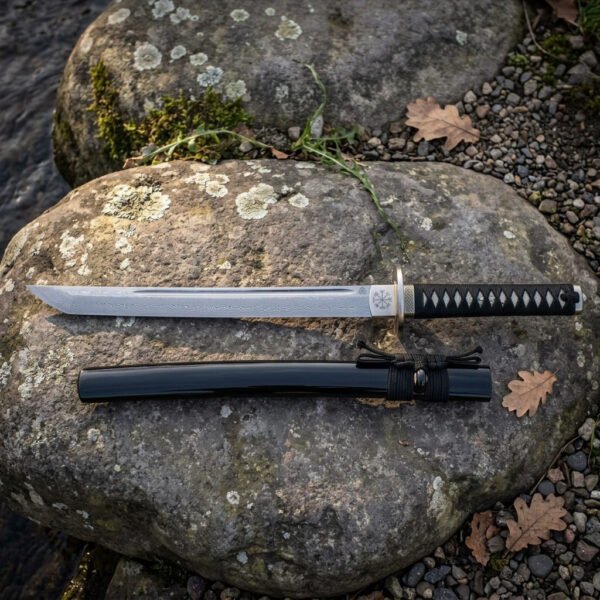
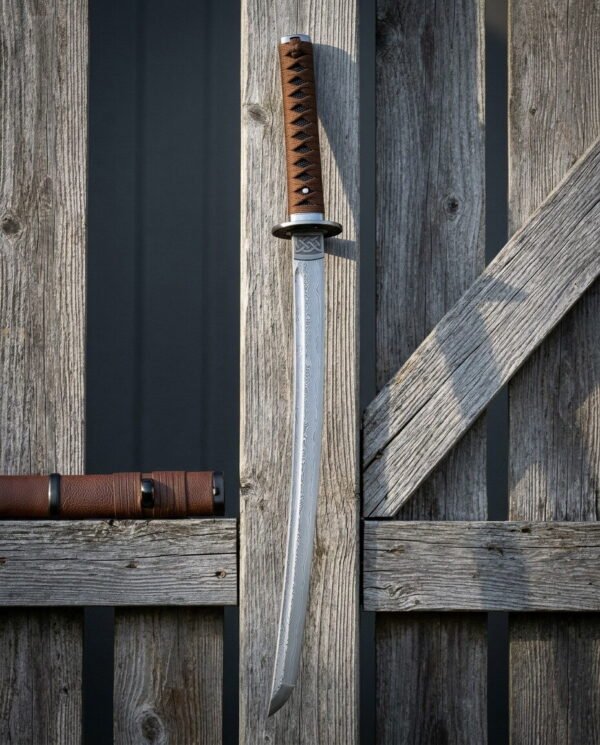
Curved single edged Japanese shapes with the fittings that go with them, habaki, tsuba, wrapped tsuka and a lacquered or wrapped saya. Overall lengths run 28 to 40 inches with 19 to 28 inches of blade, and weights from about 1 lb 12 oz on the shorter pieces to 2 lb 10 oz bare on the full katana. A pattern welded katana will not show a genuine hamon, because a hamon comes from differential hardening rather than from folding, and the two are separate processes.
Gladius and short swords
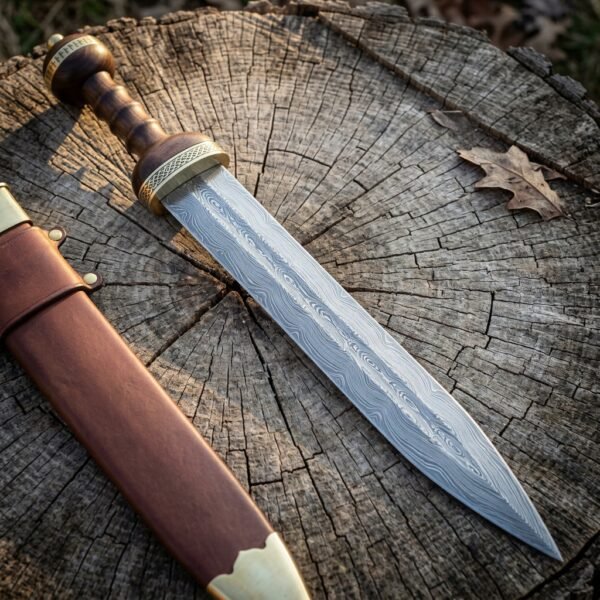
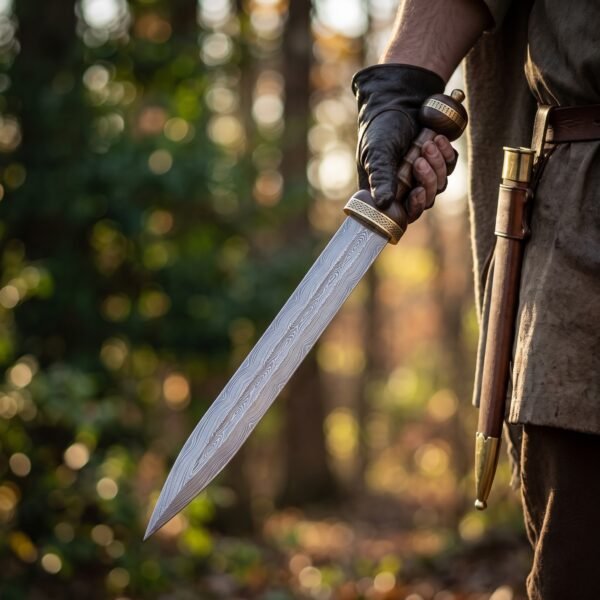
Compact thrusting and cutting blades. The gladius pieces sit at 26 to 28 inches overall with 19 to 21 inches of blade at about 2 lb 2 oz. The broader short sword group spans 25 to 38.5 inches overall with 19 to 31.5 inches of blade and weighs around 1 lb 14 oz to 1 lb 15 oz. These are the easiest swords here to display on a shelf rather than a wall.
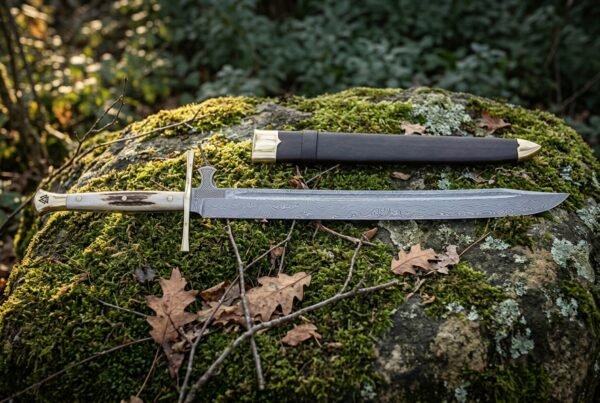
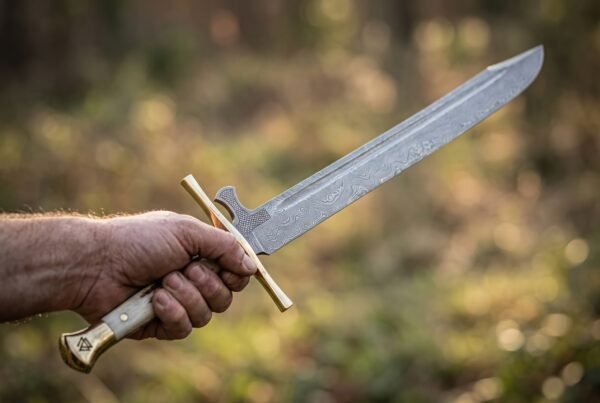
Falchions, messers, cutlasses and sabres
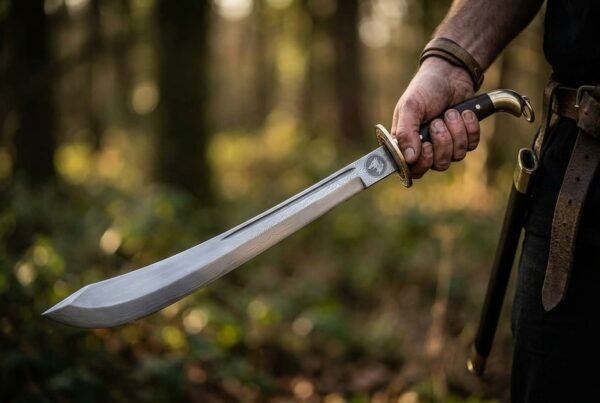
Single edged cutting blades with a heavy forward section. Falchions and messers here measure 29 to 32 inches overall with 23 to 25 inches of blade at roughly 2 lb 5 oz to 2 lb 8 oz. Cutlasses and sabres run 28 to 37 inches overall with 22 to 31 inches of blade, and the sabres carry curved single edged profiles with knuckle protection on several pieces.
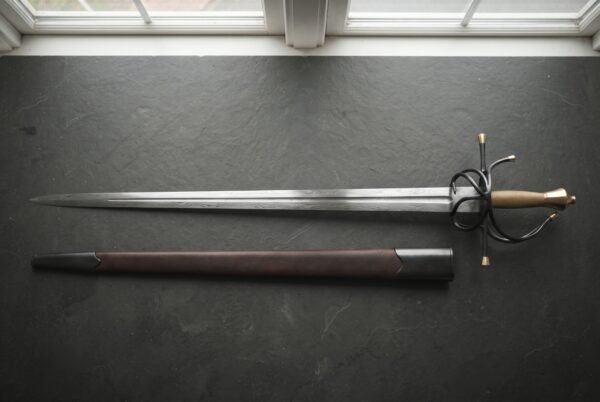
Rapiers and swept hilts
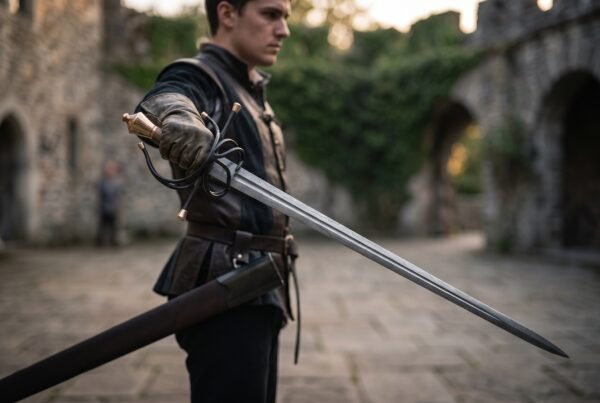
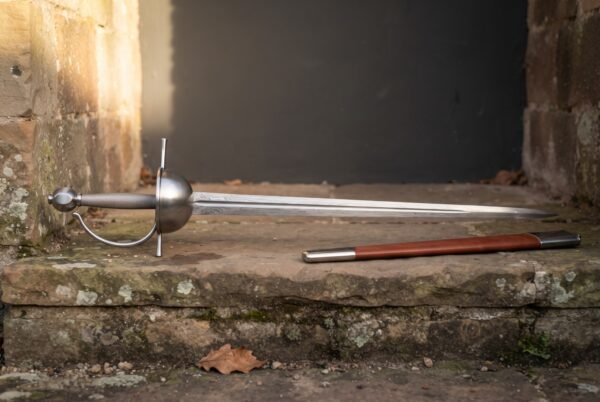
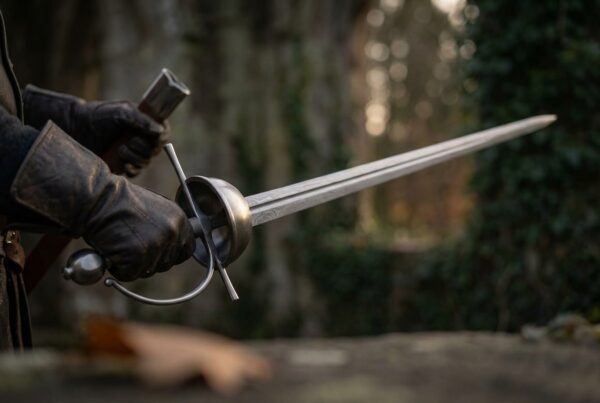
Long, narrow and thrust oriented, 43 to 45 inches overall with 35.5 to 37.5 inches of blade. The interest here is in the hilt rather than the steel, since the rings, side bars and knuckle bow are the reason the type exists at all.
Flamberges
Flame bladed swords with regular undulations running the full length of the blade, 27 to 40 inches overall with 20 to 32 inches of blade. On an etched Damascus bar the waves and the layer lines interact, and the result is the busiest surface on this page. It is a piece you buy because you like how it looks.
Lengths and weights across the range
Every figure below is taken from the specification panel of a sword on this page. These are hand forged pieces, so two swords of the same name will differ slightly. Read the numbers as what to expect rather than as a guarantee.
| Type | Overall length | Blade length | Steel and hardness | Bare weight | Best for |
|---|---|---|---|---|---|
| Viking sword | 33 to 38 in | 27 to 31 in | 1095 and 15N20 at 58 to 60 HRC | 2 lb 10 oz to 2 lb 14 oz | Norse display and collections |
| Arming sword | 35 to 38 in | 29 to 32 in | 1095 and 15N20 at 58 to 60 HRC | About 2 lb 9 oz | Single handed medieval kit |
| Longsword | 44 to 46 in | 33 to 35 in | 1095 and 15N20 at 58 to 60 HRC | About 3 lb 6 oz | Two handed reach and wall presence |
| Katana and wakizashi | 28 to 40 in | 19 to 28 in | 1095 and 15N20 at 58 to 60 HRC | 1 lb 12 oz to 2 lb 10 oz | Japanese shapes on a stand |
| Gladius | 26 to 28 in | 19 to 21 in | 1095 and 15N20 at 58 to 60 HRC | About 2 lb 2 oz | Roman kit and reenactment |
| Short sword | 25 to 38.5 in | 19 to 31.5 in | 1095 and 15N20 at 58 to 60 HRC | 1 lb 14 oz to 1 lb 15 oz | Shelf display and compact carry |
| Falchion and messer | 29 to 32 in | 23 to 25 in | 1095 and 15N20 at 58 to 60 HRC | 2 lb 5 oz to 2 lb 8 oz | Single edged cleaving profiles |
| Cutlass and sabre | 28 to 37 in | 22 to 31 in | 1095 and 15N20 at 58 to 60 HRC | Not listed | Curved single edged shapes |
| Rapier | 43 to 45 in | 35.5 to 37.5 in | 1095 and 15N20 at 58 to 60 HRC | Not listed | Swept hilt display |
| Flamberge | 27 to 40 in | 20 to 32 in | 1095 and 15N20 at 58 to 60 HRC | Not listed | Flame blades and pattern on pattern |
One thing is worth noticing in that table. Blade length and overall length do not move together in a fixed ratio, because a two handed grip eats several inches that a single hander does not.
Sharpened or display edge
Swords here are finished one of two ways and the difference is decided piece by piece, not by shape or by steel. Some carry a sharpened edge. Others are ground with a display edge, blunt along its length and often with a rounded point. The specification table on each product page states which one you are looking at, and that table is the answer.
A display edge is not a lesser piece of work. It is a deliberate choice for a sword that will hang on a wall in a house where people live, and it removes the most common way anyone gets hurt by a decorative sword, which is picking it up carelessly. If you want an edge on a piece that shipped blunt, that is a job for a competent grinder and it will change the geometry, so think about it before you start.
Nothing on this page is sold for contact against another blade or against hard targets. Pattern welded steel at 58 to 60 HRC is hard, and hard steel chips. Treat these as collection and display pieces.
Grips, fittings and scabbards
Grips are leather over a shaped wooden core on most pieces, wrapped or smooth, in tan, brown, burgundy and black, with cord or wire wrapping on some. Fittings are steel, often blackened, sometimes with brass collars at either end of the grip. Blackened steel next to an etched Damascus blade is a deliberate contrast, since the dark fittings push the light layers of the blade forward.
Most swords ship with a fitted leather scabbard, and several include a steel throat and chape. A scabbard that fits snugly when new will loosen slightly as the leather settles, which is normal. Do not store a carbon steel blade inside a leather scabbard for months at a time. Leather holds moisture against steel, and that is the single most common cause of rust on a sword that was otherwise looked after.
Keep etched Damascus clean and lightly oiled. Wipe fingerprints off after handling, because skin oil is mildly acidic and will mark an etched surface faster than it marks a polished one. Mineral oil on a soft cloth is enough. Never take an abrasive or a metal polish to the flat of a pattern welded blade, because the pattern lives in the top layer of the etch and polishing removes it. If light surface rust appears, lift it with oil and the gentlest thing that will move it.
Five checks before you buy any Damascus sword
The pattern should continue over the spine and around the edge bevels rather than stopping at the flat, because a forged bar is patterned all the way through. It should be irregular in the small details even where it is regular in the large ones, since the ladder rungs on a hand cut billet are never perfectly identical. It should change where the geometry changes, at a fuller or a taper. The seller should name both alloys, and 1095 with 15N20 is the honest answer for this kind of work. And the hardness should be stated as a number, not as an adjective.
Laser etched and chemically printed imitations fail the first and third of those checks immediately.
Where these swords are made
Every sword on this page is made by hand in the Czech Republic. Finished pieces are imported to the United States, inspected by Ransack Viking in Chicago, Illinois, and shipped from there, with engraving added after arrival. Because each bar is forged, folded and etched individually, no two blades carry the same pattern, and small differences in figure, colour and grind between two swords of the same name are expected rather than a fault.
Browse related sword categories
- Viking swords with lobed and wheel pommels
- Arming swords, the single handed knightly blade
- Longswords with hand and a half grips
- Katana and Japanese sword shapes
- Short swords for shelf and close display
- Flamberges with undulating flame blades
- The full sword range across every type
- Damascus knives in the same 1095 and 15N20 billet
- Damascus steel jewellery cut from offcut billet
- Sword stands and wall displays
Guides worth reading first
- What is Damascus steel and how pattern welded blades are made
- Real vs fake Damascus steel: five checks before you buy
- Damascus vs high carbon steel: which blade should you buy
- Display sword vs battle ready: what the words actually mean
- How to buy your first sword without wasting money
Frequently asked questions
What is a Damascus sword?
It is a sword whose blade is forged from a pattern welded bar. Layers of two steels are forge welded together, folded, drawn out and etched in acid so the alloys show as light and dark bands. On this page the two steels are 1095 and 15N20, hardened to 58 to 60 HRC.
Is Damascus steel stronger than regular steel?
No. Pattern welding is a way of decorating steel, not a way of improving it beyond what the alloys already do. The blades here are hardened to 58 to 60 HRC, which holds an edge longer than plain 1095 at 54 to 58 HRC and is slightly less forgiving under impact. Buy it for the pattern and the edge retention, not for a strength claim.
Will a Damascus sword rust?
Yes, if you let it. Most of the billet is 1095, so the blade behaves like carbon steel rather than stainless. Wipe it dry, keep a light film of oil on the steel, and do not leave it sitting in a leather scabbard in a damp room.
Are these swords sharp or blunt?
It depends on the piece. Some are finished with a sharpened edge and some are ground with an unsharpened display edge and a rounded point. The specification table on each product page states which, and that table is the accurate answer for that sword.
How can I tell real pattern welding from a printed pattern?
Look at the spine and the edge bevels. On a forged bar the pattern carries all the way through the steel, so it continues around every ground surface and shifts where the geometry changes. A printed or laser etched pattern sits on the flat and stops at the bevel. Small irregularities are a good sign, since a hand cut billet is never perfectly uniform.
Can I have a Damascus sword engraved?
Yes, on most pieces. Engraving is cut in the United States after the sword arrives and passes inspection, so send the exact spelling you want. Elder Futhark works by sound rather than letter for letter, and there is no rune for the letter C. Engraved pieces cannot be returned, so check the text twice.
Which Damascus sword should I buy first?
If you want the Norse look, a Viking sword between 33 and 38 inches overall covers it and hangs well on a standard wall. If you want a medieval single hander, take an arming sword. Only go to a longsword once you have measured the space, because 46 inches of steel takes more wall than people expect.
Where are these swords made?
They are made by hand in the Czech Republic, then imported, inspected and shipped by Ransack Viking from Chicago, Illinois, with any engraving cut in the United States after arrival.