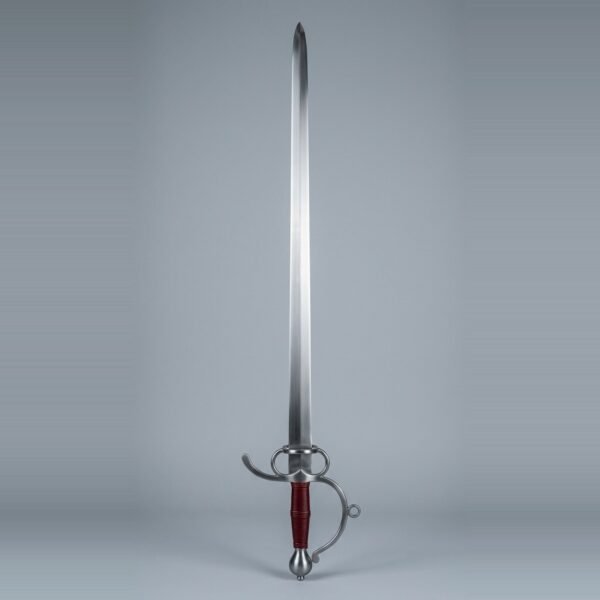
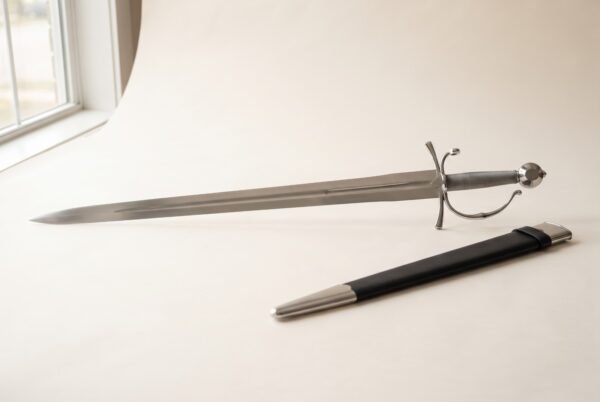
The Ashbraid is a hand forged Damascus side sword, the broad bladed cousin of the rapier that fencing masters of the sixteenth century simply called a sword. Historians borrowed the term side sword from the Italian spada da lato, meaning the sword worn at the side in ordinary clothes rather than carried into a battle line. That is the whole idea behind the type. It is short enough and light enough to wear all day through a city, complex enough at the hilt to defend an unarmoured hand, and still broad enough in the blade to cut properly. The rapier that followed it gave up the cut almost entirely in exchange for reach. This one did not, and that is why the side sword survived alongside the rapier for the better part of a century.
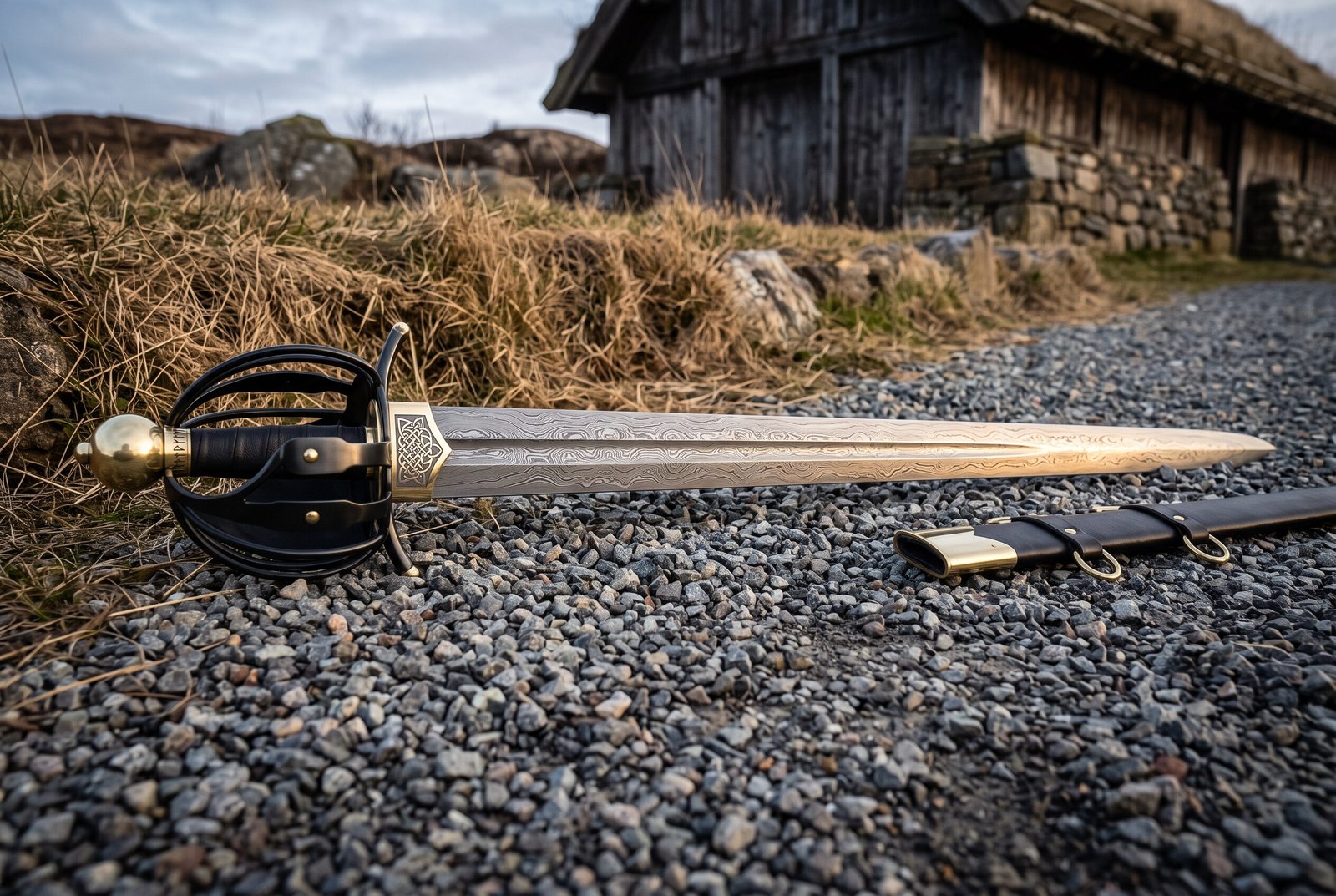
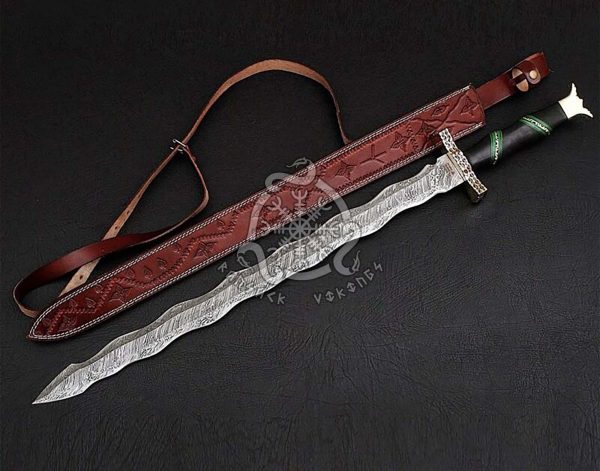
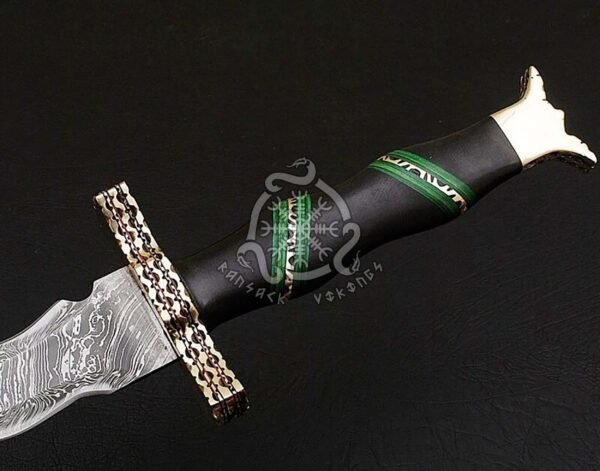
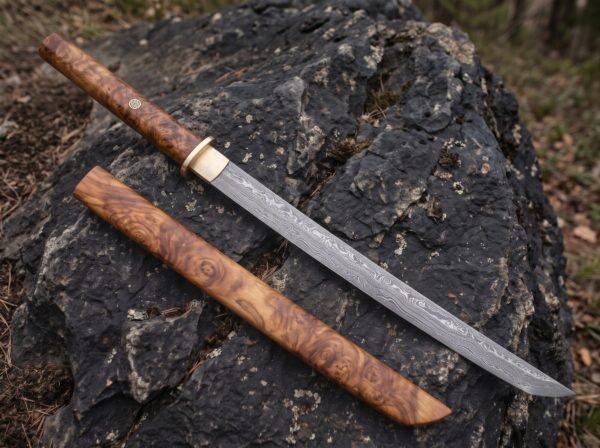
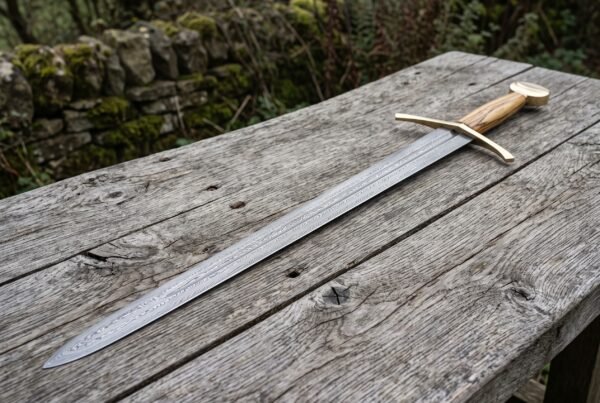
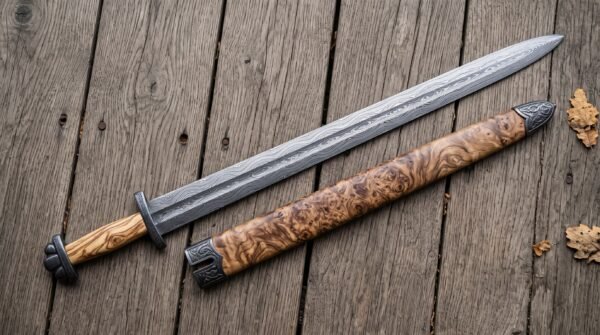
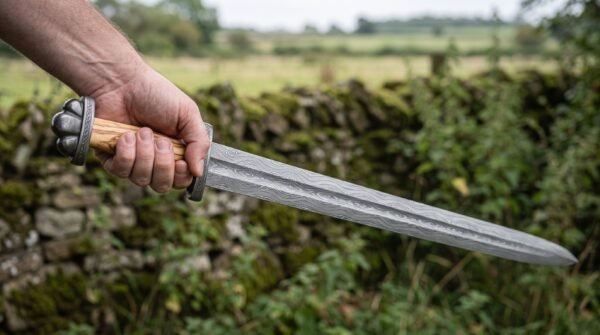
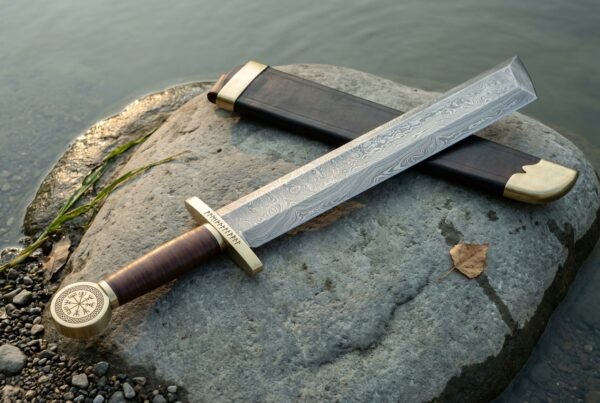
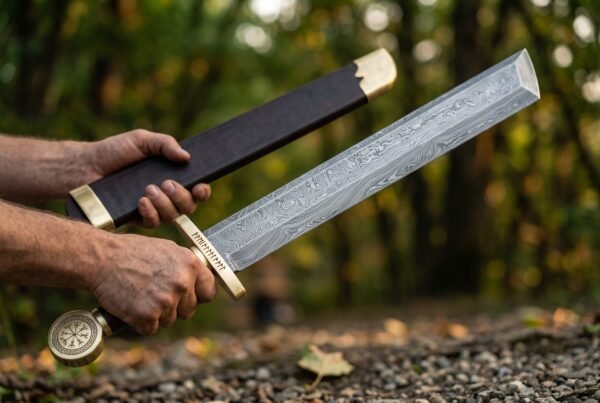
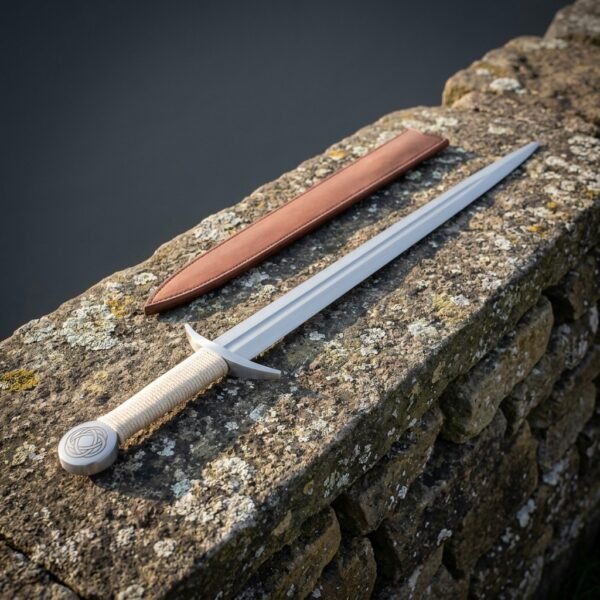
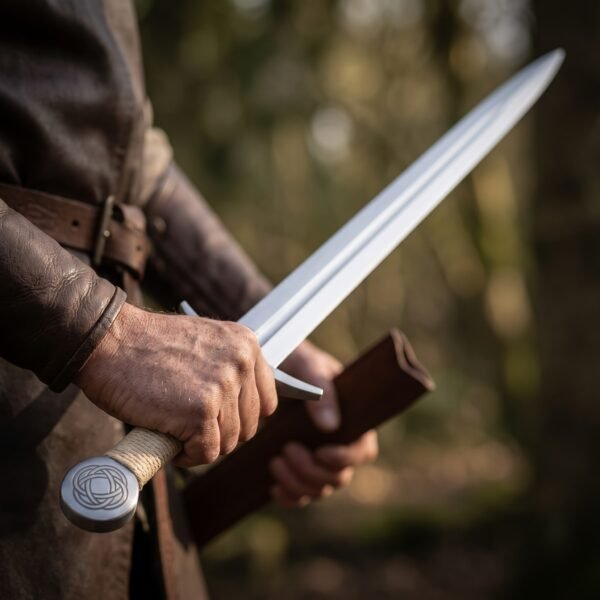
It is forged and finished in the Czech Republic. The blade is Damascus, 1095 and 15N20 forge welded in alternating layers, etched to bring up the wood grain figure that runs from the ricasso to the point. The hilt is blackened steel swept into a cage of loops around the outside of the hand, with a heavy brass ball pommel and an engraved brass collar carrying an interlaced knotwork band where the blade leaves the guard. The grip is black leather with a wrapped retaining strap. It ships with the fitted black leather scabbard shown, mounted with a brass throat and two brass hanger rings.
Specifications
| Steel | Damascus, 1095 and 15N20 forge welded |
|---|
| Hardness | 58 to 60 HRC |
|---|
| Overall length | 38 inches |
|---|
| Blade length | 31 inches |
|---|
| Blade profile | Broad double edged taper, etched wood grain Damascus figure |
|---|
| Guard | Blackened steel swept hilt with side loops and knuckle bow |
|---|
| Grip | Black leather over wood core with engraved brass collar and brass ball pommel |
|---|
| Scabbard | Black leather with brass throat and two brass hanger rings |
|---|
| SKU | RK-1406 |
|---|
What a swept hilt is actually for
The loops and bars crowded around the base of this blade look ornamental until you understand what changed in the fifteenth and sixteenth centuries. Men stopped wearing gauntlets in daily life. A medieval knight fought with a plain cross guard because his hand was inside an articulated steel glove, and the cross was only there to stop his own hand sliding onto the edge. Take the gauntlet away and the hand becomes the easiest target on the body, closer to the opponent than anything else and completely unprotected.
The answer was to build the armour into the sword. A ring set over the ricasso catches a thrust sliding down your blade before it reaches your fingers. A knuckle bow closes the front. Counter guards curl underneath to cover the palm when the hand rolls over. The result is a cage that leaves the fingers free to move but blocks the routes an incoming point can take. On this sword the cage is asymmetric, heavier on the outside where the hand faces the opponent, which is exactly how surviving originals were built. It is one of the very few examples in the history of arms where decoration and engineering arrived at the same shape.
The other thing the swept hilt allows is the finger over the cross grip. Because the ring shields the forefinger, you can hook it over the quillon block and onto the ricasso, which shortens the lever between hand and point and makes the blade far more precise. That single change in grip is what separates renaissance swordplay from medieval swordplay, and it is only possible because of the ironwork you are looking at.
Why Damascus and not stainless
This blade is a laminate. Bars of 1095 and 15N20 are stacked, welded together at forging heat, drawn out, cut, folded and welded again until the count runs into the hundreds of layers. The two steels have almost the same carbon content and harden to almost the same figure, so the finished blade behaves as one piece of steel rather than as a sandwich. What differs is nickel. 15N20 carries about two percent of it, and nickel resists the acid etch that finishes the blade, so the etched surface leaves the nickel bearing layers standing bright and the 1095 layers darker. The pattern you see is the actual internal structure of the steel showing through the surface, not a print or a spray.
Stainless cannot do this and cannot do the rest of it either. The chromium content that keeps stainless from rusting also forms coarse carbides that make a long blade brittle, which is why stainless swords are either soft enough to bend permanently or hard enough to snap. A hardened Damascus blade at 58 to 60 HRC holds an edge longer than either and springs back from a flex. It will rust if you leave it wet, and that is the trade you accept. The comparison is set out in full in Damascus versus stainless.
The grip, the brass collar and the pommel
The grip is a shaped wooden core covered in black leather, with a strap wrapped over it and a brass collar at the top. That collar is engraved with a continuous interlaced knot and it is not just trim. It seats the grip against the guard block and keeps the leather from creeping under load. Because there is wood under that leather, treat it as a wooden handle rather than as a solid steel one: keep it out of long damp storage and away from radiators and direct sun, both of which shrink a core and loosen a wrap. There is more on this in wooden handle care.
At the other end sits a heavy brass ball. On a side sword the pommel is a counterweight before it is a decoration. Putting that much mass behind the hand pulls the balance point back to within three inches of the guard, and that is what lets a blade of this width move like a light sword. Without it the same blade would feel like an axe.
Engraving, runes and your own design
Use the rune converter on this page to turn a name, a date or a short phrase into Elder Futhark and we will cut it into the steel or the handle. If you would rather have a Viking pattern than a rune line, choose your own design in the engraving option above the add to cart button and tell us whether it goes on the blade or the handle. Where a piece already carries an engraved design, your chosen engraving replaces it rather than sitting alongside it. On the Ashbraid that means the knotwork band on the brass collar is the panel your design would take over. Note that engraving on a Damascus blade cuts through the etched surface and reads as bright metal against the pattern, which most people find looks better than it sounds. See the engraving page for examples.
Care and sharpening
A Damascus surface needs slightly more attention than a plain polished one, because the etch that reveals the pattern also leaves the surface very slightly textured, and texture holds moisture. Wipe the blade after handling and keep a thin film of oil on it. Never put it away wet and never leave it stored in the scabbard for months at a time. If the pattern ever looks flat or clouded, it can be re etched rather than polished out. The routine is on the steel care page.
The edge comes sharp and ready. If you want to refresh it, use a whetstone and follow the bevel that is already there. Work in long light passes along the full length rather than grinding at one spot, and finish by stropping. Guidance is in sharpening with a whetstone.
Made in the Czech Republic
This piece is made by hand in the Czech Republic, in a workshop that still works the old way. The steel is forged, ground, heat treated and finished by smiths who learned the trade from the people before them, and the wood, horn and leather are cut and fitted by hand rather than pressed out on a line. That is also why no two pieces come out exactly the same.
Ransack Viking is a United States company. We import these pieces ourselves, check every one when it lands and ship from our warehouse in Chicago, Illinois. Engraving is done here in the United States after the piece arrives, so your runes or your own design go on before it leaves for you.
A note on handmade variation
This piece is hand forged, not machine made or bulk produced, so what arrives will not be a pixel for pixel copy of the photograph. Damascus in particular is never repeatable. The pattern is created by how the billet is drawn and manipulated under the hammer, so the swirl and density of the grain, the tone of the etch, the exact sweep of each bar in the guard and the shade of the leather will all differ from the one you see here. The dimensions, the steel and the build are the same every time. The character is not.
Frequently asked questions
Is the Damascus pattern real or is it printed on
It is real. The blade is two steels forge welded together in hundreds of layers, and the pattern is the layer structure exposed by an acid etch. You can feel it faintly with a fingernail. A printed pattern would wear off. This one goes all the way through the blade.
Is it sharp and can I cut with it
It arrives with a working edge and it is a functional sword, hardened and tempered through. Light cutting on bottles or a rolled mat is fine. It is not intended for edge on edge sparring with another steel blade.
Can I have runes engraved on it
Yes. Use the rune converter on this page for Elder Futhark, or pick your own design in the engraving option, and tell us whether it goes on the blade or the handle.
What is the difference between a side sword and a rapier
Blade width and intent. A side sword like this one keeps a broad double edge that cuts as well as it thrusts, and is usually shorter. A rapier narrows the blade dramatically and lengthens it, trading almost all cutting ability for reach and point control. Both use the same family of complex hilts.
Will the sword I receive look like the photograph
The shape, size and build will match. The Damascus figure will not, because no two billets pattern the same way. Think of the photograph as a fair representation rather than a portrait of your exact sword.
How long does shipping take
Free shipping within the United States. In stock pieces ship within a few days. Damascus takes three to five weeks in the shop, plus a few days if you have asked for engraving.
What is in the box
- Ashbraid hand forged Damascus side sword in 1095 and 15N20
- Fitted black leather scabbard with brass throat and two brass hanger rings
- Care card covering oiling, etch care and storage
- Elder Futhark rune engraving or your own Viking design if selected at checkout
- Forged and finished in the Czech Republic
Explore the range
Browse the rest of the Damascus swords, the short swords, the rapiers and the full sword range, or read the guides for more on pattern welding and care.
Other pieces in this group
In the same category sits the Sawreave short sword, pattern welded Damascus. A near match for this one is the Sawglade short sword. Closest to this in the range is the Tidegrain short sword, 5 inches overall.
Fitting out further, the Emberfall falchion belongs with it. Nothing here exactly right, build one to your own spec on the custom Viking sword page.

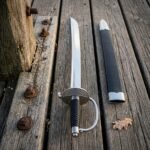
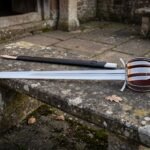

Photos don’t do this sword justice at all. Leather sheath is thick and well stitched. Not the cheap stuff you usually get. Couldn’t be happier with this.
Been eyeing this sword for months and it did not disappoint. You can tell it’s real Czech blacksmith work and shipping from the States made delivery painless.
Got this as a birthday gift and the reaction was priceless. Came in a nice gift box which made it feel even more special. Damascus blade holds a razor edge right out of the box. Edge retention has been great even after regular use. Great buy overall.