
Two different things sit in this category and they are worth separating before you buy. A rune set is twenty four small stones or tiles, one for each character of the Elder Futhark, kept loose in a pouch and drawn or cast. A runestone is a single engraved slab that stands on a base and stays where you put it. One is handled constantly, the other is looked at.
The casting sets here are natural dark grey slate tiles of roughly 1.2 by 0.9 inches and about 0.3 inches thick, or pale grey tumbled stone in a rounded oval, both cut with one rune per face and filled for contrast, and both supplied in a leather drawstring pouch with a printed card. The standing pieces are riven or honed slate, about 10 inches tall, and belong with the home decor, set into a slot cut in a solid oak or black walnut block and weighing between 2 and 3 pounds complete.
All four carry the full row of twenty four runes. Nobody here will tell you what your future holds.
Free US shipping
On most pieces. Heavier and oversized ones carry a flat charge.
Hand Forged
Heated, hammered and ground by hand.
Engraving available
Names, dates or Norse runes on most pieces.
Ships from Chicago
Inspected and dispatched from our Chicago warehouse. No import duty, no customs delay on US orders.
Runestones & Rune Sets
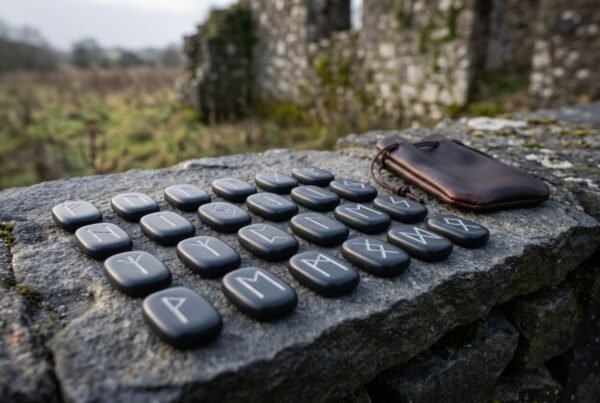
Fatecast Hand Made Engraved Slate Rune Set with 24 Elder Futhark Casting Stones | Complete Rune Row in Three Aettir | Leather Drawstring Pouch and Guide Card | RK-1695
Original price was: $139.00.$111.20Current price is: $111.20.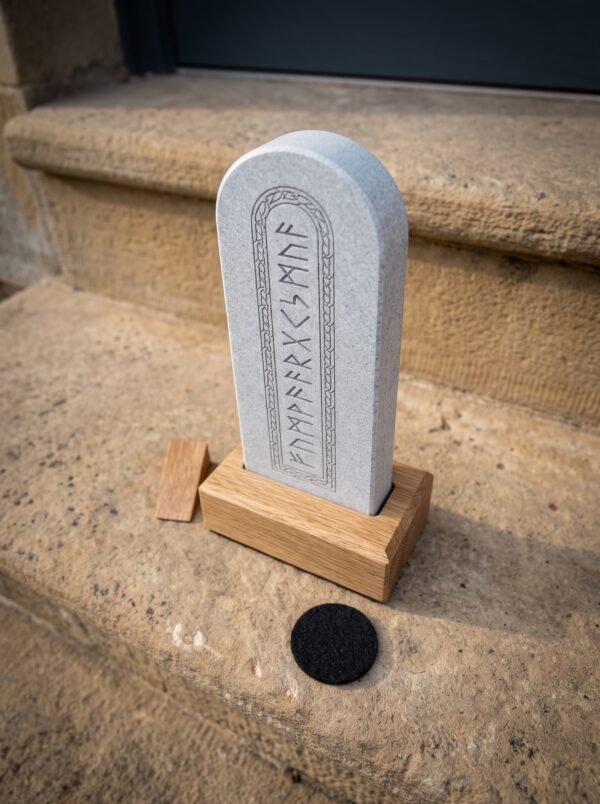
Slatestave Hand Made Engraved Pale Grey Rune Stone with Full Elder Futhark Row & Knotwork Arch | 10 Inch Standing Height | Solid Oak Display Base | Norse Home Decor Gift | RK-1705
Original price was: $159.00.$127.20Current price is: $127.20.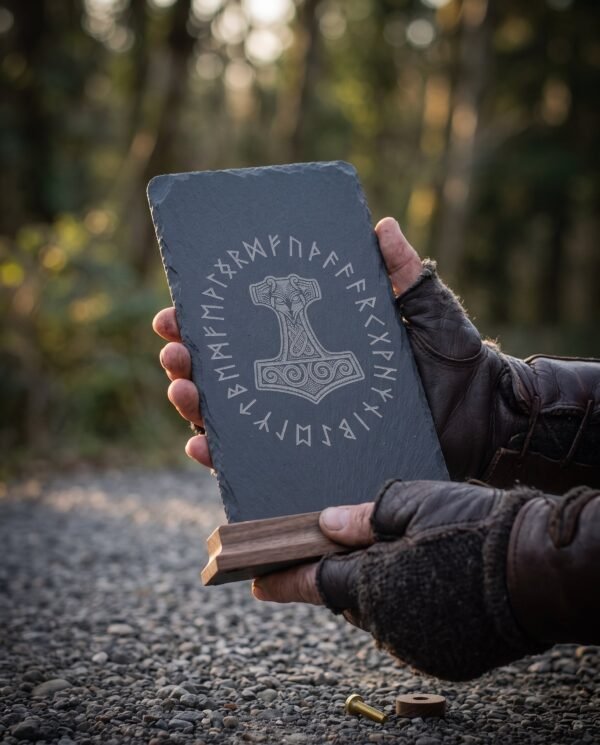
Thundermark Hand Made Engraved Slate Rune Plaque with Mjolnir and Full Elder Futhark Ring | 10 by 7 Inch Riven Slate | Solid Walnut Display Base | Norse Home Gift | RK-1714
Original price was: $139.00.$111.20Current price is: $111.20.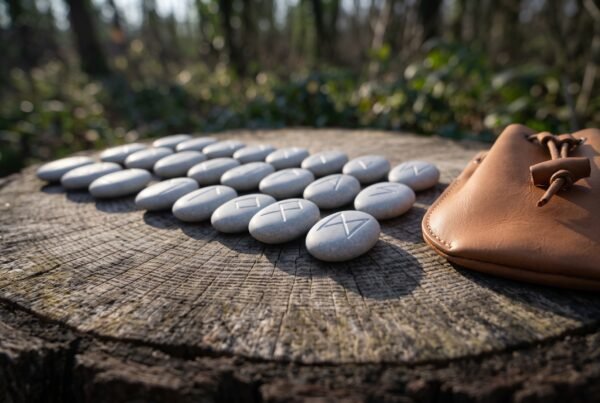
Stonecast Hand Made Elder Futhark Rune Set | 24 Engraved Casting Stones | Tumbled Stone with Tan Leather Drawstring Pouch | Norse Divination Gift | RK-1780
Original price was: $139.00.$111.20Current price is: $111.20.Runes were writing before they were anything else
The Elder Futhark is an alphabet. That is the part usually skipped over, and it is the part that makes everything else make sense. Twenty four characters, cut with straight strokes because they were designed to be carved across the grain of wood and into stone rather than written with a pen, which is why there are almost no curves in the row and why every stroke meets another at an angle. Curves are hard to cut. Straight lines are not.
It gets its name from the sound values of its first six characters, fehu, uruz, thurisaz, ansuz, raido and kaunan, which give you f, u, th, a, r and k. The order is fixed. It appears in that same sequence on inscribed objects across several centuries and a wide stretch of northern Europe, which tells you the row was taught and memorised as a unit rather than reinvented locally. It is also not alphabetical in our sense, and nobody knows why that particular order was chosen.
Because it is a phonetic alphabet, a name written in runes is transliterated by sound rather than letter by letter. There is no rune for the letter C, so a hard C takes kaunan and a soft C takes sowilo. That single fact saves a lot of disappointment later.
What the historical runestones actually were
Most of the raised stones that survive in Scandinavia are memorials. Somebody paid a carver to cut a line saying that they raised this stone for a father, a brother or a companion who died, often adding where he died and occasionally what he was doing there. They are closer to a headstone or a public notice than to anything mystical. Several thousand survive, the bulk of them in Sweden, and the great majority were raised in the eleventh century rather than in the early Viking age.
The knotwork and beast ornament that people associate with them is real and it is often the best part of the carving, with the inscription running along the body of a serpent whose head and tail meet. What is not attested is a tradition of carving a whole alphabet onto a memorial slab as a magical act. The full row does appear on some objects, and the leading explanation is that writing the alphabet out was itself considered significant, in the way that an inscription of a complete set of letters often is. The pieces here follow that idea, and the honest description of them is decorative rather than reconstructive.
The sets and stones in this collection
Four pieces. Two you handle and two you look at.
Casting sets
The slate set is twenty four tiles cut from natural dark grey slate with a honed matt face, each roughly 1.2 by 0.9 inches and about 0.3 inches thick, with the strokes cut and filled white so they read at arm's length. Edges and corners are lightly eased so the tiles do not chip against each other in the pouch, and the whole set with its brown leather drawstring bag weighs about 12 ounces. A folded guide card comes with it.
The tumbled stone set is twenty four pale grey stones, smooth faced, rounded oval and flat enough to lie still rather than rolling when they are scattered. One rune is cut into each face and filled for contrast. The stone is left unsealed, so the surface is the natural tumbled finish and it will take on hand oil over years of use. The pouch is tan leather with a drawstring and a sliding toggle, and a printed casting and meaning card is included.
Both sets are the complete Elder Futhark divided into the three traditional aettir of eight, which matters if you intend to lay them out in order rather than just draw from the bag.
Standing stones
The plaque is riven slate, meaning it is split along its natural bedding plane rather than sawn, so the face is the surface the stone made and the edges are irregular. It runs roughly 10 inches tall by 7 inches wide and between 8 and 12 millimetres thick, and that thickness varies across the slab because a riven face is never flat. A knotwork Mjolnir sits at the centre inside a complete ring of twenty four runes. It stands in a solid black walnut base about 8 inches long, grooved to take the slate, with a felt protection strip. The whole thing weighs 2 to 3 pounds.
The arched stone is honed grey slate, about 8 inches tall and 4 inches wide with an arched top, standing about 10 inches overall once it is in its base. The Elder Futhark row runs down the face inside an interlaced knotwork arch border. The base is a solid oak block with a cut slot and an oiled finish, and the complete piece weighs about 2 lb 4 oz. Felt pads and a care card are in the box.
Materials, sizes and contents across the range
Every figure below comes from the specification panel of a piece on this page. Slate is a natural material split and honed by hand, so thickness and edge shape vary and that variation is the point rather than a fault.
| Piece | Type | Material | Size | Weight | Supplied with |
|---|---|---|---|---|---|
| Fatecast | Casting set of 24 | Natural dark grey slate, honed matt, white filled cuts | Tiles about 1.2 by 0.9 in, about 0.3 in thick | About 12 oz complete | Brown leather drawstring pouch, folded guide card |
| Stonecast | Casting set of 24 | Pale grey tumbled stone, smooth faced, unsealed | Rounded oval, flat enough to lie still | Not listed | Tan leather pouch with sliding toggle, meaning card |
| Thundermark | Standing plaque | Natural riven slate on solid black walnut | About 10 in tall by 7 in wide, 8 to 12 mm thick | About 2 to 3 lb | Walnut base about 8 in long, felt protection strip |
| Slatestave | Standing stone | Natural grey slate, honed matt, on solid oak | Stone about 8 by 4 in, about 10 in standing | About 2 lb 4 oz | Oak base with cut slot, felt pads, care card |
One number to check against your shelf. The standing pieces are about 10 inches tall, which is taller than most people picture from a photograph, and the walnut base is 8 inches long, so allow for the footprint rather than just the height.
The three aettir
The row divides into three groups of eight, called aettir, and the division is old rather than modern. On some inscribed objects the groups are separated by a mark, and in later cipher systems the position of a rune is given as a group number and a position within the group, which only works because everyone already agreed where the divisions fell.
The first eight run from fehu to wunjo, the second from hagalaz to sowilo, and the third from tiwaz to othala. If you lay a set out to look at rather than to read, laying it out in three rows of eight is the arrangement that makes the structure visible, and it is also the fastest way to notice a missing stone.
How a set is cast, and what we will not claim
Start with the honest part. There is no surviving Norse manual of rune divination. What exists is a passage in Tacitus, writing about the Germanic peoples in the first century, describing a practice of cutting a branch from a fruit tree into strips, marking them, scattering them onto a white cloth and lifting three while looking upward. That is the earliest description anyone has, it predates the Viking age by centuries, and it does not say what the marks meant. Everything published since about specific rune meanings is a modern reconstruction, most of it twentieth century.
So what people actually do with a set is this. The stones are kept loose in the pouch. You put a hand in without looking and draw one, three or five, or you scatter the whole set onto a cloth and read only the faces that land upward. There is no correct method, and the card supplied with each set gives one common arrangement rather than a rule. Treat it as a prompt for thinking rather than as a forecast and it works fine. Treat it as a forecast and you are on your own.
Slate, tumbled stone and the timber bases
Slate splits cleanly along one plane and resists everything else, which is why it has been a roofing and flooring material for centuries and why it takes a cut stroke crisply without crumbling at the edge of the line. A honed face is ground flat and left matt rather than polished, so it does not glare under a lamp and the white fill in the strokes stays legible. A riven face is the surface the rock produced when it split, slightly uneven and faintly rippled, and no two are alike.
Tumbled stone is the opposite process. The stones go into a barrel with abrasive and turn for days until every edge is rounded, which is why they feel good in a hand and why they sit still when they land. They are left unsealed here, so they darken slightly with handling.
The bases are solid timber rather than veneer. Black walnut is dark, fine grained and stable, which suits the near black slate plaque. Oak is paler, harder and open grained with visible figure. Both are oiled rather than lacquered, so a scuff can be rubbed out with more oil instead of stripped and refinished. Each base has a slot cut to take the thickness of its own stone, which is why a base and a stone should stay together.
Care and storage
Slate and stone need almost nothing. Dust the face of a standing piece with a dry brush, since a cloth catches on a riven edge. If the white fill in the cuts ever looks tired, a soft toothbrush and a little water clears the dust out of the strokes and it comes back. Do not use a solvent or an abrasive cleaner on a filled cut.
Keep casting stones in their pouch rather than loose in a drawer, because stone against stone in a pocket is how corners get chipped. Draw the drawstring properly. If the leather goes stiff, a leather conditioner brings it back.
Give the timber base a wipe of furniture oil once a year and keep it off a radiator, since dry heat shrinks the wood and a shrunk slot loosens its grip on the stone. The felt pads or strip supplied are there to stop the slate rattling and to protect whatever the base is standing on. Replace them if they wear.
Engraving and personalising
The standing pieces have space on the base for a cut line, and a name, a date or a short phrase in Elder Futhark is the usual request. Remember that transliteration is by sound, and there is no rune for the letter C. Where a piece already carries an engraved design, your engraving replaces it rather than sitting alongside it. Text engraving is 19 dollars, a symbol is 39 dollars and a family crest is 49 dollars. It is permanent, an engraved piece cannot be returned, and the spelling you send is the spelling that gets cut, so read it twice.
Where these come from and how they ship
Ransack Viking is a US company based in Chicago, Illinois. The pieces are handmade in the Czech Republic, then imported, inspected and shipped from Chicago. Engraving is done in the US after arrival. Slate is quarried rather than manufactured, so colour runs from mid grey to nearly black, thickness varies across a riven slab, and the edge profile of a split stone is unique to that stone. Timber colour shifts from board to board. The engraving, the fittings and the contents of the box are the same every time.
How to choose
Buy a casting set if the point is handling. The slate tiles are crisper to read and lighter, the tumbled stones feel better in a hand and hide wear better. Buy a standing piece if the point is a shelf, and pick the riven plaque for texture and the arched stone for a cleaner face. If it is a gift for someone who does not already own a set, the casting sets present better, because they come with a card that explains what the twenty four characters are.
Browse related categories
- Viking home decor for the rest of the shelf
- Hnefatafl boards and Viking games
- Drinking horns with rune and stave engraving
- Norse pendants and rune jewellery
- Everything we can engrave to order
- Wedding and groomsmen gifts
Guides worth reading first
- Runestones explained, what the raised stones actually say
- Elder Futhark runes and how a name is transliterated
- Viking symbols and what they meant
- Mjolnir and the hammer in Norse belief
Frequently asked questions
What is the difference between a rune set and a runestone?
A set is twenty four separate stones or tiles, one per character, kept in a pouch and drawn or cast. A runestone here is a single engraved slab that stands in a timber base and stays on a shelf. Two of the pieces on this page are sets and two are standing stones.
How many runes are in the Elder Futhark?
Twenty four, divided into three groups of eight called aettir. Every piece on this page carries the complete row. Later runic alphabets used fewer characters, and the Younger Futhark of the Viking age proper was cut down to sixteen.
Did the Norse really use runes for divination?
No manual survives, so nobody can say what they did in detail. The earliest description is in Tacitus in the first century, about marked strips of fruit wood scattered on a cloth, and it does not explain the marks. Modern rune meanings are twentieth century reconstructions, and we would rather say so.
Can my name be written in runes?
Yes, by sound rather than letter by letter, because the Elder Futhark is a phonetic alphabet. There is no rune for the letter C, so a hard C uses kaunan and a soft C uses sowilo. Send the spelling you want and it will be transliterated before cutting.
How big are the standing pieces?
The riven plaque is roughly 10 inches tall by 7 inches wide on a walnut base about 8 inches long, and weighs 2 to 3 pounds. The arched stone is about 8 by 4 inches and stands about 10 inches overall in its oak base, weighing about 2 lb 4 oz.
Will my stone look like the photograph?
The engraving, the base and the dimensions will match. Slate is quarried, so colour, surface ripple, edge profile and exact thickness are particular to your stone, and a riven face is by definition unrepeatable.
How do I clean the engraving?
A soft brush for dust, and a soft toothbrush with a little water if the filled strokes look dull. Avoid solvents and abrasive cleaners, which lift the fill out of the cuts. Timber bases want a wipe of furniture oil once a year.
Where are these made?
They are handmade in the Czech Republic, then imported, inspected and shipped by Ransack Viking from Chicago, Illinois. Engraving is added in the US after arrival.
Featured pieces
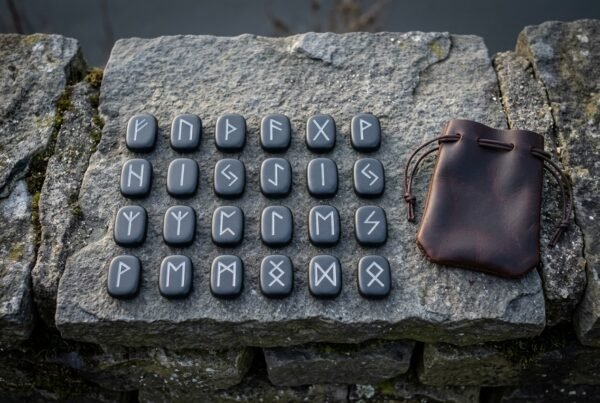 Fatecast Hand Made Engraved Slate Rune Set with 24 Elder Futhark Casting Stones
Original price was: $139.00.$111.20Current price is: $111.20.
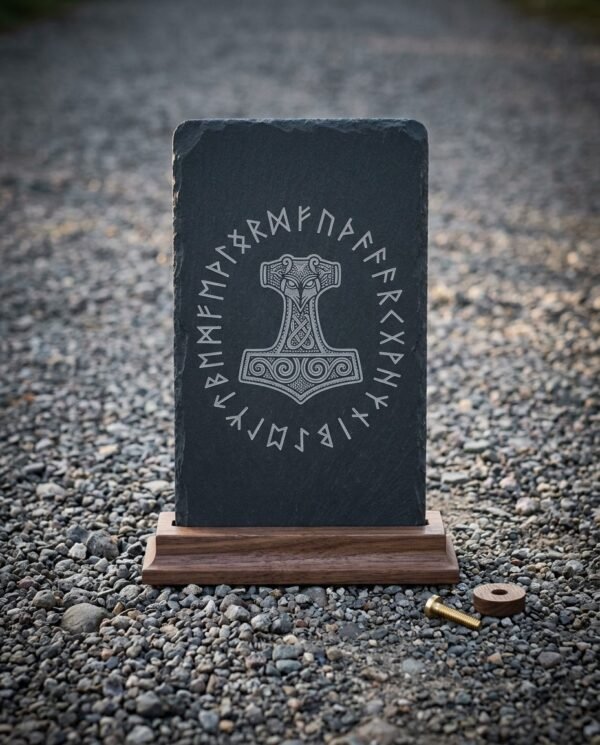 Thundermark Hand Made Engraved Slate Rune Plaque with Mjolnir and Full Elder Futhark Ring
Original price was: $139.00.$111.20Current price is: $111.20.
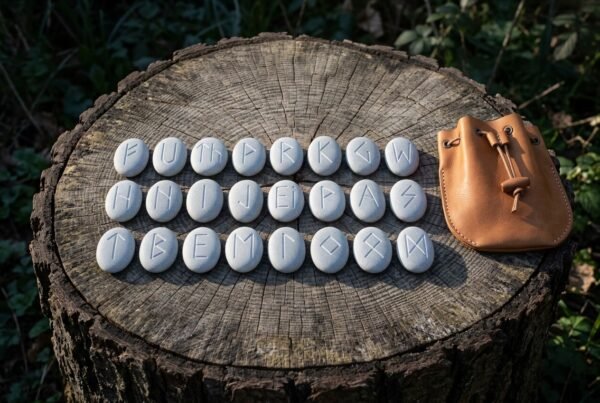 Stonecast Hand Made Elder Futhark Rune Set
Original price was: $139.00.$111.20Current price is: $111.20.
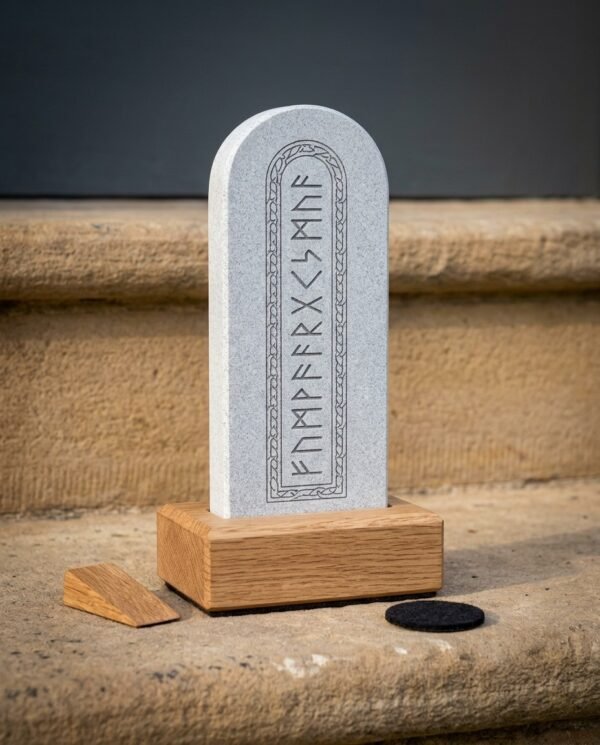 Slatestave Hand Made Engraved Pale Grey Rune Stone with Full Elder Futhark Row & Knotwork Arch
Original price was: $159.00.$127.20Current price is: $127.20.