
A tankard is a drinking vessel with a handle and a flat base, which sounds obvious until you have tried to put a drinking horn down on a table. The horn came first and it is the better known Norse shape, but it has to be drained or hung, because a cone will not stand up. The tankard is what you reach for when the drink is going to sit in front of you for an hour.
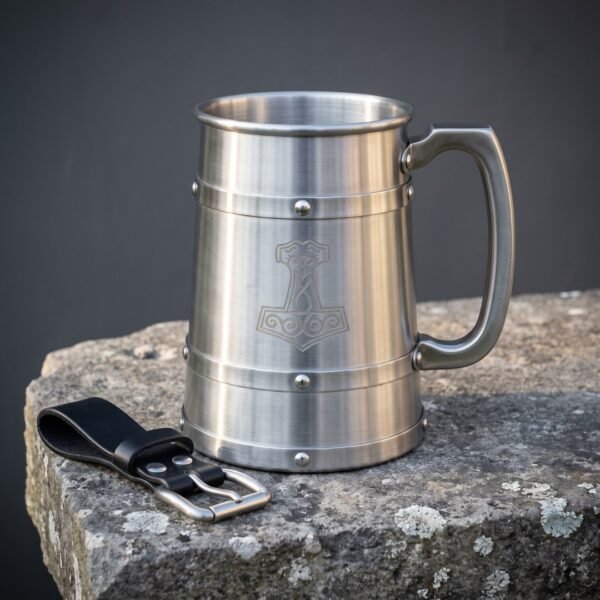
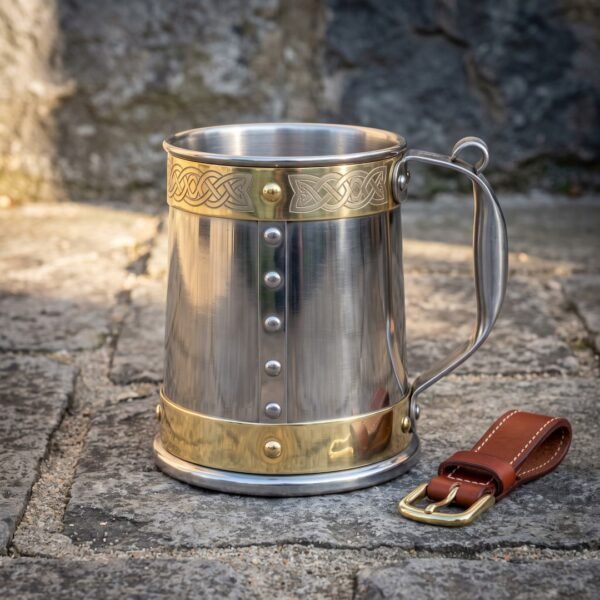
Three pieces sit on this page. One is built around a single piece of natural ox horn, banded in stainless steel, set on a turned hardwood base and holding roughly a US pint. One is food grade stainless in a brushed satin finish at about 20 fl oz and 6 inches to the rim, with a Mjolnir etched into the front panel. One is stainless with solid brass bands at shoulder and foot, both cut with Celtic knotwork, sized for a pint with the head on it. All three ship with a leather belt hanger.
Horn is for cold drink only. The steel pieces do not care.
Free US shipping
On most pieces. Heavier and oversized ones carry a flat charge.
Hand Forged
Heated, hammered and ground by hand.
Engraving available
Names, dates or Norse runes on most pieces.
Ships from Chicago
Inspected and dispatched from our Chicago warehouse. No import duty, no customs delay on US orders.
Horn Mugs & Tankards
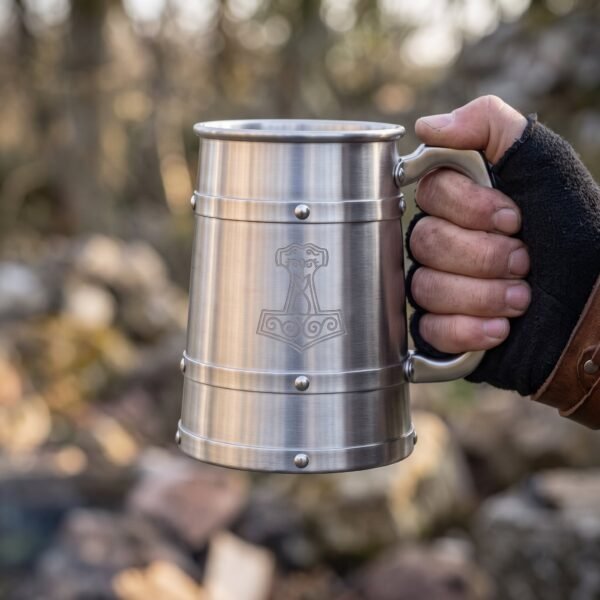
Aleholm Hand Made Stainless Steel Viking Tankard with Etched Mjolnir & Riveted Bands | 20 fl oz Capacity | Leather Belt Hanger Included | Groomsmen Gift | RK-1693
Original price was: $149.00.$119.20Current price is: $119.20.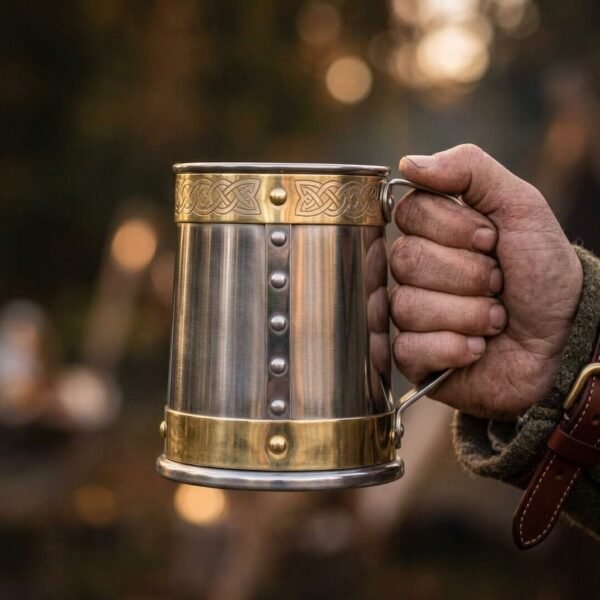
Brasshall Hand Made Stainless and Brass Viking Tankard with Celtic Knotwork Band | Riveted Body and Formed Steel Handle | Brown Leather Belt Hanger Included | Norse Ale Gift | RK-1622
Original price was: $159.00.$127.20Current price is: $127.20.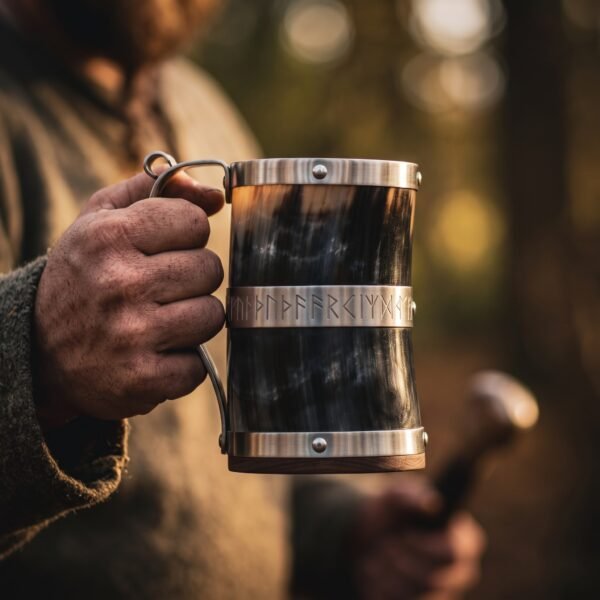
Hornmoot Hand Made Ox Horn Tankard with Rune Engraved Steel Band | Full Pint Drinking Vessel | Stainless Bands and Wooden Base and Leather Belt Hanger | Norse Mead Gift | RK-1611
Original price was: $189.00.$151.20Current price is: $151.20.Why a tankard has a flat bottom and a horn does not
The drinking horn is the shape everyone pictures when they think of a Norse hall, and it deserves the reputation. A cattle horn is a hollow keratin cone that can be cut, scraped and polished into a watertight cup with hand tools alone, it weighs almost nothing, and it does not shatter when a hall gets loud and a cup goes over. It has one flaw. You cannot set it down. A horn either gets emptied, handed on, or hung from a stand or a belt loop, which is fine at a feast where the vessel is meant to keep moving and much less fine when you want to eat with both hands.
A tankard fixes that with a flat base and a handle. The base means it stands. The handle means you can lift a full pint with your fingers rather than wrapping a whole cold hand around the body. Neither is a modern idea. Wooden staved mugs with iron hoops, turned soapstone cups and mounted wooden beakers all show up in the archaeology of the north, and the shape they share is squat, wider at the base than at the rim, low in the centre of gravity. That proportion is not decoration either. A low wide vessel does not go over when somebody thumps the table.
The other thing worth knowing before you buy is that the material changes the drink. Metal conducts heat quickly, so a chilled steel tankard pulls the temperature of a beer down fast and then reports it back through your palm. Pottery insulates and tells you nothing. Horn sits in between, warm to the touch, neutral in the mouth, and completely unbothered by an acidic cider that would put a metallic edge on a cheap mug.
The tankards in this collection
Three pieces, in three different material builds. All three carry a handle, all three are riveted rather than glued or soldered at the joints that matter, and all three ship with a leather belt hanger so the vessel can ride on your hip at a feast, a market or a reenactment weekend instead of being set down somewhere and lost.
The ox horn tankard with a runed steel band
A single piece of natural ox horn forms the body, banded top and bottom in stainless steel and set on a turned hardwood base. Capacity is approximately one US pint, and it varies slightly from piece to piece because a horn is a natural cone and no two cattle grew the same one. A third steel band runs across the middle, brushed and cut with a line of Elder Futhark runes. The handle is formed steel with a rolled thumb rest at the top, and the bands are riveted rather than clamped.
The interior is scraped, sanded and sealed food safe, and it is rated for cold drinks only. That limit is not a shortcut. Horn is keratin, the same protein as a fingernail, and heat softens it, warps it and eventually delaminates it. Period horn vessels were used for cold drink and kept away from the fire for exactly this reason. It comes with a black leather belt hanger and a steel buckle.
The horn body carries its own dark and amber marbling straight through the wall of the vessel, so the pattern you see is the material rather than a finish applied to it. Two horn tankards side by side will not match, which is the point.
The stainless tankard with an etched Mjolnir
Food grade stainless steel, brushed to a satin finish outside and left bare inside. Capacity is approximately 20 fl oz and it stands roughly 6 inches to the rim. A Mjolnir hammer with knotwork infill is etched into the front panel. Three raised bands run around the body, set with domed rivets that are finished flush on the inside so nothing catches when you wash it.
This is the least fussy piece on the page. Bare stainless is neutral to taste, does not react with sharp beer or cider, and takes beer, mead, wine and soft drinks hot or cold. Hand wash only, which is a rule about the leather hanger and the finish rather than about the steel. The hanger is black leather with a steel buckle and fits belts up to about 2 inches wide.
The stainless tankard with brass knotwork bands
Straight sided rather than tapered, in stainless steel with solid brass bands at the shoulder and at the foot. Both bands carry a continuous line of Celtic knotwork cut into them by hand, which means the interlace runs unbroken around the vessel and returns to where it started. A vertical column of domed rivets runs down the front where the rolled body is closed, and the brass bands are riveted over the top of that seam.
The handle is a formed steel strap with a rolled loop at the top and a riveted foot at the bottom. Riveted joints outlast solder and glue, particularly on a handle, which is the part that takes the whole weight of a full pint every time you lift it. The interior is bare stainless. It is sized for a pint of beer with the head on it, and formed by hand, so capacity varies very slightly. The belt hanger on this one is brown leather with a brass buckle to match the bands.
Materials, capacity and fittings
Every figure below is taken from the specification panel of a piece on this page. These are formed and fitted by hand, so read the capacities as what to expect rather than as a measured pour.
| Body | Bands and handle | Capacity | Cut work | Hot drinks | Belt hanger |
|---|---|---|---|---|---|
| Natural ox horn on a turned hardwood base | Stainless steel bands, formed steel handle | About 1 US pint | Elder Futhark rune line on the centre band | No, cold drinks only | Black leather with a steel buckle |
| Food grade stainless, brushed satin | Three raised bands, domed rivets, cast handle | About 20 fl oz, 6 in to the rim | Etched Mjolnir with knotwork infill | Yes | Black leather with a steel buckle, belts to 2 in |
| Stainless steel, riveted seam | Solid brass bands, formed steel strap handle | A pint with head | Celtic knotwork cut into both brass bands | Yes | Brown leather with a brass buckle |
The column that decides most purchases is the fifth one. If you want something to hold mulled wine or hot cider in December, the horn piece is out and the two steel tankards are in.
Sizing and what a pint actually looks like
A US pint is 16 fl oz. The stainless piece at approximately 20 fl oz therefore takes a full pint and leaves room for a head, which is why it measures about 6 inches to the rim rather than the four and a bit you would need for a bare pint. The brass banded tankard is sized the same way, for a pint with the head on it. The horn tankard is approximately a pint, and because the body is a natural cone the number moves a little either way.
If you are buying for a specific bottle or can, measure the volume you actually pour and add a quarter for foam. Nobody has ever complained that a tankard was slightly too big.
Steel, brass and horn
Stainless is the easy material. It is non reactive, neutral to taste, will not corrode from an acidic drink and takes a knock without complaint. The brushed satin finish hides fingerprints better than a mirror polish. The only stainless that goes wrong is stainless that has been left dirty and wet in a cupboard, and even then it usually cleans up.
Brass is a copper alloy and it darkens. That is not a fault and it is not corrosion. A brass band left alone for six months goes from bright yellow to a warm brown, and a metal polish on a cloth brings it straight back. Choose whichever you prefer and act accordingly. What brass will not tolerate is a dishwasher, which strips it, spots it and dulls the cut lines of the knotwork.
Horn is keratin. It is tough, light, slightly flexible and completely unlike either metal in the way it behaves. It will craze if it dries out, warp if it gets hot and stain if you leave wine standing in it overnight. Treated properly it lasts decades. The sealed interior does most of the work, and the rest is a habit of rinsing it out when you are finished rather than in the morning.
Care, cleaning and storage
Hand wash everything on this page. No dishwasher, for any of the three. The heat and the detergent will strip the sealed interior of the horn, dull the brass and cook the leather hanger if it is left attached.
For the steel tankards, warm water, a drop of washing up liquid and a soft cloth or sponge. Dry it rather than leaving it to drain, because water spots on brushed steel are annoying to remove later. For the brass bands, an occasional metal polish if you want them bright.
For the horn tankard, rinse with cool water as soon as you have finished the drink, wipe it dry and leave it standing open until the inside is dry to the touch. No hot water, no soaking, no leaving it full overnight. Store it somewhere with stable humidity and away from a radiator or a sunny windowsill, because horn shrinks and checks as it dries. If the outside looks dull, a light wipe of food safe oil brings the marbling back.
The leather hangers want the same treatment as any other leather. Keep them dry, dry them slowly and away from heat if they get soaked, and feed them with a conditioner occasionally.
Engraving
The steel bands and panels on these tankards take engraving well, and it is done in the US after arrival. Names, dates, a wedding year or a line of Elder Futhark runes go onto the plain steel of a band or the flat of a body panel. Text engraving is 19 dollars, a symbol is 39 dollars and a family crest is 49 dollars.
Two of these already carry cut work, a rune line on the horn tankard and a Mjolnir on the stainless one, so if you are adding a personal line, plan where it sits relative to what is already there. Elder Futhark is a phonetic alphabet, so a name is transliterated by sound rather than letter for letter, and there is no rune for the letter C. Engraving is permanent and an engraved piece cannot be returned, so send the exact spelling and read it twice.
Matched sets for a wedding party are the most common request. If you are ordering several, send all the names in one order so they are cut in the same session and the lettering matches.
Where these come from and how they ship
Ransack Viking is a US company based in Chicago, Illinois. These tankards are cut, formed, riveted, etched and assembled by hand in the Czech Republic, then imported, inspected and shipped from Chicago. Engraving is done in the US after arrival.
Expect small differences between two pieces of the same name. Horn colour and marbling vary from animal to animal, hand cut knotwork varies slightly in depth, and a formed body will not measure identically to the last one. That is what handmade means, and it is why the capacities are given as approximate.
How to choose
If you want the material a Norse drinker would actually recognise, and you are happy to keep it to cold drink and rinse it out promptly, take the ox horn tankard. If you want something you can fill with anything, hot or cold, and effectively cannot damage, take the brushed stainless piece with the Mjolnir. If you want the look of the old mounted vessels, with brass against steel and knotwork you can feel with a thumb, take the brass banded one.
For a gift, the deciding factor is usually whether the recipient will use it or display it. Display favours the horn. Use favours the steel. If you are buying for a whole group, our wedding and groomsmen gifts page carries the matched sets, and the drinking horns are worth a look if the vessel is going to be raised rather than parked.
Browse related categories
- Drinking horns, the vessel that will not stand up
- Viking beer mugs and steins
- Norse home decor for the hall and the shelf
- Hnefatafl boards and Viking games
- Wedding and groomsmen gifts
- Engraved and personalised pieces
- Runestones and rune sets
Guides worth reading first
- The Viking drinking horn, what it was and how it was used
- Buying a drinking horn without buying a bad one
- Elder Futhark runes and how names are transliterated
- Mjolnir, the hammer and what it meant
- Viking wedding gifts that get used
Frequently asked questions
Can I put a hot drink in these?
In the two stainless tankards, yes. In the ox horn tankard, no. Horn is keratin and heat softens it, warps it and eventually delaminates it, which is why period horn vessels were kept away from the fire. Cold drink only in the horn, every time.
Are they dishwasher safe?
No, none of them. Hand wash in warm water with a soft cloth. A dishwasher strips the sealed interior of the horn, dulls and spots the brass, and will ruin a leather hanger left attached to the handle.
How much do they hold?
The horn tankard is approximately one US pint, varying with the natural taper of each horn. The brushed stainless piece is approximately 20 fl oz and about 6 inches to the rim. The brass banded tankard is sized for a pint of beer with the head on it.
Does the horn one leak or taste of anything?
It should not. The interior is scraped, sanded and sealed food safe, and horn is neutral in the mouth in a way that cheap metal is not. Rinse it out when you finish rather than in the morning and it stays that way.
Why is the brass going brown?
Because it is brass. A copper alloy darkens over months and that is oxidation rather than damage. A metal polish on a cloth returns it to bright yellow in a couple of minutes, or leave it and let it age. Both are correct.
What is the leather hanger for?
It loops through the handle and buckles onto your belt, so a full tankard rides on your hip at a feast, a market or a camp rather than being set down on a table and lost. Every piece on this page comes with one.
Can I get one engraved with a name?
Yes. Engraving is done in the US after the piece arrives, onto a plain steel band or a flat body panel. Text is 19 dollars, a symbol is 39 dollars and a family crest is 49 dollars. An engraved piece cannot be returned, so check the spelling before you send it.
Where are these made?
Ransack Viking is a US company based in Chicago, Illinois. The tankards are handmade in the Czech Republic, then imported, inspected and shipped from Chicago, with engraving added in the US after arrival.
Featured pieces
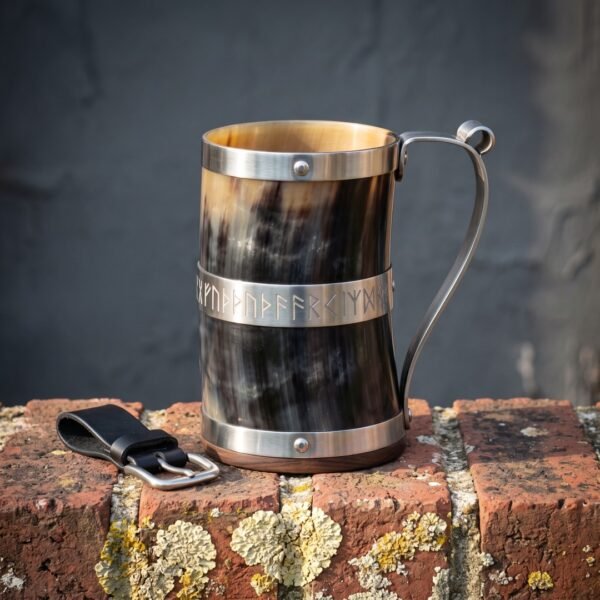 Hornmoot Hand Made Ox Horn Tankard with Rune Engraved Steel Band
Original price was: $189.00.$151.20Current price is: $151.20.
 Aleholm Hand Made Stainless Steel Viking Tankard with Etched Mjolnir & Riveted Bands
Original price was: $149.00.$119.20Current price is: $119.20.
 Brasshall Hand Made Stainless and Brass Viking Tankard with Celtic Knotwork Band
Original price was: $159.00.$127.20Current price is: $127.20.