
An arm ring is a heavy open band worn at the wrist or up on the forearm. A torc is the same idea worn at the neck. Neither has a clasp, because neither needs one. The ring goes on sideways, turned so the gap faces the narrow axis of the limb, then rotated round until the terminals sit where you want them, and the metal springs back and holds. Squeeze it a little to grip tighter, ease it apart to loosen. That is the whole fitting system.
Both pieces on this page are twisted band arm rings in a bright polished silver finish, sold on the finish rather than as hallmarked sterling, like the rest of the Norse jewellery. One has a deep rope twist body with smooth rounded terminals and adjusts at an open back. The other is an open ended cuff with a band of roughly 6 mm across a twisted rope section, an inner opening of approximately 2.5 inches, flared terminals carrying raised spiral bosses and domed caps, and Elder Futhark runes stamped into the flats behind them.
Try it on the forearm before you decide it is too small for a wrist. Finger sizes live with the rings.
Free US shipping
On most pieces. Heavier and oversized ones carry a flat charge.
Hand Forged
Heated, hammered and ground by hand.
Engraving available
Names, dates or Norse runes on most pieces.
Ships from Chicago
Inspected and dispatched from our Chicago warehouse. No import duty, no customs delay on US orders.
Arm Rings & Torcs
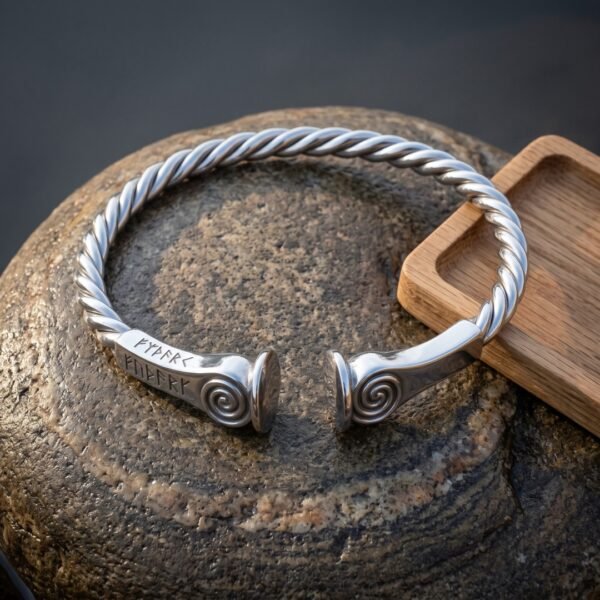
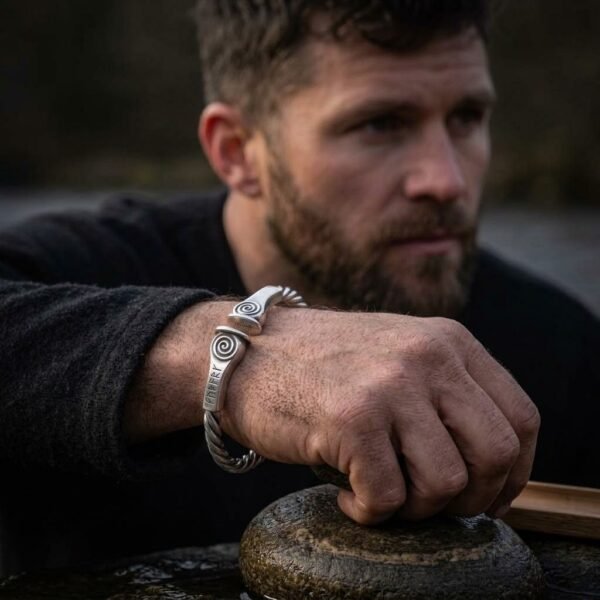
Coilspire Hand Made Twisted Viking Arm Ring with Spiral Terminals & Elder Futhark Runes | Open Cuff Torc | Norse Oath Gift | RK-1761
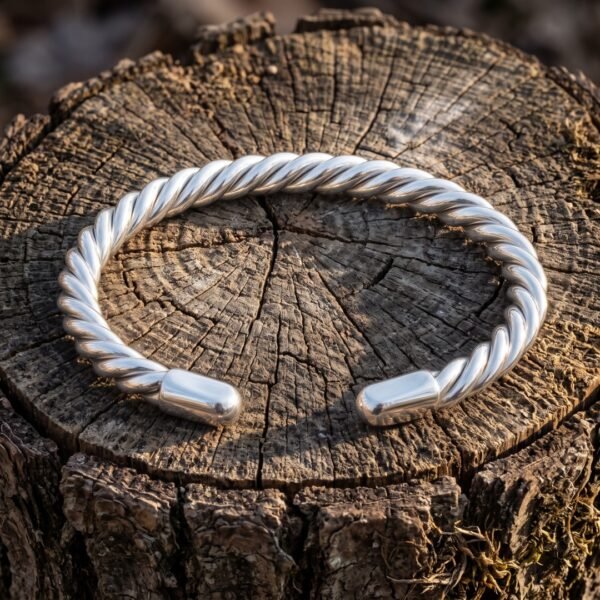
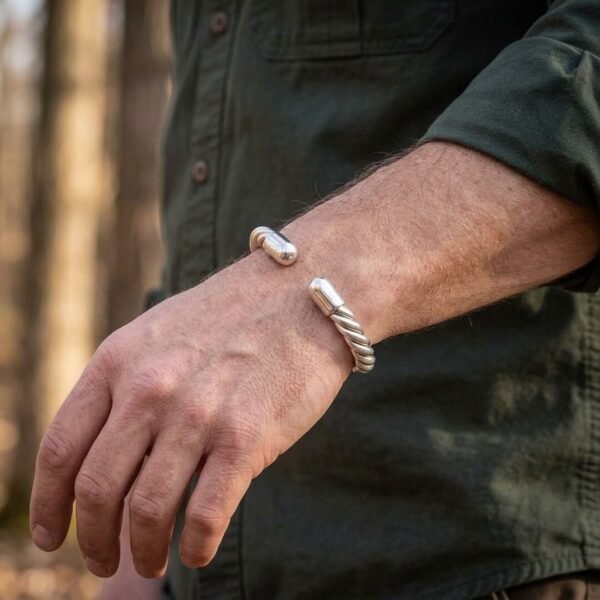
Coilbright Hand Made Twisted Viking Arm Ring with Rope Coil Body & Rounded Terminals | Norse Wedding Gift | RK-1779
Rings were money before they were jewellery
The Norse word for a generous lord translates as ring giver, and the poets use it constantly. That is not a metaphor about generosity in the abstract. A lord who kept a following handed out silver arm rings, and those rings did two jobs at once. They were payment, and they were public proof that an oath had been made, worn on the arm where everyone in the hall could see it. You could not quietly forget who you had sworn to when the evidence was sitting on your forearm catching the firelight.
Because the silver itself was the value, a ring had to be divisible. Hoards across the Viking world are full of hacksilver, which is exactly what it sounds like: arm rings, neck rings and brooches deliberately chopped into fragments so a debt could be settled by weight. The Cuerdale hoard in Lancashire and the enormous Spillings hoard on Gotland both contain it in quantity. Many surviving rings also carry test nicks along the band, small cuts made to check that the silver went all the way through rather than covering something cheaper.
That is the real reason so many Norse rings are open rather than closed. A closed ring is an ornament. An open one is a bar of silver you happen to be wearing, and it can be cut, weighed and spent. The form on this page comes directly out of that logic, which is a more interesting origin than most jewellery can claim.
Arm ring, torc, and the difference
The two words get used loosely, so it is worth being precise. An arm ring is worn on the arm, either as a cuff at the wrist or higher up on the forearm where it grips the muscle. A torc is the same construction worn at the neck, and it is a form the Norse inherited from a much older Celtic and Iron Age tradition rather than inventing. Both are open, both are sprung, and both are fitted by flexing rather than by any catch.
Both pieces currently on this page are arm rings rather than neck torcs. They are made the same way and they behave the same way, so everything below about twisting, fitting and care applies equally to either form.
Why the band is twisted
The rope twist is the single most common decoration on surviving Norse arm rings and neck rings, and it exists for a mechanical reason before an aesthetic one. Twisting a bar work hardens it. Every turn puts the metal into a slight permanent strain, and a work hardened bar resists bending far better than a straight annealed one of the same thickness. A twisted ring keeps its shape on an arm that is doing things, which a smooth bar of the same weight will not.
The second effect is optical. A plain round bar gives you one highlight running along its length. A twisted bar gives you a highlight on every ridge, so the piece reads as bright from across a room even in poor light. That is why these look heavier and more valuable than the same metal drawn straight, and it is why the makers kept doing it for four hundred years.
The distinction that matters when you are buying is whether the band is genuinely twisted or cast to look twisted. A cast imitation has a repeating pattern that stops and starts, and the ridges are soft. A truly twisted band runs continuously and the light catches a different facet as the arm moves. Both pieces here are twisted rather than cast to imitate it.
The arm rings in this collection
Two pieces, both twisted, both open, both in a bright polished silver finish. They differ in the terminals, in what is stamped on them, and in how they arrive.
The rope twist ring with rounded terminals
A heavy round bar worked into a deep rope twist and finished with two smooth rounded caps at the ends. Solid cast and formed metal with a bright polished silver finish, high polish rather than a plating over a base colour. It is open at the back and adjusts by gently opening or closing that gap, with no clasp anywhere on it to fail.
Worn at the wrist it sits as a substantial cuff. On a slimmer forearm it rides higher, which is how the originals were usually carried. The terminals are polished with no sharp edges, which sounds obvious until you have worn a cheap cuff that catches on a sleeve every time you reach for something. It ships in a cloth pouch with a polishing cloth.
The twisted cuff with spiral terminals and runes
Silver finish metal alloy with a bright polish, and again not solid sterling. This is the more decorated of the two. The band is a twisted rope section approximately 6 mm across, and the inner opening measures approximately 2.5 inches, adjustable by gentle flexing. The ends flare out into heavy terminals, each carrying a raised spiral boss on the outer face and a domed cap on the end.
The flats just behind those terminals are stamped with Elder Futhark runes. The finish is a bright polish with darkened recesses, so the spirals and the rune cuts stay legible instead of washing out against the shine. It arrives in a gift box.
Sizes, bands and terminals
Every figure below is taken from the specification panel of a piece on this page. These are formed and twisted by hand, so read the measurements as what to expect rather than as a jeweller's gauge reading.
| Piece | Material and finish | Band | Terminals | Fit | In the box |
|---|---|---|---|---|---|
| Rope twist arm ring | Solid formed metal, bright polished silver finish, no plating | Heavy round bar in a deep rope twist | Smooth rounded caps, polished, no sharp edges | Open backed, adjusted by opening or closing the gap | Cloth pouch and polishing cloth |
| Twisted cuff with spiral bosses | Silver finish alloy, bright polish, not solid sterling | Twisted rope section, about 6 mm across | Flared ends with raised spiral bosses and domed caps | Open ended, inner opening about 2.5 in, adjusted by flexing | Gift box |
Neither piece is hallmarked sterling and we would rather put that in the table than in a returns email. They are sold on the finish.
Sizing and how to put one on
An inner opening of approximately 2.5 inches is an arm measurement, not a wrist circumference. Wrap a tape measure around the point where you want the ring to sit, then divide that circumference by about three to get the rough diameter you need. Most adult wrists land between 6.5 and 8 inches around, which puts the diameter in the region of 2.1 to 2.5 inches, so a 2.5 inch opening sits comfortably at the wrist on larger arms and moves up the forearm on slimmer ones.
Putting it on is a rotation, not a squeeze. Turn the gap so it faces the narrow axis of your arm, slide the ring over sideways, then rotate it a quarter turn so the terminals come round to the front or the outside. Never force the ring straight on over the widest part of the hand.
Adjusting it is a small movement done with both hands and a lot of patience. Squeeze the terminals gently towards each other to tighten, ease them apart to loosen, and do it in tiny increments, checking the fit between each one. Metal that is flexed hard and often eventually fatigues, so make one careful adjustment and then leave it alone rather than opening and closing the ring every day.
The finish, and what it is not
Both pieces are a bright polished silver finish rather than hallmarked sterling. That is stated on both product pages and it is stated here, because the difference matters. Sterling is soft, warm in colour, and needs polishing several times a year as it oxidises. A polished silver finish gives you the colour and the shine without that maintenance, and it holds up better against a desk edge or a car door.
Neither piece is Damascus steel. The forge welded 1095 and 15N20 that runs through our blades is a blade material, and it is not what these are made from. If you are looking for something that carries a pattern welded band, that is a different page.
What you should expect from the finish is that it stays bright with almost no effort, that it will scratch if you drag it along stone, and that the darkened recesses in the spirals and rune cuts are there deliberately to make the detail readable rather than being tarnish that needs removing.
Care and storage
Warm water, a drop of washing up liquid and a soft cloth take off skin oil and anything the day has added. Dry it properly, particularly down in the valleys of the twist where water sits. The polishing cloth supplied with the rope twist piece is for the raised ridges, which is where handling dulls a polish first.
Do not scrub the darkened recesses on the spiral terminals or inside the rune stamps. That darkening is contrast, put there on purpose, and an aggressive polish will lift it and leave the detail flat and hard to read.
Take an arm ring off before the gym, before heavy lifting and before anything that puts a hard edge against the band. A cuff that gets crushed against a barbell will not spring back to where it was. Store it in the pouch or box it came in rather than loose in a drawer, so it is not being slowly flattened under everything else.
Engraving
The plain flats behind the terminals, and the inner face of the band, are where engraving goes. Names, dates, initials or an Elder Futhark rune line all work at this size, and it is done in the US after the piece arrives. Text engraving is 19 dollars, a symbol is 39 dollars and a family crest is 49 dollars.
One of the two pieces already carries stamped runes behind the terminals, so if you are adding a personal line, plan where it sits relative to what is already there. Elder Futhark is a phonetic alphabet rather than a cipher, so a name is transliterated by sound and not letter for letter, and there is no rune for the letter C. Our guide to the runes covers it. Engraving is permanent and an engraved piece cannot be returned, so send the exact spelling and read it twice.
Arm rings are the traditional oath object, which is why they turn up so often as wedding and handfasting pieces. A date on the inside of the band is the usual request.
Where these come from and how they ship
Ransack Viking is a US company based in Chicago, Illinois. Both arm rings are formed, twisted, stamped and polished by hand in the Czech Republic, then imported, inspected and shipped from Chicago. Engraving is done in the US after arrival.
Because the band is twisted by hand, the pitch of the twist and the exact opening will vary a little between two rings of the same name. That is what handmade means, and it is why the opening is given as approximate.
How to choose
If you want the cleaner piece, something that reads as a heavy twisted band and nothing else, take the rope twist ring with the rounded terminals. It is the one to wear daily and the one that will not catch on a sleeve.
If you want detail to look at, spiral bosses, domed caps and a rune line already stamped into the metal, take the twisted cuff. It is also the one that arrives gift boxed. If you want the same twisted look at the neck or on a finger, our Viking rings and bracelets page is the next place to look, and Norse pendants covers the pieces that hang rather than grip.
Browse related categories
- Norse jewellery, the full range
- Viking rings and bracelets
- Mjolnir pendants
- Norse pendants, Valknut, Vegvisir and Yggdrasil
- Beard rings and beads
- Engraved and personalised pieces
- Wedding and groomsmen gifts
Guides worth reading first
- Elder Futhark runes and how names are written
- Viking symbols and their meanings
- A guide to the Norse gods
- Viking wedding gifts that get used
- Runestones explained
Frequently asked questions
Why is there no clasp?
Because a clasp is the part that breaks. An open ring is put on sideways, with the gap turned to the narrow axis of the arm, then rotated round so the terminals sit where you want them. The metal springs slightly and holds. It also means one ring covers a range of arm sizes.
How do I know if it will fit?
Measure around the point where you want it to sit and divide by about three for the diameter you need. Most adult wrists are 6.5 to 8 inches around, giving roughly 2.1 to 2.5 inches of diameter. The cuff on this page has an inner opening of approximately 2.5 inches.
Can I adjust it?
Yes, gently and rarely. Squeeze the terminals a little towards each other to tighten or ease them apart to loosen, in small increments with both hands. Metal flexed hard and often will eventually fatigue, so make one careful adjustment and then leave it.
Is this solid silver?
No. Both pieces are a bright polished silver finish rather than hallmarked sterling, and that is stated on both product pages. The finish gives you the colour and shine without the polishing that sterling demands, and it stands up better to daily knocks.
Is the band really twisted or just cast that way?
Really twisted. A cast imitation has a repeating pattern that stops and starts and the ridges are soft. A genuinely twisted band runs continuously and catches a different facet as the arm moves. Twisting also work hardens the metal, so the ring holds its shape.
Wrist or forearm?
Either. Worn at the wrist it sits as a substantial cuff. On a slimmer forearm it rides higher on the muscle, which is how the originals were usually carried and how they stay put without gripping the wrist bone.
What is the difference between an arm ring and a torc?
Where it is worn. An arm ring goes on the wrist or forearm, a torc goes at the neck. The construction is the same, open, sprung and fitted by flexing. Both pieces currently on this page are arm rings.
Where are these made?
Ransack Viking is a US company based in Chicago, Illinois. The arm rings are handmade in the Czech Republic, then imported, inspected and shipped from Chicago, with engraving added in the US after arrival.