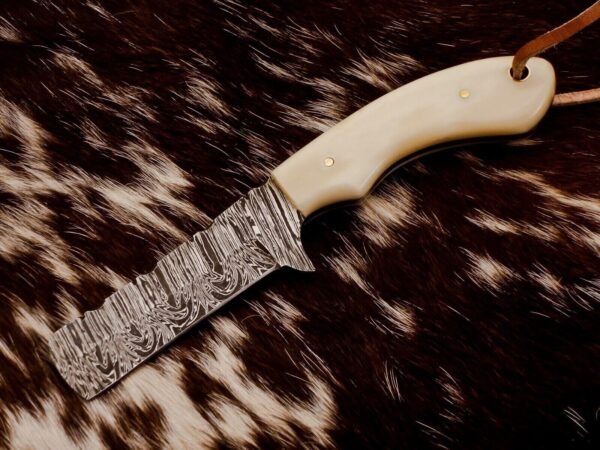
A bull cutter is a short, wide knife with a deep belly and a rounded tip. It is a cattle working pattern out of the American stock trade, a cousin of the bowie, and every part of the shape follows the job. The blade is wide so a single slicing stroke covers ground. It is short overall so it stays controllable at arm’s reach under an animal that is not enjoying the process. And the tip is blunted or heavily rounded so the point cannot dig where it is not wanted, which in a working pen is worth more than a needle point ever was.
The knife here runs 6.5 inches overall with a 3.5 inch blade and a 3 inch camel bone handle over a full tang. The steel is hand forged Damascus of 1095 and 15N20, 393 layers, hardened to 58 to 60 HRC, etched to a wind and mix twist fire pattern with brass file work along the spine. A fitted leather sheath is included.
It is heavier in the hand than the photographs suggest, and it slices far better than its size implies. Blade shape is doing all of it.
Free US shipping
On most pieces. Heavier and oversized ones carry a flat charge.
Hand Forged
Heated, hammered and ground by hand.
Engraving available
Names, dates or Norse runes on most pieces.
Ships from Memphis
Inspected and dispatched from our Tennessee warehouse. No import duty, no customs delay on US orders.
Cowboy Bull Cutter

The pattern that was named for a job nobody wants to discuss
Bull cutter is a working name and it is a literal one. The pattern comes out of the American cattle trade, where a hand needed a knife for stock work performed quickly, close in, and on an animal that had no interest in cooperating. Everything about the shape is an answer to those conditions, and the reason the profile still exists on a shelf a century later is that the answers turned out to be good ones for a lot of other jobs too.
Start with the tip. A bull cutter has a blunt or heavily rounded point, and that is the single most important feature on it. In a working pen a knife that cannot accidentally puncture is worth more than a knife that can. A sharp point catches, digs and goes somewhere unplanned the moment the animal moves. Round the point off and the same blade becomes something you can use under pressure without watching where the tip is every second.
Then the belly. The edge sweeps in a long continuous curve from the ricasso to the tip, and that curve is where a slicing knife does its work. A straight edge cuts at whatever point you push it against. A deep bellied edge lets you draw the knife through a cut with the contact point travelling along the curve, which is a longer effective edge than the blade is long. On a 3.5 inch blade, that geometry buys you the slicing performance of something considerably larger.
Finally the length. Six and a half inches overall is small. It is small deliberately, because a working knife used at arm's reach in an awkward position wants the blade close to your hand where you can steer it. Length is the enemy of control at that distance.
Why it ended up in kitchens and camps
The bull cutter outlived the specific job it was named for, and the reason is that a wide blade with a deep belly and a safe tip is quietly excellent at ordinary work. It breaks down a chicken. It peels, slices and portions at a camp table. It is the knife you would want in a coat pocket for any cutting task where a fine point contributes nothing and a rounded one removes a hazard.
It also handles well for people who are nervous around knives, which is not a small thing when you are buying a gift. A knife that will not stab something by accident is an easier object to hand to somebody than a clip point bowie.
What it does not do is anything requiring a point. It will not bore a hole, it will not do fine detail work at the tip, and it is a poor choice for field dressing where a precise point matters. That work belongs to a hunting knife or a skinner, and there is no shame in owning both.
The knife in this collection
One piece sits on this page, and every figure below comes from its own specification panel.
The camel bone bull cutter in 393 layer Damascus
Six and a half inches overall, with a blade of 3.5 inches drawn out under the hammer and a handle of 3 inches. The blade is a western bull cutter profile with a deep belly and a rounded tip, and the handle is camel bone fitted to the finished tang rather than to a template. Full tang throughout, with the steel running the whole length and width of the grip.
The steel is hand forged Damascus of 1095 and 15N20, forge welded to 393 layers and hardened to 58 to 60 HRC. Etched, that layer count produces a fine and busy figure rather than the broad bands you get from a low layer billet. The pattern here is a wind and mix twist, which means the billet was twisted along its axis before being drawn out, so the layers spiral and the etched surface reads as swirls rather than stripes. Brass file work runs along the spine.
It ships sharpened, with a fitted leather sheath.
Sizes, steel and fittings
Every figure below is taken from the specification panel of the piece on this page. It is forged and ground by hand, so read the numbers as what to expect rather than as a guarantee to the millimetre.
| Knife | Steel and hardness | Overall length | Blade | Handle | Sheath |
|---|---|---|---|---|---|
| Camel bone bull cutter | Hand forged Damascus, 1095 and 15N20, 393 layers, 58 to 60 HRC | 6.5 in | 3.5 in, western bull cutter profile with a deep belly and rounded tip, wind and mix twist fire pattern, brass file work | Camel bone, 3.0 in, full tang | Fitted leather |
Two numbers there tell you most of what you need. A 3.5 inch blade on a 6.5 inch knife means the handle is nearly as long as the blade, which is exactly right for a pattern meant to be gripped firmly and used close in.
Sizing and how it sits in the hand
Three inches of handle is a full grip for most adults, particularly on a knife with this much blade width, because the width gives your thumb somewhere to sit on the spine. If you have large hands, expect the little finger to sit at the very end of the scales rather than wrapped comfortably in the middle. That is normal for the pattern and it is not a fault.
The knife is heavier than a 6.5 inch object usually is. A wide blade is a lot of steel, and the balance sits close to the front of the handle rather than out in the blade. What that means in practice is that the knife feels planted rather than lively. You push it and it goes where you put it.
Blade length matters for carry as well as for use. At 3.5 inches this sits at or just above the threshold that several states and a great many cities use in their carry rules. Owning it is legal essentially everywhere in the United States. Carrying it is a different question, and our state by state summary is the place to start, treated as a summary rather than legal advice.
Damascus, layers and what 393 actually means
Damascus here means pattern welded steel: alternating layers of 1095 and 15N20 forge welded into one billet, folded and drawn out, then acid etched so the two alloys darken at different rates and the layers show as light and dark. It is not a mystery metal and it is not the historical Wootz that the word originally described. Our guide to what Damascus steel is covers the difference.
The layer count is a description of how many times the billet was folded, not a quality score. Three hundred and ninety three layers gives a fine figure with a lot of movement in it, which suits a small blade, because a coarse pattern on a 3.5 inch knife looks like two stripes and nothing else. A twist pattern on top of that count is what produces the swirled fire figure rather than a straight ladder.
At 58 to 60 HRC this is the harder of our two house steels. It holds an edge slightly longer than plain 1095 at 54 to 58 HRC and it takes a little more work on a coarse stone to bring back. Neither steel is stainless and both will rust if neglected. If you want the knife that comes back fastest on a stone rather than the one that looks best, plain high carbon is the honest answer and this guide lays out the trade.
Camel bone, and how to look after it
Camel bone is dense, close grained and takes a polish, and it ages with handling rather than wearing out. It behaves much like antler or horn, which means it does not like being dried out. Keep it away from a radiator, out of a hot car and off a sunny windowsill, because bone shrinks as it dries and a shrinking scale can crack or pull away from a pin.
A wipe of oil once or twice a year is all it wants. Any food safe oil works, applied with a cloth and the excess wiped off. If the bone starts to look chalky under the thumb, that is the point to do it rather than a month later.
The handle is fitted to the finished tang rather than to a template, which means the scales were shaped around this particular knife. Two knives of the same name will not have identical handle profiles or identical bone colour, and neither will match the photograph exactly.
Care, sharpening and rust
Wipe the blade dry after every use and leave a light film of oil on it. Damascus rusts exactly like any other high carbon steel, and the etched surface shows a fingerprint faster than a satin polish does. Camellia, mineral or any food safe oil is fine.
Sharpen along the curve rather than pushing the blade straight across a flat stone. A deep bellied edge only touches the stone at one point at a time, so the stroke has to sweep, letting the contact point travel from the ricasso towards the tip. Push it straight and you will flatten the belly, which destroys the geometry that makes the knife slice. Match the angle you find on the blade rather than imposing a new one.
At 58 to 60 HRC a 1000 grit stone restores a working edge and a 3000 grit polishes it. Take your time on the coarse stone, because this hardness resists it. Store the knife out of the sheath if it will sit for months, because leather holds moisture against steel. Grey patina is stable and harmless. Orange spotting lifts with fine abrasive and oil, and our care guide covers the method.
Engraving
The blade flat and the camel bone handle both take engraving, done in the US after the knife arrives. Names, dates, a ranch brand or an Elder Futhark rune line all work at this size. Text engraving is 19 dollars, a symbol is 39 dollars and a family crest is 49 dollars.
On a Damascus blade, engraving cuts through the etched surface, so the lettering shows bright against the pattern. That reads well and it is permanent in a way that a printed mark is not. Elder Futhark is a phonetic alphabet rather than a cipher, so a name is transliterated by sound and not letter for letter, and there is no rune for the letter C. Engraving is permanent and an engraved piece cannot be returned, so send the exact spelling and read it twice.
Where this comes from and how it ships
Ransack Viking is a US company based in Memphis, Tennessee. The knife is forged, heat treated, ground and finished by hand in the Czech Republic, then imported, inspected and shipped from Memphis. Engraving is done in the US after arrival.
Because the billet is forged and twisted by hand, the etched figure varies between two knives of the same name. So does the colour of the bone. Anyone who shows you a Damascus pattern that is identical piece to piece is showing you something that was not forged one at a time.
How to choose
If you want a small, wide, safe slicing knife that will not put a point somewhere you did not intend, this is the pattern, and it is a genuinely useful shape rather than a novelty. It suits camp cooking, general utility and anybody working around animals.
If you need a point, look elsewhere. A hunting knife or a bowie gives you the clip point this deliberately lacks, and a skinner gives you a similar sweeping belly with a finer forward end. If you like the Damascus and want more of it, the Damascus knives page carries the full range in the same steel.
Browse related categories
- Damascus knives in forge welded 1095 and 15N20
- Hunting knives for field work
- Skinner knives with sweeping bellies
- Bowie knives with long clip points
- Chef and kitchen knives
- Folding and pocket knives
- Leather sheaths and replacements
- Engraved and personalised pieces
Guides worth reading first
- Knife blade shapes and what each one is good at
- What Damascus steel actually is
- Real and fake Damascus, how to tell
- Damascus or high carbon, which should you buy
- Knife laws by state
Frequently asked questions
What is a bull cutter knife?
A short, wide cattle working knife from the American stock trade, with a deep bellied edge for a long slicing stroke and a blunt or rounded tip so the point cannot dig where it is not wanted. The pattern outlived the job it was named for because the shape is useful.
Why is the tip rounded?
Safety, and it is the whole point of the pattern. A knife that cannot accidentally puncture is worth more in a working pen than one with a needle point. The same feature makes it an easy knife to hand to somebody who is nervous around blades.
Is it any use for anything else?
Yes. A wide blade with a deep belly and a safe tip is very good at camp cooking, portioning and general utility. What it will not do is anything needing a point, so it is a poor choice for field dressing.
How big is it?
Six and a half inches overall, with a 3.5 inch blade and a 3 inch camel bone handle. It is heavier in the hand than that suggests, because a wide blade is a lot of steel, and the balance sits just forward of the handle.
What does 393 layers mean?
It describes how many times the billet of 1095 and 15N20 was folded before being drawn out, not a quality score. A high count gives a fine, busy figure, which suits a small blade. A coarse pattern on a 3.5 inch knife would show as two stripes and little else.
How do I sharpen the curve?
Sweep rather than push. Let the contact point travel along the curve from the ricasso towards the tip through the stroke, and match the existing angle. Pushing it straight across a flat stone flattens the belly and ruins the geometry that makes it slice.
Will the Damascus rust?
Yes. It is 1095 and 15N20 and neither is stainless. Wipe it dry after use, leave a light film of oil on it, and store it out of the sheath if it will sit for months. Grey patina is stable and harmless, and orange spotting lifts with fine abrasive and oil.
Where is it made?
Ransack Viking is a US company based in Memphis, Tennessee. The knife is handmade in the Czech Republic, then imported, inspected and shipped from Memphis, with engraving added in the US after arrival.