
Blog
Knife Blade Shapes Explained: Drop Point, Tanto, Gut Hook & More

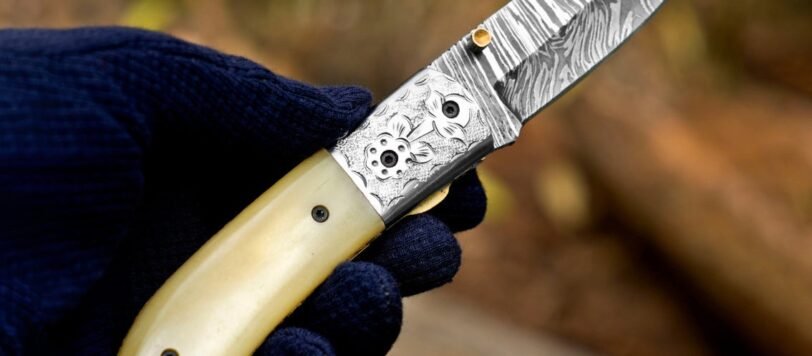
Knife blade shapes describe the profile of the blade: the line of the spine, the edge, and the point. Each shape trades strength, piercing ability and slicing performance against the others, and none of them is good at everything, whatever a catalog implies. Drop points give the best all-around balance, clip points pierce better at the cost of tip strength, tantos maximize tip toughness, trailing points excel at slicing hide, and specialty profiles like the gut hook and sheepsfoot exist for one job each. This guide explains the common blade shapes, what each is actually best at, and how to pick the right one for hunting, everyday carry, or the kitchen. Many of the shapes below are offered in pattern-welded steel in our Damascus knife collection.
The Anatomy Behind Every Shape
Three features define a blade profile. The spine is the unsharpened back; where and how it descends to the point determines tip strength. The belly is the curved section of edge near the tip; more belly means longer, smoother slicing strokes. The point is where spine and edge meet; the closer it sits to the centerline of the blade, and the more steel behind it, the stronger it is. Every named shape below is just a different arrangement of those three elements, which is why no shape is “best,” only best for a task.
The Core Blade Shapes
The shapes below cover the ones you will actually meet on a knife listing. Read each one for what it does well and, just as important, what it does badly, because the second half is where most buying mistakes are made.
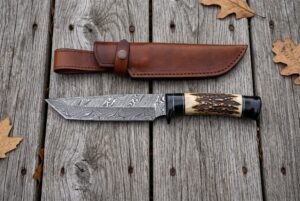
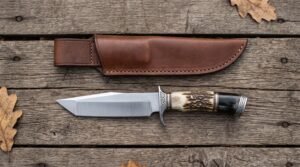
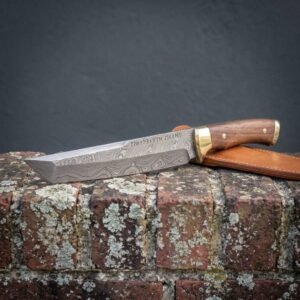
Drop point: the all-rounder
The spine slopes gently (“drops”) from handle to tip, putting the point near the blade’s centerline with plenty of steel behind it. The result is a strong, controllable tip plus a generous belly for slicing. This is the default shape on most hunting knives for good reason: the lowered point is less likely to nick organs while field dressing, and the belly does the skinning. If you can own only one fixed blade, a drop point is the sensible answer.
Clip point: the piercer
The spine runs straight, then a section near the tip is “clipped” off, straight or concave, producing a finer, sharper point. Clip points pierce and do detail work beautifully and remain excellent slicers. This is the classic profile of the Bowie knife, and it has stayed popular because it earns the attention. The trade-off is honest: that slender tip has less steel behind it and can snap under prying or hard lateral stress.
Tanto: the tip that survives
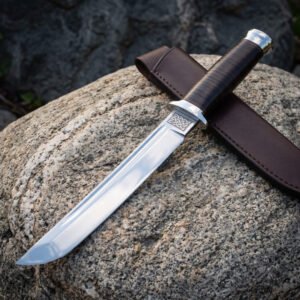
The modern tanto ends in an angular, chisel-like point with a high grind and almost no belly. Nearly all its cross-section is preserved right up to the tip, making it the strongest common point for piercing hard materials. The cost is slicing. With little belly, long draw cuts and skinning strokes are awkward, and the two-part edge takes more care to sharpen. A good many tantos are bought for how they look and then spend their lives opening parcels, which is a waste of an unusually strong tip.
Trailing point: the slicer
The spine curves upward so the point sits above the handle line (“trailing” behind the cutting action), creating maximum belly. This is the shape of dedicated skinner knives and fillet profiles: sweeping cuts through hide or flesh with minimal risk of the tip digging in. The raised, fine tip is comparatively delicate and is the wrong tool for stabbing or prying. It will tell you so, once.
Spear point and dagger: the symmetrical points
Spear points center the tip on the blade axis with symmetrical curves on both sides; daggers sharpen both of those edges. The centered tip pierces predictably and penetrates deeply, which is why the profile defines historical fighting blades and modern dagger knives. With modest belly and (on true daggers) no unsharpened spine to press on, they give up utility slicing in exchange.
Sheepsfoot and wharncliffe: the straight edges
Both carry a straight cutting edge with a spine that curves down to meet it, the sheepsfoot bluntly, the wharncliffe in a long taper. With little or no point, they are the safest shapes for cutting near skin, rope work, and box-opening, and the straight edge is trivially easy to sharpen. No point, of course, means no piercing.
Gut hook: the one-job specialist
A gut hook is a sharpened, C-shaped notch ground into the spine, usually of a drop-point or trailing-point skinner. Its single purpose is opening the abdominal hide of game like a zipper, the hook lifts the skin away from the organs beneath, so the cut cannot puncture them. Hunters love or ignore it; it does nothing else, but it does that one thing better than any plain blade.
Seax broken back: the Norse profile
The seax is the working knife of the Viking age, and the broken-back version is its most recognizable form. The spine runs straight from the handle, then breaks in a sharp downward angle to meet a straight edge at the point. It gives a strong, needle-ish tip on a long straight edge that is easy to sharpen and good for slicing, whittling and general camp work. It is not a specialist; it is a thousand-year-old generalist, and it is the direct ancestor of the modern clip and drop points. The full range lives in our Viking seax collection.
Kukri recurve: the chopper
The kukri is the forward-bent blade from the Indian subcontinent, and its shape is built around one idea: moving the weight and the impact point forward so the blade chops far above its size. The edge curves inward (a recurve) near the handle for whittling and detail, then bellies out and drops forward for chopping, where the inward bend drives the sweet spot into the target with real force. It splits, chops and carves like a small hatchet while still doing knife work near the handle. Its only real weaknesses are that the deep belly and forward bend make it awkward on a flat cutting board, and the recurve is slower to sharpen than a straight edge because a flat stone cannot sit fully in the inward curve. For a camper who wants one blade that chops firewood and still carves a tent peg, though, it is hard to beat.
Blade Shapes Compared
| Shape | Tip Strength | Piercing | Slicing / Belly | Best For |
|---|---|---|---|---|
| Drop point | High | Good | Very good | Hunting, general field use, EDC |
| Clip point | Moderate | Excellent | Very good | Bowies, detail work, traditional carry |
| Tanto | Very high | Excellent (hard media) | Limited | Tactical use, piercing tough materials |
| Trailing point | Low | Fair | Excellent | Skinning, slicing, fillet work |
| Spear point / dagger | Moderate, high | Excellent | Limited | Symmetrical piercing, historical designs |
| Sheepsfoot / wharncliffe | High (no point) | None | Good (straight edge) | Rope, boxes, safety-critical cutting |
| Seax broken back | High | Good | Very good | Camp, whittling, general Norse-style use |
| Kukri recurve | High | Fair | Good (chops) | Chopping, splitting, heavy field work |
| Gut hook (spine feature) | n/a | n/a | n/a | Opening hide without piercing organs |
How Many Blade Shapes Do You Actually Need?
Fewer than the catalog suggests. Most people are well served by two knives: a drop point for general use and a dedicated shape for whatever they do most. A hunter adds a trailing-point or gut-hook skinner. A collector adds a clip-point Bowie or a broken-back seax for the history. A camper who chops adds a kukri. Everyone else can stop at the drop point and be honestly done. Buying one of every profile is a fine way to build a display, but it is not how you build a working kit, and a shelf of specialist shapes will still see the drop point do most of the cutting.
The reason is that most cutting is slicing, and most of the rest is light piercing, and a drop point does both without complaint. The specialist shapes earn their place only when a task is repeated often enough that the small edge they give becomes worth the trade-off they demand. If you skin fifty animals a year, the trailing point pays for itself. If you skin two, the drop point is fine and you will not miss the difference.
Matching Shape to Job
For a deer hunter, the classic pairing is a drop point for field dressing plus a trailing-point skinner, or one gut-hook skinner that covers both. For everyday carry, drop points and clip points dominate folding pocket knives because daily tasks are mostly slicing with occasional piercing. In the kitchen, chef profiles are their own family, but the same belly logic applies: curved edges rock and slice, straight edges chop. For anglers, the fillet knife is essentially a long, thin trailing point tuned for flexibility. And historical patterns, the seax’s long straight edge with a dramatic broken-back point, the Bowie’s fighting clip, are reminders that every “modern” shape has centuries of field testing behind it.
Grind vs. Shape: They Are Not the Same
People mix these up constantly, including a fair number of people selling knives, so it is worth a line. The shape is the outline of the blade seen from the side, everything above. The grind is how the flats are ground down to the edge, seen end on. A flat grind thins evenly from spine to edge and is a good all-rounder. A hollow grind is scooped out and gives a very thin, keen edge that is superb for slicing and skinning but a little more fragile. A convex grind bulges outward to the edge and is the toughest, favored on choppers like the kukri. A scandi grind is a single wide bevel low on the blade, loved for whittling because it is easy to sharpen freehand. You can put most grinds on most shapes, so a listing that names one tells you only half the story. For how a knife cuts, judge shape and grind together.
Does Blade Shape Matter More Than Steel?
For how a knife cuts, shape and grind matter more than steel grade; for how long it keeps cutting, steel and heat treatment take over. A trailing-point skinner in ordinary steel will out-skin a tanto in the finest alloy ever poured, simply because the geometry fits the job. Choose the shape for the task first, then choose the steel for the maintenance and edge-life balance you want. Our blades are plain 1095 at 54 to 58 HRC or Damascus made from 1095 and 15N20 at 58 to 60 HRC, and what those numbers mean is covered in our guide to Damascus steel. Both decisions matter; they just answer different questions.
A Note on Steel and Origin
Whatever shape you pick, the steel underneath it on this site is the same short list: plain 1095 high-carbon, or Damascus forge welded from 1095 and 15N20. We do not use stainless. Every blade is handmade in the Czech Republic the old way, imported to Chicago, Illinois, inspected, and shipped from there, with any engraving done in the US. High-carbon steel rewards a wipe and a light coat of oil after use and punishes neglect with rust, whichever shape the blade happens to be.
Dagger profiles are a category of their own, separated out in the main types of dagger, and turning a profile into a purchase is covered in how to choose a Viking knife. The terms used for grinds and steels are defined in the glossary of steel terms. Two profiles that sit outside the usual list are covered in the kukri and its forward curve and, for a large clip point, the best Bowie knife.
Questions people ask
What is the best all-around knife blade shape?
The drop point, and it is not a close race. Its centered, well-supported tip is strong, its belly slices efficiently, and it handles hunting, camp chores, and everyday tasks without a real weakness, which is why it is the most common shape on quality fixed blades and folders alike. If you are buying one knife and cannot decide, buy a drop point and stop reading.
What is the difference between a drop point and a clip point?
A drop point’s spine slopes smoothly to a strong, lowered tip; a clip point’s spine is cut away near the end, creating a finer, sharper tip. Clip points pierce better and do finer detail work, while drop points resist tip breakage better. Both slice well, so the choice comes down to whether you value a fine point or a tough one.
What is a tanto blade actually good for?
Piercing tough materials, and very little else. The tanto’s angular geomety keeps nearly full blade thickness out to the tip, so it punches through hard media that would snap a slender point. It is a poor skinner and a poor slicer because it has almost no belly. Choose it for strength, not for versatility.
Why do skinning knives have a trailing point?
The upswept spine creates a long, continuous belly that glides through hide in one smooth stroke, while the raised tip stays out of the meat. That geometry makes trailing points the fastest, cleanest shape for skinning game and filleting fish, at the cost of a delicate tip that is poor for piercing or prying.
What is a seax and how is its blade shaped?
A seax is the working knife of the Viking age. Its most recognizable form is the broken back: the spine runs straight then angles sharply down to meet a straight edge at the point. That gives a strong tip and a long, easy-to-sharpen edge, which made it a do-everything camp and utility knife, and the direct ancestor of modern clip and drop points.
What blade shape is safest for utility work?
Sheepsfoot and wharncliffe profiles. Their straight edges cut aggressively, but the blunt or gradually tapered spine means there is little or no point to accidentally stab into skin, cargo, or an inflatable, which is why rescue and rigging knives use them.
Is a gut hook a blade shape?
Strictly, no. It is a feature added to a blade rather than a profile of its own: a sharpened hook ground into the spine, almost always on a drop-point or trailing-point skinner. It opens the hide of game without piercing the organs underneath, and that is its entire job. It has never pretended otherwise.
You can also build a piece from the steel up. Design your own covers six commission builders, from a seax to a polearm.
Pieces in the catalogue
If you are shopping rather than reading, the Tantostag Tanto knife and the Hornhook gut hook hunting knife are the nearest match. Also worth opening, the Olivewhorl kukri knife and the Bonespire dagger knife.
The clipped point, scaled up
Stretch a clipped point out to sword length and you have most of a messer. The Skarnvald grosses messer keeps that point, the messer guide explains the sword built like a knife, and there are more in HEMA messers.
Shop the range
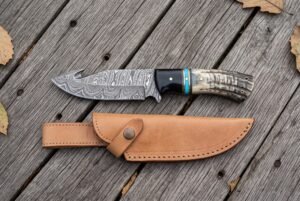 Hornreaver Hand Forged Damascus Gut Hook Hunting Knife with Buffalo Horn and Ram Horn Handle and Turquoise and Brass Spacers | Hunting Gift | RK-360
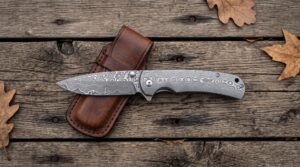 Leafcarry Hand Forged Damascus Folding Pocket Knife with Damascus Steel Handle Ready for Engraving & Cowhide Leather Sheath | Everyday Carry Collector Gift | RK-375
40 thoughts on “Knife Blade Shapes Explained: Drop Point, Tanto, Gut Hook & More”
Comments are closed.