
Blog
Best Bowie Knives: A Buyer’s Guide to the American Classic

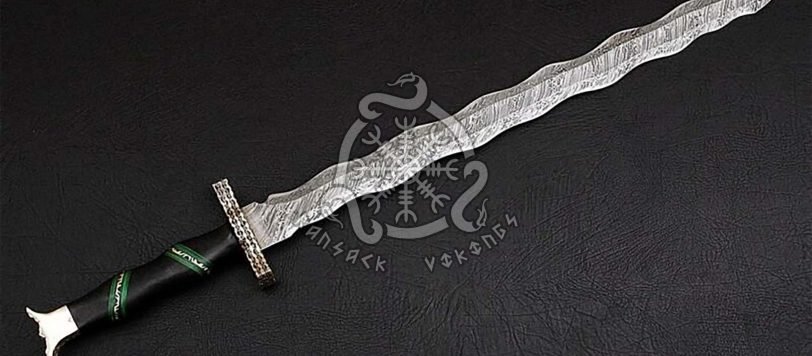
The best Bowie knife is a full-tang fixed blade with a 7-to-10-inch clip-point blade, a substantial crossguard, and a handle that fills the hand. That is the pattern that made the Bowie an American icon, and it has been copied ever since by every maker who wanted a knife to look serious on a shelf. Modern buyers choose between hard-use camp Bowies, hand-forged Damascus showpieces, and historically styled collector pieces, and the right pick depends on which of those jobs you actually want done. This guide covers what defines a true Bowie, the main variations, steel and handle choices, and the honest reasons a Bowie might be the wrong knife for you. Our hand-forged Bowie knives ship from Chicago, IL, and most can be personalized with free engraving.
What Makes a Knife a Bowie?
The Bowie pattern traces back to the 1830s frontier and the knife associated with James Bowie. While historical examples varied, the modern consensus Bowie has four signatures: a long blade (typically 7 inches or more), a clip point, the spine “clipped” in a straight or concave line toward the tip, a crossguard to protect the hand, and enough weight and belly to chop as well as slice. The clipped spine, often sharpened or false-edged, gives a big knife an agile, piercing tip that a plain drop point cannot match at this size.
The Main Types of Bowie Knives
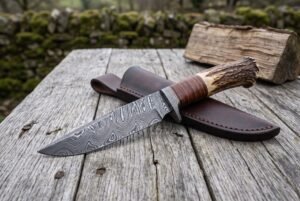 Staghide Hand Forged Damascus Bowie Knife with Stag Horn and Stacked Leather Handle and Damascus Guard & Leather Sheath | Hunting and Camping Bowie Gift | RK-385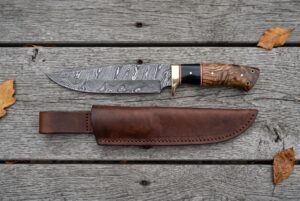
 Longrose Hand Forged Damascus Bowie Knife with Rosewood Handle and Steel Bolster and Black Fiber Spacer & Leather Sheath | Hunting Bowie Collector Gift | RK-473
Working Camp Bowie
Thick spine, tough high-carbon blade, plain handle. Built to chop kindling, clear brush, process game, and take a beating. This is the Bowie to actually use hard.
Damascus Bowie
The classic profile forged in layered pattern-welded steel. Fully functional, and bought mostly for the one-of-a-kind pattern rather than the performance. It is our most popular gift and display choice, and there is no shame in that. If you want to compare patterns before committing, the Damascus bowie knives at Black Mamba Knives are worth a look too, on the understanding that looking at Damascus is how people end up owning three.
Historical and Frontier Styles
Coffin-handled grips, brass backstraps, and period-styled guards for collectors who want the 19th-century look.
Modern Tactical Bowie
The clip-point silhouette in contemporary materials, synthetic handles, coated blades, molded sheaths. Capable, and missing almost all of the traditional character most Bowie buyers came for.
Bowie Types Compared
| Type | Typical Blade | Best For | Trade-Off |
|---|---|---|---|
| Working camp Bowie | 7 to 10 in | Camp chores, heavy use | Plainer looks |
| Damascus Bowie | 7 to 10 in | Gifts, display, light use | Needs rust care |
| Historical style | 8 to 12 in | Collections, reenactment | Less ergonomic |
| Tactical Bowie | 6 to 9 in | Modern outdoor kits | No traditional charm |
How to Choose a Bowie Knife
Blade Length: Bigger Is Not Always Better
Seven to eight inches is the sweet spot for a Bowie that still works: long enough to chop and command respect, short enough to control for food prep and game. Ten inches and up is display territory with occasional chopping duties. If most of your cutting is skinning and field dressing, you honestly want a 4-to-5-inch blade from our hunting knife collection instead, with the Bowie staying in camp.
Steel Choice
High-carbon steel is traditional for Bowies and takes the edge-holding, shock-resistant temper this pattern needs. Pattern-welded Damascus adds the layered look with similar performance. Both want a wipe of oil after use; if you cannot commit to that, our Damascus steel vs stainless steel comparison explains where stainless makes sense.
Tang and Guard
A knife this size generates real leverage. Insist on a full tang or a strong hidden tang, and a guard substantial enough to stop your hand sliding forward on a hard thrust or a stalled chop. Check that the guard is tight, a rattling guard on a new knife is a build-quality red flag.
Handle and Balance
Traditional Bowie handles run to stabilized wood, bone, stag, and horn. Whatever the material, the balance point should sit at or just ahead of the guard: blade-heavy enough to chop, not so nose-heavy it tires the wrist. Coffin and rounded-oval grips both work; avoid slick, heavily lacquered handles on a knife you plan to swing.
Sheath
A big blade demands a serious sheath: thick leather, welted seams so the edge cannot cut through, and a retention strap. A dangler or belt loop that lets the knife ride at a natural angle makes a blade this size far more comfortable to carry, and comfort is what decides whether it comes with you twice.
Who Should NOT Buy a Bowie Knife?
Skip the Bowie if you need a precise game-processing knife. The size that makes it impressive, is the size that makes it clumsy inside a deer. Skip it if you want an everyday belt knife for general tasks; a 4-to-5-inch fixed blade or a stout bull cutter knife does the same daily work without the weight. And know your local laws: some states restrict carrying large fixed blades, especially concealed, even where ownership is fully legal.
Caring for a Bowie
Wipe the blade after every use and before storage, and add a thin coat of mineral oil on carbon or Damascus steel. Strop to maintain the edge; sharpen the main bevel on a coarse-then-fine stone at a slightly steeper angle than a small knife, since a chopping edge needs durability. Store the knife out of its leather sheath in a dry place. Check guard and handle hardware once a season. That routine keeps a hand-forged Bowie ready for another generation, more care guides are on the Ransack Viking blog.
The Bowie is not the only big single edged belt knife with a following. Nine centuries earlier the Norse were carrying the langseax on the same logic: one heavy blade, worn where the hand falls, able to work all day and fight if it had to. If that idea appeals more than the frontier version, the Viking knives collection carries the seax patterns in forged high carbon and Damascus steel.
Bowie Knife FAQ
What is the ideal Bowie knife size?
A 7-to-8-inch blade with an overall length around 12 to 13 inches balances the Bowie’s chopping power against the fact that you still have to control it. Larger blades up to 12 inches make dramatic display and heavy chopping pieces, while anything under 6 inches has quietly stopped being a Bowie and become a hunting knife.
Are Bowie knives legal to own and carry?
Ownership is legal throughout the US. Carry is where laws differ: several states and cities regulate carrying large fixed-blade knives, particularly concealed carry, and rules have loosened in some states in recent years while remaining strict in others. Check your current state and city law before carrying any large knife in public.
What is the clip point on a Bowie for?
The clipped spine thins and lowers the tip, giving a large, heavy blade a surprisingly precise, fast point for piercing and detail work. Historically it also allowed a sharpened false edge for back-cuts. In practical terms, it means one big knife can chop with its belly and still do fine tip work.
Is a Damascus Bowie knife practical or just for show?
A properly forged pattern-welded Bowie is a fully functional knife, the layered construction historically aimed at combining hardness with toughness. It will chop and slice like a plain carbon blade of the same geometry. The only real difference is that owners baby them, because each pattern is unique and most were bought partly for looks.
Can you hunt with a Bowie knife?
You can, and camp Bowies handle quartering and heavy cuts well, but a full-size Bowie is oversized for field dressing and skinning, where a 3.5-to-5-inch blade gives far more control. Many hunters pair a compact hunter for the animal with a Bowie for camp chores, each does its own job well.
Do engraved Bowie knives make good gifts?
Bowies are among the most-gifted knives we sell, largely because the blade flat gives an engraver somewhere to work. A name, date, or short phrase fits comfortably, and we offer free engraving on most models. Engraved Bowies are popular for groomsmen, retirements, milestone birthdays, and anyone with frontier history in the family.
The Norse equivalent of this blade is the seax, and the two are compared in the seax and Bowie comparison. Where the Bowie sits among fighting blades generally is covered in the types of dagger.
What the shop carries
The catalogue carries the Staghide Bowie knife and the Sandbone Bowie knife. So do the Brasscliff Bowie knife and the Emberstack Bowie knife.
Shop the range
Staghide Hand Forged Damascus Bowie Knife with Stag Horn and Stacked Leather Handle and Damascus Guard & Leather Sheath | Hunting and Camping Bowie Gift | RK-385Longrose Hand Forged Damascus Bowie Knife with Rosewood Handle and Steel Bolster and Black Fiber Spacer & Leather Sheath | Hunting Bowie Collector Gift | RK-473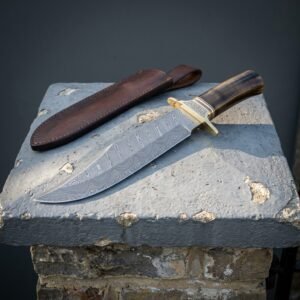
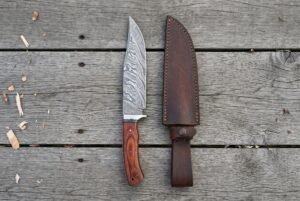
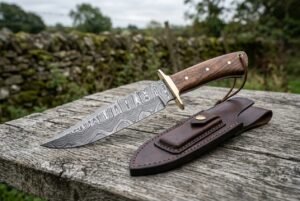 Timberedge Hand Forged Damascus Bowie Knife with Wood Handle & Leather Sheath | Hunting Camping and Fathers Day Gift | RK-492
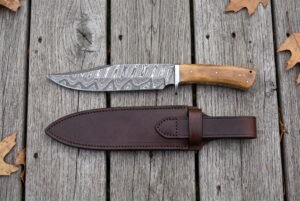 Sandbone Hand Forged Damascus Bowie Knife with Dyed Camel Bone Handle & Leather Sheath | Hunting and Camping Bowie Gift | RK-488