
Blog
Karambit Knives: What They’re For and How to Choose One

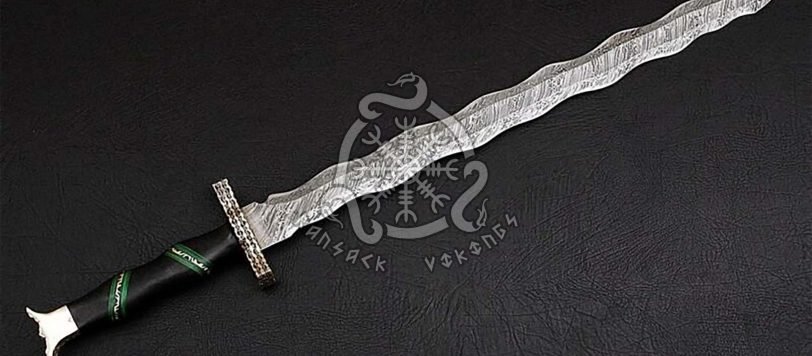
A karambit is a curved, claw-shaped knife from Southeast Asia, held with the blade curving downward out of the bottom of the fist and usually carrying a safety ring on the pommel for the index or pinky finger. It is sold today with a great deal of tactical atmosphere around it, and it began as an agricultural tool from Indonesia and the surrounding region, used for cutting rope, harvesting crops, and utility work. Both of those are true, and the farming half explains the knife rather better. It is known now as a martial arts training blade, a striking collector’s piece, and an unusual but capable utility knife. This guide explains where the karambit comes from, what the curve is actually good at, how to choose one, and who should honestly pick a different knife. You can browse hand-forged pieces in the karambit knife collection; everything ships from Chicago, IL, and many models can be engraved.
Where the Karambit Comes From
The karambit (also spelled kerambit) originates in Indonesia, Malaysia, and the Philippines, where small curved blades were everyday farming tools. The shape echoes a tiger’s claw, and folklore leans into that image. Over centuries the design was absorbed into regional martial arts such as silat, which developed systems around the blade’s hooking, downward-curved geometry. Modern interest in karambits comes from three directions at once: martial artists, collectors drawn to the distinctive silhouette, and knife users who discover that a claw blade pulls cuts toward the user’s grip with unusual control.
The farming origin explains the shape better than the folklore does. A worker harvesting rice or cutting cord wants a blade that hooks the material, holds it against the edge, and finishes the cut with a pull of the arm. A small curved blade with a finger ring does exactly that. The fighting use came later and borrowed the same geometry. A karambit is a field tool that martial artists adopted, not the other way around.
Anatomy: What Makes a Karambit a Karambit
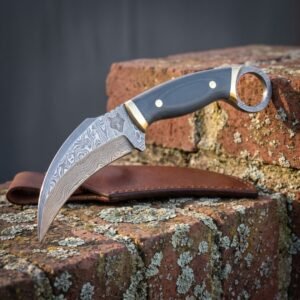
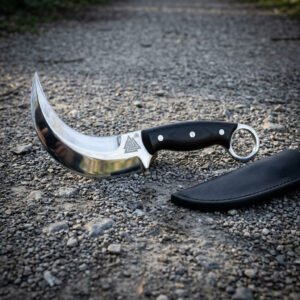
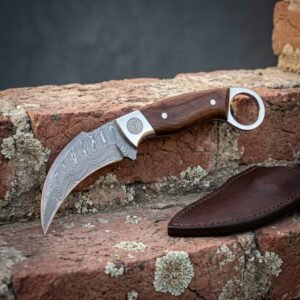
Three features define the pattern. First, the curved, claw-like blade, sharpened on the inside (concave) edge; some versions add a backedge. Second, the safety ring at the pommel: with a finger through the ring, the knife stays indexed in the hand even with a loose grip, and cannot easily be dropped or pulled away. Third, the reverse-grip orientation: the classic hold puts the blade emerging from the bottom of the fist, curve facing forward. Fixed-blade karambits are the traditional form; modern folding karambits add a pocket clip and sometimes assisted opening.
The Ring: More Than a Finger Hole
The ring is the part people ask about most, and it does more than one job. The obvious one is retention. With a finger through it, the knife cannot be dropped, cannot be knocked out of the hand, and cannot be pulled away by whatever it is cutting. That matters more than it sounds when the material is under tension, like a rope or a strap that springs when it parts.
The second job is indexing. Because the ring sits in one place on one finger, the blade always ends up at the same angle in the hand without looking. A farmer reaching down for the next stalk, or a user working in the dark, gets the edge where they expect it every time.
The third job is freeing the hand. The knife can hang from one finger while the rest of the hand grips, lifts or ties, then swing back into the palm when needed.
Fit is everything. The ring has to pass over the finger easily but not rattle. Too tight and the knife binds, which is dangerous when you need to let go. Too loose and it spins, which defeats the indexing. Measure the finger you will actually use, with a glove if you work in gloves, and compare it to the listed ring diameter before you buy.
Grip Styles, Plainly
Reverse grip, ring on the index finger is the classic hold. The blade points down out of the bottom of the fist with the curve facing forward. This is the grip martial arts systems teach and the one that makes the claw shape work for hooking cuts. It takes practice, because the edge is close to your own forearm and wrist.
Forward grip, ring on the pinky turns the karambit into something closer to a small hawkbill utility knife. The blade points up and away, the curve faces you, and pull cuts on rope, cord or carpet feel natural. For most people who buy a karambit for work rather than training, this is the grip they quietly end up using, whatever the product video showed them.
Whatever the grip, the rule is the same: if you have to think about where the edge is, stop and reposition. The curve rewards a settled hand and punishes a fumbling one.
Why the Curve Works
A straight edge cuts by pushing or drawing across material that has to be held still by something else. A concave edge cuts by trapping the material in the curve so that the pull of your arm does both jobs at once. As the blade draws back, the material slides deeper into the curve and meets the edge at an increasingly steep angle, so the cut gets more aggressive as it goes rather than less. That is why rope, netting, webbing, seat belts and carpet part so easily under a hooked blade, and why linoleum knives, pruning knives and hawkbills all share the shape.
The same geometry is why the karambit is a poor piercer and a poor slicer on a board. The tip trails behind the belly of the curve, so it does not lead into a thrust, and the edge cannot lie flat on a cutting surface. Choosing a karambit is choosing the pull cut over everything else.
What Is a Karambit Actually Used For?
Utility Cutting
The hooked edge excels at pull cuts: rope, cord, netting, webbing, opening feed bags, cutting carpet and roofing felt. The curve traps material against the edge instead of letting it slide off the tip, the same reason linoleum and carpet knives are hooked.
Martial Arts Training
Silat, kali, and some modern defensive systems train karambit techniques. Practitioners should train with blunt trainers, and live blades belong only in experienced hands. The reverse grip that makes the karambit retention-friendly also makes it genuinely unforgiving for the untrained. Butterfly knife owners get the same advice for the same reason, and a shop that sells both balisong knives and trainers will let you buy them in the right order.
Collection and Display
The claw silhouette, especially in pattern-welded Damascus steel, is one of the most visually striking knife patterns there is to collect and engrave. A fair number are bought for that reason alone and never cut anything at all, which is a perfectly respectable way to own a knife.
Karambit vs. Straight Blade: Honest Comparison
| Task | Karambit | Straight Blade |
|---|---|---|
| Pull-cutting rope and cord | Excellent | Good |
| Retention in the hand | Excellent (safety ring) | Depends on handle |
| Piercing and drilling | Poor | Good to excellent |
| Food prep and slicing on a board | Poor | Excellent |
| Skinning and game work | Limited | Excellent |
| Learning curve | Steep | Minimal |
Damascus Karambits
The claw shape shows off a Damascus pattern better than almost any other blade, because the etched layers follow the long sweep of the curve. The Damascus karambits on this site are forge welded from 1095 high-carbon steel and 15N20 nickel steel, then heat treated to 58 to 60 HRC. The plain versions are 1095 at 54 to 58 HRC. Neither is stainless, and we do not use stainless for anything, so a Damascus karambit needs the same wipe and light oil as every other carbon blade. If you want the shape in pattern-welded steel, the wider Damascus knife collection is the place to compare it with the other Damascus patterns, and the Viking knife collection holds the plain 1095 pieces alongside it. What Damascus is and how it is made is covered in our guide to Damascus steel.
How to Choose a Karambit
Fixed vs. Folding
Fixed blades are stronger, simpler, and true to the original pattern, the right call for utility use and collection. Folders are more pocketable but add a lock and pivot to a blade shape that already has a learning curve. Either way, the local rules on carrying a knife may treat the two differently, so check before you decide.
Steel and Edge
High-carbon and Damascus steels take the keen edge a curved blade needs and resharpen predictably. Stainless steels trade some of that for corrosion resistance; we do not use them. The trade-offs are the same as any blade, and our Damascus steel vs stainless steel guide covers them. Note that sharpening a concave edge requires a round or tapered stone. If you do not own one, buy it at the same time as the knife, because the day you need it is not the day to find this out.
Ring Fit and Handle
The safety ring must fit your finger with a glove on and without binding bare. Too small is dangerous, too large defeats the retention purpose. The handle should index naturally in reverse grip with the ring seated. If you have to think about your grip, the knife does not fit.
Sheath and Carry
A fixed karambit needs a fitted sheath with positive retention. And carry rules matter: how a fixed blade may be carried, how long it may be, and whether it may be concealed all vary from place to place, so check yours before the knife leaves the house.
A Note on the Law
We are a knife shop, not a law office, and we will not tell you what is legal where you live. The rules on owning and carrying knives differ between countries, between states, and often between cities within the same state, and a karambit’s fixed blade, its curve, its ring and, on folders, its opening mechanism can each be treated differently. Before you buy, and certainly before you carry, look up the rules for your own city and state from an official source. If you cannot find a clear answer, assume the stricter reading.
Who Should NOT Buy a Karambit?
Several kinds of buyer should walk straight past this one. If you want a single practical knife for everyday tasks, a straight-edged blade is more versatile and it is not a close contest; a drop-point from our hunting knife collection or a dagger for collectors does more with less learning curve. If you are buying for self-defense without committing to training, the karambit’s reverse grip is a liability, not an advantage. And if you dislike specialized sharpening, the concave edge will frustrate you. It needs round stones and patience.
Care and Sharpening
Care matches any carbon or Damascus blade: keep it clean, dry, and lightly oiled, and store it out of leather. Sharpening is the one karambit-specific skill. Use a tapered round ceramic rod or a fine round file wrapped in wet-dry paper, working along the inside curve at a consistent angle until a small burr forms, then strop it off over a dowel. Five minutes of practice makes it routine. More sharpening and care guides are in the Ransack Viking guides.
Where These Knives Come From
Ransack Viking is a US company in Chicago, Illinois. The knives are not made in Chicago. Every blade is handmade in the Czech Republic the old way, then imported to Chicago, inspected, and shipped from there. Engraving is done in the US after inspection.
The curve is what makes this knife awkward to sharpen, dealt with in sharpening a curved edge. It also sits in a legally sensitive group, so check how your state treats carry before you carry one, and see the dagger types for where it fits.
Questions people ask
What is a karambit knife?
A karambit is a Southeast Asian knife with a curved, claw-shaped blade sharpened on the inside edge and a safety ring at the pommel. Held traditionally in reverse grip with a finger through the ring, it began as a farming and utility tool in Indonesia and the region and is now used for utility cutting, martial arts training, and collecting.
What is the ring on a karambit for?
The ring locks the knife to your hand. With the index or pinky finger through it, the karambit cannot be dropped or easily stripped from your grip, and it can pivot in the hand for different holds. It also allows the knife to hang from the finger while the hand does other work, a farmer’s feature before it was a fighter’s one.
Are karambits legal to own?
That depends entirely on where you live, and we are not going to guess on your behalf. Rules on owning and carrying knives vary between countries, states and cities, and a karambit’s fixed blade, curve, ring and opening mechanism can each be treated differently. Check the rules for your own city and state from an official source before you buy and before you carry.
Is a karambit good for self-defense?
Only in trained hands. The ring gives excellent retention and the curve is effective at close range, which is why several martial arts systems teach it. But the reverse grip and hooked edge take real training to use safely, and an untrained user is considerably more likely to injure themselves than anyone else. For most people the defensive value comes from the training, not from the blade shape.
How do you sharpen a curved karambit blade?
Use a round or tapered sharpening rod, ceramic or fine diamond, and work along the concave edge at a consistent angle, from heel to tip, until you feel a burr on the outside. Then remove the burr with light alternating passes or a strop curved over a dowel. Flat bench stones cannot reach the inside curve, which is the only real difference from sharpening any other knife, and the entire reason karambits have a reputation for being difficult.
What steel is a Damascus karambit made from?
Ours are forge welded from 1095 high-carbon steel and 15N20 nickel steel, heat treated to 58 to 60 HRC, which holds a fine edge on the curve and resharpens on a round stone. The plain versions are 1095 at 54 to 58 HRC. Neither is stainless, so both need a wipe and a light coat of oil after use to stay rust free.
Can a karambit be engraved?
Yes. The blade flats and handle scales take engraving well, and the dramatic claw profile makes engraved karambits popular display and gift pieces. Engraving on our knives is done in the US after the blade arrives from the forge and is inspected, and personalization has no effect on the blade’s balance or function.
The shop side of this
Closest to this in the shop, the Talonveil Karambit knife and the Talonvalk Valknut Karambit knife. Alongside them, the Pakkaclaw Karambit knife and the Ramclaw Karambit knife.
Shop the range
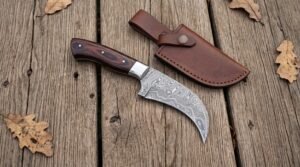
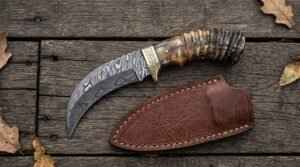
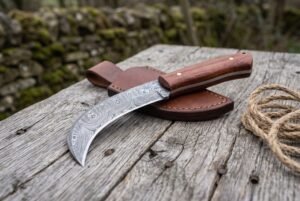 Roseclaw Hand Forged Damascus Hawkbill Knife with Rosewood Handle & Handmade Leather Sheath | Tactical Everyday Carry and Collector Gift | RK-1068