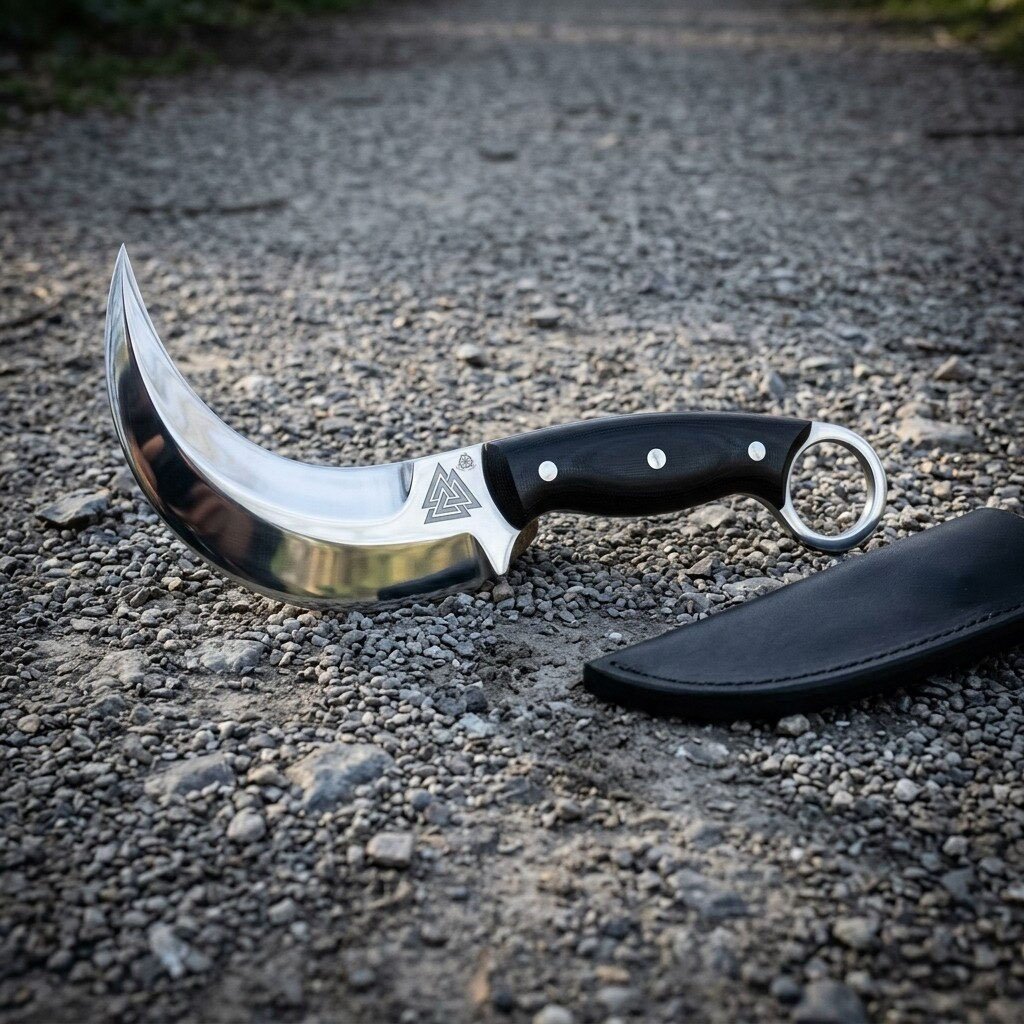
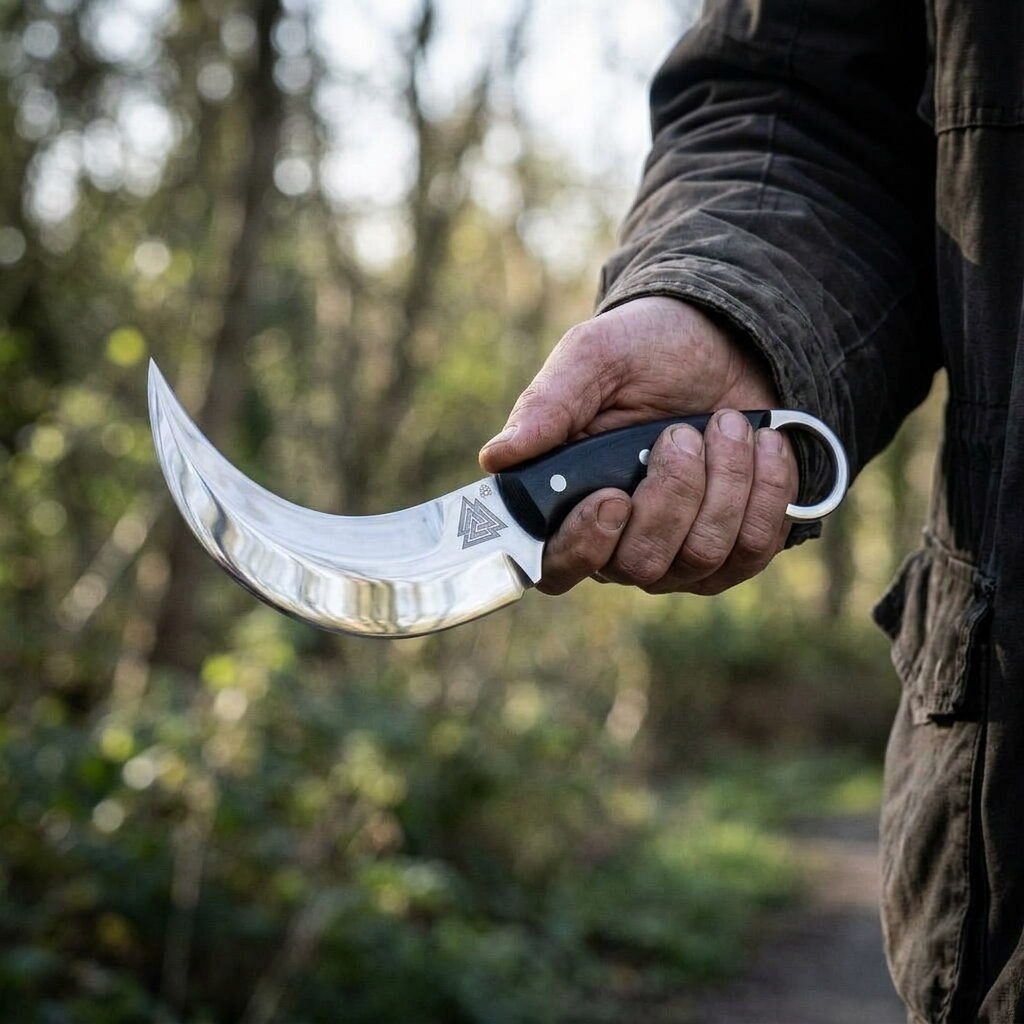
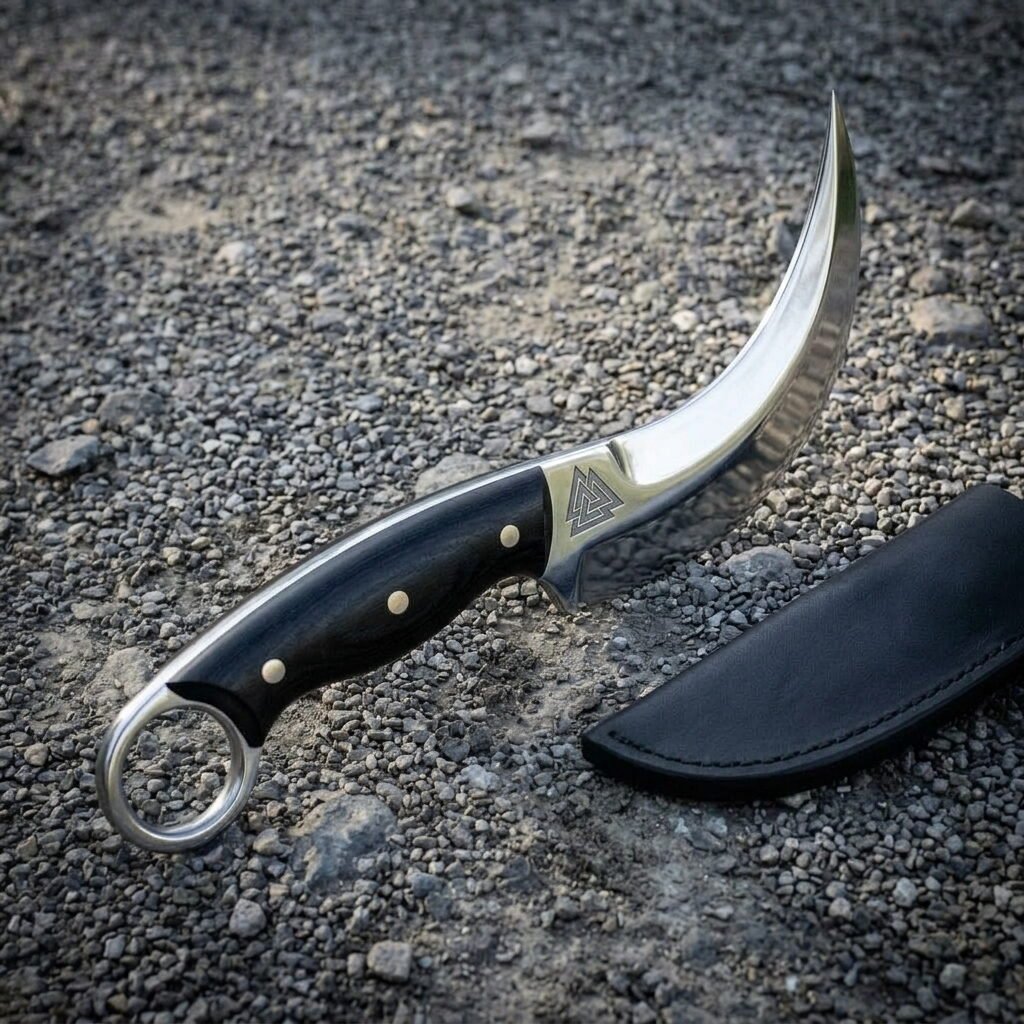
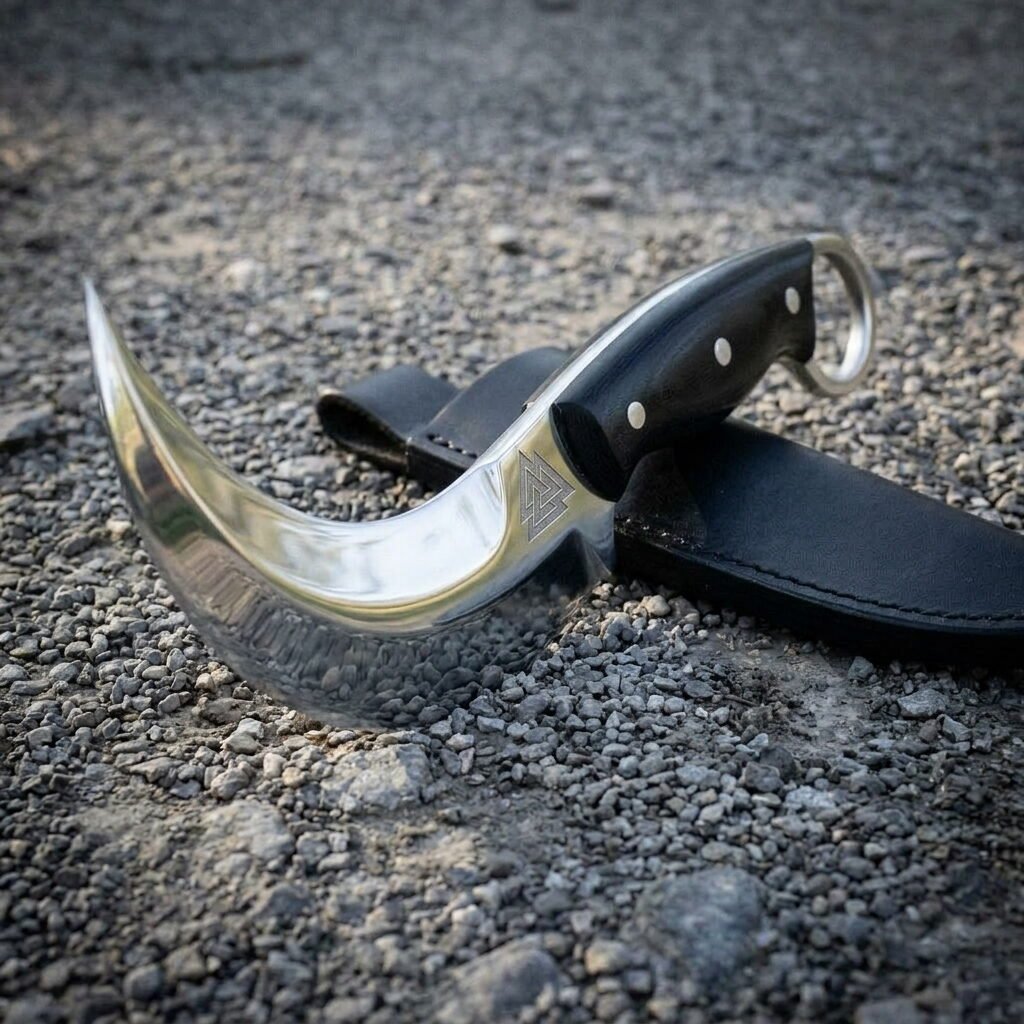
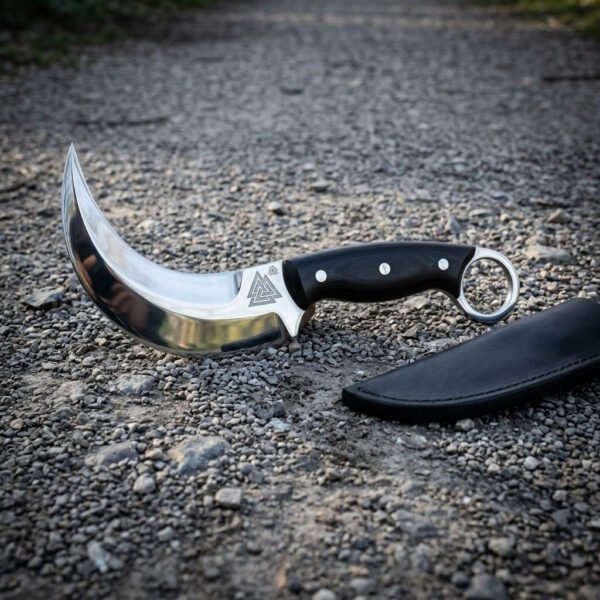
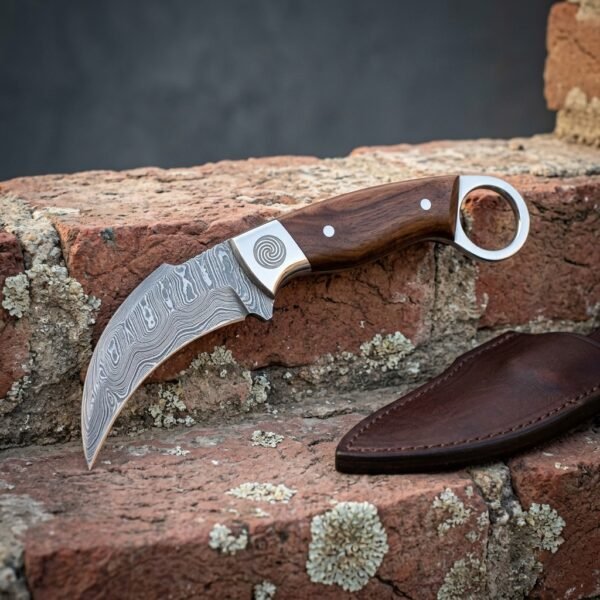
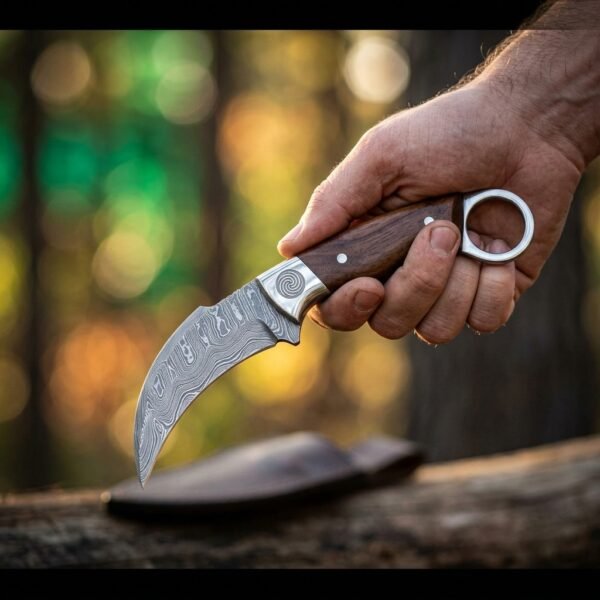
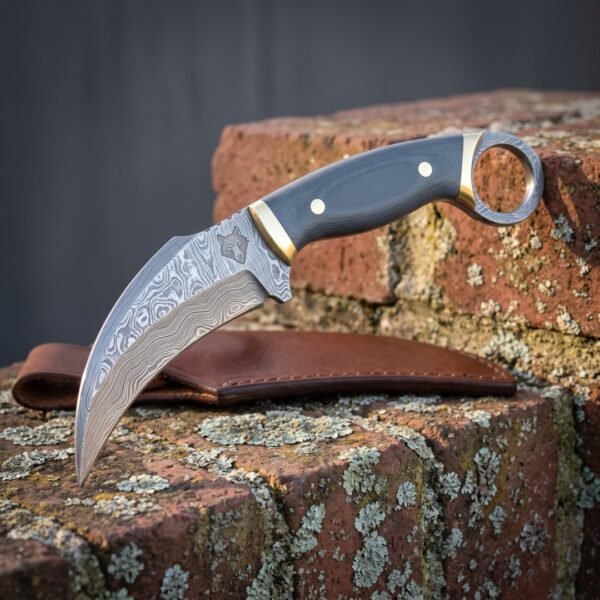
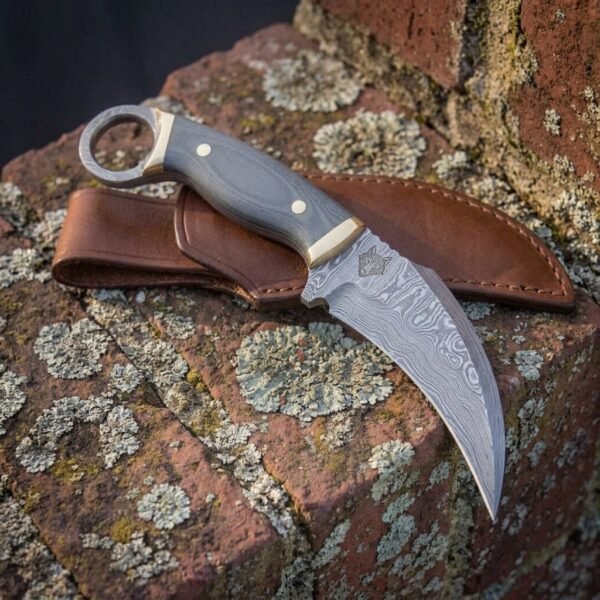
The Talonvalk is a full size karambit, a curved talon of a knife with a finger ring at the butt and a deep hawkbill belly that pulls through material rather than pushing into it. The blade is hand forged from 1095 high carbon steel, brought to a mirror polish, and carries an etched Valknut, the three interlocked triangles that appear on the Stora Hammars picture stones on Gotland and on fittings from the Oseberg ship burial. The handle is black canvas micarta, pinned through with polished steel, and the knife rides in a fitted cowhide sheath cut to the curve.
The karambit did not begin life as a fighting knife. It came out of the rice fields of the Minangkabau in West Sumatra, where a short hooked blade with a ring for the index finger was the fastest way to cut stalks close to the ground without losing the tool when your hand was wet. The ring is what makes a karambit a karambit rather than a plain hawkbill, and every other part of the design follows from it. This one is forged, ground, heat treated, polished and etched in the Czech Republic, and it ships with the leather sheath shown and nothing further to buy before you can use it. Filed under the karambit knives, and the Damascus knives are the other half of that shelf.
Specifications
| Blade steel | 1095 high carbon, hardened to 54 to 58 HRC |
|---|
| Blade finish | Mirror polish with an etched Valknut at the ricasso |
|---|
| Blade length | Approximately 6 inches measured along the curve |
|---|
| Overall length | Approximately 11 inches including the ring |
|---|
| Blade shape | Deep hawkbill with a single plain edge |
|---|
| Guard | None, the blade steps down into the scales at the ricasso |
|---|
| Handle | Black canvas micarta scales over a full tang |
|---|
| Pins | Three polished steel pins |
|---|
| Pommel | Integral steel retention ring |
|---|
| Sheath | Black cowhide leather, wet formed and stitched to the blade curve |
|---|
| Included | Knife and leather sheath |
|---|
| SKU | RK-1851 |
|---|
What the finger ring on a karambit actually does
Slide your index finger through the ring and the knife stops being something you hold and becomes something attached to you. That is the whole point of the design. Grip strength is no longer the thing keeping the tool in your hand, so the hand can stay loose, and a loose hand is a hand that can still work an hour later. Field workers who cut all day understood that long before anyone called this a tactical shape.
The ring also lets the knife pivot. Let the handle rotate against the finger and the blade swings from a forward grip to a reverse grip without ever leaving you. That single movement is why the karambit spread from farm work into the fighting arts of the Malay archipelago and then outward from there.
The curve does the second half of the job. A straight edge has to be pressed into what it cuts. A hawkbill traps material in the belly of the curve and slices as you draw back, so the work happens on the pull rather than the push. Rope, cordage, netting, cardboard, webbing and vine all behave the same way under it. The tip sits below the line of your knuckles, which is why a karambit feels awkward for the first ten minutes and obvious after that.
1095 high carbon steel and the mirror polish
The blade is 1095, a plain high carbon steel with roughly one percent carbon and very little else in it. There is nothing clever about the alloy, and that is exactly why smiths keep reaching for it. It moves predictably under the hammer, it takes an even quench, and at 54 to 58 HRC it holds a working edge while staying tough enough that a hard twist bends it instead of snapping it. It also sharpens on a plain stone with no special abrasive and comes back keen faster than a stainless blade of the same hardness.
The heat treat is the part that matters most. The blade is normalised to settle the grain after forging, brought to critical heat, quenched in oil, and then tempered back so it lands in that band rather than glass hard. A blade that skips those steps can look identical and behave nothing like it.
The trade you make for all of that is rust. 1095 carries almost no chromium, so it will spot if it is left wet or handled and put straight away. A mirror polish helps, because a polished surface gives moisture fewer places to sit, but polish is not the same thing as stainless. The Valknut is etched into that polish, which is why it reads as a soft grey figure on a bright ground rather than as a cut groove.
Engraving, runes and your own design
Use the rune converter on this page to turn a name, a date or a short phrase into Elder Futhark and we will cut it into the steel, the leather or the wood. If you would rather have a Viking pattern than a rune line, choose your own design in the engraving option above the add to cart button and tell us where it goes. Where a piece already carries an engraved design, your chosen engraving replaces it rather than sitting alongside it. On this knife that means the Valknut is what gets replaced, so if you want a name on the blade the triangles come off. Full detail is on the engraving page.
Handling and balance
The weight sits just ahead of the ring, close to the front pin, so the knife hangs level from the finger and does not try to dive point down. In a forward grip the point leads and the edge faces away. In a reverse grip the edge faces in and the ring locks against the base of the palm. Both are secure without squeezing. The scales are canvas micarta with the weave left slightly proud, which is grippier wet than dry, and the sheath holds the blade by friction on the spine rather than by a strap, so it draws clean and quiet.
Care
Wipe the blade dry after use and put a thin film of mineral oil or camellia oil on the steel before it goes away. If a grey haze appears on the polish, a soft cloth and a little oil will lift it. Do not store the knife inside the leather sheath for months at a time, because vegetable tanned leather holds moisture against steel and that is how pitting starts. Feed the sheath once or twice a year with a leather balm and it will outlast you. There is more on rust, patina and edge work on our steel care page.
Made in the Czech Republic
This piece is made by hand in the Czech Republic, in a workshop that still works the old way. The steel is forged, ground, heat treated and finished by smiths who learned the trade from the people before them, and the wood, horn and leather are cut and fitted by hand rather than pressed out on a line. That is also why no two pieces come out exactly the same.
Ransack Viking is a United States company. We import these pieces ourselves, check every one when it lands and ship from our warehouse in Chicago, Illinois. Engraving is done here in the United States after the piece arrives, so your runes or your own design go on before it leaves for you.
A note on handmade variation
This is hand made, not machine made and not bulk produced, so what arrives will not be a pixel for pixel copy of the photograph. The exact sweep of the hawkbill, the height of the polish, the depth of the etch and the grain of the micarta all shift a little from one knife to the next because each is worked by hand from natural and semi natural materials. The steel, the dimensions and the build are the same every time. The character is not, and that is the honest trade you make buying from a forge instead of a factory. There is a longer piece on what a karambit is, and another on the knife laws by state.
Frequently asked questions
Is it sharp out of the box?
Yes. It leaves the shop shaving sharp along the full curve. The inside of a hawkbill bites early, so take care the first time you draw it from the sheath.
Is this legal for me to carry?
We cannot advise on that. Fixed blade and ring handled knives are regulated differently from state to state and city to city, so check your local law before carrying it.
Will the blade rust?
It can. 1095 is not stainless. Keep it dry, keep a light oil film on it, and it will stay bright for years.
Can I sharpen the curve on a flat stone?
A round rod or the corner of a stone works far better. Follow the curve in short strokes rather than trying to run the whole belly across a flat surface.
Is the sheath left or right handed?
It is a symmetrical pouch sheath with no handed bias, so it carries from either side.
How long before it ships?
One to two weeks of processing, then free shipping inside the United States.
What is in the box
- One Talonvalk Valknut karambit in 1095 high carbon steel
- One fitted black cowhide leather sheath
- A light protective oil film on the blade
- Forged and finished in the Czech Republic
Explore the range
More in karambit knives, Viking knives and Norse arms, plus sharpening and rune notes in the guides.
Close to this one
For a straight comparison, see the Clawfold karambit knife, 8 inches overall. Worth putting side by side with this is the Talonveil karambit knife, 9 inches overall. In the same category sits the Clawshade karambit knife, pattern welded Damascus.
From the same corner of the shop, there is the Runehollow kukri knife. Nothing here exactly right, build one to your own spec on the custom hunting knife page.



Reviews
There are no reviews yet