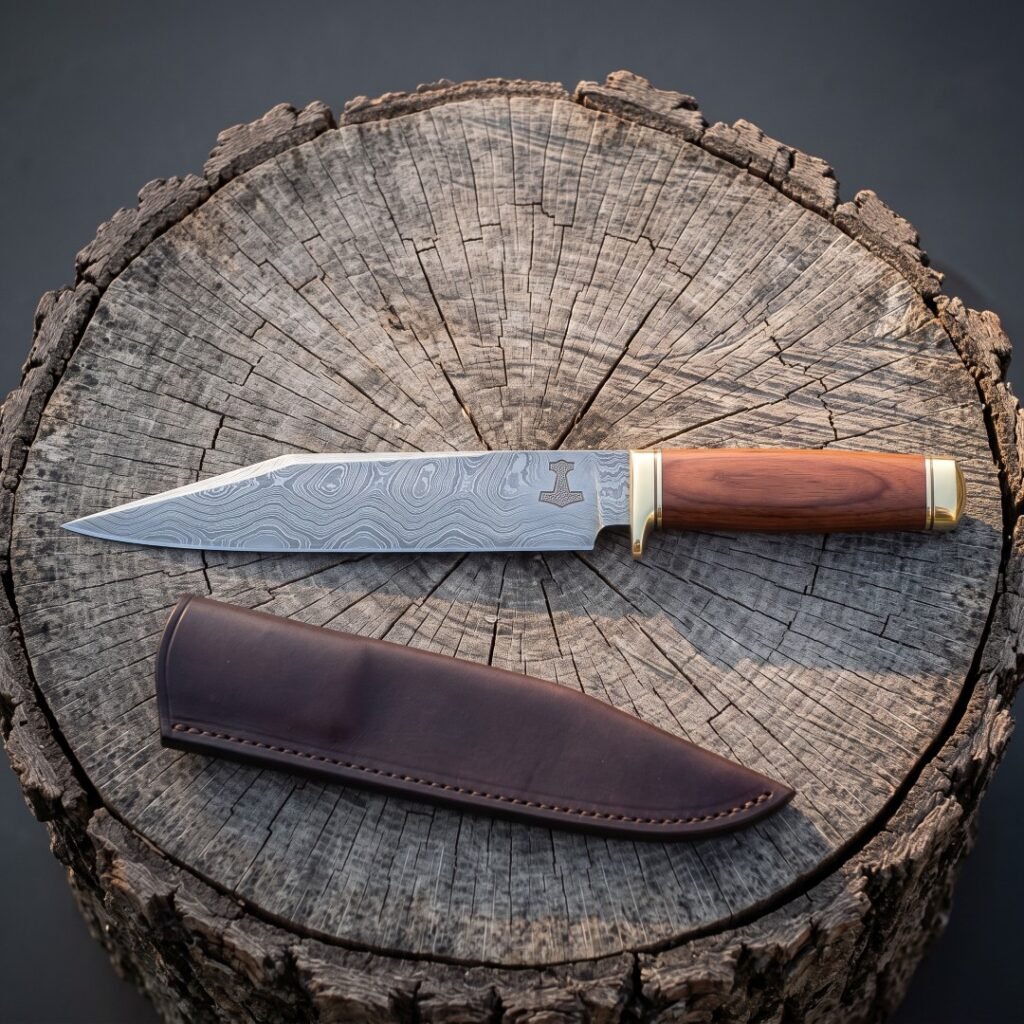
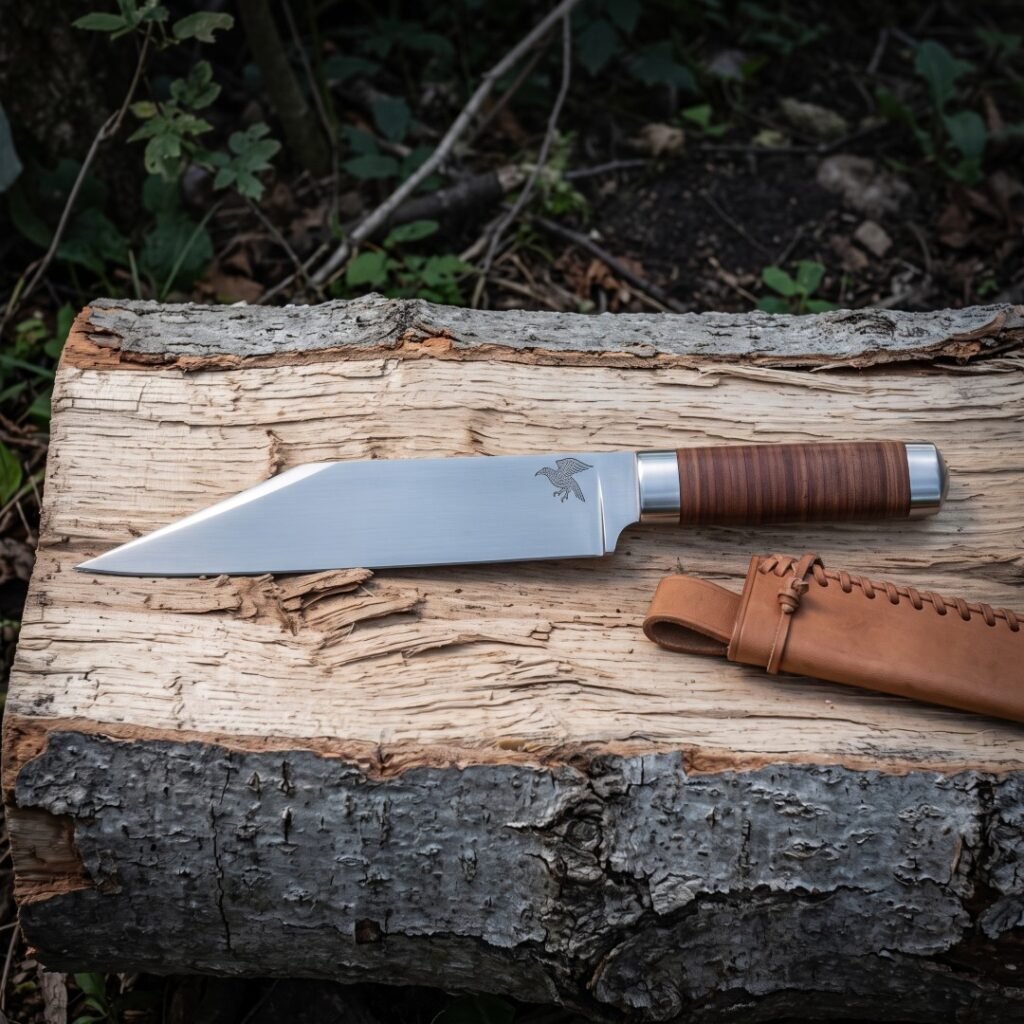
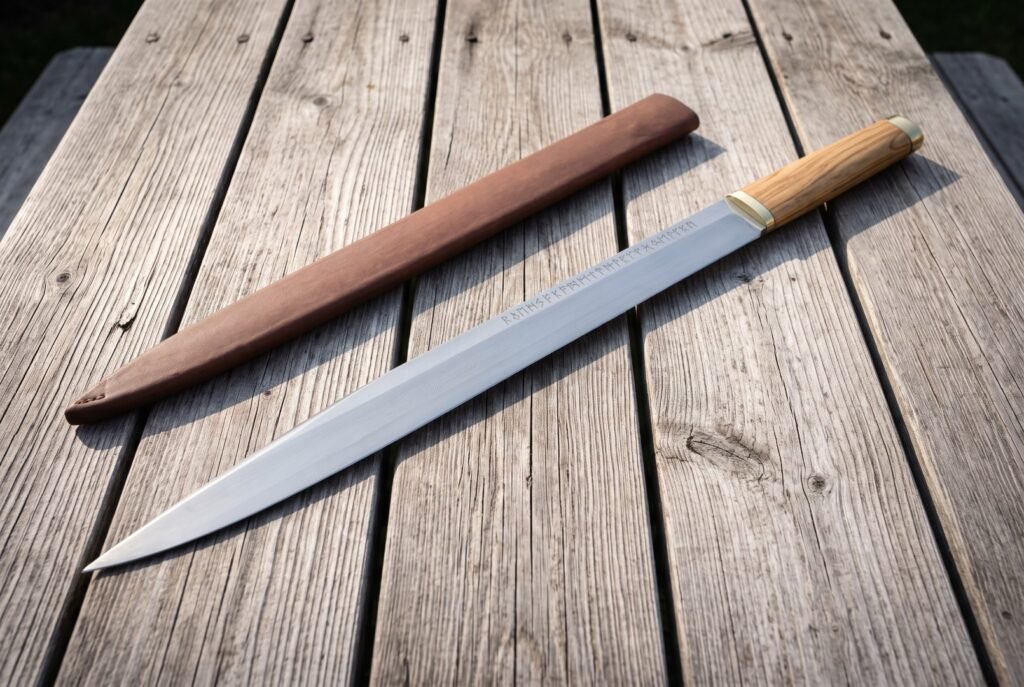
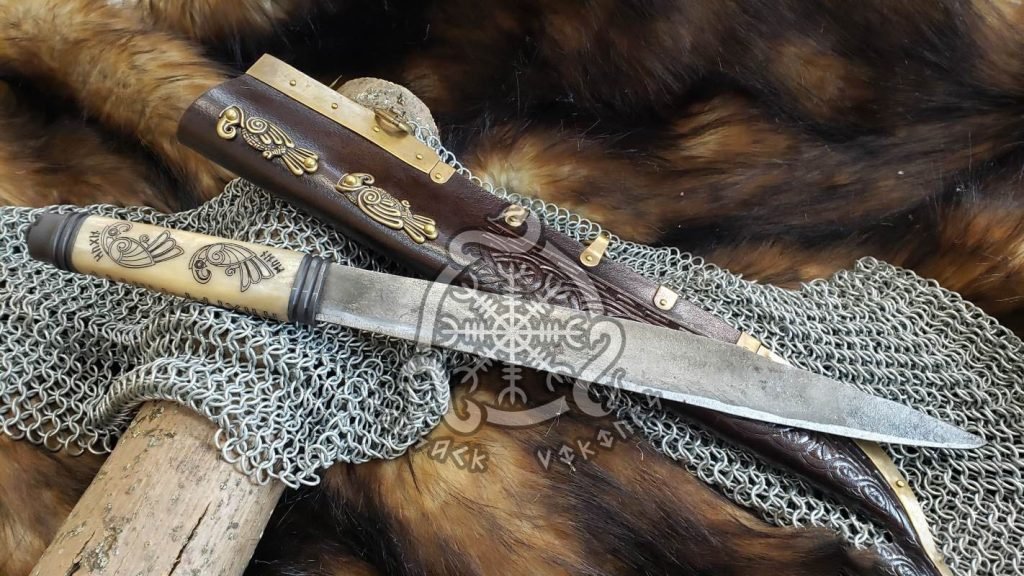
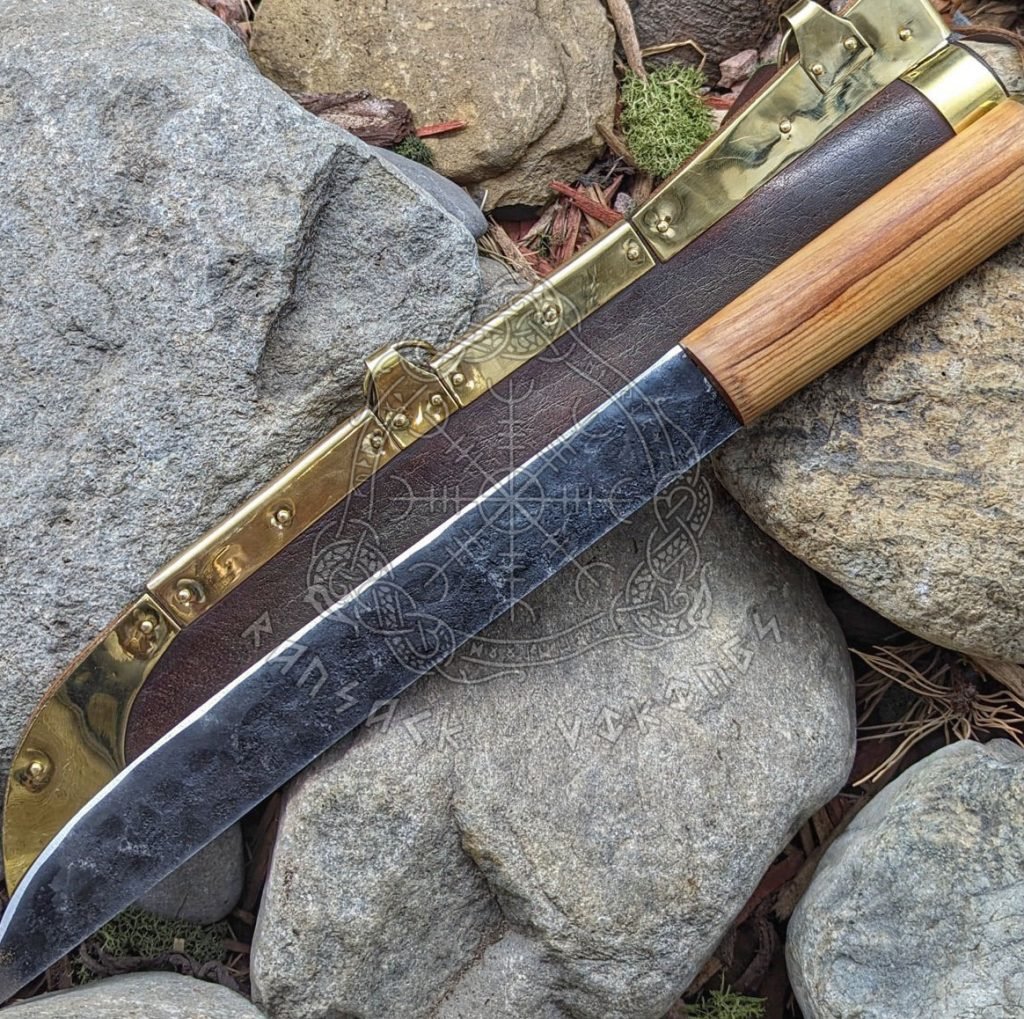
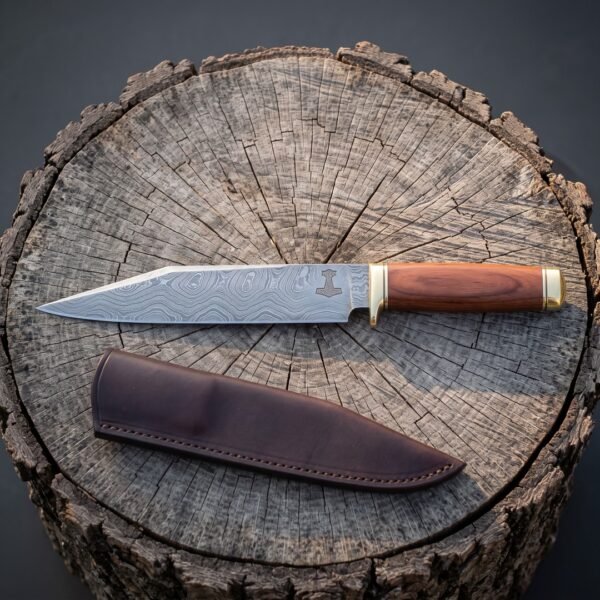
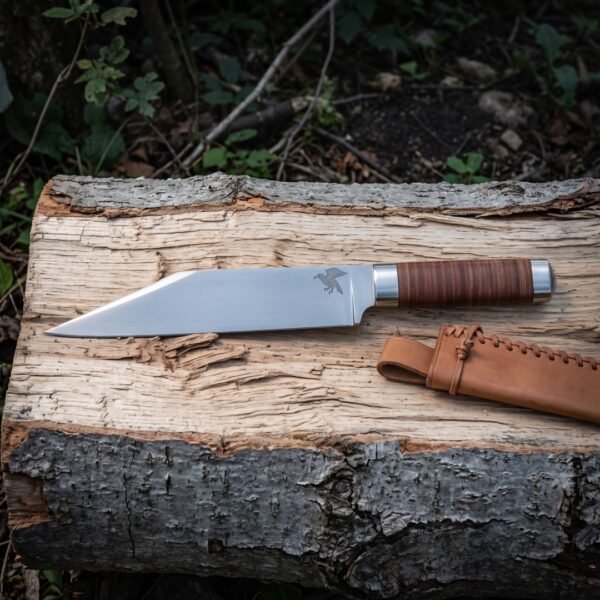
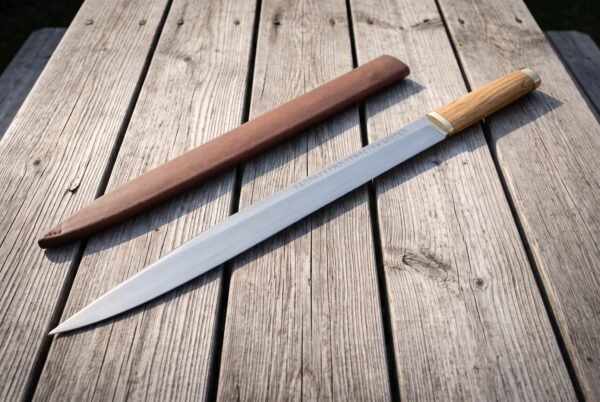
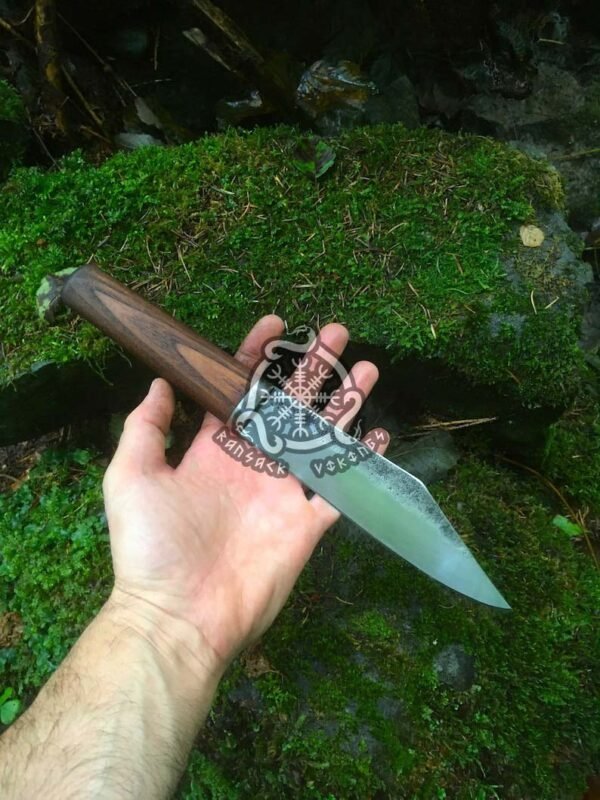
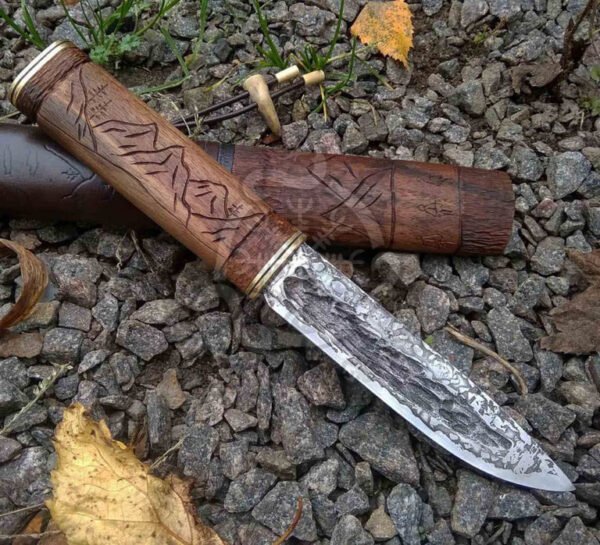
The Brassward is a hand forged 1095 high carbon steel Viking seax knife with a broad single edged blade, a wooden handle and a brass bolster at the throat. It measures 16 inches overall with an 11 inch blade, 1.3 inches at its widest, on a 5 inch handle. That puts it firmly in langseax territory rather than the small belt knife most people picture, and it has the weight in the hand to prove it. What to look for in a seax, from tang to handle, is set out in the seax buying guide.
The word seax is Old English for knife, and it is the word buried inside the name Saxon. It described a whole family of single edged blades used across northern Europe from roughly the fifth century to the eleventh, ranging from a three inch eating knife to a fighting blade the length of a short sword. The most famous survivor is the Seax of Beagnoth, pulled out of the Thames in 1857 and now in the British Museum. It matters for two reasons. It is a textbook broken back blade, and it carries the only complete Anglo Saxon futhorc alphabet ever found on a single object, cut into the flat along with the owner name Beagnoth. A working knife, signed by its owner, with the whole runic alphabet down the side of it. That is the object this style of blade descends from.
Every Brassward is forged from bar, heat treated, ground, fitted and finished in the Czech Republic. Shipping inside the United States is free, processing takes one to two weeks, and returns are accepted within seven days.
Specifications
| Steel | Hand forged 1095 high carbon steel |
|---|
| Hardness | 54 to 58 HRC |
|---|
| Overall length | 16 inches |
|---|
| Blade length | 11 inches |
|---|
| Blade width | 1.3 inches at the widest point |
|---|
| Handle length | 5 inches |
|---|
| Handle | Wood with a brass bolster |
|---|
| SKU | RK-617 |
|---|
The broken back profile and why it looks like that
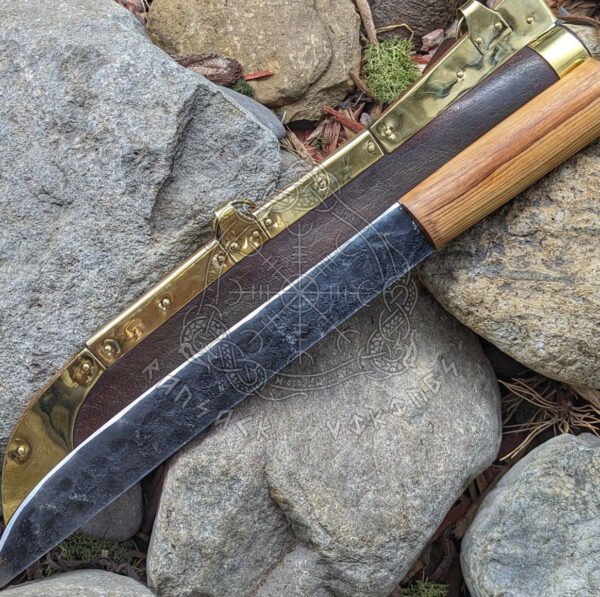
Run your eye along the spine of this blade. It travels straight and flat from the bolster, then breaks downward at a clear angle and runs in a straight line to meet the edge at the point. That sharp kink is the defining feature of the broken back seax, and it is not a stylistic choice made in a design studio. It is what the grave finds and river finds show, again and again, across England and Scandinavia in the ninth and tenth centuries.
The geometry does real work. Keeping the spine thick and straight for most of the blade puts mass behind the middle of the edge, which is the part you use for chopping and heavy slicing. Dropping the spine sharply at the end brings the point down onto the centre line of the blade, so a thrust lands where you are aiming rather than riding high. It also produces a very acute tip without thinning the whole blade, which is how you get a knife that will pierce and still survive being battered through a joint or a green branch.
The other thing to understand is that the seax was never a specialist. A free man in a Norse or Anglo Saxon settlement carried one knife and it did everything. It cut meat at the table, trimmed leather, shaved pegs, gutted fish and stood in as a fighting knife when it had to. That is why the profile is broad and heavy rather than delicate. A single edge with a thick unsharpened spine is stronger than a double edged blade of the same weight, and you can put your thumb or the heel of your other hand on that spine to force a cut. The seax was carried horizontally across the front of the belt, edge upward, held by loops or a scabbard sewn to the belt itself, which is why so many surviving scabbard fittings are flat plates rather than hanging rings.
Why 1095 high carbon and not stainless
This blade is 1095, a simple high carbon steel with roughly one percent carbon and almost nothing else in it. Heat treated to 54 to 58 HRC it is tough enough to take abuse without chipping and hard enough to hold a working edge through a long day. It is also the steel that comes closest in behaviour to what a Norse smith was actually working with, which was bloomery iron carburised at the edge. Simple carbon steel is what a blade of this shape wants.
Stainless resists rust by carrying a high chromium content, and that chromium forms hard carbides which make the steel harder to sharpen and, in the grades used at this price point, more prone to rolling under load. 1095 goes the other way. It takes an edge fast on a plain stone, it takes it very keen, and it pays for that by needing to be kept dry and oiled. Left wet it will spot within a day. Wiped and oiled it will go grey with a protective patina and stay that way for a lifetime. The trade offs are set out in Damascus versus stainless.
The wooden handle and the brass bolster
The grip is wood, shaped and sanded by hand so it fills the palm rather than sitting flat against it, and finished with oil rather than lacquer. That matters because an oil finish can be topped up at home when it dulls, while a lacquered handle has to be stripped and redone once it starts to flake. Give it a light wipe of mineral or tung oil once or twice a year, especially if it lives somewhere dry, and it will stay tight on the tang. The method is in wooden handle care.
The brass bolster at the front of the handle is doing three jobs. It seals the joint where the blade meets the wood, which is the place water gets in and starts rot and rust. It adds mass right at the balance point, which pulls the centre of balance back toward your hand and makes an 11 inch blade feel controllable. And brass is soft enough to be peened and fitted tight against the tang without cracking the wood around it. Brass will darken and dull over time. That is oxidation, not damage, and a minute with a soft cloth and a little metal polish brings it back if you prefer it bright.
Engraving, runes and your own design
Use the rune converter on this page to turn a name, a date or a short phrase into Elder Futhark and we will cut it into the steel or the handle. If you would rather have a Viking pattern than a rune line, choose your own design in the engraving option above the add to cart button and tell us whether it goes on the blade or the handle. Where a piece already carries an engraved design, your chosen engraving replaces it rather than sitting alongside it. On a seax this is more than decoration. The flat above the edge on a broken back blade is exactly where the historical inscriptions sit, which is why a rune line reads correctly on this shape. See the engraving page.
Care and sharpening
Dry the blade after every use, including the join where the steel meets the bolster. Put a thin film of oil on the steel before it goes into storage, and do not leave it sitting in a closed damp scabbard for months. If a rust spot appears, it lifts with fine abrasive and oil and does not need a workshop. The routine is in steel care.
Sharpening 1095 is the easy part. A medium stone, a consistent angle, light pressure, then a strop. It is far more forgiving than stainless and you can bring a dull seax back in a few minutes. Do not use a powered grinder. The heat will pull the temper out of the edge and no amount of stone work will put it back. Step by step in sharpening with a whetstone.
Made in the Czech Republic
This is a handmade piece from the Czech Republic, made in a workshop that still forges, grinds and finishes by hand instead of stamping parts out. The smiths there have kept the older way of working, and the wood, horn and leather are shaped and fitted by hand as well. Two pieces of the same design will never be identical, and that is part of what you are buying.
Ransack Viking is a United States company. We handle the import ourselves, look over every piece when it lands and ship from our warehouse in Memphis, Tennessee. Engraving is done in the United States after the piece arrives, so your design goes on before we send it out.
A note on handmade variation
The Brassward is hand forged. It is not machine made and it is not bulk produced, so what arrives will not be a pixel for pixel copy of the photograph. The grain and tone of the wood, the exact colour of the brass, the finish left by the grinder and the precise angle of the broken back will vary from one knife to the next, because each is worked by hand from natural materials. The dimensions, the steel and the build are the same every time. The character is not.
Frequently asked questions
Is this sharp when it arrives?
Yes. The edge is put on by hand before packing and the knife will cut on arrival. It is a working edge rather than a shaving edge, which is the correct finish for a blade this heavy.
Is the tang full length?
Yes. The blade and tang are forged from one piece of 1095 running through the handle and secured behind the brass bolster.
Does it come with a sheath?
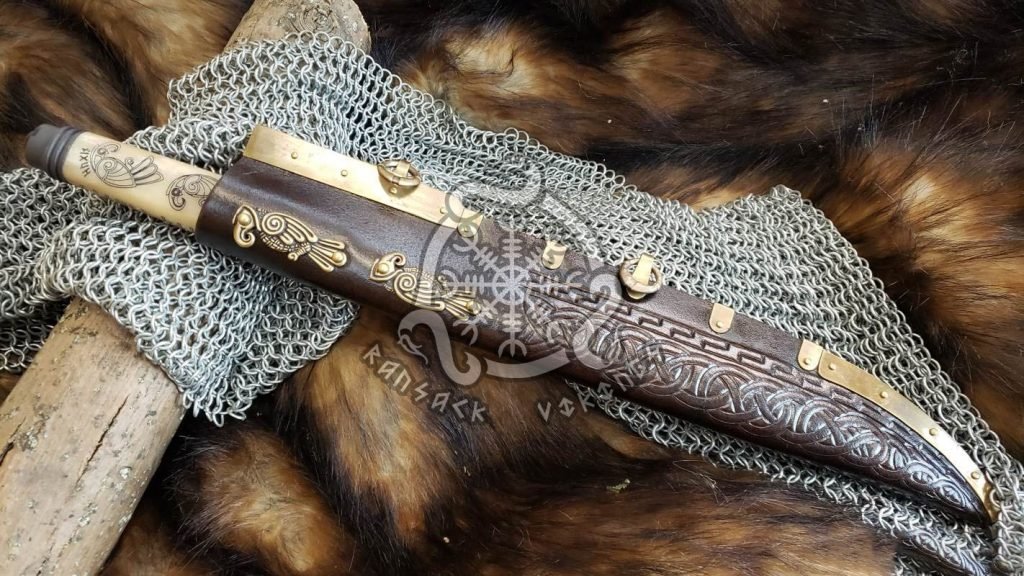
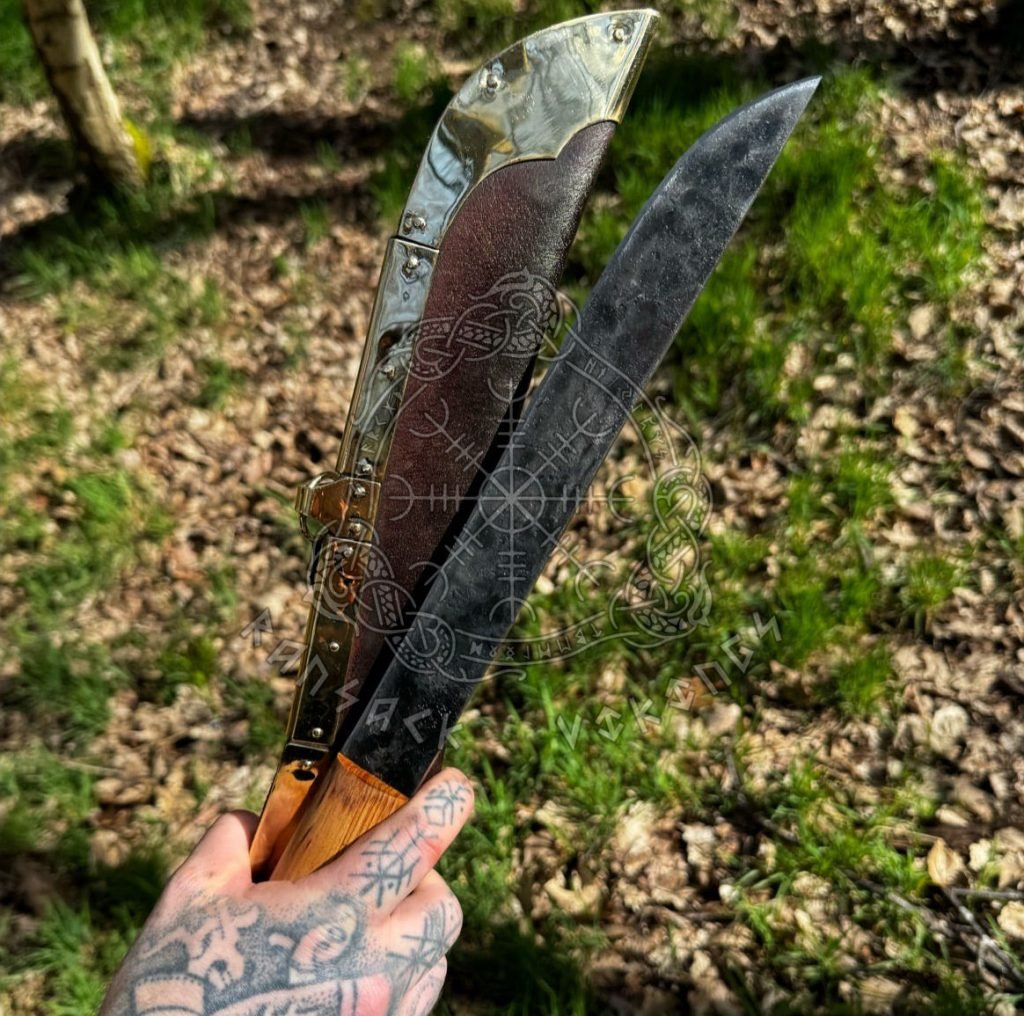
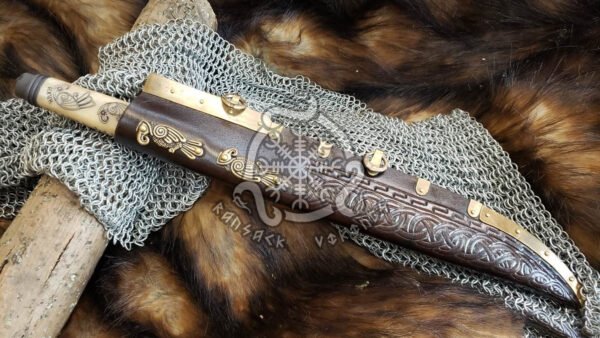
This listing is for the knife itself. If you need a fitted leather sheath, contact us before ordering and we will tell you what we can cut for it.
Why is only one side of the blade sharpened?
Because that is what a seax is. Single edged with a thick flat spine is the whole design, and the unsharpened back is what lets you push on the blade with your other hand to force a cut through something stubborn.
What is the difference between this and a Viking sword?
A sword is double edged, longer, and made purely for fighting by a specialist smith for someone wealthy. A seax is single edged, shorter, and was the everyday tool almost everyone owned. At 16 inches overall this sits at the large end of the seax family, which is the point where the two start to overlap.
Can I take it camping or is it just for display?
It is a functional knife and it will do camp work happily. Check your own local rules on carrying a fixed blade of this length in public, since those vary considerably from one state and city to the next.
What is in the box
- One Brassward 1095 high carbon Viking seax knife
- Protective packaging
- Forged and finished in the Czech Republic
Explore the range
Related collections: Viking Seax, Viking Knives, Swords and Hunting Knives. The history, the steel and the sharpening are covered in the guides.











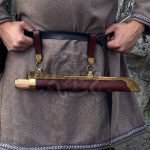
This knife beat every expectation I had. Came in a nice gift box which made it feel even more special. Already telling my friends to check this out.
Overall a good buying experience. Blade quality is solid. Arrived a bit less sharp than expected but a few passes on a strop fixed it. Wood handle looks great though it’s a little smaller than I imagined. Still very happy with it and would recommend.
Got this as a birthday gift and the reaction was priceless. Fit and finish is museum quality. You can tell real craftsmen made this by hand. Came in a nice gift box which made it feel even more special. Shipping was fast and everything arrived well packaged.
Photos don’t do this knife justice at all. Edge retention has been great even after regular use. Came in a nice gift box which made it feel even more special. 10/10 would buy again.
Absolutely blown away by this knife. If you’re on the fence just get it. You won’t regret it. Love that this is Czech craftsmanship and shipping from the US meant it showed up in just a few days.