
A messer is a single edged sword of the fifteenth and sixteenth centuries, and what makes it a messer is the hilt rather than the blade. The tang is a flat slab sandwiched between two wooden scales and riveted through, exactly the way a kitchen knife is built, instead of a narrow tang passing through a pommel and peened over. The nine on this page run from a 24 inch bauernwehr up to a 44 inch two handed kriegsmesser, and six of them are blunt trainers in 51CrV4 spring steel hardened to 49 to 52 HRC.
Three are sharp. Torvhaug, Jarnfeld and Hallvarn are 1095 high carbon at 54 to 58 HRC, ground and finished as cutting blades for tatami and test cutting. They are not sparring tools and the listings say so plainly. The other six carry a blunted flat land and a rolled or rounded point.
Hilts vary more than the blades do. Ring nagels, a mushroom head stud, a long forward angled spike, a full knuckle bow and two pieces with no cross at all. The messer guide explains what each form is for, and blunt against sharp covers which of these two groups you want. See also the messers in the main sword range and the sabres and dussacks that carry the single edged tradition forward.
Most of these take a custom engraving on the blade, the nagel block or the scales, chosen on the product page.
If you want a single edged blade built to your own measurements instead, start with the sword builder and set the blade length, the spine, the point and the grip.
Free US shipping
On most pieces. Heavier and oversized ones carry a flat charge.
Hand Forged
Heated, hammered and ground by hand.
Engraving available
Names, dates or Norse runes on most pieces.
Ships from New York
Inspected and dispatched from our New York warehouse. No import duty, no customs delay on US orders.
HEMA Messers
The knife that grew into a sword
Every other sword in this catalogue is built the same way underneath. A narrow tang runs up through a cross, up through a grip, up through a pommel, and the end is peened over to hold the whole assembly in compression. The messer is not built that way. Its tang is a flat slab the full width of the grip, two wooden scales are laid one on each side, and rivets pass straight through all three. That is knife construction, and it is the single feature that decides whether a sword belongs in this family.
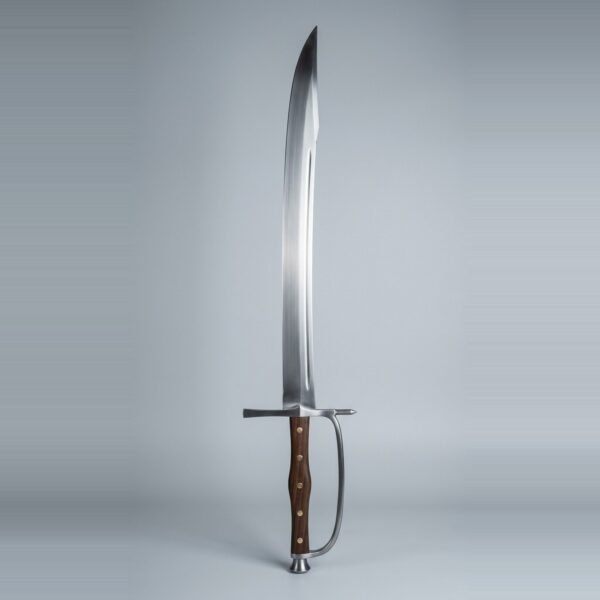
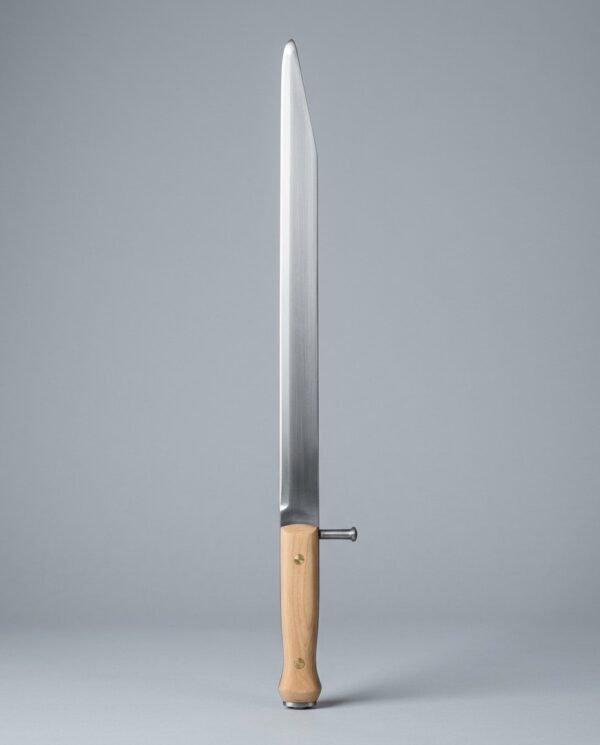
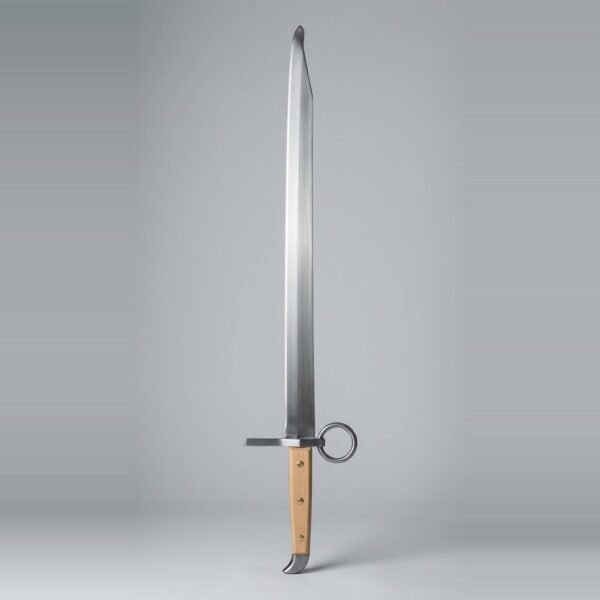
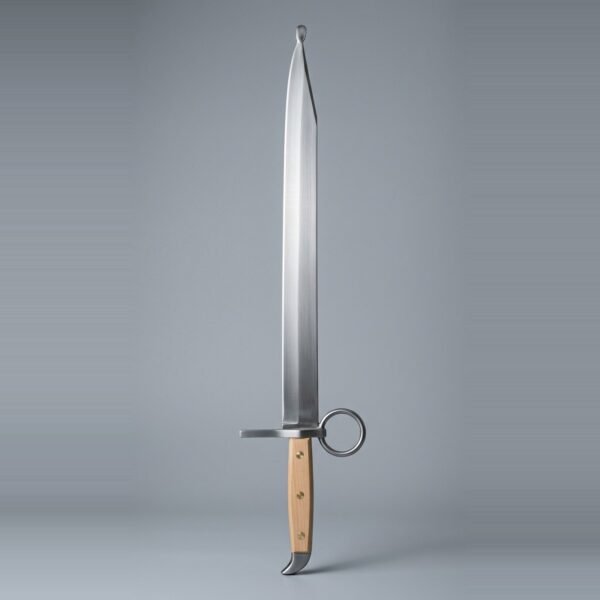
The name simply means knife in German, and the construction is the reason. You can see it on every piece on this page. Look at the grip edge on and the steel of the tang shows as a stripe running between the two scales from the guard block to the butt. Brunhak and Brenvald show three brass rivets, Jarnfeld shows four, Storvekk shows five along a longer grip, and Hallvarn shows two.
What this changes in the hand
Slab tang construction puts more of the mass forward of the hand than a pommel assembly does, because there is no heavy counterweight sitting behind the grip. Six of the nine pieces here carry no pommel at all in the usual sense. Skarnvald closes its tang with the rear rivet and nothing else. Others finish with a cap rather than a pommel, and the cap forms are worth knowing by name. A beak cap hooks back over the heel of the hand, which is what Brenvald and Brunhak carry. A trumpet cap flares outward behind the hand, which is Jarnfeld and Storvekk. Hallvarn is closed by a plain steel ferrule.
You will read in a good many places that messers were built as knives so that townsmen could carry a sword while technically owning a knife, and so slip around a law restricting sword ownership. It is a tidy story and the sources do not support it. Treat it as folklore. The construction is far better explained by the fact that cutlers and bladesmiths were separate trades with separate guilds, and a cutler could build this.
The nagel, and the forms it takes
The nagel is the stud that projects sideways from the guard block, standing out over the flat of the blade and shielding the back of the hand. It is the second signature of the family after the slab tang, and it is the part where the forms differ most. Ransack Viking lists the nagel form on every product page in this category because it changes how the piece protects you.
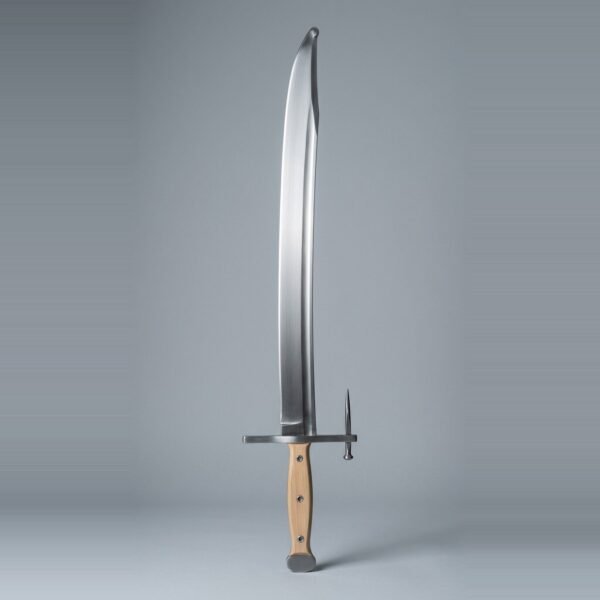
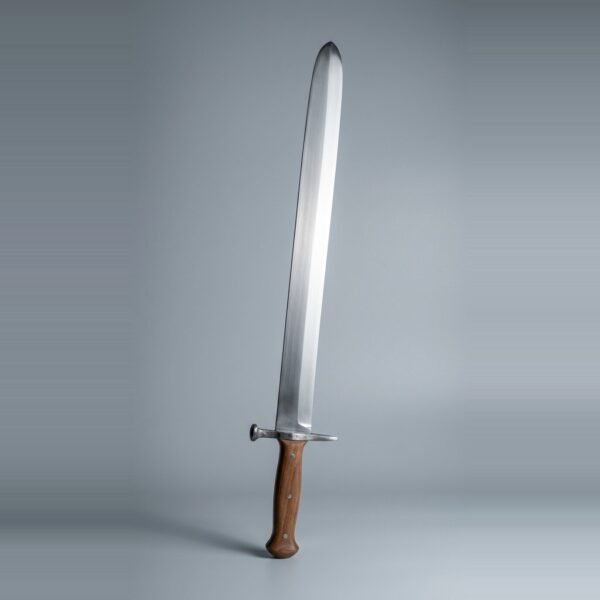
A ring nagel closes back on itself into a loop, which covers more of the hand and catches an incoming blade rather than deflecting it. Brenvald and Brunhak both carry that form, Brunhak's being the larger of the two. A mushroom head nagel is a short stud with a flared cap, which is what Molgarth has, and it gives the least coverage of the three but the least to catch on a scabbard or a belt as well. A spike nagel is a long bar angled forward towards the point, and Aurnvik carries an especially long one.
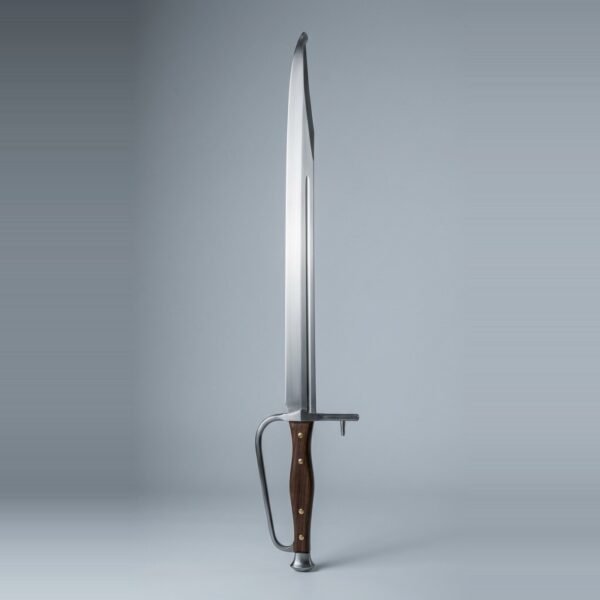
Two pieces here take the idea in the opposite direction. Jarnfeld and Storvekk both carry a full knuckle bow instead, a bar sweeping from the guard block back to the butt cap, which encloses the whole hand. That is the late form of the family and it is the one that eventually becomes the sabre hilt. Hallvarn and Skarnvald go the other way and carry a nagel with no cross bar of any kind.
The size bands, from bauernwehr to kriegsmesser
Messer is a family rather than a single type, and the names describe overlapping size bands rather than four hard categories. Retailers and the period sources both use them loosely. What follows is the consensus range, and every piece here is listed with its own real measurement so you can place it yourself.
Bauernwehr
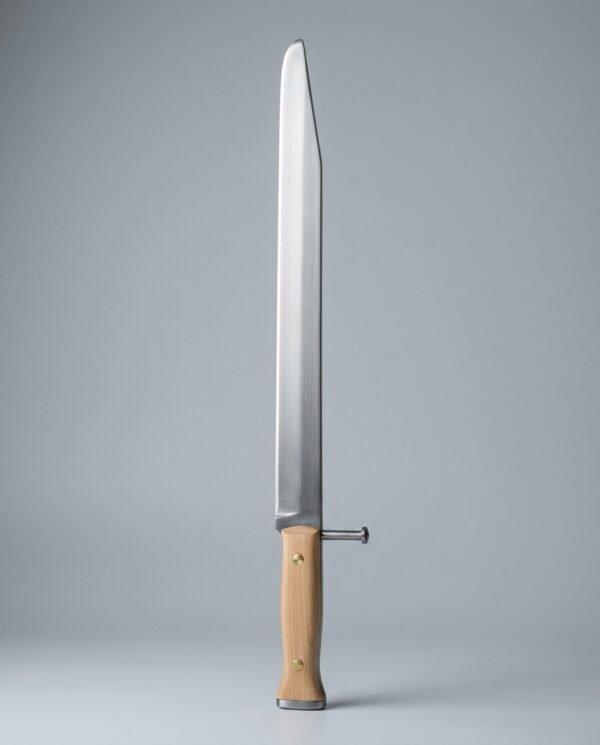
The smallest, at roughly 15 to 35 cm of blade. It is a large belt knife rather than a sword, worn as a working tool and used as a sidearm. Hallvarn on this page is the one example here, at about 24 inches overall with an 18 inch blade, no cross bar and a single side nagel. It is sharp.
Langes messer and grosses messer
The heart of the family and the one the fencing sources care about. Blades run roughly 45 to 90 cm, with the grosses messer sitting at the upper end at about 75 to 113 cm overall. Six of the nine here sit in this band, from Aurnvik and Molgarth at about 35 inches overall up to Skarnvald at about 39 inches. All are used in one hand. Do not treat langes and grosses as separate products. They overlap in period and they overlap in retail.
Kriegsmesser
The one genuinely distinct item, because it is two handed. Period examples run 1 to 1.35 m overall. Storvekk is the example here at about 44 inches with a 33 inch curved blade and a grip half again the length of a one hand messer grip, held by five brass rivets through walnut scales. It is the piece to buy if you already fence longsword and want the same reach with a single edge.
Lecküchner, Meyer and what the sources teach
The messer has more surviving instructional material behind it than most people assume. Johannes Lecküchner completed the largest work on the langes messer in 1482, a manuscript of several hundred leaves that takes the German longsword system and rebuilds it for a single edged sword used in one hand. Guards, master strikes, winding at the bind and the whole vocabulary are carried across. If you already know longsword, the messer is the shortest road into a second system, because a great deal of what you know transfers directly.
Joachim Meyer's printed treatise of 1570 does not teach the messer itself. It teaches the dussack, the short single edged practice blade that took over the same role in the German schools of the later sixteenth century, and the dussack material is generally read as carrying the single edged tradition forward from where Lecküchner left it. If you want to see where the family goes next, the dussack guide follows it, and the sabre and dussack category carries the pieces.
The clipped point and the false edge
Most messers finish in a clipped point. The spine is cut away at an angle for the last few inches, which brings the point down towards the centre line of the blade so the piece thrusts properly despite having only one true edge. That cut back section is usually sharpened on the sharps, and it is called a false edge, because it is an edge on the back of the blade rather than the cutting side.
Seven of the nine here carry a clipped point. Molgarth does not, finishing instead in a rounded tip with a straight spine running all the way, which is the safest of the nine at the point and a sensible choice for a first messer. Aurnvik has the clip but the point itself is rounded off. On the blunts, Brenvald and Brunhak have a false edge along the clip that is blunted rather than ground. On Torvhaug and Jarnfeld it is sharp.
Sharps against blunts
Three of the nine are sharp and six are blunt. This is not a preference. It is two entirely different products that happen to share a shape.
Torvhaug, Jarnfeld and Hallvarn are 1095 high carbon steel hardened to 54 to 58 HRC with ground and finished cutting edges. They are made to cut tatami, water bottles and rolled mat, and they will hold an edge doing it. They are not sparring tools and Ransack Viking will not sell them as such. Do not take one to a club night.
The other six are 51CrV4 spring steel hardened to 49 to 52 HRC with a blunted flat land along the edge and a rolled or rounded point. That lower hardness is deliberate. A blade at 54 to 58 HRC resists bending until it takes a permanent set or breaks, which is fine on a wall and dangerous in a bind. Spring steel at 49 to 52 HRC bends and returns. It will never take a fine edge, and it does not need to. The guide on blunts against sharps sets out the full difference, and the flex guide explains the tiers.
On tip shape, read the ruleset of any event you intend to enter rather than the listing. Some published rulesets require a spatulated or rolled tip with a minimum diameter of 1.5 cm, and a rounded tip is not the same thing as a spatulated one. Ransack Viking claims tournament legality for nothing on this page without naming the ruleset.
Every messer on this page, side by side
Every figure in the table below is taken from the specification panel of a product on this page. Nothing is estimated. Sizes vary piece to piece because each blade is forged and ground by hand, so read a stated length as nominal rather than exact.
| Piece | Overall length | Blade type | Steel and hardness | Flex | Guard or tip note |
|---|---|---|---|---|---|
| Hallvarn bauernwehr | About 24 inches | Single edged, flat spine, long acute clipped point | 1095 at 54 to 58 HRC | Stiff, not a sparring tool | No cross bar, steel nagel through the tang, acute clipped point, sharp |
| Aurnvik langes messer | About 35 inches | Single edged messer blade with a clipped point, rounded off at the end | 51CrV4 at 49 to 52 HRC | Medium tier, the usual club setting for messer work | Cross carrying a long nagel spike angled forward towards the point |
| Molgarth langes messer | About 35 inches | Single edged, straight spine, finishing in a rounded tip with no clip | 51CrV4 at 49 to 52 HRC | Medium tier, the usual club setting for messer work | Mushroom head nagel off the flat, tip rounded and turned over |
| Brenvald langes messer | About 37 inches | Single edged with a clipped point and a false edge along the clip | 51CrV4 at 49 to 52 HRC | Medium tier, stiff through the forte with give in the last third | Ring nagel over the back of the hand, point blunted at the clip |
| Brunhak langes messer | About 37 inches | Single edged messer blade with a clipped point and a false edge | 51CrV4 at 49 to 52 HRC | Medium, for drill and controlled sparring | Straight cross with a large ring nagel, clipped tip rolled about 15 mm |
| Torvhaug langes messer | About 37 inches | Single edged, straight through the body, clipped at the point | 1095 at 54 to 58 HRC | Stiff, a cutting sharp and not a sparring blade | Steel cross bar in the messer form, clipped point with a short false edge, sharp |
| Jarnfeld langes messer | About 38 inches | Single edged messer blade with a fuller running close to the spine | 1095 at 54 to 58 HRC | Stiff, a cutting sharp and not a sparring blade | Full knuckle bow back to a trumpet cap, upswept clipped point, sharp |
| Skarnvald grosses messer | About 39 inches | Single edged messer blade with a clipped point | 51CrV4 at 49 to 52 HRC | Medium, the tier most clubs ask for in a one handed trainer | No cross of any kind, steel side nagel, tip blunted and rounded off |
| Storvekk kriegsmesser | About 44 inches | Curved single edged blade, clipped point at the end of the curve | 51CrV4 at 49 to 52 HRC | Medium to strong tier, set for two hand messer work | Knuckle bow carried round to a trumpet butt cap, tip rolled about 15 mm |
Blade lengths run from about 18 inches on Hallvarn to about 33 inches on Storvekk. None of the nine ships with a scabbard.
Browse related sword categories
- Messers in the main sword range, sharpened and for display
- The full HEMA range, from feders to rapiers and sabres
- Sabres and dussacks, where the single edged tradition goes next
- Arming sword trainers, the single handed double edged answer
- HEMA longswords and hand and a half blunts for two hands
- Feders, the purpose built longsword fencing tool with a schilt
- Sabres in the main sword range, curved and single edged
- Engraved and personalised pieces across the whole catalogue
Guides worth reading first
- The messer guide, from bauernwehr to kriegsmesser
- What HEMA is, and what the sources actually are
- Blunt against sharp training swords, and which one you need
- How to choose your first HEMA sword without wasting money
- HEMA sword flex explained, tier by tier
- The dussack, the Czech blade that became a German sidearm
- HEMA tournament gear rules and what the rulesets ask for
- Care and oiling for carbon and spring steel blades
Frequently asked questions
What is a messer sword?
It is a single edged European sword of roughly 1400 to 1600, defined by knife style hilt construction. The tang is a flat slab the width of the grip, two scales are riveted to it through the steel, and the guard block usually carries a nagel standing out sideways to shield the hand. Blades run from about 18 inches on a bauernwehr to over 33 inches on a kriegsmesser.
What is a nagel and what does it do?
The nagel is a stud projecting sideways from the guard block over the flat of the blade, and it protects the back of the hand from a blade sliding down the outside. Forms differ. A ring nagel loops back on itself and covers most, a mushroom head is a short flared stud, and a spike angles forward towards the point. Later pieces replace it with a full knuckle bow.
What is the difference between a langes messer and a grosses messer?
Very little in practice, and the two names overlap in both the period sources and modern retail. Langes messer generally means a one handed sword with a blade of roughly 45 to 90 cm. Grosses messer sits at the upper end of that, around 75 to 113 cm overall. The kriegsmesser is the only member of the family that is genuinely separate, because it takes two hands.
Which of these messers are sharp?
Three. Torvhaug, Jarnfeld and Hallvarn are 1095 high carbon steel at 54 to 58 HRC with ground and finished cutting edges, sold for tatami and test cutting. They are not sparring tools. The other six are blunt trainers in 51CrV4 spring steel at 49 to 52 HRC with a flat land along the edge and a rolled or rounded point.
Can I spar with a messer?
With the blunt ones, yes, in a club with proper protective kit and a coach. Messer is a taught discipline with a substantial manuscript tradition behind it, and clubs run it as a course rather than as free play. Never spar with one of the three sharps. Whether a given blunt passes a particular event comes down to that event's published ruleset, mostly on tip shape.
What is a clipped point?
It is the spine cut away at an angle for the last few inches of the blade, which brings the point down towards the centre line so a single edged sword can thrust properly. The cut back section is called a false edge. On the sharps here it is ground and sharp. On the blunts it is blunted. Molgarth has no clip at all and finishes in a plain rounded tip.
Do messers come with a scabbard?
None of the nine on this page does. The Included row on each product page says exactly what is in the box, and where a scabbard is absent it says so rather than leaving you to assume. Several ship with a care cloth and a care card instead.
Where are these made and how are they shipped?
They are made by hand in the Czech Republic and imported by Ransack Viking. Every one is checked for hilt tightness, rivet seating and blade straightness at the North Babylon, New York warehouse and shipped from there. Shipping inside the United States is free, returns run for seven days, and the lifetime warranty against defects in the forging, the grind, the heat treat and the fittings needs no receipt.
Featured pieces
 Aurnvik Hand Forged 51CrV4 Spring Steel Langes Messer with Forward Angled Nagel Spike & Blonde Scales
$369.00
 Jarnfeld Hand Forged 1095 Langes Messer with Full Knuckle Bow & Upswept Clipped Point
$469.00
 Molgarth Hand Forged 51CrV4 Spring Steel Langes Messer with Mushroom Head Nagel & Rounded Tip
$359.00
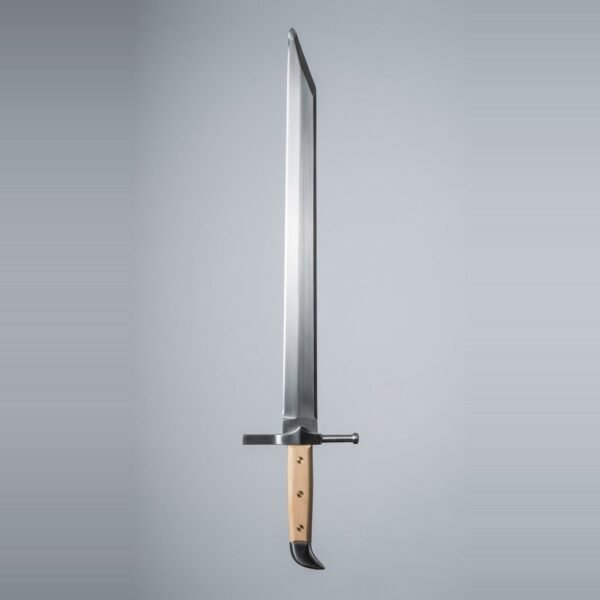 Torvhaug Hand Forged 1095 Langes Messer with Ground Sharp Edge & Clipped Point
$449.00