Blog
What Is HEMA? Historical European Martial Arts Explained

HEMA stands for Historical European Martial Arts. It is the practice of the fighting systems that European masters wrote down between roughly 1300 and 1900, reconstructed from the manuals they left behind, and then tested by hitting another consenting adult with a steel training sword until the theory either holds up or falls over.
That last part is the bit that surprises people. HEMA is not a costume hobby and it is not choreography. There is no script, no agreed outcome and no polite pause while somebody finds their mark. Two people in protective kit try to hit each other and not be hit, using techniques taken from a book written by somebody who has been dead for five hundred years. It is closer to judo than to a film set.
This guide explains what the art is, what people actually do on a club night, and what you need to own before anyone lets you spar. If you already know the answer and you are here for the buying decision, skip to choosing your first HEMA sword or read what a feder is first, because that one piece of vocabulary explains most of the catalogue. Everything discussed below sits in the HEMA swords range.
What the letters actually mean
Historical means the source is a document, not a guess. European means the tradition is European rather than Japanese or Chinese, which already have unbroken teaching lineages. Martial Arts means it is a fighting system with technique, footwork, timing and measure, taught in a structured way and pressure tested against a resisting partner.
The word people trip over is historical. HEMA is a reconstruction, not a survival. The teaching chain broke. Nobody alive learned longsword from a master who learned it from a master going back to Liechtenauer. What exists instead is a very large pile of surviving manuals, and a community of people arguing about how to read them. That argument is the hobby. Somebody publishes an interpretation, somebody else fights them with it, and the interpretation either wins fights or quietly disappears.
Where the material comes from
The manuscripts
The earliest substantial source is a German manuscript usually dated to around 1300, and from there the record thickens considerably. The German tradition runs through the Liechtenauer verses and the commentaries on them. The Italian tradition runs through Fiore and later through the Bolognese masters. The sixteenth century adds printed books, which means diagrams, page numbers and far more copies surviving.
By the seventeenth century the rapier treatises are dense enough to include geometry. By the nineteenth century military sabre manuals are printed as drill instruction for armies, which makes them the clearest sources in the whole corpus and the easiest place for a new student to start reading.
The revival
Serious reconstruction restarted in the 1990s, accelerated when libraries began scanning manuscripts and putting them online, and turned into an international competitive scene in the 2000s. That timeline matters commercially, because the gear market is about twenty five years old. It is still maturing, supply is unreliable, and several well known makers currently have waits measured in months rather than days.
What happens on a club night
A typical session is warm up, footwork, a technical drill from a named source, then some form of free play at whatever intensity the club runs. Nobody hands a new person a steel blade in week one. Most clubs start you empty handed or with a nylon trainer, and steel arrives when your control is good enough that you will not injure somebody by accident.
Longsword
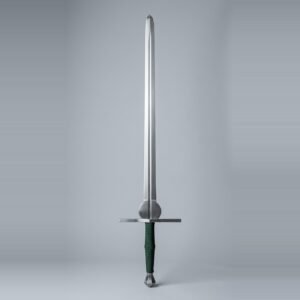
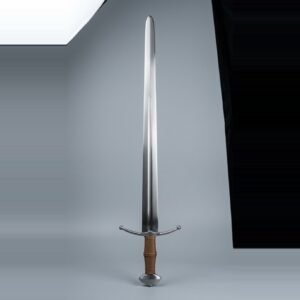
The flagship discipline and the largest tournament category. Two hands on the grip, a blade around a hundred centimetres, and a system built around binding against the other blade and winning the leverage contest. Most clubs are longsword clubs with other things bolted on. The training blade for this is the feder, which is covered properly in its own guide.
Messer and dussack
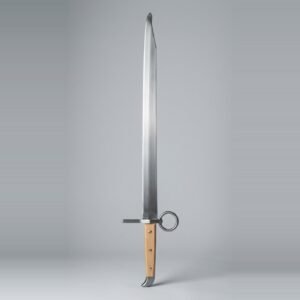
Single edged, one hand, and much older in the club schedule than most people expect. The messer is built like a large knife, with a flat tang sandwiched between two scales and riveted through, plus a sideways stud on the quillon block called the nagel that shields the knuckles. The dussack came into German practice from the Czech tesak during the Hussite Wars in the early fifteenth century, which is a genuinely pleasant fact for a shop importing from the Czech Republic.
Rapier and sidesword
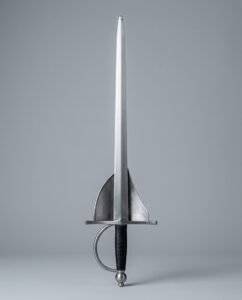
Longer, lighter in the hand, and almost entirely about distance and the point. Rapier proper runs from about 1540 until the smallsword displaces it around 1715. The sidesword is the shorter broader ancestor that still cuts properly. A common fitting rule from the period sources is that with the point on the floor the quillons should sit at your navel, which is a far better sizing guide than any chart.
Sabre, smallsword and spadroon
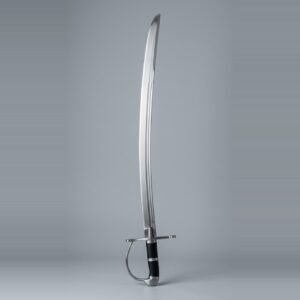
The later end of the art, and the most fragmented. Military sabre patterns, Italian sabre, Polish szabla, duelling sabre, spadroon and smallsword all have their own manuals and their own followings. Smallsword is the one discipline where an ornate hilt is period correct rather than fantasy creep.
What you have to buy, roughly in order
Clubs vary, but the order almost never does. Mask first, then gloves, then a jacket, then gorget and forearm and elbow protection, then the sword, then everything the club insists on before it will let you into free play. The sword is usually the last major purchase, not the first, which catches out anybody who arrives having already bought one.
Budget honestly. A student who trains regularly tends to spend across the first year and a half rather than in one go, and steel usually arrives around month twelve. The good news is that a decent training sword lasts years. The bad news is that masks, gloves and jackets are consumables and the gloves in particular get destroyed.
Engraving is the one place where personalisation is welcome rather than mocked, because a club with twelve identical feders in a rack has a genuine identification problem. A name or a short line of Elder Futhark on the ricasso solves it. That is handled in the United States after arrival and explained on the engraving page.
What a training blade is made of
Spring steel. Specifically 51CrV4, 6150, 9260 or 1095, typically hardened to about 49 to 52 HRC. That is deliberately softer than a cutting blade, because a training blade has to bend under a hard bind and spring back rather than take a permanent set or snap.
If a listing says stainless, close the tab. Stainless is used on decorative swords because it never needs oiling and looks good on a wall. It is also harder and more brittle than a sparring blade should be, and it is the single clearest sign that the seller has no idea what the product is for. The same applies to a rat tail tang, cast furniture and a chrome finish.
The other number that matters is flex, which is the property that decides whether a thrust bends the blade harmlessly or breaks a rib. The market sells it in named tiers rather than as a single figure, and it is explained fully in the flex guide. Steel and hardness in general are covered in the steel glossary and in steel and hardness.
Tournaments, and how they shape the gear
Competition rules are the reason the catalogue looks the way it does. They are also the reason a piece that is perfectly good for drilling can be refused at the gear check desk on the morning of an event.
The Berlin HEMA Cup gear requirements are a good representative example. Permitted tip shapes are spatulated or rolled, with a minimum diameter of 1.5 cm, across every tournament category. Rounded tips are not allowed on rapier and sabre. Longsword blades must have a clearly distinguishable edge, back and flats. Tip caps are supplied by the tournament and personal caps are not accepted.
Two more rules catch people out. Many longsword tournaments will not accept a blunt longsword at all and allow only purpose built feders or sword shaped feders. And rondel daggers are banned in the dagger event at the London HEMA Open. Never buy anything on the strength of a seller claiming it is tournament legal without naming the ruleset, because tournament legal on its own is a marketing phrase and means nothing. Full detail is in the tournament gear guide.
Things that will get you gently mocked
This community fact checks. It is not unkind about it, but it does notice.
Calling a feder a blunt longsword, or the reverse, is the classic. So is describing a training sword as sharp, or a cutting sword as safe for sparring, which is covered in blunt against sharp training swords. Horned helmets and double headed axes belong to the same family of error and are dealt with elsewhere in the guides. Adding gemstones, dragon finials or a leather thong to a training sword is the aesthetic version of the same mistake. Training gear is plain because plain is what survives contact.
One more, which is really a photography point. If a listing crops the tip out of frame, assume the seller does not own the thing they are selling. The tip is the part the rules care about most and it is the part a careless photograph loses first.
Where to see these
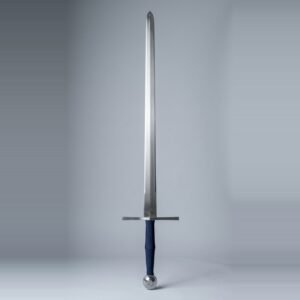
If you want to look at the shapes rather than read about them, start with the Vindlaur feder, which is the standard longsword training form with a rounded schilt. Set it beside the Drakvend blunt longsword and the difference the whole sport argues about becomes obvious in about two seconds. For the single edged side, the Brenvald langes messer shows the nagel and the riveted scale construction clearly, and the Ceravalt rapier covers the thrusting end of the art. Wider ranges sit under feders and HEMA longswords.
HEMA questions
Is HEMA dangerous?
It carries the same order of risk as judo or boxing, which is to say real but managed. The protective kit is mandatory for a reason, the blades are blunt and flexible, and clubs control the intensity of free play. Bruises are normal, broken fingers happen, and serious injury is rare when the gear rules are followed.
Do I need my own sword to start?
Almost never. Most clubs have loan gear for the first few months and would rather you learned the footwork before you spent four hundred dollars. Buy a mask and gloves first, ask your instructor what the club accepts, then buy steel.
What age do you have to be?
Clubs set their own minimums and some run youth classes with nylon trainers. Steel blades from this shop are sold to adults aged 18 and over.
Is HEMA the same as fencing?
Modern Olympic fencing descends from one narrow branch of the same tree, standardised into a sport with right of way conventions and a single blade form per event. HEMA works from the original manuals, uses many different blade forms, and generally has no right of way rule. A fencer will find the footwork familiar and the rest of it strange.
Can I learn HEMA from books and videos alone?
You can learn a great deal of theory that way and it will not survive first contact with a resisting partner. The manuals assume a teacher standing next to you. Solo study plus a club is the normal path, and solo study alone tends to produce very confident people with very bad measure.
Why are HEMA swords blunt if the originals were sharp?
Because the point of training is to repeat the technique thousands of times against a live partner without anybody losing a hand. Blunt trainers have a flat edge land of roughly 2 to 3.5 mm, a widened tip and a softer heat treat so the blade flexes instead of breaking. Sharps exist in the same catalogue for test cutting against tatami and bottles, and they are never used against a person.
How much does a first year in HEMA cost?
Club fees plus kit, spread over about eighteen months rather than paid at once, with the mask and gloves first and the sword usually last. Prices on individual pieces are listed on each product page and we do not quote a figure here because gear requirements differ by club and by country.
What does HEMA stand for again?
Historical European Martial Arts. You will also see WMA for Western Martial Arts, which is broadly the same thing with an older label, and HES for Historical European Swordsmanship, which some clubs prefer because it is more specific about the blade.
If this has convinced you to start, read how to choose your first HEMA sword next, then find a club before you buy anything. The club will tell you what it accepts, and that answer beats every buying guide including this one.