Blog
Yule Traditions: How the Norse Really Spent Midwinter

Yule, jól in Old Norse, was the midwinter feast of the pagan north. What can be said about it with confidence is short. It was held in the dark of winter, it involved sacrifice, meat and a serious quantity of ale, and it mattered enough that a Christian king had to move it rather than abolish it. Most of the rest, the log, the goat, Odin as an early Santa, arrived centuries later. Below is what the sources actually support, and the point where each one runs out.
The written evidence is thin and mostly late. The fullest accounts come from Snorri Sturluson, an Icelandic Christian writing around 1230, more than two hundred years after Norway converted. A handful of skaldic verses and an English monk fill in some gaps. Where the evidence is weak, this page says so.
Yule traditions at a glance
| Tradition | Where it comes from | How solid is it |
|---|---|---|
| Drinking Yule with ale | Skaldic verse around 900, Hakon’s law in Snorri | Solid |
| A midwinter sacrifice | Snorri’s Ynglinga saga and Hakonar saga | Likely, details uncertain |
| Toasts to Odin, Njord, Freyr and the dead | Snorri’s account of feasts in Trondelag | Plausible, written late |
| Vows on the boar | Prose in the Poetic Edda | Attested in one source |
| The Wild Hunt | Folklore collected from the 1700s on | Real folklore, no Viking Age source |
| Yule log, Yule goat, Odin as Santa | Early modern and modern customs | Later additions |
| Yule on 21 December | Modern heathen practice | The original date is unknown |
The word is older than the Vikings
Yule was not invented in Scandinavia. A fragment of a Gothic church calendar from the sixth century names a month fruma jiuleis, the month before Yule, which lines up with November. In 725 the English monk Bede, writing about the pagan calendar of his own people, gave the name Giuli to the months either side of midwinter and said the year began on the night Christians called Christmas Eve, a night the heathen English called Modranecht, the night of the mothers.
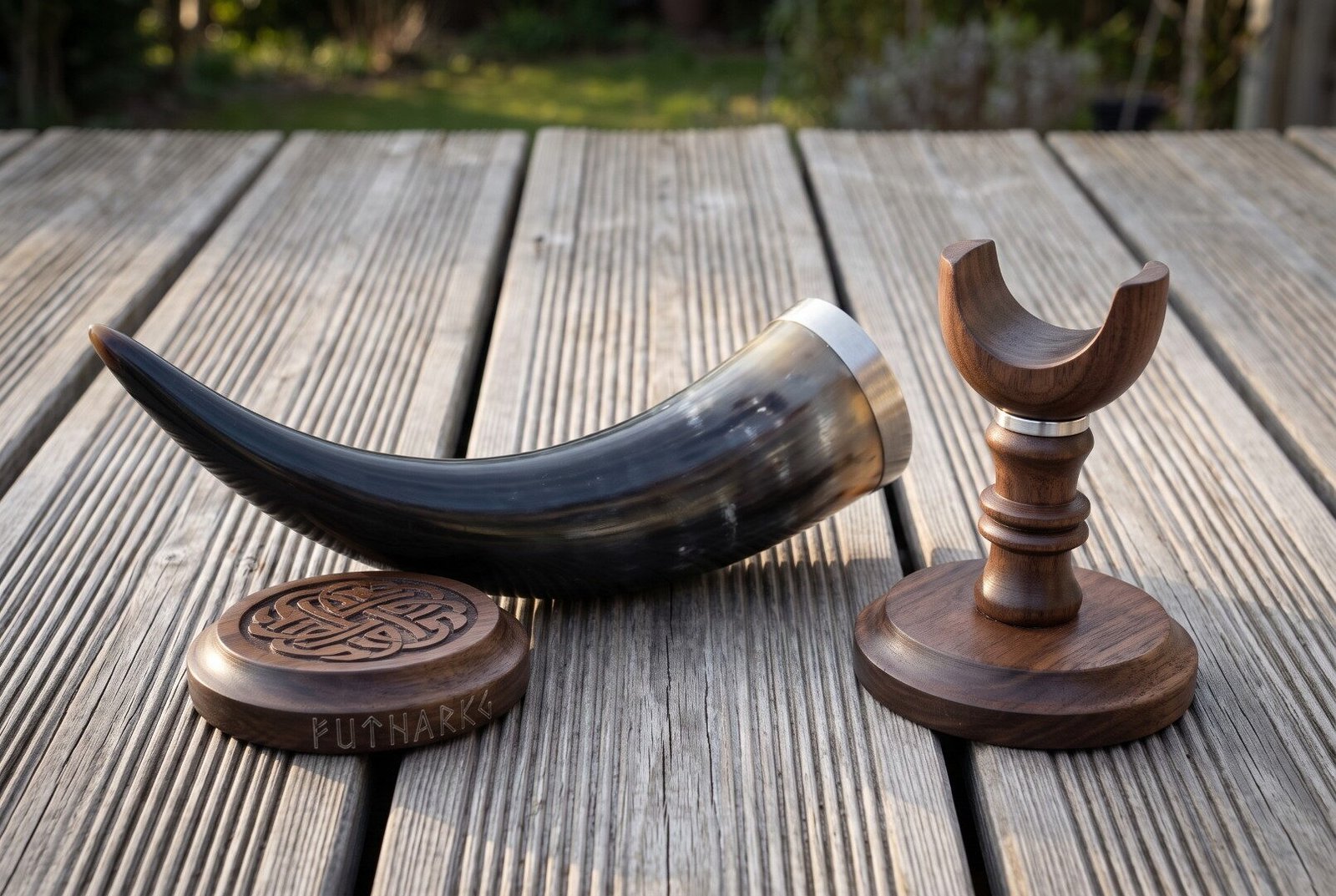
 Oakcradle Hand Made Drinking Horn with Stand | Dark Natural Ox Horn | Turned Walnut Cradle and Carved Knotwork Coaster | Norse Table Gift | RK-1677
 Draughtraven Hand Made Viking Drinking Horn and Leather Belt Hanger | Natural Ox Horn | Polished Steel Rim and Tip Band with Engraved Raven Strap | Norse Feast Gift | RK-1672
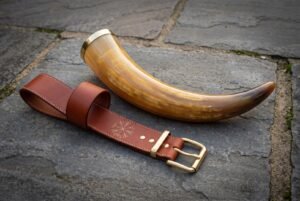 Hornmead Hand Made Viking Drinking Horn with Polished Brass Rim | Roughly 14 to 16 Inches Along the Curve | Vegvisir Stamped Leather Belt Hanger | Norse Mead Gift | RK-1711
Bede is describing the Anglo Saxons, not the Norse, so his evidence only tells you the word and the season were shared across the Germanic world. What the mothers were, and what was done for them, he does not say. Nobody else does either. The origin of the word itself is also unsettled, which is a polite way of saying several etymologies exist and none has won.
What the Norse sources say
You drank Yule
The oldest Norse evidence is a verb phrase. In a poem usually dated to around 900 and credited to the skald Thorbjorn Hornklofi, King Harald Fairhair is praised as a man who would drink Yule out at sea if he had to. Drekka jol, to drink Yule, is how the feast was described. It tells you what the central activity was, and it is the closest to contemporary that the evidence gets.
Odin wore the name
Among Odin’s many names is Jolnir, roughly the Yule one, and skaldic verse can refer to the gods collectively as jolnar. That ties the feast to the gods in general and to Odin in particular, though it says nothing about how either was honoured at midwinter. His wider character is covered in Odin the All Father.
Three sacrifices a year
In Ynglinga saga, Snorri says Odin laid down the law of sacrifice: one at the beginning of winter for a good year, one at midwinter for growth, and one in summer for victory. The midwinter sacrifice is the one that maps onto Yule. Snorri was writing a history that begins with Odin as a human king from Asia, so this is a learned Christian reconstruction rather than a field report, but the seasonal pattern fits what other sources hint at.
Hakon the Good’s Yule law
The single most useful passage about Yule is in Snorri’s saga of Hakon the Good, son of Harald Fairhair, who was raised at the court of King Athelstan in England and came home a Christian to rule Norway from around 934 to 961. According to Snorri, Hakon made it law that Yule should begin at the same time as the Christian festival. Every man had to have ale brewed from a measure of malt, or pay a fine, and keep the feast holy for as long as it lasted.
Snorri adds that before this, Yule had begun on hokunott, midwinter night, and was kept for three nights. What hokunott means is not known, and neither is the exact night it fell on. Scholars have argued for a lunar date, a date in January and several other options. The honest position is that the original timing is lost.
It is worth noticing what the Christian reform actually was. Hakon did not ban the feast. He moved it onto the church calendar and made the beer compulsory. This is why Christmas is still jul across Scandinavia, and why the Norse never really had to choose between the two.
The feast in the hall: blood, boiled meat and toasts
For what a sacrificial feast looked like, Snorri gives a description from Trondelag in the time of Sigurd, the jarl at Lade. Farmers brought their own food and ale. Animals were slaughtered, horses among them. The blood, called hlaut, was caught in bowls and sprinkled with twigs over the altars, the walls of the temple and the people. The meat was boiled in kettles hung over fires down the middle of the temple floor.
The chieftain blessed the cups and the meat, and the toasts went in order. Odin’s cup came first, for victory and for the king’s power. Then Njord’s and Freyr’s, for good harvests and peace. Many then drank the bragafull, the chieftain’s cup, and finally toasts to kinsmen who lay in their mounds.
Two cautions. This passage describes sacrifice feasts in general rather than Yule by name, and Snorri was writing long after anyone had seen one. It is still the best picture there is, and the order of toasts has a specific, unglamorous quality that does not read like invention.
The same saga shows how awkward it was to be the Christian king at the pagan table. At an autumn feast Hakon made the sign of the cross over his cup, and Sigurd smoothed it over by telling the farmers it was Thor’s hammer sign. At the following Yule at Maere the farmers pressed harder, and Hakon ate a few bites of horse liver and drank the toasts without crossing himself. Politics at the holiday table has a long history.
Sumbl, vows and the Yule boar
The formal drinking at these feasts is usually called sumbl. The horn or cup went round in order, toasts were spoken over it, and men made boasts and vows that they were then expected to keep. The Old Norse word for those vows is heitstrenging.
The one Yule scene that shows this directly is in the prose of Helgakvida Hjorvardssonar in the Poetic Edda. On Yule eve the vow boar was led in, men laid their hands on it and made their vows over the bragafull. Hedinn, a little carried away, vowed to have Svava, the woman his own brother loved, and spent the rest of the story regretting it. Few sources make the case against promises after the fourth horn quite so clearly.
People often link that boar to the Christmas ham still eaten in Sweden and elsewhere. It is a reasonable guess and an unproven one.
As for what they drank from, horns were used alongside wooden cups and, in wealthy halls, glass. Horn itself rots, so Viking Age drinking horns survive mostly as their metal rims and tip fittings, and on Gotland picture stones that show a woman offering a horn to an arriving rider. The guide to the Viking drinking horn goes through the finds and how to use one without wearing the contents.
The Wild Hunt is folklore, and later
Across Scandinavia and Germany there are folk traditions of a ghostly host riding through the winter sky, most often around Christmas. In Norway it is the Oskoreia. In parts of Sweden it was called Odin’s hunt. Anyone caught outdoors when it passed was in trouble, and in some versions the riders were the restless dead.
These stories are real, but they were written down by folklorists from the 1700s and 1800s onward. The name Wild Hunt and the firm link to Odin owe a great deal to Jacob Grimm, whose Deutsche Mythologie of 1835 tied the German wild huntsman to Wodan. No saga, Edda poem or Viking Age source describes the hunt. It may carry something genuinely old. It cannot be shown to.
What is modern, or at least much later
The Yule log
Burning a great log at Christmas is recorded in England and on the Continent from the early modern period, and the poet Robert Herrick wrote about it in the 1600s. There is no Norse source for it. A fire in the hall at midwinter is a safe assumption. A ceremonial log is not attested.
The Yule goat
The Scandinavian julbock, now best known as a straw goat, is a folk custom recorded in the modern era. Connecting it to Thor’s two goats is tempting and entirely speculative.
Odin as Santa
A popular theory online says Santa is a dressed down Odin and his eight reindeer are Sleipnir’s eight legs. The eight reindeer come from the American poem A Visit from St. Nicholas, published in 1823, and nothing in the Norse material describes Odin bringing presents. Odin is far more likely to take something from you than to leave it by the fire.
The theory gets a fuller hearing, reindeer and all, in Viking Santa: is Father Christmas really Odin?
Twelve days and 21 December
The twelve days belong to Christian Christmastide. Snorri’s pagan Yule lasted three nights. As for the date, the Norse reckoned the year in winters and moons, and there is no evidence they pinned Yule to the astronomical solstice. Most modern heathen groups keep Yule around 21 December, which is a sensible modern choice and not a recovered ancient one.
Keeping Yule now
If you want a midwinter that a Norse farmer would recognise, the sources give you the outline: meat, a fire, ale, toasts to the gods and to your dead, and preferably no rash promises about your brother’s girlfriend. Everything else is decoration, and decoration is allowed.
What actually went on the table is covered in Viking food and the midwinter feast, from porridge and skyr to the horse meat the church later banned.
A horn is the obvious place to start, since the toast is the one ritual the sources describe in order. The Runemead rune drinking horn carries a full Elder Futhark row along the curve and is $169. The Amberdraught horn with its oak stand is $199, and the stand means nobody has to hold a full horn for the length of a long toast. The rest are in drinking horns.
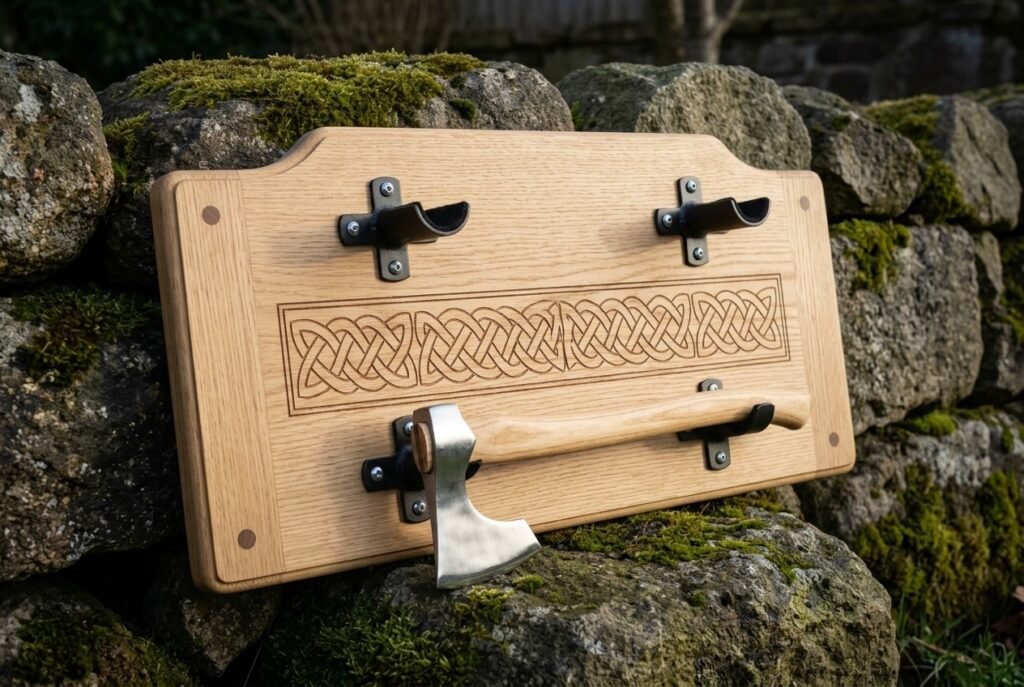
For the hall itself, the Hearthspire three branch candle holder at $179 uses old style pricket spikes for beeswax tapers, and the Oakhewn bearded axe on a carved oak plaque at $329 is the sort of decoration that lasts longer than tinsel. The wider range is under Viking home decor. If you are buying for someone rather than for the table, Viking Christmas gifts sorts the options by who they are for.
Shopping for one man in particular? Christmas gifts for your husband narrows it down.
Every piece on the site is handmade in the Czech Republic by workshops that still work by hand, and imported by Ransack Viking. Engraving and rune work are cut in the United States after the piece arrives.
Questions people ask
What are the traditional Yule traditions?
The ones with real evidence behind them are a midwinter feast with sacrifice, boiled meat, ale brewed for the occasion and formal toasts to the gods and the dead. Vows made over the cup or over a boar are attested in one Edda poem. The Yule log, the Yule goat and Odin as a gift bringer are later customs.
When is Yule?
Modern celebrations usually fall around the winter solstice on 21 December. The original Norse date is not known. Snorri says pagan Yule began on hokunott, midwinter night, and lasted three nights, until Hakon the Good moved it to match Christmas.
Did the Vikings celebrate Christmas?
Christian Norwegians did after conversion, and they kept the old name for it. Hakon the Good’s law placed Yule on the Christian date in the tenth century, which is why Christmas is still called jul in the Scandinavian languages.
What did the Norse drink at Yule?
Ale above all. Hakon’s law required every household to brew ale from a set measure of malt for the feast. Mead was also drunk, mainly in wealthier halls, from horns, wooden cups and occasionally imported glass.
Is the Wild Hunt a Viking tradition?
Not on present evidence. The Wild Hunt is well recorded in Scandinavian and German folklore from the 1700s on, and Jacob Grimm linked it to Odin in 1835, but no Viking Age or saga source describes it.
Is the Yule log Norse?
There is no Norse source for it. The custom is recorded in England and continental Europe from the early modern period. A fire in the hall at midwinter is a fair assumption, but a special log is not attested.
Shop the range
Oakcradle Hand Made Drinking Horn with Stand | Dark Natural Ox Horn | Turned Walnut Cradle and Carved Knotwork Coaster | Norse Table Gift | RK-1677Draughtraven Hand Made Viking Drinking Horn and Leather Belt Hanger | Natural Ox Horn | Polished Steel Rim and Tip Band with Engraved Raven Strap | Norse Feast Gift | RK-1672Hornmead Hand Made Viking Drinking Horn with Polished Brass Rim | Roughly 14 to 16 Inches Along the Curve | Vegvisir Stamped Leather Belt Hanger | Norse Mead Gift | RK-1711 Brasshall Hand Made Stainless and Brass Viking Tankard with Celtic Knotwork Band | Riveted Body and Formed Steel Handle | Brown Leather Belt Hanger Included | Norse Ale Gift | RK-1622
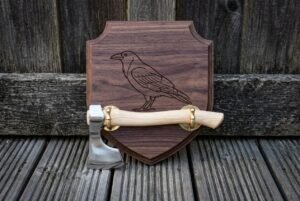 Rookhelm Hand Forged Bearded Axe on Walnut Raven Wall Plaque | 14 Inch Ash Haft and 5 Inch Cutting Edge | Solid Brass Mounting Brackets | Norse Wall Display Gift | RK-1712
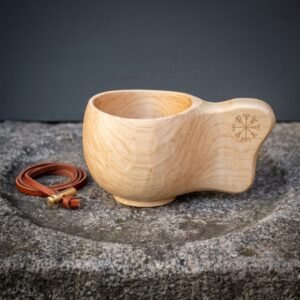 Birchhollow Hand Made Birch Kuksa Wooden Cup | 10 fl oz Carved Bowl | Vegvisir Burned into the Handle and Leather Carry Cord | Camp and Hearth Gift | RK-1605
